![AWS BYOIP & IPv4 Leasing: Unlock Savings[Case Study]](/uploads/resized/AWS BYOIP & IPv4 Leasing Unlock Savings [Case Study].jpg)

When Amazon Web Services started charging $0.005 per hour for every public IP address, a lot of teams running on the cloud suddenly had a new line item to explain to finance. The fee is small on its own, but it adds up quickly, and that is precisely why it is worth sitting down and looking closely at how your public IP addresses are managed. One of the more sensible responses is to bring your own IP space, a model usually shortened to BYOIP, and to lease that address space rather than buy it. Working with an IPv4 leasing provider such as Prefixx lets a business step around the AWS surcharge, keep its IP administration in order, and hold on to a good deal of control and flexibility along the way. It is not only a way to soften an immediate cost increase. It is also a decision that fits the longer conversation most companies are already having about running their infrastructure efficiently and using their resources wisely.
AWS's New Pricing Model: Evaluating the Impact
The change AWS made to its pricing, that $0.005 hourly fee on each public IP address, is a real adjustment for any business that leans heavily on public IP resources. It gives organizations a good reason to sit down and look again at what their infrastructure is actually costing them. For a company holding a large pool of public IPs, the effect on the budget is not trivial at all:
- $0.12 per day
- $3.60 per month (assuming a 31-day month)
- $43.20 per year
Consider a company running 256 public IPv4 addresses. Under the new AWS policy, its monthly bill for those addresses climbs to roughly $921.60, and over a full year that turns into a burden that is hard to ignore. When a single pricing change pushes costs up this much, it tends to be the moment a team finally schedules the careful review of infrastructure spending that had been sitting on the back burner.
With that shift in place, there is a clear and pressing case for finding a more affordable and more manageable way to allocate IP resources.
This is where the Bring-Your-Own IP model, backed by a provider like Prefixx, becomes genuinely worth considering. Choosing BYOIP gives a business a way around the higher AWS fees, and it also hands more of the day-to-day control over IP management back to the team that actually uses the addresses. The result tends to be both more flexible and easier to run. Here is a short summary of what that shift looks like in practice:
1. AWS Price Hike Impact: The pricing change at AWS raises operating costs in a way that shows up plainly on the invoice. Put 256 public IPv4 addresses into service and you are looking at close to $921.60 every month, which of course compounds into a meaningfully larger annual figure.
2. Strategic Shift to BYOIP: In answer to those new AWS charges, the BYOIP approach stands out as a sound and practical move, since it lets a business sidestep the fees entirely while taking firmer hold of its own IP resources.
3. Leasing IPs as a Cost-Effective Solution: Choosing to lease IPv4 space through Prefixx works out as the more sensible option on the balance sheet when you set it beside the AWS numbers. It brings the yearly cost of managing your IP addresses down considerably, and that speaks directly to the pressure the AWS price increase created in the first place.
4. Operational Efficiency and Added Benefits: The savings are only part of the story. Adopting BYOIP through Prefixx.net comes with practical, day-to-day advantages as well. You are not required to hold your own membership at a regional internet registry, and our team prepares the paperwork that trips most people up, including the Letter of Authorization, the Route Origin Authorization, and the IRR records that go with your prefix. That groundwork is what keeps leased addresses working correctly once they are running inside an AWS environment.
5. Guaranteed Stability: Prefixx puts a good deal of weight on stability, and the availability of your addresses is held steady for the full length of the lease. For companies that plan out over a longer horizon, that steadiness is exactly what lets them treat Prefixx as a dependable partner rather than just a vendor, and it keeps IP resource management both affordable and predictable.
A pricing change of this kind is really an opening. It is the point at which a business can step back and put a more sustainable way of managing its IP addresses into place. The BYOIP model, and in particular the leasing options offered through a provider like Prefixx, is a down-to-earth answer to the financial side of the AWS updates, and it tends to help on both fronts at once, keeping costs in check while making the operation itself run a little more smoothly.
Understanding IPv4 Leasing
IPv4 leasing simply means that an organization is granted the right to use a block of IPv4 addresses for a set period, without ever taking permanent ownership of them. Compared with buying addresses outright, which is an expensive undertaking given how scarce IPv4 space has become and how much demand there is for it around the world, leasing gives you a good measure of flexibility and keeps a fair amount of money in your pocket.
The Mechanics of IPv4 Leasing
The way IPv4 leasing actually works rests on dedicated IP brokers and online platforms that bring address holders together with the businesses that want to lease from them. A good broker makes sure every transaction is legitimate, that it lines up with the rules set by the regional internet registries, and that there is a sensible way to sort things out if a dispute ever comes up. The party doing the leasing normally signs a contract that spells out how long the lease runs, how many addresses are involved, and how payment is handled. There is a technical side to all of this as well, including keeping the WHOIS records current and making certain the leased addresses are routed the way they should be.
Advantages of IPv4 Leasing
Cost Efficiency: Leasing lets an organization avoid the large sum of money it would otherwise have to put down to buy IPv4 addresses, and that matters all the more as prices in the IPv4 market keep drifting upward.
Flexibility and Scalability: An organization can dial its IP requirements up or down as circumstances change, leaning on a long-term lease when it wants steadiness or a month-to-month arrangement when it would rather keep its options open.
Speed and Accessibility: Getting addresses through a lease is usually faster than going through a full purchase, which means a business can respond to a growth opportunity or a new project without a long wait.
Risk Mitigation: The IPv4 market has its share of uncertainty, from swings in price to the slow move toward IPv6, and leasing is a reasonable way to work through it. By leasing the IPv4 space it needs today, an organization can shift toward IPv6 at its own pace and lower the chance of being caught out down the road.
Comparative Cost Analysis: Prefixx’s IPv4 Leasing vs. AWS Public IP Charges(with hike)
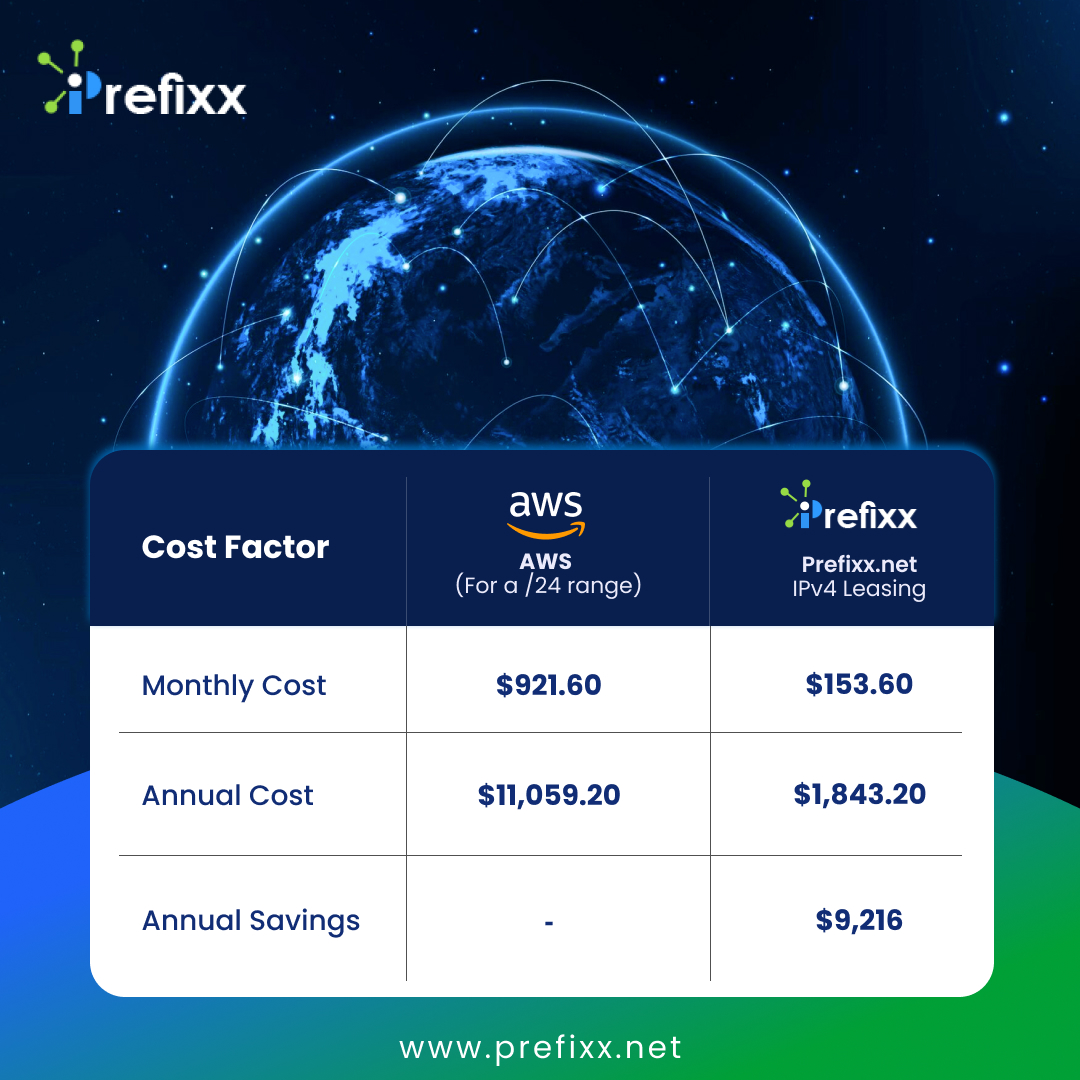
As you weigh up how to cover your public IP needs, it really helps to see the cost difference between what AWS charges and what leasing from Prefixx would cost you. The comparison below lays out, side by side, how much a business could save over a year with Prefixx on a single /24 range, which works out to 256 addresses.
AWS's Pricing Structure:
Monthly Cost for a /24 Range: $921.60
Annual Cost: $11,059.20
Prefixx.net's IPv4 Leasing Solutions:
Monthly Cost for a /24 Range: $153.60
Annual Cost: Starts around $1,644, which reflects our average of $8.4 per IP, and can land a little lower or a little higher depending on the particulars of the lease. We set pricing to stay flexible and easy on the budget, and it moves to fit what your situation actually calls for:
Lowest Annual Cost per IP: $7.2 (under optimal conditions)
Highest Annual Cost per IP: $12 (for premium or specialized requirements)
Annual Savings with Prefixx:
Going with Prefixx.net for your IPv4 leasing can save as much as $9,415.20 a year against what AWS would charge for the same /24 range. A gap of that size says a good deal about how well leasing works, and it is especially telling for any business that wants to trim its running costs without giving up the quality or the reliability of the addresses it depends on.
Why Choose Prefixx's IPv4 Leasing?
Cost Efficiency: Our pricing is set to keep real money in your budget, which is what makes leasing a workable choice for managing IP resources over the long haul rather than just a short-term patch.
Flexibility & Scalability: Shape the way your IP resources are allocated to match how the business is actually moving, and scale up or back when you need to without a painful hit to the finances.
Tailored Solutions: Some clients simply want the most economical arrangement they can get, while others come to us with a more specialized set of requirements. Our pricing bends to fit either one, so you end up paying for value that lines up with what you genuinely need.
Case Studies: The Advantage of IPv4 Leasing through Prefixx
The benefits of IPv4 leasing turn up across a surprising range of industries. Working with Prefixx, companies have brought their costs down, grown more easily when they needed to, and generally found their operations running better for it. The table that follows walks through a set of example scenarios, drawn from different sectors, so you can see the concrete gains in each case.
Strategic Advantages with Prefixx
Opting for IPv4 leasing from a provider like Prefixx gives a business a considered way to manage both the headaches and the costs that come with internet addressing, and that is doubly true now that AWS has changed its pricing. Leasing takes some of the financial weight off, and it leaves a company free to adapt as the wider internet keeps shifting underneath it. It is a sensible move on two counts, because it covers what you need from IPv4 today and also gets you ready for the eventual move to IPv6. By leasing, a company sidesteps the large upfront outlay that buying addresses would require, yet it keeps the room it needs to grow and adjust its network. Operations carry on without interruption, connectivity holds, and the IPv4 space you already have keeps earning its keep while you prepare for whatever comes next.
Navigating the IPv6 Transition
Moving to IPv6 brings a set of challenges all its own, and they are felt most keenly by organizations running a dual-stack setup that has to serve both IPv4 and IPv6 at the same time. The recent AWS increase on IPv4 usage piles one more complication on top of that, which is exactly why it pays to have a thought-out plan for how you make the IPv6 transition.
The IPv6 Transition Challenge:
The internet is going to keep moving toward IPv6 one way or another, simply because IPv4 space has been running dry and the demand for a bigger address pool is not going away. That move is not without its difficulties, though. A lot of businesses are sitting in a dual-stack environment right now, keeping both IPv4 and IPv6 going side by side. The updated AWS pricing makes that balancing act harder still, since organizations now have to weigh the money and the technical work together rather than one at a time.
If you would like a hand thinking this through, we have written up a piece that goes into the useful details, including workable approaches to IPv4 to IPv6 tunneling. It is the kind of reading that helps a business handle the transition sensibly, keeping disruption to a minimum while it holds costs down.
Role of IPv4 Leasing in Transition Strategies:
Against that shifting backdrop, IPv4 leasing turns out to be a rather important tool, because it lets a business keep using the IPv4 resources it relies on while it works its way toward IPv6 at a comfortable pace. That lowers the risk that usually rides along with a big transition, and it keeps the lights on while the work is underway. Leasing lets an organization take IPv6 in stages, following the sound practices and guidance you will find in resources like our own blog. A phased approach of this sort makes for a gentler shift to IPv6 and gives a team the room to deal with both the technical tangle and the financial side of a change this large.
Conclusion: Navigating AWS's IPv4 Charges with Precision
The change in how AWS prices IPv4 is reason enough to take a careful second look at the way you manage your IP addresses. Prefixx answers that with a down-to-earth and budget-friendly option, in the form of IPv4 leasing options that bring costs down while giving a digital business more flexibility and more room to grow. It deals with the money side of the AWS changes, and it keeps the business free to adapt and expand as it goes. Choosing to lease IPv4 space from Prefixx is, in the end, a sound way to stay both efficient and cost-effective in a fast-moving market.
Contact us to discuss your IPv4 needs today
No hidden fees, free consult. A broker replies within one business day.