
By Savvas Bout, Founder of Prefixx. Last updated 1 September 2026.
In short, many network teams wish to have announced, fully routable IPv4 addresses but the free pool of IPv4 addresses was consumed years ago.
However, the many tradeoffs involved when renting IP addresses are very dependent on the lease time, the specific terms and conditions, and the protection afforded the lessee in terms of non-revocation. Routing hygiene and the Reputation of the lessor and underlying resources. Careful contract review is essential, as some agreements include clauses limiting the lessee's ability to transfer or re-announce blocks without prior written consent.
This guide explains the finer details of how to actually use IPv4 leasing on your network, including how it is registered and routed. Moreover, we outline situations where purchasing IP addresses is the preferred choice over leasing, and vice versa.
We cover operational details often glossed over by most providers, such as RPKI ROA coverage, rDNS delegation, and IP addresses appearing on blacklists.
What is an IP lease and how do IP blocks work
An IP address lease can have two different meanings.
The dhcp server meaning and what it does
A DHCP lease in networking is a temporary assignment of an IP address. The assignment of an IP address by a DHCP server to a client is for a time period specified by a lease time. The client must then renew the lease or request a new assignment after the lease time has expired.
This is typically the default configuration in a local area network and in a hosting environment. Most DHCP servers allow administrators to customize the lease duration and other parameters through the configuration interface to match their network's specific requirements. When the lease expires, the client sends a renewal request to the DHCP server to maintain its current IP assignment.
The commercial meaning of dhcp server
An rented IP space is a contract in the address market. Leases are written for a specific time period and allow a lessee to utilize a routable public block of IP block (i.e. a /24) held by a holder.
The lessee has control of routing of assigned IP addresses and receives full rights of use to assigned IP addresses without purchasing them.
Ptr records and reputation when a lease expires
Commercial leases often include routing paperwork that connects the lessee to their block, a Letter of Authorization (LOA), an RPKI ROA for the autnums involved, and the IRR objects used to provision the routes. As part of the handover to a lessee Prefixx can set up PTR records for assigned space. Additionally, Check the ptr records and major blacklists prior to handover in order to avoid any inherited reputation problems.
This documentation legally connects the routing infrastructure between lessor and lessee, ensuring seamless BGP announcements across upstream providers. For example, a /24 block might include 256 PTR entries configured to match the lessee's hostname conventions and branding requirements. Most upstream transit providers will accept the routing announcement only after verifying that all authorization documents are properly signed and current.
Before we get to commercial offers for public IPv4 addresses, businesses and web hosting companies will want to know how to lease IPv4 addresses via DHCP at the protocol level.
How commercial lease IPv4 agreements work
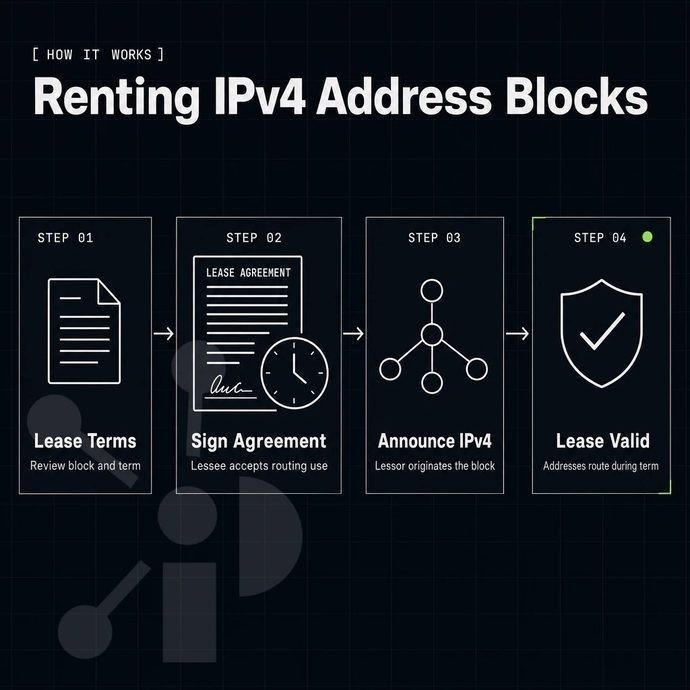
Commercial IPv4 leasing allows users to lease IP addresses as if they were owned by the lessee. These IP addresses are announced by the lessee using BGP. Additionally, then used and managed by the client lessee in production just as if they were part of the lessee's own pool of owned IPv4 IP range. The leasing is for a set lease period. Many organizations lease blocks to provide their users with stable, routable addresses for customer-facing services and applications.
Securing your IP blocks
- Request a block (/24 or larger) to purchase from a current holder or Prefixx broker. Note the holder RIR region and desired usage of the requested block. Prefixx reviews every block for Tixx acceptance prior to offering for purchase.
- Receive your LOA. Your Letter of Authorization (LOA) is a formal document granted to the holder of a block of IP addresses. The original holder of the block of IP addresses still holds registration with the RIR for that block of IP addresses. The LOA grants the holder full operational control of the announced IP address block.
Configuring your IP space
- You just announce your prefix via BGP with your ASN. That’s how hosting providers, ISPs and data centers for example announce owned prefixes. No special routing necessary.
- Set PTR records for your IPs. Typically your broker would set up reverse DNS for you, then you can set up ptr records as desired. Prefixx manages the rDNS delegation for you as part of our white-glove service.
Who uses IP address space this way
Many hosting companies, enterprises, and dedicated servers operators lease IP addresses for short periods of time when they need a large number of clean, routable IPs fast. The same IP address reputation that you receive on day one will carry your traffic for as long as you deploy it. Therefore, prior to use, always verify the IP address’s status on various blacklists. After reading this, you may want to know how much it costs.
Leasing vs. Buying IPv4 addresses: which makes sense?
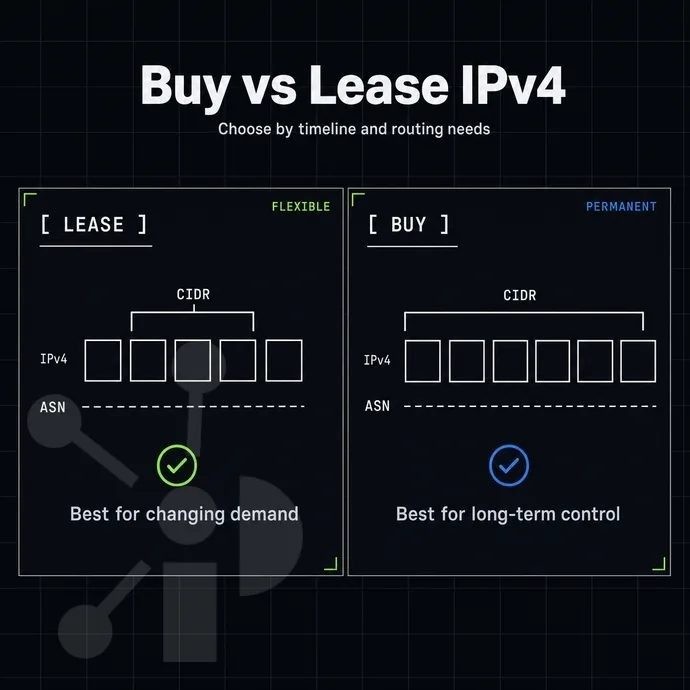
Connecting your IP strategy to your business timeline and network leads to the right choice. Firstly, leasing allows companies to make use of IP resources under a contract while not transferring ownership of these. Secondly, buying IP leads to full control of the acquired resources. The transfer of network RIRs needed for ownership, however, is done within a timeframe of several weeks. Regional Internet Registries like IANA coordinate global IP allocation policies and maintain the authoritative registry of number resources distributed to organizations worldwide.
When leasing fits
Flexible lease terms are ideal for short-term projects, growth testing, or any team needing to react quickly to business needs without capital outlay.
When purchasing fits
Long-term infrastructure projects with stable requirements are typically best suited for full ownership, where resources are controlled indefinitely with no ongoing lease payments.
Dhcp server side-by-side comparison
- Leasing: fast provisioning, no acquisition cost, contractual usage rights.
- Buying: permanent ownership, one-time cost, RIR transfer required.
Our lease-vs-buy guide covers both paths in detail.
Why choose Prefixx for IPv4 leasing
Prefixx is a boutique IPv4 brokerage that manages the full IPv4 leasing process on your behalf. Every block passes Tixx quality control before it reaches a lessee: ownership verification, blacklist scanning against major blacklists, and routing hygiene checks.
Our team then prepares the LOA, RPKI ROA, and IRR route objects, sets reverse DNS records, and corrects geolocation, so your IP space is ready to route from day one. We work directly with customers to ensure their leased blocks meet specific technical and compliance requirements before deployment.
- Tixx QC on every block: ownership, leading blocklists, routing hygiene.
- White-glove included: geolocation correction, reverse DNS, reputation monitoring, abuse handling.
- Non-revocation lease guarantee with provisioning within 24 hours.
- LOA, RPKI ROA, and IRR route objects prepared by our team.
- Zero buyer fees; registered broker with ARIN, RIPE NCC, and APNIC.
To lease IPv4 addresses or compare IP blocks, visit our leasing page and speak with a consultant.
Frequently asked questions
How do IP leases and lease term durations work in data centers?
An IPv4 address allocation rental is a commercial arrangement where an organization rents a block of IPv4 addresses from a holder without taking ownership. The lessee gets full routing rights, including an LOA, RPKI ROA, and IRR route objects, for the duration of the agreement. This arrangement typically takes the form of a written contract specifying routing responsibilities, payment terms, and technical handover procedures. Most lessors require the lessee to accept the terms of a routing agreement that outlines permitted use cases and technical responsibilities.
When does an IP address lease renewal request occur during the lease time?
Commercial IPv4 leases typically run on monthly or annual terms, with multi-year contracts available for organizations that need long-term stability. The term is agreed upfront with the client and documented in a contract that includes a non-revocation guarantee and no hidden fees, so the address range cannot be pulled mid-term. Organizations can typically extend their agreements upon expiration if they require continued access to the same IP resources beyond the initial contract term. Some providers offer discounts when clients commit to terms of a year or longer, with savings reaching nearly half the monthly rate for multi-year agreements. Clients who wish to renew their existing agreements can typically do so by contacting their provider 30 to 60 days before expiration to negotiate updated terms.
What is the cost per lease renewal period for renting an IP address?
Lease pricing depends on block size, RIR region, address reputation, and contract length, so there is no single published rate across the market. ARIN and RIPE NCC blocks can trade at noticeably different levels in the same month. Contact Prefixx for a personalized quote based on your exact server requirements.
Can you rent an IP address for a specific lease duration?
Yes. Renting, or leasing, IPv4 network address subnet is a well-established practice in the secondary market and is fully supported by ARIN, RIPE NCC, and APNIC policy frameworks. A reputable broker like Prefixx provides the LOA, RPKI ROA, and IRR objects needed to announce the block, and includes white-glove support covering geolocation correction, reverse DNS, reputation monitoring, and lease renewal assistance. When you lease IPv4 through Prefixx, provisioning is completed within 24 hours of contract signing.
Dhcp server leases vs commercial IPv4 leases: key differences
A DHCP lease is a short-lived, automatic assignment of a private or public routable address from a local server or ISP to a single device, typically lasting minutes to days. Each computer or mobile device on the network receives its own temporary IP through this automated process. Many ISPs use DHCP leasing internally to manage customer connections and dynamically allocate addresses as subscribers connect to the network.
A commercial IPv4 lease is a contractual arrangement between two businesses for an entire address block, often a /24 or larger, with routing rights, legal documentation, and a fixed term measured in months or years. The two share the word "lease" but operate at completely different layers: DHCP is a network protocol; a commercial lease is a business and legal transaction handled through a broker.
internet address leasing covers two totally different concepts: First, there are the automatic short-term DHCP leases your local network sets up without you even knowing. Second, there is commercial IPv4 leasing. This you procure on a purposeful basis to announce a /22+ network block that you did not purchase to own. Thus saving the client from a large up-front capital outlay and the possibly impossible RIR transfer process required for purchase and assignment as a new owner.
So in essence, choosing to lease IPv4 addresses offers a client the advantage of speed and flexibility upon request, while buying a block outright has the advantage of a permanent asset that you can do with as you wish. Typically, a company will have to weigh up a number of different factors for its customers across various hosting environments, such as time, budget and the intended use of the property over time.
If you are weighing a lease against a purchase, or need a vetted block with routing paperwork handled from day one, Prefixx can walk you through both paths. Every lease includes white-glove network service: LOA, RPKI ROA, IRR objects, and provisioning within 24 hours. Get a quote from Prefixx and find out which option fits your situation.
Contact us to discuss your IPv4 needs today
No hidden fees, free consult. A broker replies within one business day.