
By Savvas Bout, Founder of Prefixx. Last updated 31 August 2026.
Purchasing a block of IP addresses in the form of a block of IPv4 addresses can lock up a lot of capital and could require a full RIR transfer which can take weeks to complete. Leasing a block of IPv4 addresses as a subnet with routable addresses allows you to get the addresses you need on a time line of your choosing.
Leasing also provides flexibility around availability, letting you scale address blocks up or down as demand shifts without long-term capital commitments. Many providers now offer flexible lease terms that range from monthly rolling contracts to multi-year commitments, enabling businesses to align IP address costs directly with project lifecycles. For businesses evaluating whether leasing or buying makes sense, the decision often hinges on cash flow constraints and the expected duration of address usage. For more context, see lease vs buy guide.
Without having to worry about the ownership of the addresses. This can be very beneficial to clients who are deploying new infrastructure, need clean IPs to expand into a new region, or are in the interim while a purchase closes for additional IP space. The benefits of leasing extend to avoiding the administrative burden of RIR transfers and the financial risk of holding depreciating assets on balance sheets.
Each lease typically includes routing paperwork that is not always correctly completed. LOAs are issued without corresponding RPKI ROAs. IRR route objects are uncreated. During IPv4 leasing arrangements, geolocation information for in-addr.arpa areas is not updated to reflect the new holder's country information for the area (i.e., it is left to reflect the information of the prior holder of the area). Such gaps in processing IPv4 addresses can cause a variety of problems, including blocking of mail, failure of fraud checks, and misrouting of traffic.
Reverse DNS delegation is often overlooked, leaving ptr records pointing to outdated or incorrect hostnames that trigger spam filters and authentication failures. Proper configuration of reverse DNS records ensures that PTR lookups resolve correctly, preventing mail servers from rejecting messages due to mismatched forward and reverse resolution. Addressing these configuration concerns proactively prevents service disruptions and ensures that leased address space performs reliably from day one.
IPv4 Subnet Leases: How they work, what makes a good contract and how to select suppliers in terms of the key factors to routing health. BYOIP and lease IPv4 options on bare metal and cloud services. For more context, see Dynamic Host Configuration Protocol.
What it means to lease IPv4 addresses in a subnet
Leasing of contiguously owned routable IPv4 address space held by others for fixed terms of time is a model of use rather than a model of purchase. A lessee would announce a block of IPv4 address space held by another in BGP, then use that in production for the term of the lease.
At end of the lease term the space would be returned to the holder of the space, but a lessee would never own the space. This subnet leasing model allows organizations to test new services or expand into additional regions without the financial commitment of purchasing address space outright.
What IP space looks like in a lease
Blocks under a lease are typically allocated in CIDR notation.
The Regional Internet Registries (RIRs) distribute IP address space in CIDR format.
How IPv4 leasing works as a cost effective practice
A Letter of Authorization is issued by your provider. Your team then enters a LOA into the system of your upstream provider, adds an RPKI ROA and then announces the appropriate prefix in BGP. Once you submit the routing configuration, most upstream providers process the announcement within 24 to 48 hours of receiving your request.
No additional fees or per-IP charges.
When leasing IP resources makes sense
- You need IPv4 addresses quickly without a multi-month acquisition process.
- Your requirement is temporary or project-scoped.
- The capital budget is constrained but there is operational spend available.
Now that you know IPv4 leasing fits your intended use, learn more about the process from start to finish, from your requirements to the live announcement.
IP reputation, routing hygiene, and why quality matters
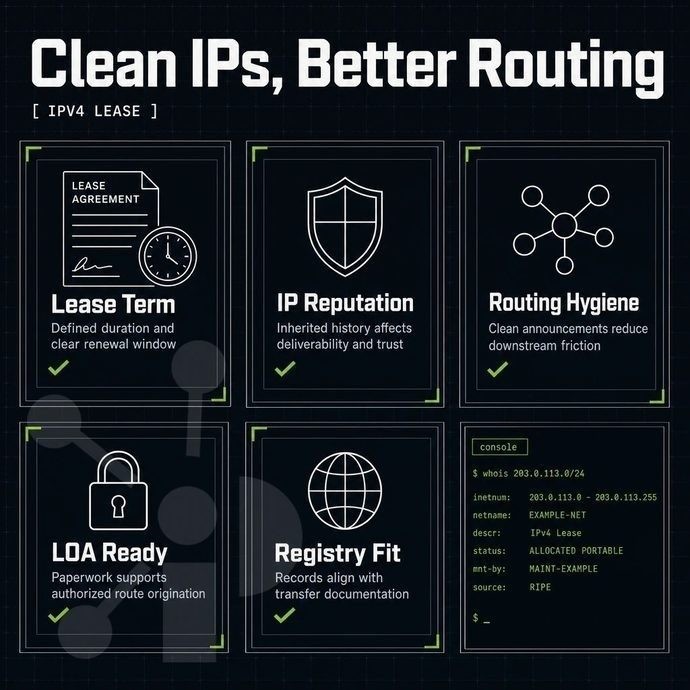
When you lease an IPv4 subnet, you acquire the full history of that block of IP addresses. Thus a block of IP address numbers that in the past have been used to distribute spam, have been used to host botnets. Reputation concerns extend beyond spam history to include fraud scores, geolocation mismatches, and prior association with malicious activity that can persist in threat intelligence databases for years.
Alternatively, IPv4 leasing addresses that have in the past been poorly configured by prior lessees are going to cause all sorts of problems for you and your operations from the very first day that you start to use those IP address numbers. Clean IP reputation is a requirement, not a secondary consideration.
IP addresses space reputation and dnsbl coverage
The presence of blacklists is the most immediate risk. Each of Spamhaus ZEN, Barracuda, SpamCop, SORBS and CBL maintains its own independent threat feeds of blocked IPv4 addresses. A single listing during IPv4 leasing can cause immediate problems such as preventing mail from being sent out, immediately being rejected by ad-platforms and flagged up at upstream providers. Prefixx scans 12 different DNSBLs before any block affects a lessee and continues to monitor throughout the lease.
The block size of IP addresses affects the concentration of risk. Smaller IP blocks (i.e. fewer addresses) have more concentrated risk. The history of one 'bad actor' affects a larger proportion of IPv4 addresses that could otherwise be used.
BGP routing validity for leased IPv4 addresses
Inconsistent IRR objects mean that some networks might refuse announcement of IPv4 addresses and prefixes. Finally, a correct origin ASN hygiene, i.e. correct announcement of leased IP addresses by ASes with a bad routing history, is ensured at the BGP layer.
Prefixx checks whether the ROA (or ROAs) announced for a prefix involved in IPv4 leasing, corresponding IRR route objects, and the origin ASN of the announcement respectively are valid before provisioning the announcement of the prefix.
Ongoing monitoring as a lease IPv4 condition
That is why Prefixx’s portal continuously tracks BGP visibility, RPKI validity and the reputation of providers for all 12 DNSBLs throughout the lease term.
How providers check and monitor blocks to ensure a clean reputation at provisioning differs. It is important to continuously monitor and verify a provider's reputation to protect mail deliverability, hosting and ad serving in the long run. Providers that fail to maintain proper IP reputation monitoring expose lessees to sudden blacklist additions that can disrupt critical business operations within hours.
Reputation monitoring should include real-time checks of mail server connectivity and SMTP handshake success rates to catch emerging issues before they escalate. Providers must balance automated scanning with responsive support, ensuring customers receive timely alerts and remediation guidance when reputation issues arise.
Understanding what makes a block clean is one thing. Understanding how the different operators can utilize a clean block of space is quite another.
Common use cases for IPv4 leasing a subnet
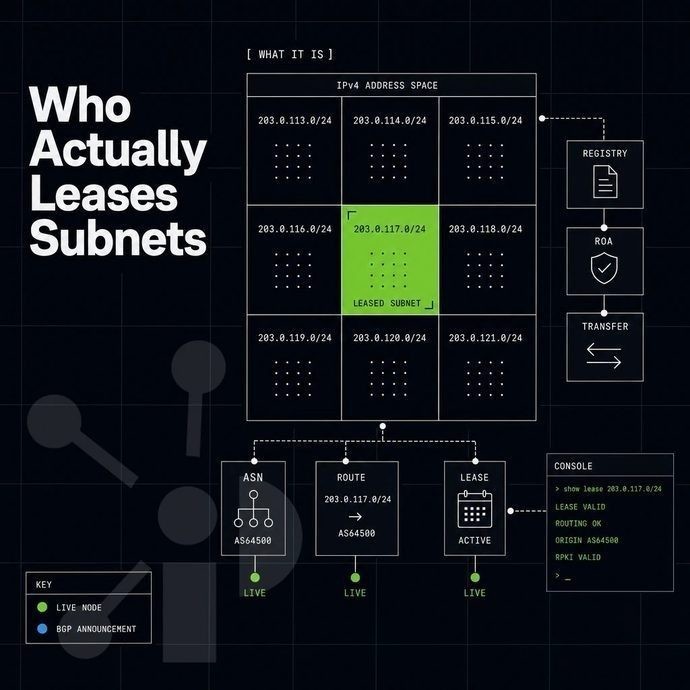
While leased IPs can suit many different types of operators, in reality most deals are done with a handful of buyer profiles that are all driven by different factors: capacity, timing, reputation, routing flexibility. Organizations with diverse infrastructure needs often find that leasing provides the agility to test new markets or services without committing to permanent address ownership. Leasing eliminates the need for permanent ownership, allowing operators to redirect capital toward infrastructure expansion or service development instead of tying up funds in depreciating IP assets.
This flexibility is especially valuable for companies expanding their digital presence across multiple regions of the world, where address requirements can vary significantly by market. Companies seeking to optimize capital allocation often prefer leasing because it converts a large upfront purchase into predictable operational expenses that align with monthly or quarterly budgets. By converting capital expenditure into predictable monthly expenses, leasing reduces the upfront cost barrier and improves cash flow management for growing businesses.
Hosting providers and dedicated servers with IPv4 leasing
By hosting providers adding capacity faster than it would take for a purchase transfer to complete, they can close use of leased blocks and get new dedicated servers routed within 24 hours of provision. The intended use is declared upfront and Prefixx then provisions clean, reputation-checked space.
Isps and operators bridging their own network
Many ISPs are in the process of transferring old space to new buyers. The time between sale and delivery of new space can be used to lease a /24 or /23 that is announced into the ISP’s own network. Thus helping many businesses keep their customers online without having to resort to CGNAT. We prepare the LOA and RPKI ROA for the announced space, and BGP announcement is a straightforward task.
This interim approach to IPv4 leasing ensures continuity of service while avoiding the capital expense and administrative delays of immediate block purchases. The leased block integrates seamlessly with the existing routing infrastructure, allowing the ISP to maintain service quality and avoid customer-facing disruptions during the transition period. ISPs that maintain uninterrupted service during ownership transitions build trust with customers and reduce churn risk during critical infrastructure changes.
Saas platforms, VPN operators, and cloud operators using IPv4 leasing
Send email from your SaaS app using a cost effective dedicated sending service. VPN services need space that can send IP addresses in reputation systems. Cloud services offering BYOIP hosted workloads on AWS, GCP, Azure, OCI or Cloudflare need a block of IP addresses that can be imported. Prefixx provides routing in the form of paperwork for all three intended use cases.
As we outlined in the preceding sections, your choice of provider for IPv4 addresses will make or break your new rental agreement. So what do you get with a new Prefixx lease agreement?
Why choose Prefixx to lease an IPv4 subnet
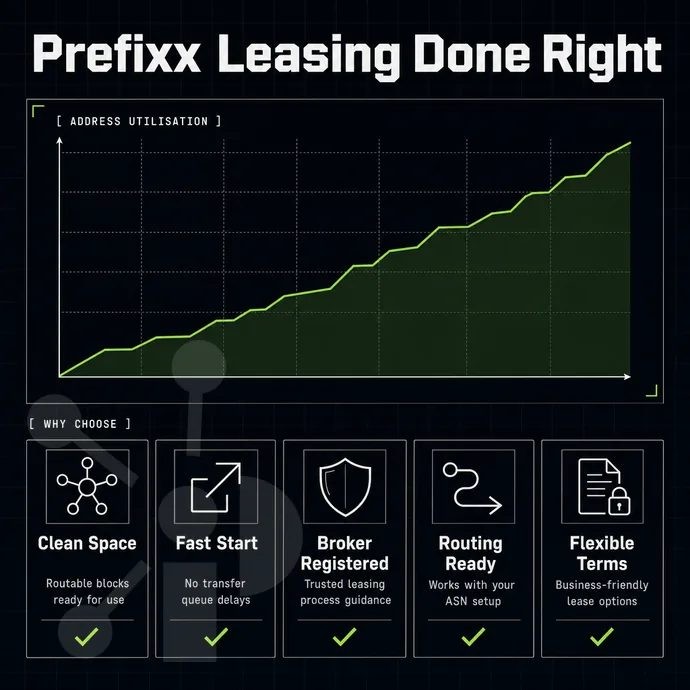
Prefixx is a registered IPv4 broker with ARIN, RIPE NCC and APNIC, specializing in IPv4 leasing for businesses that need clean, routable address space without the upfront investment of buying. Our team handles every step, from Tixx quality control on each block to LOA, RPKI ROA and IRR preparation, so your subnet leasing experience has no hidden fees and no routing surprises.
- Tixx QC on every block: Ownership, blacklist status and routing hygiene checked before any IP addresses reach you.
- Non-revocation guarantee: Leased IPs stay yours for the lease term. No mid-contract clawbacks.
- White-glove included: We manage rDNS, set PTR records, correct geolocation and monitor IP reputation across 12 DNSBLs.
- Provisioning within 24 hours: LOA, ROA and IRR objects prepared by our support team, ready for BGP routing fast.
- Flexible terms, zero buyer fees: Our seller-only commission model keeps our incentive aligned with a clean, fast deal for you.
If you are ready to lease IPv4 addresses or want to compare block sizes and adaptable lease agreements, contact our team at Prefixx.net for a personalized offer.
Leasing an IPv4 subnet gives you routable address space without the capital commitment of a full purchase. The economics of lease agreements make sense for short-term projects, cloud deployments, and any situation where the flexibility of leasing IPv4 addresses outweighs the long-term value of ownership. Block quality is not optional: reputation, RPKI validity, and clean routing hygiene determine whether your traffic actually reaches its destination.
Operators who prioritize cash flow preservation often find that leasing delivers immediate operational value without the liquidity constraints associated with buying large address blocks outright. Leasing structures also eliminate the opportunity cost of tying up capital in depreciating assets, allowing teams to allocate budget toward infrastructure that directly generates revenue.
The right lease comes with non-revocation guarantees, white-glove routing paperwork, and a provider who has already vetted the block to ensure clean IPs before handing it over. Prefixx includes all of that as standard for its clients: Tixx quality control on every block, LOA and RPKI ROA preparation handled by the team, and provisioning within 24 hours. If you have a subnet size and timeline in mind, reach out to Prefixx for a personalized offer.
Contact us to discuss your IPv4 needs today
No hidden fees, free consult. A broker replies within one business day.