
The cost of purchasing IPv4 addresses has risen steadily since regional registries exhausted their free pools of IP addresses.
For example, organizations buying a /24 from ARIN would likely pay a different price per IP than those purchasing an identical size block from RIPE NCC in the same month. Factors that influence the cost of a block of IP addresses include the size of the block, local demand, the IP addresses’ current routing and the eligibility of the buyer to transfer the IP addresses.
Buyers representing enterprises, hosting providers, and smaller businesses each face distinct eligibility requirements and routing considerations that shape their acquisition strategy. For more context, see I own 4 blocks of /22 - Shall I lease or sell them better.
The article outlines the various costs in acquiring a block of internet IP addresses, including the cost of the addresses themselves in terms of registry location and size of the block. The reputation of the current holder(s), their listing on various blacklists, the cost of transfers of IP addresses. Additionally, The costs of brokers and escrow services that facilitate the acquisition. Professional advisory services can also help buyers navigate the technical due diligence required to assess block quality and routing status.
Additionally, the various things to look for when comparing the IPv4 price of different blocks to avoid overpaying for one with hidden problems in terms of routing and reputation. It starts with current prices for blocks of IP addresses and then outlines the various variables that influence cost. Understanding these key takeaways helps buyers evaluate blocks more effectively and avoid common pitfalls during acquisition.
What does it actually cost to buy IPv4 addresses in 2026
There is no official price list for IPv4 addresses. Prices for IPv4 addresses are negotiated or auctioned on the secondary market, and can change based on the size of the address block, the RIR from which the block was allocated, and the buyer’s reputation.
How IP reputation drives the cost to buy IP addresses
The key to IP trading is block size. Recent sales of /24s under the RIPE NCC’s public auction process have cleared at around $6,400 or $25 per IP. However, Larger blocks trade at lower per-IP rates while smaller, clean blocks can command higher prices. For more context, see IPv4 address exhaustion.
Region is the second major influencer in the transfer market. The prices for ARIN and RIPE NCC IP space can vary in the same month, as well as between APNIC blocks with their own unique demand curves. Pricing is greatly influenced by the individual Hosting providers and carriers in each region. Understanding how regional demand affects the IPv4 price helps buyers identify which registry offers the most favorable terms for their specific requirements.
What the current market looks like for IP addresses
Third-party auction data and pricing calculators put the price for a clean, routable IP block at $15-$50 per address in 2026, depending on the specific region and the conditioner of the block. A price this low is not the norm.
Where to buy IP addresses without overpaying
We have brokered IPv4 addresses on the market for all five RIRs and will handle all the necessary transfer paperwork for you. In the next section you will find an explanation of all the variables that influence the price for usable IP space and how they affect it. Our team works directly with clients throughout the entire transfer process to ensure compliance with registry policies.
Registry transfer fees and hidden costs buyers often miss
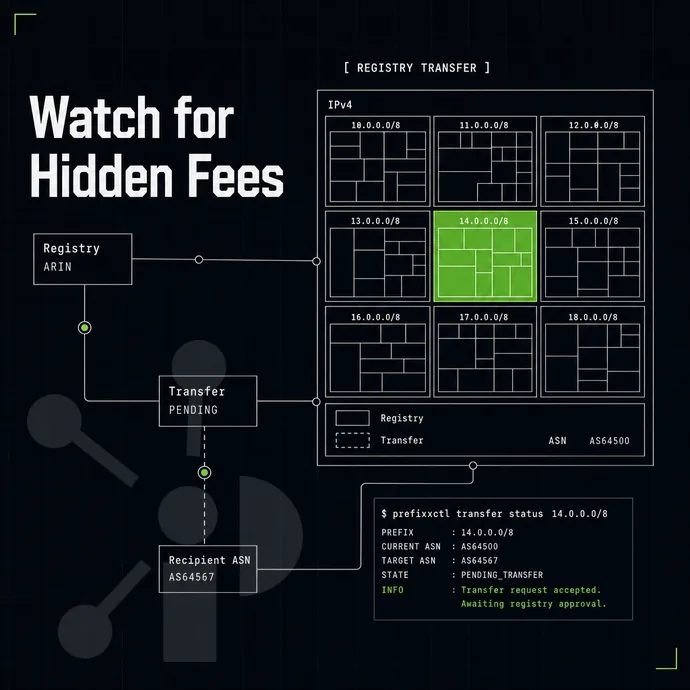
Pay per address is average price and includes Registry fees and other membership costs as well as fees paid by others through escrow. The time frame involved can have significant implications for business. Organizations and businesses must account for these timing considerations when planning their address acquisition strategy.
Preparation and fees for long term commitments
- Budget for administrative fees charged by the registries for IP address administration. The American Registry for Internet Numbers (ARIN) charges a transfer fee that starts at $500. Fees for RIPE NCC and APNIC services also need to be budgeted. The fees for smaller blocks of IP addresses are not zero. Inter-RIR transfers also incur the administrative fees of the second registry.
- The annual membership/sponsorship fee for organizations that hold IP space in most registries. For RIPE NCC registered entities that do not have their own LIR (Local Internet Registry), a sponsoring LIR must be assigned. Prefixx can sponsor a RIPE LIR for PI and/or ASN holders.
The transfer and pre approval process
- Complete pre approval prior to closing a deal. It can take weeks for ARIN and other registries to process documented justification for a transfer. It’s best to start this process early.
- You should also factor in the cost of escrow and legal review of your purchase agreement. The purpose of escrow is to protect both parties to a transaction but it costs money to have someone act on your behalf. In addition to the cost of escrow, the review of a purchase agreement by an attorney is typically charged as a separate legal service outside of the agreement’s market value.
Final sale prices check
- Make sure you reconcile the total cost of purchase prior to signing the agreement to ensure you have factored in the block price, registry fees, escrow. Legal fees and any sponsorship costs to arrive at a total cost which often surprise buyers who were only focusing on a cost per address basis.
Note: Inter-RIR transfers involve two registries, two fee schedules, and a longer approval window.
Now that you have a full picture of the price and costs of owning, you can decide whether buying outright is best for you, or if leasing would be more suitable. Consulting with experienced brokers can provide the guidance and support needed to evaluate both ownership and leasing scenarios for your specific requirements.
Buying vs leasing: which makes more financial sense
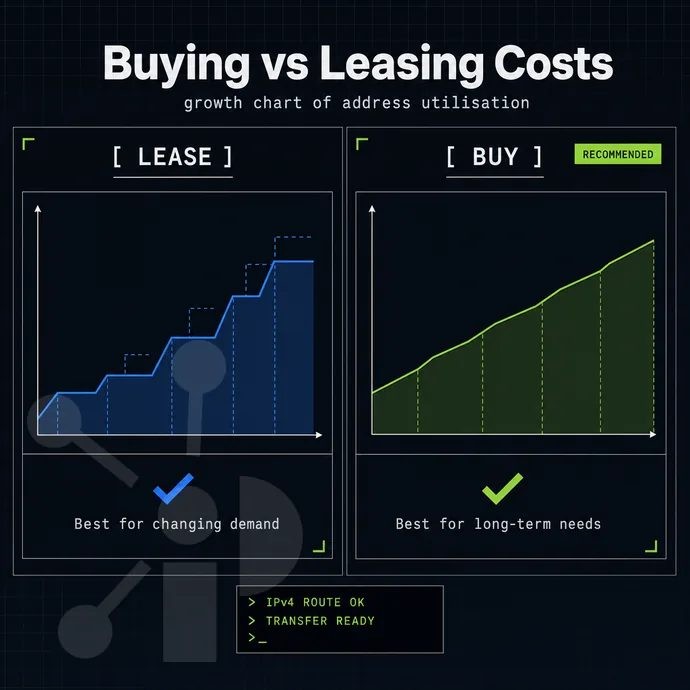
Buying and leasing IPv4 addresses are both ways to solve the problem of running out of addresses, but they go about it in opposite financial ways.
The cost structure of buying versus lease prices
Buying a block upfront requires a large amount of capital. The purchase price has recently sat in the region of $30 to $40 per address for a /24 (256 IP addresses). Once the block has been purchased, the only ongoing expenses are the RIR membership fees.
The block in question is a very liquid asset that can be sold at a later date and would be listed as an asset on a balance sheet. Organizations treating these blocks as long-term assets often factor in potential appreciation when evaluating the total cost of ownership.
Buying long term internet facing infrastructure has many advantages, such as no per-IP fees anymore. You have full control on the routing, the rep history, and you can even sell it back later. Organizations that rely on stable internet connectivity often prefer ownership to avoid dependency on third-party lease terms.
The cost structure of leasing in the asia pacific region
The cost of the leasing spread is passed through as fixed monthly charges. Leasing can work out to be 40 to 70 times cheaper than buying cash than the equivalent monthly rental. There is no transfer process involved and provisioning can be achieved quicker than with leasing.
However, the lessee does not build any equity in the asset and the rental communications form part of the lessee’s network and are dependent on the terms and conditions of the lease. The lessee remains dependent on the lessor's infrastructure and policies, which may limit how users can configure or manage the leased address space.
Short-term or uncertain demand is typically best suited to short-term leasing agreements. Examples of such demand include seasonal peaks, short-term project work, and staged rollouts of new services or products. For example, a retailer scaling infrastructure for a holiday shopping surge may lease a /22 for three months rather than committing to ownership.
Which path fits your situation
Companies with fixed multi-year address needs and sufficient up-front capital to close a purchase typically get best value by buying. Companies with fluctuating network needs, limited capital, and a need to act quickly, however, are best served by leasing first and then buying if the market justifies it later. Organizations that expect to expand their infrastructure over time may find purchasing provides the flexibility to scale without renegotiating lease terms.
Prefixx offers both paths. Leases include white-glove service: LOA, RPKI ROA, IRR objects, reputation monitoring, and provisioning within 24 hours. For full details on how we structure each option, see our lease vs. buy page.
It doesn’t matter which option you choose, the transfer process works the same way. Experienced brokers provide guidance and support throughout the process to ensure compliance with registry policies and smooth completion of the transaction.
How the IPv4 transfer process works step by step
Buying an IP block is a sequential process and understanding this helps organizations buying IP in the transfer market to better plan and budget for their purchases. Buyers interested in acquiring blocks should work closely with their broker to understand each phase and its timeline.
From need to negotiation in a limited supply market
Begin by determining your required subnet size. While a /24 will cover most needs for now, larger blocks of address space are often more cost effective in the long run. Your registered broker will source listings from the secondary market and negotiate price with the listed seller for you.
IPv4 price, due diligence, and escrow
We run quality control on the block before we close any deal. Funds are placed into escrow for the seller only after the buyer has approved the report. The escrow arrangement protects both parties by holding funds in a neutral account until all conditions are satisfied.
RIR transfer and routing key takeaways
We process the inter-RIR transfer request with the corresponding RIR of the region. After the WHOIS database update has been approved by the registry, our team processes the LOA for the buyer to start routing as soon as possible, setting them up for future success. Processing time for the transfer differs from one registry to another. The LOA grants the buyer immediate routing authority and access to begin using the addresses in production environments.
All of these steps are where a registered broker earns their commissions for the deal. Experienced brokers guide clients through registry paperwork, coordinate escrow arrangements, and ensure compliance with regional policies.
Why work with a registered IPv4 addresses broker
Buying IPv4 addresses on the open market involves verifying ownership, checking the IP’s reputation and completing the multi-step transfer process with the relevant RIR. Each of these verification and documentation steps can be time consuming, particularly for buyers unfamiliar with RIR procedures.
- No fees for buyers, Prefixx only charges sellers of blocks. Buyers pay the market value for the block they are buying, nothing more.
- Tixx quality control: Tixx checks every block for ownership, blacklisting and routing quality before selling it to customers.
- The transaction is escrow secured, meaning all funds are held in escrow until the close of the transfer in question.
- We prepare the LOA, RPKI ROA, and IRR route objects as white-glove paperwork for your review and the registries.
- We are a registered holder with ARIN, RIPE NCC and APNIC. Registering with these organizations ensures that any transfer submissions are processed smoothly and that you can rely on us to keep to your desired infrastructure timeline.
If you are ready to compare current market details or discuss lease prices and purchase prices for a specific block size, explore available IPv4 addresses or visit our pricing page to get a personalized offer. For additional guidance on the transfer process and common questions, refer to our FAQ section where we address typical concerns about block acquisition and registry requirements.
Why choose Prefixx
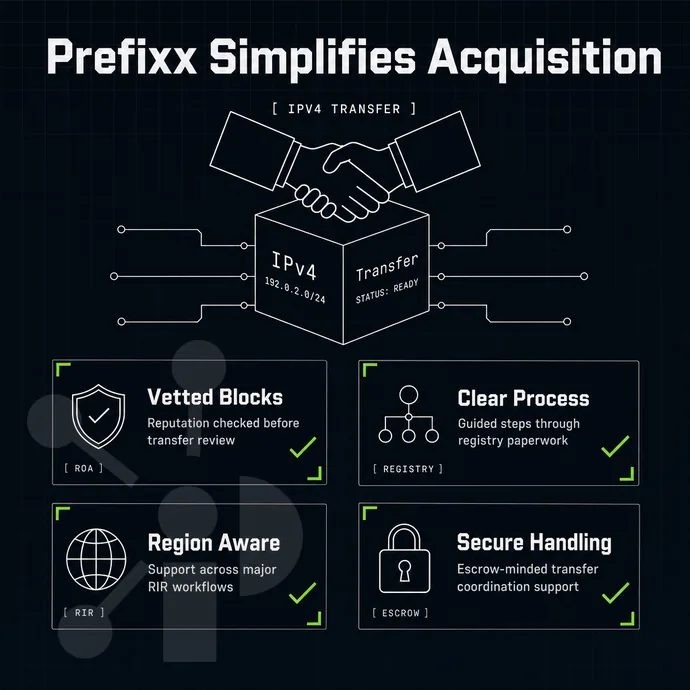
The IPv4 address pricing is shaped by block size, RIR region, IP reputation, and transfer process complexity. Navigating those factors without a specialist means paying more money than necessary or getting stuck in a time-consuming pre-approval process. In recent years, the complexity of these factors has increased as available inventory has tightened across most registries.
We broker IPv4 addresses across the full resale market: buying, selling, and leasing, with inter-RIR transfers handled across ARIN, RIPE NCC, APNIC, and LACNIC. Every block goes through Tixx quality control before it reaches a buyer, so you know the IPv4 price is justified by verified reputation history, transfer eligibility, and routing hygiene, protecting your future operations up front. That due diligence directly affects final price and protects your infrastructure investment.
- Zero buyer fees. You pay the seller's ask. Our commission comes from the seller side only, at 3 to 8% of the sale price depending on block size.
- Tixx QC on every block. Ownership, blacklist status, routing hygiene, and RIR standing are verified before any deal closes. No surprises after transfer.
- White-glove transfer paperwork. Our team prepares the LOA, RPKI ROA, and IRR route objects for you. The transfer process does not stall because of missing documents.
- Leasing available. If long-term commitments or capital outlay are a concern, lease prices offer a flexible path to access IPv4 addresses without a full purchase.
- BYOIP deployment support. Once your block transfers, our consultants support BYOIP deployment onto bare metal or major cloud platforms.
If you want to discuss current market conditions, compare purchase prices across RIR regions, or get details on a specific block size, reach out to our team at Prefixx.net.
Frequently asked questions
Why does buying IPv4 addresses take so long for most companies despite high demand?
Yes. Any organization can buy IPv4 address space on the aftermarket. The five regional registries (ARIN, RIPE NCC, APNIC, LACNIC and AFRINIC) exhausted their free pools between 2011 and 2020, so the transfer market is now the only source. You work with a registered broker who vets the block, handles escrow, and files the RIR transfer paperwork on your behalf.
How can I purchase public IPv4 addresses for use on the internet?
The standard path is to engage a registered IPv4 broker, agree on a block size, regional registry, and IPv4 price, and complete the deal through an escrow-secured transaction. The broker handles ownership verification, blacklist checks, and the RIR transfer filing. Prefixx covers all of that end to end, from sourcing a vetted block through to routing paperwork (LOA, RPKI ROA, IRR), with zero fees charged to the buyer. Prefixx works directly with buyers to ensure each transaction meets the specific technical and compliance requirements that customers face in their respective jurisdictions.
Can you buy a new IP address during address exhaustion?
What you can buy is previously allocated space transferred to you through the IPv4 transfer market. Blocks range from a single /24 (256 addresses) up to a /16 (65,536 addresses), and every transfer is recorded with the relevant RIR. Organizations treat these blocks as digital assets that can be held, transferred, or deployed according to their operational needs.
What is the current rental price for an IPv4 address?
Lease rates vary by block size, IP registry region, and IP reputation, and they are not published on a fixed price list. A /24 under ARIN and an identically sized block under RIPE NCC can trade at noticeably different rates in the same month. Lessors typically quote rates on a case-by-case basis after reviewing the technical requirements and use case of prospective businesses.
Pricing for IPv4 addresses is largely based on the registry that they are from, the size of the block of IP addresses, and the historical usage of the IP addresses. Because there is no published rate card for IPv4, two identical blocks of IP addresses could be listed for different prices in the same month.
Additionally, there are often hidden costs to purchasing IP addresses, such as a registry transfer fee. Alternatively, A clean-up fee for a ‘blacklisted’ block of IP addresses, that can end up costing a buyer much more than the listed price of the IP addresses.
Leasing is better for preserving capital and getting you routed faster, while buying is better for building a long-term asset. There is no one-size-fits-all answer on the IPv4 price question you'll find on the internet, and it ultimately depends on your growth timeline, budget structure, and the amount of routing paperwork your team can handle.
Prefixx handles both sides. Every block goes through Tixx quality control before it reaches a buyer, and the white-glove team prepares the LOA, RPKI ROA, and IRR objects on your behalf. Get a personalized offer from Prefixx and know exactly what you are buying before you commit.
Contact us to discuss your IPv4 needs today
No hidden fees, free consult. A broker replies within one business day.