
By Savvas Bout, Founder of Prefixx. Last updated 23 September 2026.
Even seemingly straightforward IPv4 transactions where organizations request resources can hit unexpected roadblocks once RIR transfer policies surface during the deal making process and severely hinder the timeline. Organizations pursuing IP transfers must navigate these policy frameworks carefully to avoid delays that can extend timelines by months.
All these potential pitfall points can have a huge impact on inter RIR transfers and the intended transfer of address space, making it crucial to know when which restrictions apply in 2026.
The five RIRs (ARIN, RIPE NCC, APNIC, LACNIC and AFRINIC) all have their own transfer policies governing inter RIR transfers, with significant differences: timeframes, eligibility, justification requirements, and acceptable inter-RIR paths. What is permitted in one registry may be prohibited in another.
Below we outline the key restrictions for each of the five registries, explain how these interact in inter RIR transfers, and set out the key steps to complete a transfer through complex policy. LACNIC, which serves Latin America and the Caribbean, enforces particularly strict justification standards for incoming transfers from other regions.
What RIR transfer restrictions are and why they exist
A RIR’s transfer restrictions are the rules set by a regional internet registry regarding the transfer of IPv4 address space and AS numbers (ASNs). These restrictions are intended to protect the integrity of the RIR system, to ensure that Internet number resources are allocated and used by organizations with a real need for them to operate part of the Internet, and to prevent speculation with a limited resource.
Why each regional internet registry imposes restrictions
As the free space in the address pool dried up, the commodity of address space began to trade. Organizations holding previously allocated address space found themselves with a tradable asset as scarcity drove market formation.
The core goals for each restriction across all registries are identical.
- Confirming the receiving organization has a documented need.
- Verifying the transferring party holds the resources legitimately.
- Maintain accuracy of the registry’s WHOIS and routing data after the move.
Intra-rir internet number resource transfers within one registry
RIPE NCC transfers, for example, require both parties to be members and for the block to be unencumbered prior to transfer. Organizations should also confirm that any applicable transfer fees have been settled before initiating the process.
Inter RIR IPv4 address transfers crossing registry boundaries
Inter-RIR transfers are the transfer of resources between two different RIRs (e.g. ARIN to APNIC). Both the source and destination RIRs must approve the transfer. Each RIR applies its own policies for such transfers, and not all registry pairs support all types of resources for inter-RIR transfer s.
So, prior to entering into any transfer of internet resources such as IP addresses with ARIN, RIPE, or any other regional internet registry, it is crucial to perform due diligence to ensure that the required policies are in place for the type of resources to be transferred.
As brokers of internet number resource transfers for Prefixx, we manage transactions across the regions managed by ARIN, RIPE NCC, APNIC and LACNIC. We verify eligibility to hold and transfer number resources for proposed parties prior to commencement of any paperwork.
One critical restriction on transfers of IP addresses is the post-transfer holding period, which in some cases can lock a block of number resources for up to 24 months after the transfer has taken place. Proper verification of eligibility ensures that the intended recipients can legally hold the IP resources under the policies of the receiving registry.
The 24-month lock: how post-transfer holding periods work
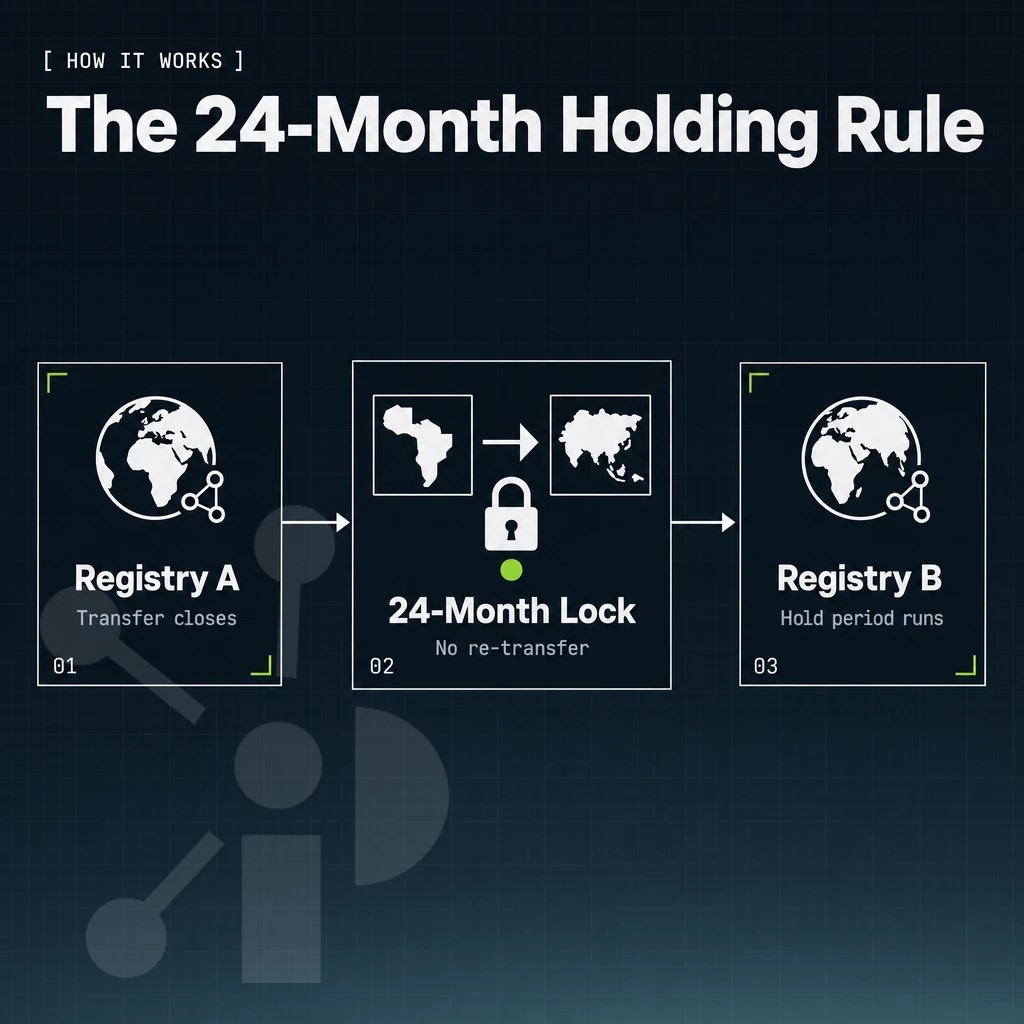
ARIN and RIPE NCC both have a 24-month restriction on number resources transferred after a transfer has closed. The restriction is a simple 24-month ban on re-transfer of the number resources transferred. The restriction is designed to prevent address-flipping and other forms of speculative churn in the secondary market of number resources.
How the clock works with IP addresses
Note that a 24 month restriction is attached to the block of IP addresses, not to a particular organization.
IP address resources acquired in the transfer market are illiquid for a period of two years.
The m&a exemption for IP transfers
Number resources of acquired entities are transferred as part of the corporate deal. Provided the asset purchase agreement covering the transferred IP addresses is provided as evidence that the transfer is not speculative in nature but part of a larger corporate transaction, the restriction does not apply.
Legacy resources may however require additional documentation to prove chain of custody at the RIR level. When legacy resources transferred involve multiple registries, coordination of custody documentation across RIR databases becomes essential to avoid processing delays.
Decision guide for IP addresses resource holders
If you need to request resources for an inter RIR transfers situation that you expect to reverse within two years or so, you can lock the resources for now and set up the transfer as a qualifying corporate transaction.
Note that as part of Tixx quality control for every block, Prefixx reviews the transfer eligibility of IP addresses against each regional internet registry RIR and flags any restriction that is active at the time of the close of the deal. This review process examines whether any active element located in the registry's policy framework would prevent or delay the proposed transaction.
Intra-rir vs inter-rir transfers: different rules for each path
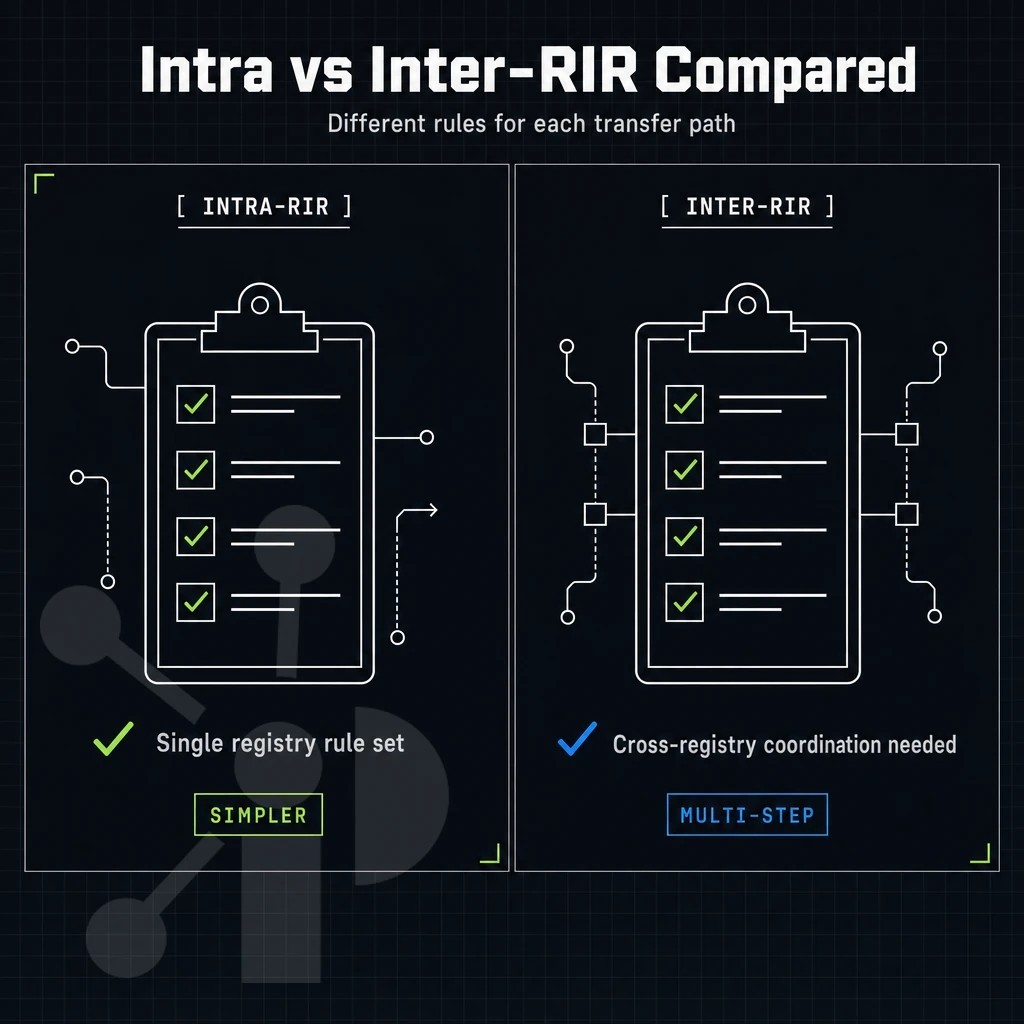
Please note that not all IPv4 transfers of complete or partial blocks are alike: intra-RIR transfers are restricted to a single registry's region, whereas inter RIR transfers between different registries follow a separate set of rules.
The rules for inter RIR transfers are significantly different from internal ones, and establishing which of the two scenarios above is relevant to you is necessary to determine a realistic time frame and required documentation. Organizations operating entirely within a single registry's jurisdiction will find that intra RIR transfers typically involve fewer procedural steps and shorter approval windows.
Intra RIR transfers of IP addresses
An intra-RIR transfer is a transfer request involving resources between two entities that are both based within the same Internet Registry (RIR). For example, both the source and destination of the transfer could be ARIN customers, or RIPE NCC customers, etc. Intra-RIR transfers are relatively easy to process as approval for the transfer is granted by one registry rather than two.
- Confirm the eligible parties for a transfer. Both the source of the IP address and the recipient for a transfer must be members of the same Regional Internet Registry (RIR). ARIN’s minimum block size for a transfer request is a /24. Complete or partial blocks may be eligible for a transfer based on the policies of the relevant RIR.
- Submit a transfer request via the member portal of the registry in question. The transfer of an organizational entity to a new service typically involves the submission of organizational details and resource justification and a signing of the relevant service agreement.
- Await single-registry approval. The one registry reviews and confirms the transfer completion. These tend to be shorter than for inter-RIR transfers.
Inter RIR transfers: crossing registry boundaries
An inter-RIR transfer is used to move a block of numbers between two different RIRs, such as from ARIN to the RIPE NCC. Both the source RIR and destination RIR must approve the transfer before it is complete. All of the RIRs (ARIN, RIPE NCC, APNIC, and LACNIC) support inter-RIR transfers. In addition to transferring addresses, the RIPE NCC also supports the transfer of Autonomous System numbers (ASN).
- Involve both registries early in the transfer process. Reach out to the sending and receiving RIRs before you start filling out any paperwork. The rules for IP number transfers vary between registries, and the potential for getting the documentation wrong is great.
- Dual documentation has to be prepared for each registry, i.e. in addition to the usual forms also a justification of the required resources as well as a verification of the organization is required. The RIPE NCC, for example, requires the recipient of a IP number to hold a valid service agreement before the transfer request can be accepted.
- Approvals should be coordinated in sequence. Each transfer does not complete until both relevant registries have confirmed. Allow extra time (weeks) for this step to be included in the overall project timeline.
Note: Submitting to only one registry is the most common mistake in inter-RIR transfers. The receiving RIR must independently approve the move. Prefixx manages both sides of this coordination, preparing all paperwork and liaising with each registry on your behalf. The specific rules each registry enforces, and where they diverge, are covered in the registry-by-registry breakdown below.
Registry-by-registry transfer policy development breakdown
The all five regional registries (RIRs) set their own policies for allocating IP address space. These policies can vary greatly from one RIR to another and typically outline criteria for allocation of IP address space. The documentation required to apply for an allocation, and whether transfers of IP address space between registries are allowed. Each registry's policy development process reflects the unique needs and governance structures of its service region.
Registries that support inter RIR transfers
The following four RIRs implement transfer policy within a compatible framework: ARIN, RIPE NCC, APNIC and LACNIC. APNIC governs the asia pacific region and maintains transfer policies consistent with this collaborative framework.
Transfers between two of the four participating databases require agreed policy on both ends. The complexity increases when the RIRs involved maintain different policy interpretations for the same transfer scenario.
Registry-specific requirements for IP addresses
ARIN region IP addresses and reverse DNS
The recipient must justify the need for the allocated IP addresses. The minimum amount of IP addresses that can be transferred is a /24. The transfer of IP addresses requires an ARIN Online account by the recipient and is subject to the annual registration renewal fees after the transfer. Some allocated IP addresses are even subject to a 36-month restriction on transfer. Organizations should review the applicable fee schedule before initiating a transfer to understand the annual costs associated with maintaining the registration.
RIPE database service region
RIPE NCC facilitates both intra-RIR and inter-RIR IP address transfers for full and partial blocks. Organizations seeking to consolidate address holdings within the RIPE region often find intra RIR procedures more straightforward than cross-registry movements.
Update to the RIPE database occurs immediately on transfer to holder. The recipient must have a real and substantial connection to the region or be a valid organization identifier in the registry. National internet registries operating under the RIPE NCC database also must update their local database records. Organizations operating in regions such as central asia must demonstrate their connection through documentation of physical presence or operational activity within the service region.
RIR regions covered by APNIC and LACNIC for IP addresses
APNIC requires a recipient submitting a transfer request to demonstrate a need for IP addresses or resources in the region as stated by the organization's regional policies. As for LACNIC, it makes inter-RIR transfers possible but with stricter criteria than the rest of the regional internet registry RIRs studied here. Both registries require the organization receiving internet number resources to be in good standing with the RIR before a transfer can take place.
We handle all transfer paperwork with all the Regional Internet Registries (ARIN, RIPE NCC, APNIC, LACNIC). We verify eligibility of both parties before we contact any other RIR for policy reasons, thus never stalling a deal at a policy gate.
Even when inter RIR transfers meet registry policy, the deal can still fail the eligibility checks for the receiving organization that each of the registries runs independently. The requesting organization must satisfy the specific eligibility criteria of the destination registry, which vary by region and may include proof of operational need or regional presence.
IPv4 transfer eligibility requirements that can block you
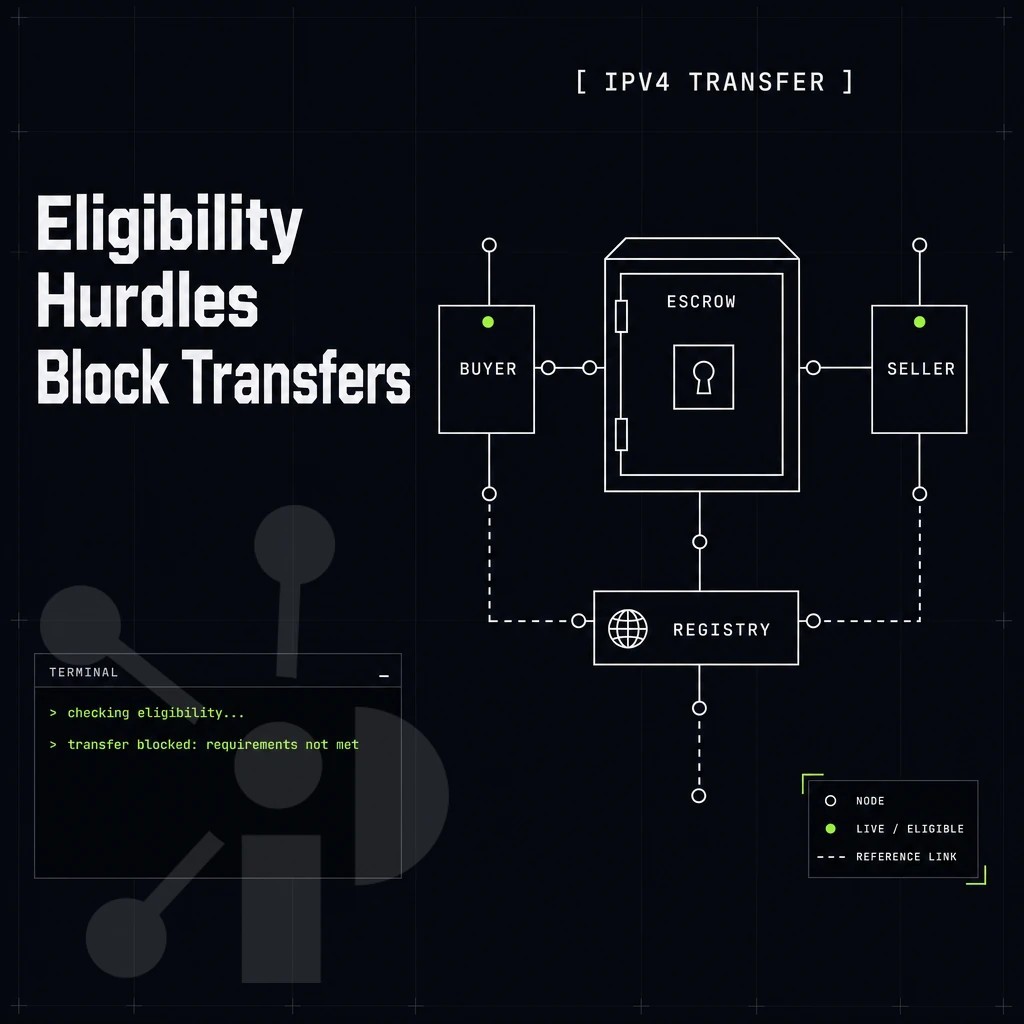
Most regional internet registry transfer rules are based on eligibility criteria rather than on formal requirements to be fulfilled by means of paperwork. The transfer of a single IP address block is checked against a predefined set of criteria for both the source and destination of the IP address space in question. Each relevant RIR applies its own eligibility framework to verify that both parties meet the necessary criteria for the transaction.
Recipient and organizational checks using IP addresses
The organization receiving an address block must be an authorized resource holder (ARH) for that region, or a new organization that has registered with a valid organization identifier, including any legacy status designations, with the appropriate RIR database(s). A receiving organization without an active org record cannot have IP space assigned to it by a registry. Organizations such as hosting providers typically maintain active records across multiple registries to facilitate resource assignments in the regions where they operate.
ARIN requires the requesting organization to demonstrate that it will use the allocated space within 24 months. Since IPv4 is a scarce resource, needs-justification will reject speculative acquisitions of IP addresses. Typically, ARIN requires supporting documentation such as a network diagram or utilization forecast for blocks of IPv4 address space larger than a /24 in the ARIN region. Organizations preparing a transfer request should gather this documentation early to avoid delays in the approval process.
RIR transfer eligibility for RIPE NCC and legacy resources
The RIPE NCC requires recipients to have a real and substantial connection to the RIPE NCC service region.
Legacy resources carry separate rules. Legacy status must be confirmed in the RIR database before a transfer is initiated.
Block-level locks and resource history
For each block in existence, there is a historical record of all the resource moves that have occurred on that block. Recently completed inter RIR transfers on a block can sometimes place that block under a 24-month lock, meaning that even though the block may be owned by someone else, the block is ineligible for a new transfer.
By checking the prior resource status of a block in the RIR database, we are able to surface these types of locks before they cause any delays. Although we review the prior resource history for each deal before we can submit the change for the new holder, after the transfer process has closed, the holder must also update geolocation information as well as IP address space routing information for the newly held space.
What happens to geolocation and routing after a cross-registry transfer

Moving an IP address from one RIR region to another does not automatically update the geolocation databases, IP routing tables.
Geolocation lag after a cross-registry transfer
Note that it can take weeks or even months for IP addresses in a IPv4 address space block that has moved from one registry to another to be correctly resolved to the new region by providers such as MaxMind.
Similarly, the new address block needs to be registered in the destination RIR database. For RIPE NCC this means registration of inetnum and route objects in the RIPE database. Until this step has been completed, Internet resources will still show the previous holder in public WHOIS. The RIPE database stores these records in a ripe document structure that must be updated to reflect the new ownership and routing policy.
RPKI and IRR routing hygiene
RPKI ROAs and IRR route objects are not transferred automatically to a new holder of a block of IP addresses.
Until then, BGP peers configured to enforce strict RPKI validation will block or announce the prefix with an error, as RPKI validity and IRR consistency are two of the core routing hygiene checks, and are most critical in the period after inter RIR transfers of IP space have taken place.
What the new holder must action
| Task | Where | If skipped |
|---|---|---|
| Publish RFC 8805 geofeed | Your web server, linked from WHOIS | Wrong country in geolocation databases |
| Create RPKI ROAs | Destination RIR portal or ARIN Online account | Prefix marked invalid by strict validators |
| Update IRR route objects | RIPE database or relevant IRR | Routing inconsistency, possible filtering |
| Set up reverse DNS and annual registration renewal | Destination RIR | PTR failures, lapsed registration |
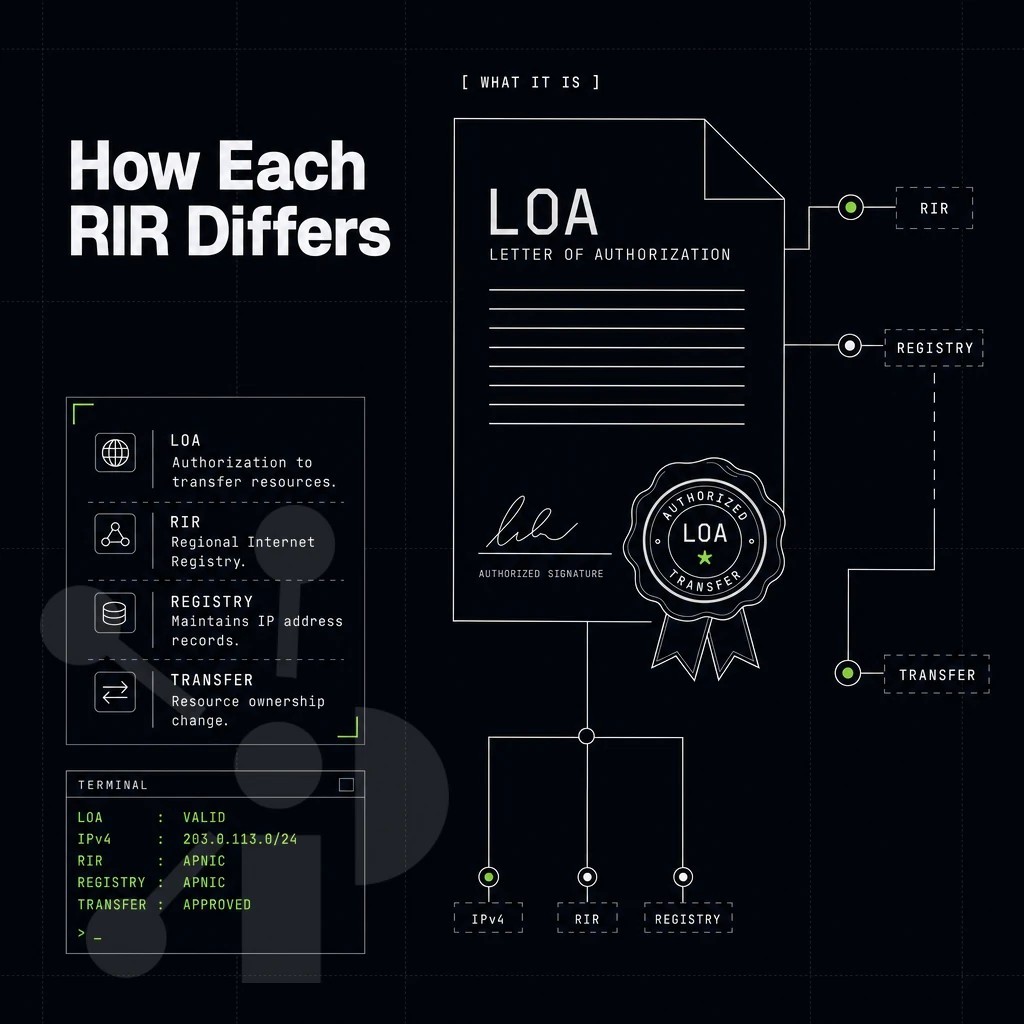
When Internet governance frameworks update for the new holder of a purchased or leased IPv4 address space, Prefixx can create the LOA, the RPKI ROAs and the IRR route objects for the new holder.
We can assist you completely through the transfer process.
Key restrictions at a glance
When transferring internet number resources between RIRs, every transfer is governed by the specific rules of the destination registry. Thus, for example, ARIN requires an Organization Identifier and an ARIN Online account for any authorized resource holder managing IP numbers, while the RIPE NCC requires a real and meaningful connection to its service region.
The APNIC terms of service include a provision for a post-transfer lock on transferred resources. These restrictions are intended to help ensure the integrity of the regional Internet registry system.
Using a registered broker greatly reduces the chance of a transfer request failing. Prefixx is registered with all the RIRs (ARIN, RIPE NCC, APNIC) and can facilitate LACNIC transfers. Thus, every RIR transfer is handled by experts with first-hand knowledge of the current policy at the respective RIR.
Although the specifics of the restrictions on IP addresses in any transfer request can vary significantly from one registry to another, two basic rules are generally applicable.
First, there is typically a post-transfer holding period of 24 months or so, during which the transferred block is locked.
What takes three weeks to process at ARIN may take longer to process at APNIC or RIPE NCC.
If you are planning a transfer of IP addresses and want to avoid the common delays, the Prefixx team works across ARIN, RIPE NCC, APNIC and LACNIC. Get in touch to have a senior consultant review your block's eligibility before the paperwork starts.
Contact us to discuss your IPv4 needs today
No hidden fees, free consult. A broker replies within one business day.