
By Savvas Bout, Founder of Prefixx. Last updated 13 October 2026.
A block that looks perfectly OK on paper can lose huge value even before the transfer has completed.
Additionally, The performance of a leased range of IP addresses that you rent for production use. As mentioned before, the value of an IPv4 block can decrease significantly due to a number of factors, including the block’s history as being listed on blacklists, the routing of the block, the holder’s standing with the relevant RIR, the size of the block, and the registry where the block is held.
In some cases a /24 with a bad spam reputation that has an as yet unresolved case of IP address abuse can have a lower acquisition cost than a 'clean' equivalent size block. And also a previously unannounced block, as well as legacy allocated IP addresses with unknown transfer eligibility all carry a risk premium. Blocks previously associated with malicious activities typically require remediation before they can command market-rate pricing.
This article covers all the factors that decrease the value of IPv4 blocks, how to identify them before you buy or sell IP addresses, and what you can do about them, giving both buyers and sellers the information needed to make informed decisions about the true market value of their assets.
What lowers IPv4 pricing: the core factors
The value of IPv4 address space has changed over time and is not fixed. A clean IPv4 address space block can loose value significantly after acquisition before a buyer is found for it. All causes for such a loss in value are preventable. There are four main types of depressors: bad reputation, wrong block size and fragmentation, wrong RIR region, and lack of proper documentation.
Is your IPv4 block a good IPv4 addresses investment?
The value of a block depends heavily on its history. Spam, malware (C2) and phishing addresses get listed in blacklists and this negatively affects both the price one can sell such an address for as well as the rent one can get for it. Blocks previously used by hosting providers often carry elevated spam scores that persist across ownership changes.
Also important is the routing history of a block of IP addresses. Blocks of IP addresses that have been hijacked in the past, announced from multiple conflicting ASNs, or that have been left unrouted for years are considered problematic during due diligence. Clean routing records for IPv4 addresses demonstrate stability and reduce the risk profile that acquirers evaluate during technical review.
IP address block size and fragmentation
Much harder to route, much harder to sell than smaller, fragmented allocations. A /28 from a larger allocation will typically get a lower price per IP than a clean /24. Typically, people want to buy contiguous IP space which they can announce as a single prefix. Buyers typically evaluate blocks using cidr notation to assess whether the prefix length aligns with their routing requirements.
No new addresses!
Hidden fees in documentation gaps
Missing or outdated WHOIS information, missing RPKI ROAs, and stale IRR route objects are all indicators of neglect.
By mapping out the core depressors we can gain insight into how secondary markets price assets.
How IP addresses are valued on the secondary market
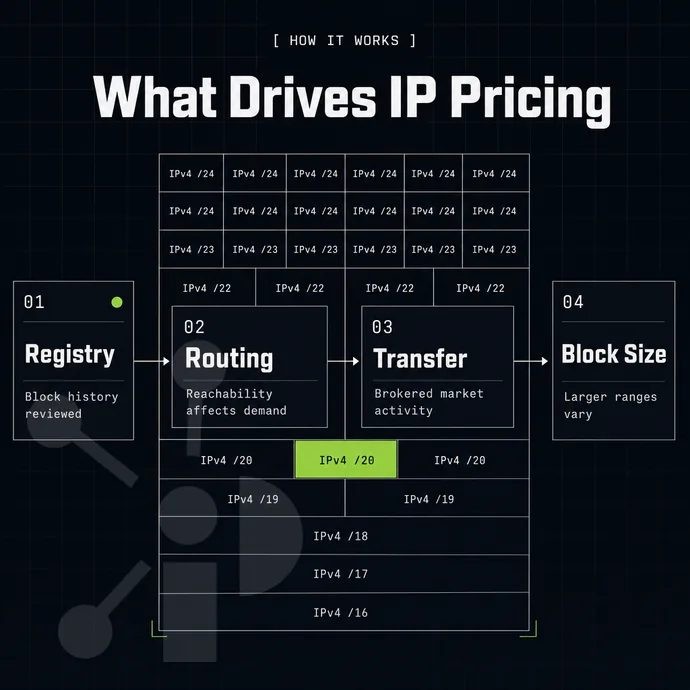
There is no official index for pricing IPv4 addresses. They are primarily traded in peer to peer deals or through brokers. Knowing what influences the price of IP addresses is crucial for protecting their value whether you own them or are about to purchase them.
How supply and demand set prices for IP addresses
All free IPv4 address pools of the five RIRs closed between 2011 and 2020. Since then all used IPv4 addresses are bought on the secondary market. The supply of IPv4 addresses is structurally fixed. The demand of customers for IPv4 addresses however keeps rising because more and more networks are expanded. This mismatch is pushing the prices for IPv4 addresses in an upward direction in a stable way.
Why IP addresses carry different values by RIR region
There is no pricing information published by the registries for IP addresses. Prices for IP addresses are negotiated in private negotiations and can vary widely from one region to another. Identical blocks of IP addresses (e.g. a /24) can have different prices in the same month if one is registered under ARIN and the other under RIPE NCC. The acquisition cost ultimately reflects not only the block size and registry but also the negotiating leverage and urgency of each party.
Historically, ARIN registered IP address space has commanded a premium on the secondary market in part because the strict transfer policy of ARIN in combination with a relatively concentrated group of buyers has driven up the prices.
What shapes current market value for IP addresses
| Factor | Effect on value |
|---|---|
| Block size | Larger blocks (/16, /20) often trade at a per-address discount versus a /24 |
| RIR region | ARIN, RIPE NCC and APNIC each carry distinct price bands |
| Reputation history | Blacklisted or abuse-flagged blocks sell at a discount |
| Transfer eligibility | Blocks with clean RIR standing close faster and at higher prices |
For buying and selling Prefixx runs Tixx quality checks on the blocks before closing a deal. These checks reveal hidden reputation or eligibility problems that would otherwise only surface after the transfer. Addressing reputation issues early in the process ensures smoother negotiations and preserves the block's market value.
Block size has the largest predictable effect on per-IP pricing of all the variables listed in the above table. Economies of scale mean that larger allocations typically achieve lower per-IP costs, making them more attractive to institutional buyers.
Routing history, reverse DNS, and documentation gaps that hurt value
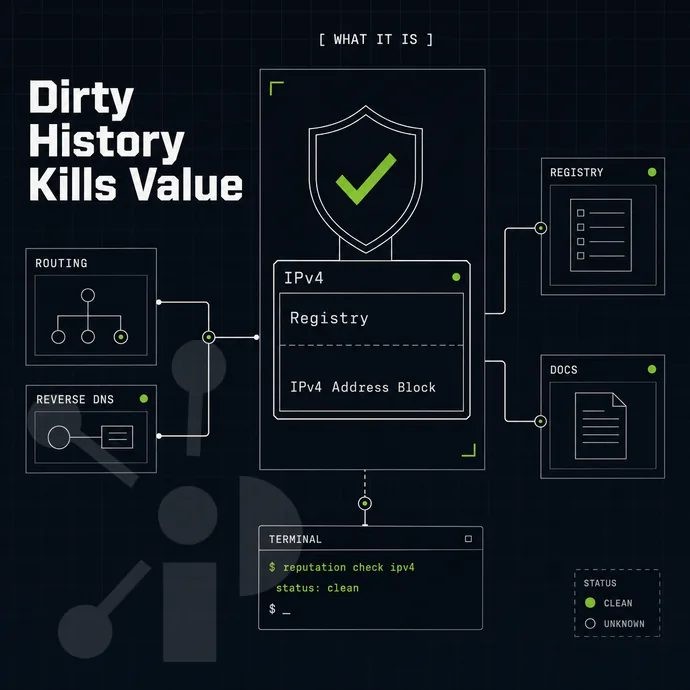
There are two areas of huge undevelopment risk that can seriously dampen buyer demand and lower the price someone is willing to pay for a block of IP: routing hygiene and documentation quality.
BGP announcements, IRR, and RPKI gaps
Unannounced BGP inconsistent announcements are a red flag. If a single /24 /48 /60 block is announced by multiple ASes for extended periods of time and no one can explain why, then one can safely assume there is a history of hijacking or mismanagement.
Missing IRR route objects or objects that are outdated to make announcements up-to-date also cause problems. Announcements are filtered by IRR objects by carriers. A missing RPKI ROA also causes additional problems. A missing RPKI ROA makes an announcement invalid for Route Origin Validation. It would likely be discarded by most networks.
Acquire address space outright for reverse DNS documentation
The lack of reverse DNS delegation is a quiet but persistent value destroyer for people trying to buy a block to use for mail servers or web hosting and want a clean PTR record right away. Organizations deploying infrastructure with cloud providers often require properly configured reverse DNS to ensure their services are not flagged or rejected by recipient mail servers.
Inaccurate WHOIS data and missing geofeed entries for IP address space cause geolocation databases to incorrectly locate IP space which impacts online advertising targeting, Content Delivery Network (CDN) placement and compliance checking. Time to correct these inaccuracies post-transfer of address space negatively impacts seller’s confidence to close a deal.
Transfer-readiness and ownership gaps
Several deals are currently stalled due to documentation problems. Resource holders of IPv4 addresses are unable to provide buyers with a clean LOA or provide adequate evidence of an unbroken chain of ownership. As a result, buyers are placed on a waiting list while legal review is completed. In many cases the transfer process comes to a halt and the buyer walks. Documentation gaps introduce operational risk that can derail transactions even when both parties are otherwise ready to proceed.
We use Tixx checks for every block we list and flag up any issues before they are published for buyers to search for.
Once a server has a good reputation and proper documentation in place, the main variable left is geography. The price for the same server can vary greatly between different RIRs that hold the space for you. Blocks registered under ARIN RIPE registries typically attract the most competitive bids because both regions enforce transparent transfer policies and maintain robust compliance frameworks.
RIR region and how geography shifts market prices
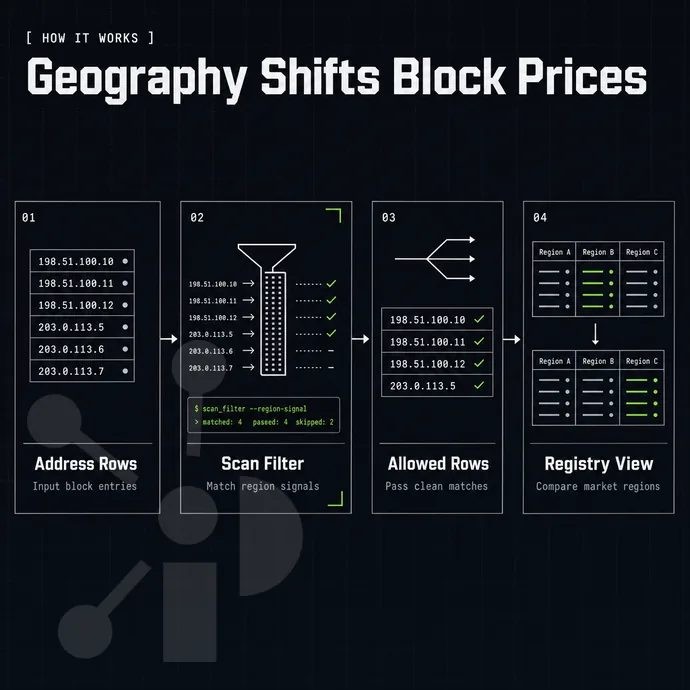
Price for the same /24 block can vary greatly from one registry to another. The price for the same block of space is often highly dependent on the registry that holds the space (RIR), as well as the reputation of the space, the size of the block, and how high demand is for that particular range.
Current pricing is greatly affected by regional demand as well as by policy and transfer rules in place at the respective RIRs. Regional policy differences shape how quickly customer demand translates into completed transactions across different registries.
How regional demand moves the number
There is consistently high demand at ARIN and RIPE NCC. The North American market is characterized by relatively low supply and strict transfer rules which leads to higher prices for space there. The supply of RIPE NCC space benefits from deep liquidity and a large number of Internet service providers competing with each other for the same blocks of IP space.
Demand from Asia-Pacific operators for APNIC space is increasing but supply is in short supply. Inter-RIR transfers add complexity. LACNIC has strict controls on outward transfers of space from Latin America which means that all supply is locked into the region and it is very difficult for external buyers to get any space held by LACNIC members. AFRINIC space is largely unavailable on the open market due to ongoing policy issues.
Secondary market prices by RIR region
| RIR | Transfer eligibility | Typical demand level | Key price driver |
|---|---|---|---|
| ARIN | Full intra- and inter-RIR | Very high | North American cloud and enterprise appetite |
| RIPE NCC | Full intra- and inter-RIR | High | Deep liquidity, mature broker market |
| APNIC | Intra-RIR; inter-RIR possible with policy caveats | Growing | Surge in internet connected devices across Asia-Pacific |
| LACNIC | Intra-RIR only; outbound blocked | Moderate | Transfer restrictions cap external demand |
| AFRINIC | Severely restricted | Very low | Policy disputes limit market access |
What this means when you buy or sell
Market trends confirm the premium that buyers are willing to pay to complete a transfer in a timely and secure fashion. Blocks from the ARIN and RIPE NCC regions tend to move most quickly and at the strongest prices. Organizations that need to sell their allocations quickly often find that clean routing records and transparent transfer processes help them achieve better pricing outcomes in these premium regions.
Note that if you are a resource holder of LACNIC or AFRINIC space, your potential pool of buyers is likely to be smaller than for other regions, and time to close a deal may be longer. Prefixx is a registered ARIN, RIPE NCC and APNIC broker and can assist with LACNIC space transfers. Transfers within ARIN RIPE or APNIC jurisdictions typically benefit from established policy frameworks and streamlined inter-registry coordination that accelerates the approval process.
Knowing what your block is worth in your region is half the decision. The other half is whether you should sell it and get a single payout or work with it to create ongoing income for you. Understanding the lease rate your block can command helps you model the recurring revenue stream against a one-time sale.
Is IPv4 still a good investment? Lease vs. One-time sale
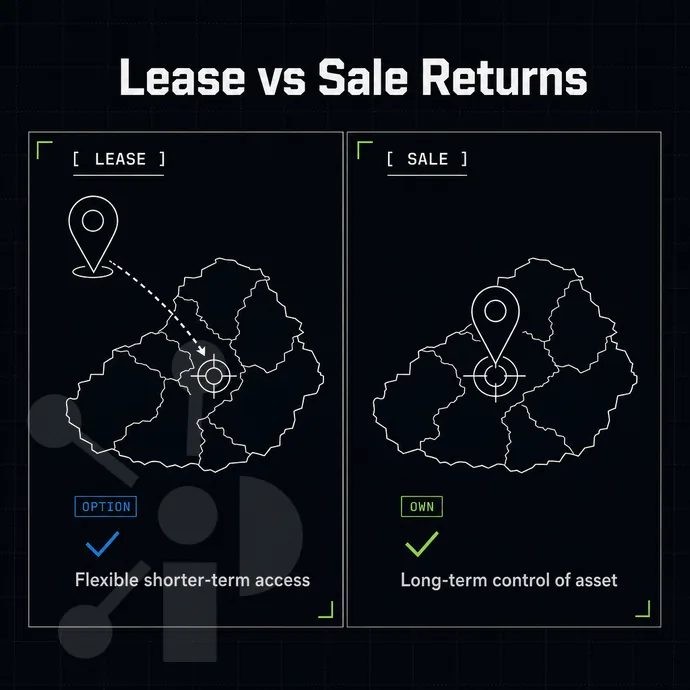
Since the free pools of IPv4 addresses ran out several years ago, IPv4 addresses have appreciately in value. The ongoing demand for them from cloud-native and enterprise buyers keeps upward pressure on them. So for any holder of these IPv4 addresses the question remains: sell once and get it over with, or hold on and collect rent forever? The lease rate for IPv4 space has become an attractive alternative for holders who prefer recurring income over a one-time sale.
Weighing the one time sale against leasing
- First, assess your liquidity need. A one time sale delivers immediate capital and eliminates further management of that customer. If you need cash immediately or do not have an internal routing team to manage such a customer, a clean exit is likely better than trying to hold on to them.
- Treat the lease as another revenue stream. While you own the assets, you can collect a steady sum of money each month for a number of years to come. The total of those lease payments can actually exceed the one-time sale price for a given block and reputation, for larger blocks.
- Check current market data before deciding. Block prices and lease rates move with supply, RIR region, and reputation history. Pull a current valuation before committing to either path. Note: a block with blacklist history will underperform in the lease market regardless of size.
Factoring in cloud and enterprise demand
- Identify the leasing drivers. As cloud-native operators with BYOIP programs on AWS, GCP, Azure, OCI and Cloudflare continue to expand, the number of qualified lessees has increased dramatically. Integration with a single cloud platform can command a premium lease.
- So you can find the right buyer for your IP addresses. Prefixx checks each block on the Tixx Waitlist before listing it and completes the LOA, RPKI ROA and IRR objects for you. It then connects you with suitable buyers or lessees from all over the world in all 5 RIR regions. This way you can make an informed decision based on real demand instead of mere speculation.
The value that you can extract from a block of IPv4 addresses depends on the preparation of the block and how that is processed through Prefixx's process. Proper preparation ensures that each IP address block meets the technical and administrative standards buyers expect during transfer evaluation.
How Prefixx helps sellers protect and maximise block value
All the factors that decrease the value of an IPv4 block (dirty routing history, blacklisted IP addresses, stale WHOIS information, bad reverse DNS etc.) have fixes. We apply these fixes before we sell your block to others. Our team provides ongoing support throughout the remediation process to ensure each issue is resolved correctly and efficiently.
- Tixx quality control: Every IPv4 block gets a pre-sale check covering ownership, transfer eligibility, blacklists, routing hygiene and RIR standing, plus a transfer readiness score.
- White-glove preparation: Our team corrects geolocation, configures rDNS, monitors reputation and handles abuse complaints, protecting address reputation and market value.
- Routing paperwork handled: LOA, RPKI ROA and IRR route objects are prepared by our consultants, not left to the seller.
- Escrow-secured transfer process: Funds are held in escrow until the transfer completes. No hidden fees, no buyer fees, seller-only commission of 3 to 8%.
- Registered broker: Prefixx is a registered broker with ARIN, RIPE NCC and APNIC, covering the major RIR regions where demand is highest.
If you hold IPv4 addresses and want accurate pricing guidance based on current market data, speak with our team for a no-obligation assessment of your block.
Frequently asked questions about free pool
How do demand, free pool depletion, address history, and WHOIS data shape an IPv4 block's value?
Four factors drive the gap: RIR region, block size, reputation history, and transfer eligibility. A clean block of IPv4 addresses under a high-demand registry with no blacklist hits and a clear chain of ownership commands the strongest offers. Blocks that are stuck in a policy hold, carry abuse history, or have inconsistent WHOIS records trade at a discount. Buyers pay for certainty, so anything that introduces doubt lowers the number. Organizations that sell blocks with these deficiencies often face extended negotiation periods as prospective acquirers conduct additional due diligence.
Does IP address block size affect the price per IP?
Yes, and the relationship runs in both directions. Larger blocks such as a /16 or /18 attract a smaller pool of buyers, which can suppress the per-IP price even though the total deal value is higher. Smaller blocks like a /24 are far more liquid because more buyers can absorb them, so the per-IP rate is typically higher. The sweet spot for per-IP value has historically sat in the /22 to /24 range, where demand is deepest. Conversely, smaller blocks benefit from broader market accessibility, making them easier to price and move in competitive timeframes.
How do blacklist listings affect what a buyer will pay?
Active listings of your IPv4 addresses on major DNSBLs, including Spamhaus ZEN, Barracuda, and SpamCop, are the fastest way to lose buyer interest. Blocks with multiple active DNSBL entries become difficult to sell at any price until the listings are fully resolved and delisted.
Even historic listings that have since cleared can raise questions if the abuse pattern was severe.
Does the RIR region change how much my block is worth?
It does, and the spread can be significant. ARIN space covering North America and RIPE NCC space covering Europe, the Middle East, and Central Asia consistently attract the most competitive offers because demand from cloud operators, ISPs, and enterprises is concentrated there. Transfers between ARIN ripe registries benefit from mature policy frameworks that streamline pre-approval and reduce closing timelines compared to emerging regions.
APNIC blocks are also actively traded, while LACNIC and AFRINIC space typically moves at lower per-IP rates due to a narrower buyer pool and tighter transfer policy constraints. Over the past few years, a /24 under ARIN and an identically sized block under RIPE NCC can trade at noticeably different rates in the same month, and neither number is published anywhere official. The pricing differential between ARIN ripe blocks reflects both regional policy frameworks and the concentration of enterprise infrastructure in those jurisdictions.
Can I recover value from a block with a bad reputation history?
Yes, but it takes deliberate work before you list. Addressing reputation issues and verifying clean routing status before you sell ensures the block attracts serious interest at competitive pricing.
Sellers who document the remediation steps for their IPv4 addresses and provide a current clean scan report recover more value than those who list without context. Prefixx's white-glove service includes reputation monitoring and blacklist scanning of IPv4 addresses, which gives buyers confidence that the cleanup is real. Prefixx provides ongoing technical support throughout the remediation process to ensure sellers meet registry requirements and buyer expectations.
Is it better to sell or lease IP addresses?
It depends on whether you need capital now or prefer recurring income over time. Leasing generates a predictable monthly return amid growing demand, but keeps you responsible for the block's reputation, routing health, and RIR compliance across certain regions for the duration of the agreement. The decision also hinges on whether you want to exit ownership of the IPv4 addresses entirely or maintain control while monetizing the resource through lease agreements.
If the block is clean and the market is strong, selling at today's rates often outperforms years of lease income in net present value terms. The decision hinges on whether the current market valuation of your IPv4 addresses justifies an immediate exit versus the operational overhead of maintaining lease agreements.
What documentation do I need to get full value when selling a block?
Buyers and registries require proof of ownership, a clean WHOIS record matching your current organization details, and confirmation that the block is free of any policy holds or transfer restrictions at the RIR. Working with experienced brokers can provide valuable support in assembling documentation and navigating registry requirements efficiently.
Gaps in any of these, such as stale WHOIS data or missing ROAs, give buyers grounds to negotiate the price down. Prefixx prepares the LOA, RPKI ROAs, and IRR route objects for the IPv4 addresses as part of every deal, so the paperwork does not become a value leak. Prefixx provides dedicated support throughout the documentation process to ensure all records are accurate and complete before closing.
Surprisingly, block reputation and documentation quality matter more than most sellers expect. Spam complaints, missing RPKI ROAs as well as incomplete IRR records quietly cut into the value a seller can get for a block on the secondary market.
Before you list or price any address space, an independent quality check is the single most useful step you can take.
You get a health report and transfer readiness score before a deal is on the table. If you are preparing to sell or want to understand how the lease market affects what your block is actually worth today, start with a no-obligation conversation with the Prefixx team.
Contact us to discuss your IPv4 needs today
No hidden fees, free consult. A broker replies within one business day.