
The depletion of IPv4 address space under ARIN is not a future problem for North American network teams, it is their current reality. Leasing IPv4 address space under ARIN allows a network team to immediately utilize large blocks of address space that are already routed and ready for production usage. Many organizations find leasing to be the quicker and less capital intensive means to announce additional prefixes.
However, the use of ARIN leased address space across RIR regions does come with a set of mechanics that must be accurately utilized, including non-revocation guarantees, RPKI ROA configuration, LOA issuance, and IRR route objects. Additionally, ongoing IP reputation hygiene helps prevent your leased allocation from being placed on block lists and suffering deliverability and/or routing visibility problems as a result. These same mechanics apply whether the leased block is used within ARIN's service region or in other regions where cross-RIR routing is required.
This article explains how ARIN’s IPv4 leasing works in practice, how to establish a healthy lease as opposed to an unhealthy one, the benefits and detriments of leasing as opposed to purchasing IPv4 addresses outright. Additionally, The intricacies of transfer and routing for newly leased IP space. Understanding these distinctions helps organizations evaluate the risk profile of each approach before committing resources.
Alternatively, you may be looking to fill out a gap in your IPv4 allocation while a purchase requests are making their way through an RIR's review process. This information, including details on how abuse requests are handled, will provide you with a solid understanding of your available choices and help you to make informed decisions regarding your IPv4 strategy.
We begin with an overview of what a lease is. Organizations often find that managing temporary allocations during transition periods requires careful coordination with their technical teams to ensure seamless integration.
Understanding what an ARIN IPv4 lease actually is
An ARIN IPv4 lease is a way that a registered holder of an IPv4 block can give another organization operational use of addresses for a certain period of time in exchange for some payment. The addresses are not transferred in the ARIN database (i.e. registration is not transferred), the addresses are given for operational assistance and use. The original holder retains registration authority while granting the lessee practical control over routing and deployment.
ARIN is the American registry for internet numbers. ARIN records allocations, but does not lease out addresses itself. The lessee would use the leasing arrangement's addresses in a routing table that is covered by an LOA issued by the holder. ARIN's core mission centers on registry stewardship rather than commercial transactions involving number resources. The registry serves as the authoritative source for registration data but leaves commercial arrangements to the parties involved.
Assistance creating the right leasing vs. Buying trade-off decision
Buying the asset (such as Internet number resources) sells them to you permanently. Leasing the same asset however can trade off permanent ownership for an operational expense, lower capital expenditure, and sooner deployment. Many Internet service providers use leasing when they lack capital to devote to permanent facilities, or when needed temporarily to serve growing demand. For more context, see AfriNIC.
What is the average cost to lease an IP address?
The lease rates follow the secondary market for used IP addresses. The rates for IP addresses from the ARIN region are typically higher than for equivalent sizes of IP addresses from the RIPE region. We’d be happy to provide you with current quotes and assist you in negotiating a structured deal within your budget for the amount of IP addresses you require. Many organizations work with specialized brokers who understand regional pricing dynamics and can help identify suitable lessors.
What documents do I need to route a leased ARIN block?
Three documents are required:
- LOA (Letter of Authorization) from the registered holder of the ASN for which you wish to announce the new prefix.
- RPKI ROA signed by the holder, covering your origin ASN.
- IRR route object matching the prefix and origin ASN.
In addition to distribution, it is helpful to have an understanding of the pricing policy under which these documents are prepared. Understanding pricing policy helps organizations evaluate financial exposure and assess the risk of budget overruns during resource planning cycles.
ARIN policy on IPv4 IP address leasing
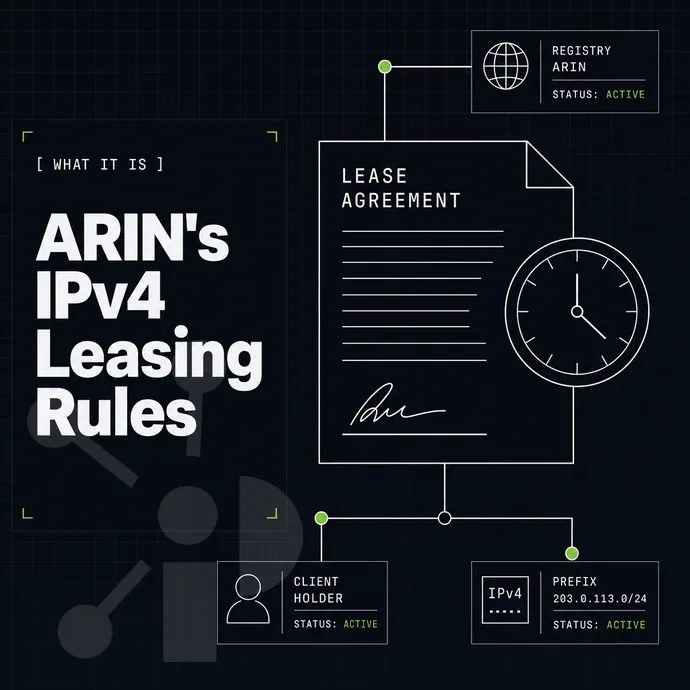
Note that ARIN considers leasing to be completely different from assigning new IPv4 addresses, and that leasing already-assigned IPv4 resources is permitted. Resources that are the subject of a lease are registered to the lessor of the block leased, and thus leasing is a viable option for organizations that require IP addresses immediately. The lessor retains registration authority throughout the lease term, maintaining their role as the official holder in ARIN's records.
What is ARIN IPv4 and how it powers internet services
ARIN registration services manages IP addresses for North America and related services such as network services, connectivity services and number resource policy services. ARIN used up its ‘free pool’ of IPv4 addresses on September 24, 2015, and since then no more free IPv4 addresses are handed out.
That date marked the exhaustion point after which organizations could no longer receive allocations from the available pool. ARIN serves the North American region by maintaining the registry and coordinating resource distribution for organizations operating within its geographic scope.
The waiting list context for providing internet services
Today, any organization can apply for an address through ARIN and get put on a queue for returned space. Leasing bypasses all this and provides immediately usable, routable space because ARIN policy around registration governs the lessor’s registration, not the lessee’s use. Organizations seeking allocation from the queue must demonstrate they meet the following requirements established by ARIN for justified need. Organizations must prepare documentation and submit their application through ARIN's online portal to join the queue.
Compliance and intended use across other regions with allocated resources
Intended use of the lessee's space must comply with ARIN policies. It is advisable to maintain a record of the arrangement(s) made here. We manage a vetted block of space (with LOA, RPKI ROA, and IRR objects, etc.) for our customers, relieving them of the many compliance issues. With that said, what will you be paying for?
Address block sizes and what each covers
The Prefix length determines how many IP addresses a /net is supposed to hold and thus how much per IP/month you will be charged. The following table maps the most common sizes found in the ARIN secondary market, along with their typical pricing, to the number of hosts they contain. These pricing benchmarks reflect what buyers and lessees typically encounter when evaluating options in the secondary marketplace.
| Prefix | Host IPs | Typical use case |
|---|---|---|
| /24 | 256 | Single server fleet, small SaaS |
| /23 | 512 | Mid-size hosting or VPN rollout |
| /22 | 1,024 | Regional CDN edge, ISP customer pool |
| /21 | 2,048 | Mid-tier carrier or enterprise WAN |
| /20 | 4,096 | Large cloud or telco allocation |
Why the /24 is the internet number resources market baseline
The smallest unit of IP block that most Internet Service Providers will include in a BGP routing table is a /24. IP range that is smaller than this may not be routed. The /24 is therefore the most liquid unit of secondary market IP address block. It is the minimum amount of independent routing IP space that can be transferred under ARIN transfer policies.
How many IPv4 addresses are left following requirements
There are roughly 4.3 billion IPv4 addresses in total, all of which have been allocated. The free pool of IP addresses that ARIN can give out to customers was exhausted in 2015. Today, all newly allocated IP addresses are acquired through the secondary transfer or lease market, exactly what the ARIN transfer policy was intended to facilitate.
How prefix size moves the per IP rate
Prefixes of greater size have lower per IP lease rates due to greater spread of overhead for things such as LOA, RPKI ROA, IRR objects, and abuse processing. A /24 for example has higher unit cost per IP because the same amount of overhead is concentrated on 256 IPs instead of being distributed. Organizations managing larger allocations benefit from economies of scale that reduce administrative burden per address.
Increasing prefix size by one bit doubles the number of IPs covered while reducing the per IP rate, and the justification for doing so is clear: while total monthly cost goes up, there is often significant savings per IP. It's best for buyers to size to actual needs, as over provisioning in search of lower unit pricing can end up being more expensive. Organizations must demonstrate that their technical requirements and operational plans support the requested prefix size to satisfy eligibility criteria.
A /22 is usually the best choice for new infrastructure as it has four times the capacity of a /24 and a lower per IP cost while still being easy to route and manage under a single ARIN registered block.
So we have decided on the block size, but is leasing the best option or could you be better off buying property straight out? Organizations evaluating their options should consider how liquid the secondary marketplace has become when weighing lease flexibility against outright ownership.
Lease vs. Buy: choosing the right path for ARIN IPv4 addresses
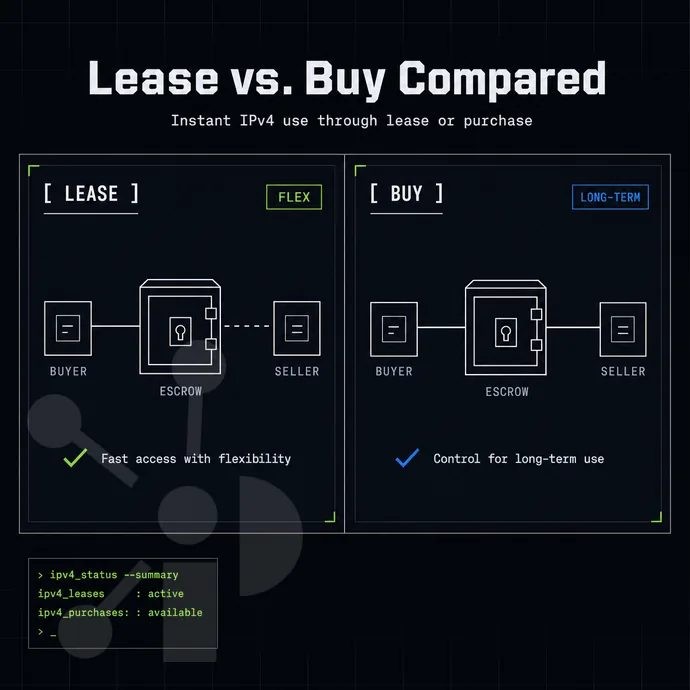
Both leasing and buying enable the instant use of deployable IPv4 IP allocation in the ARIN region. The most suitable model depends on various factors, including budget structure, time frame, and whether long term ownership of the asset matters to you and your organization. Organizations should carefully assess their technical requirements and eligibility criteria before committing to either model.
Was ARIN created to allow IPv4 leasing?
While ARIN does not prohibit leasing of allocated space, the framework established for Registration is based upon the original allocation holder(s). Thus, RIR transfer and applicable ARIN fees for transfer do not apply to a lessee. Understanding the registration framework and its implications helps organizations evaluate whether leasing aligns with their governance and compliance requirements.
Buying: asset, transfer, and applicable fees
The transfers register you as the new owner of the block after going through a full ARIN process. You own the block and can start building equity. You will need to pay the full upfront cost of buying and there is the cost and time it takes to do a RIR transfer (which can take some time in all RIRs).
The transfer process includes documentation review and verification steps that confirm your organization meets the registry's requirements. Organizations must submit detailed justification documentation and proof of technical need as part of the transfer application process.
Leasing: operational spend, no transfer
Leasing an address pool converts address capacity into a fixed operational pricing expense. If a defined-term project or a capacity-bridge is required and the deployment of an asset (server, closet-full, etc.) with associated capital-expenditure is not required, then leasing routable space resources is a good option.
Through our leasing service, we can have a Letter of Authorization (LOA), RPKI Resource Authorization Object (ROA), and Internet Routing Registry (IRR) objects created for you within 24 hours, along with abuse handling support, to put your network on a route-able basis. Organizations can post their routing announcements immediately once these authorization documents are in place.
- Lease: no transfer, no RIR fees, faster provisioning.
- Buy: full ownership, equity, longer process.
See the Prefixx lease vs. buy guide for a deeper comparison across all dimensions. If leasing is the right fit for eligible customers, here is exactly how Prefixx structures and delivers it.
How Prefixx handles ARIN IPv4 leasing
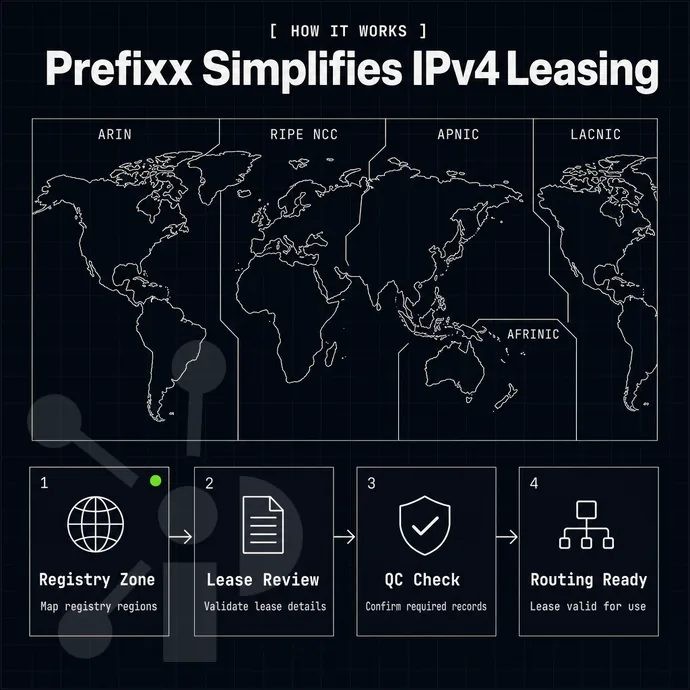
Prefixx was founded in 2018 and is a registrar with ARIN, RIPE NCC and APNIC. All of Prefixx's ARIN IPv4 leases go through Tixx QC justification checks before being provisioned. All routing requests for the leased IPv4s during the lease term are handled by hand by the team at Prefixx. The team reviews all routing and justification reports to ensure compliance throughout the lease term.
- Vetted ARIN blocks of IP addresses for sale. We verify ownership, blacklists, routing health, and RIR status before we sell any IP addresses to our customers.
- No buyer fees. Commission only paid by seller. No hidden fees applicable to lessee.
- Guarantee, Your non-revocation for the leased space for the stipulated lease term, provisioned within 24 hours.
- White-glove routing for you. We create LOA, RPKI ROA and IRR route objects for you, geolocation correction and reverse DNS as well as appropriate abuse contact included.
- Our portal provides transparency into your server with BGP monitoring, 12 DNSBLs reputation scanning, geolocation and rDNS management.
To explore ARIN IPv4 lease options or compare indicative pricing across RIR regions, visit Prefixx.net/lease-IPv4-addresses or reach out to our team directly.
As an RIR, ARIN does not operate a leasing program for IPv4 numbers. All IPv4 leases in the ARIN region are arranged on a purely private basis between a resource holder and a lessee. ARIN's role is limited to maintaining the registry and enforcing its policies, while the commercial terms and compliance with applicable regulations remain the responsibility of the contracting parties.
When evaluating a leasing arrangement, the quality of the contract, the reputation of the block of numbers being leased, and the routing arrangements all relate to the organization from whom you are purchasing the numbers, so keeping detailed records of these factors is essential. The reputation of the lessor within the technical community can serve as a useful indicator of the reliability and quality of the leasing arrangement.
Pricing for an IP space allocation is generally based on a few factors: the block size of space needed, the historical reputation of the requesting company, and the desired term for which space is needed. A clean /24 (i.e. no blacklists) will generally cost more than a similarly-sized block with a poor reputation history.
Leasing IP space to preserve capital while gaining immediate access to a block of routable space is generally faster than attempting to transfer existing space. However, Does not build long-term asset value like owning IP does.
If you are ready to compare options for ARIN IPv4 space, Prefixx can source vetted blocks, handle the LOA, RPKI ROA and IRR paperwork, and get you provisioned within 24 hours.
Contact us to discuss your IPv4 needs today
No hidden fees, free consult. A broker replies within one business day.