
By Savvas Bout, Founder of Prefixx. Last updated 8 October 2026.
No IPv4 space = no new customers. They need to be able to sign them up on the spot, rather than pay the spot market price. So to serve their customers effectively, hosting providers have begun to use leased IPv4 space. Leasing allows providers to scale their infrastructure in direct response to demand without the capital expense of outright acquisition. This leasing approach has emerged as a practical solution for providers who need immediate address capacity while maintaining financial flexibility.
Leased space is supplied under a contract and is fully routed and clean. They don't have to tie up capital in buying the IPv4 address space upfront with lease payments, and they don't have to wait for months for a transfer of space that they have purchased to finally clear. This approach proves cost effective for providers who prefer operational flexibility over long-term capital allocation. This leasing model represents a practical solution for providers seeking to balance immediate infrastructure demands with financial prudence.
The mechanics of a block of IP addresses vary greatly from lease to lease. Blocks of IP addresses that arrive without a valid LOA, RPKI ROA (Resource Public Key Infrastructure Route Origin Authorisation). Providers must verify that the leased IPv4 addresses arrive with proper authorization documentation to ensure seamless routing and acceptance by upstream networks.
Additionally, IRR route objects are generally considered to be 'dead on arrival' at most of the upstream network providers. In addition, a 'poisoned' reputation will cost you in customer support hours long before you actually start to route any traffic with that block of IP addresses. Many enterprises discover this reality only after committing resources to a block, making due diligence on IP reputation essential before any deployment begins.
This guide explains the ins and outs of IPv4 leasing for web hosting providers: what to check for when signing up for a lease, the differences between white-glove provisioning and self-serve, the paper work involved in any changes to routing. Additionally, last but not least, how to determine whether leasing work, buying, or a mix of both is best for your current growth stage. We start with the supply problem.
Why IPv4 leasing for hosting providers is now essential
All 5 RIR free pools of IP addresses were exhaustively allocated every years from 2011 to 2020. There are no more IP addresses for hosting providers to grow with. All 4.3 billion internet protocol addresses are fully allocated. For community perspectives, see IPv4 Leasing vs Buying - What's Your Move? : r/networking.
Why hosting providers feel the squeeze on IPv4 addresses
Growth of customers leads to three things: more VPS’s, more dedicated servers and more BYOIP requests from enterprises bringing their own IP address space to deploy within. Typically most hosting providers are woefully short of addressing space to support the long term commitment of growth as described in their roadmaps. Each VPS and dedicated server requires its own routable address, and enterprise clients often bring complex network topologies that span multiple devices.
Those data centers were allocated large blocks of IP addresses at very low cost as they expanded out in the years prior to 2015. Today’s new providers have no such luck. IPv4 addresses are now transferred in the secondary market and there is strong competition for clean, large blocks of IP addresses that can be routed.
What is the average cost to lease IPv4 addresses?
Pricing for IPv4 leases generally follows the dimensions of size, geography by RIR, and historical reputation. Rarely transparent, most brokers including Prefixx, charge custom pricing for given blocks, of given term, meeting specified requirements for routing etc. Contact us to get a current quote from our consultants.
Do leased IP addresses require your own ASN for IP reputation?
The requirement for an ASN to announce a leased block of IP addresses via BGP is not always applicable. Most already hold an ASN as a provider and can announce announced leased IP addresses using their current Autonomous System. We assist in preparing the LOA, RPKI ROA and IRR route objects for the announced block(s) of IP addresses. Below is a description of how we handle the leasing process once the supply has been detailed.
IPv4 leasing vs buying: a cost and commitment comparison
For hosting providers considering IPv4 options, there is a simple trade off: buy a block of IPv4 addresses for a higher upfront price and own them straight away, or retain capital and pay predictable monthly lease charges. Not all scenarios are better under one model than the other, and so we have outlined the key dimensions across this network of factors in the table below.
| Dimension | Buying | Leasing |
|---|---|---|
| Capital outlay | High upfront | Low or none |
| Monthly cost | None after purchase | Ongoing fee |
| Ownership | Full ownership | Usage rights only |
| Flexibility | Low, asset is illiquid | High, cancel or scale |
| RIR transfer required | Yes | No |
IPv4 addresses: financial flexibility vs long term commitment
Market conditions for buying suits providers with steady, long-term address needs vary. The price for a /24 under ARIN can differ greatly from the price for an identically sized block of addresses under RIPE NCC even on the same day. Leasing arrangements typically offer monthly rates that can provide more predictable budgeting compared to outright purchases in volatile markets.
Leasing IPs is cost effective for short term projects or very fast scaling teams.
How can I lease IPv4 addresses in a subnet?
Leasing a subnet is a straightforward process that can be completed within a short timeframe with a reputable broker who can offer you competitive rates and great service. Working with a broker who provides expert guidance ensures that all documentation and routing prerequisites are properly addressed from the outset.
- Outline your specific needs. We stock various sizes of inventory in different RIR regions, to meet your various needs.
- Just Request a Quote. We contact you with a full quote based on your exact Prefixx.net specification. Offer is valid for 72 hours.
- Review the Tixx health report for a block. This report will indicate if the block is on a blacklist, checks routing health and verifies ownership before you commit the change.
- Sign the non-revocation terms of the lease agreement within 24 hours of provisioning. LOA, RPKI ROA, and IRR objects are provided by our team as required.
Note: Always confirm the lease includes a non-revocation clause. Without it, the lessor can reclaim the block mid-contract, disrupting your routing. Knowing how to lease within your network is only half the picture, knowing what to check before you sign is equally important. A well-structured lease agreement aligns the technical terms with your specific business needs, ensuring continuity of service and predictable operational costs.
What to check before leasing an IP block size

The way hosting providers inherit a spam reputation from a previous user of an IPv4 block leased without checking the block first is to run a few simple checks before signing any leasing agreement. Hosting providers who lease IPv4 blocks must protect their clients from inheriting spam or fraud reputations that could disrupt email delivery and network access.
IP assets reputation and abuse history
A block’s history of abuse will travel with it as spammer/frauder previously using the block of IP addresses can cause problems with mail and traffic to your customers. A single listing on a DNSBL network can take weeks to remove, and the purchase price of that delay is steep since some registries simply won't delist you on request. Organizations must weigh these reputation costs against their immediate demand for address space when evaluating lease options.
Routing hygiene and route origin authorization
The block needs to have a valid RPKI ROA for the origin ASN in question. If no such ROA exists then announcements from that origin will be dropped by the upstream providers. Many ISPs now enforce strict ROA validation policies to prevent route hijacking and ensure routing security.
What block sizes are available when leasing IPv4 addresses?
Leased IPs are typically offered by providers in /24 blocks (256 IPs) and up. Hosting providers that are scaling quickly often start with a /24 and add more IPs as required. Prefixx sources the vetted IP assets from all major RIRs and matches the block size to the customer’s required capacity. Expert advice is provided through our network on a per-lease basis to ensure that the block is correctly sized from the outset.
Tixx by Prefixx runs full ownership verification, full blacklist scan and full routing sanity check on each block before lease is issued to tenant. This verification process ensures that both small startups and large enterprises receive clean, routable address space that meets strict compliance standards.
RIR regions and how they affect your lease
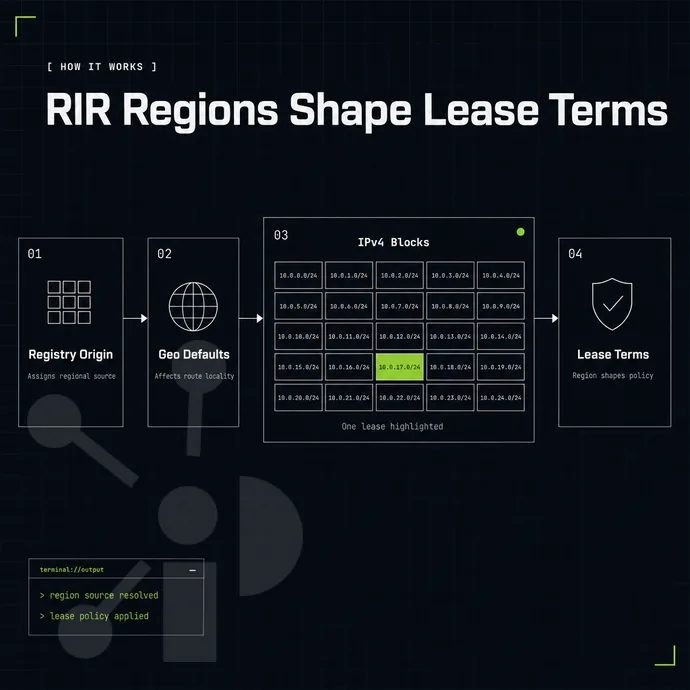
A registry origin is assigned to every leased block of IP addresses. The registry origin determines a geolocation as well as possible default route and acceptable use policies for that block of IP addresses. Understanding these registry-level distinctions helps hosting providers navigate the compliance landscape across different regions of the industry.
How registry origin affects your customers
The five RIRs for the global address space distribute it by geography. ARIN allocates North American IP numbers. RIPE NCC covers Europe and the Middle East while APNIC serves Asia Pacific with IP numbers. A hosting provider mis-routining IP numbers registered with a wrong RIR may lose financial flexibility when those addresses get distributed across wrong continents, breaking geo services and CDN rules.
Geolocation databases often are not updated in time for newly announced network areas and can take days or even weeks. We update a daily geofeed and distribute it to all major providers on your behalf. This proactive distribution ensures that ISPs and content delivery networks can immediately route traffic correctly to your announced prefixes.
Large blocks versus smaller address blocks
Large blocks may have good routing efficiency, but require more justification to the various registries than smaller blocks. In the hosting world, the standard unit of lease for a hosting provider is a /24, which routes very cleanly across all the various network registries. Address space is leased on a geographic basis to match the space to the customers’ real geography, and we can broker space in every RIR.
The choice of block size directly affects both routing table acceptance and the administrative overhead of managing subnet allocations across multiple data centers. Hosting providers must manage subnet allocations carefully to balance routing efficiency with the administrative burden of tracking assignments across their infrastructure.
What happens to my leased IPs when the lease ends?
When a lease term expires (i.e. the addresses are “returned” to the lessor), the LOA and ROA for those addresses are withdrawn. BGP advertisements for those addresses cease to be advertised. Services bound to those addresses will fail.
The lease agreement should clearly specify the notice period and any penalties that apply if either party terminates early, as the purchase price of unplanned downtime can far exceed the cost of the lease itself. Hosting providers should plan their migration strategy well before lease expiration to ensure a smooth transition of services to new address space.
We urge clients to plan their network migrations well in advance of lease expiry, rather than at the last minute. How Prefixx’s leasing service works is an important consideration here. Planning ahead ensures the leasing service can align address allocation with your specific business needs without rushed decisions.
Providers who proactively manage their address inventory and renewal timelines avoid the operational disruptions that come with expired authorizations. A smooth transition requires coordination between your network operations team and the broker to ensure all routing and documentation updates occur seamlessly.
Why Prefixx makes leasing work for IPv4 addresses
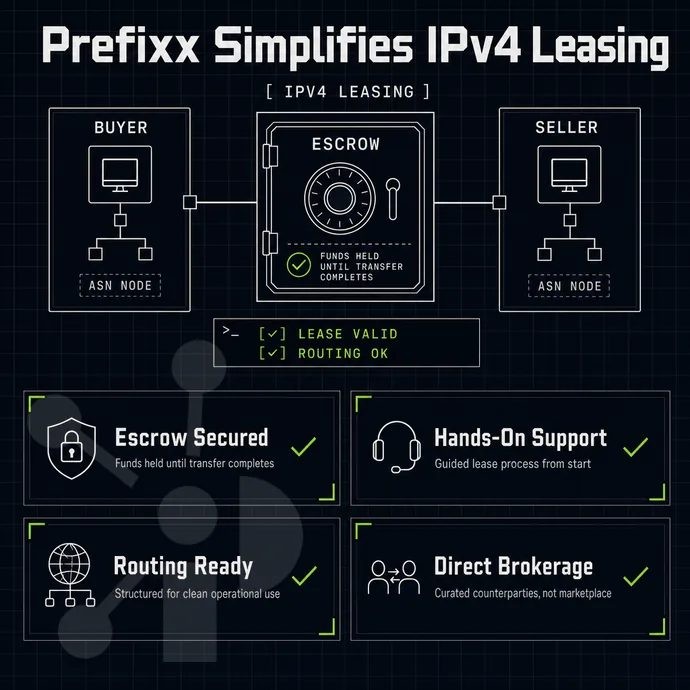
Prefixx is a boutique brokerage for the sale and lease of IPv4 addresses. We are not a marketplace and all of our leases include hands-on support from a senior consultant at Prefixx who is registered with ARIN, RIPE NCC and APNIC in all five RIR regions.
- Tixx quality control on every IP block (ownership verified, abuse history checked, IP reputation clean before provisioning).
- This is a white-glove service: we create the LOA and then set up route origin authorization (RPKI ROA) and the relevant IRR route objects, plus rDNS delegation and geolocation fix-up.
- Guarantee non-revocation of leased IPs and provision within 24 hours to get them connected to your network as quickly as possible.
- We deploy BYOIP on our bare metal servers. No additional charge per IP. All managed via our client portal where you can monitor your BGP and manage 12 DNSBLs as well as your reverse DNS (rDNS) listings.
- We price based on your block size and business model with no fees to buyers.
Organizations planning to scale address space without a long-term commitment will find leasing a cost-effective path. Contact our team to compare options.
When a hosting provider wants to add address space to their servers without having to spend the capital to buy the addresses, they can rent IPv4 address space in the form of a block.
To meet business needs, the leased space will have to go through the same check as space that's been purchased, good reputation, correct RIR assignment, RPKI availability, and a non-revocation guarantee. There's also a difference between a RIPE block and an ARIN block for data centers: how they are routed, how they can be transferred, and what price they are selling for on the current market.
If you need space quickly, leasing from a broker who offers transparent pricing and handles the LOA, RPKI ROAs, IRR route objects, and geolocation correction on your behalf removes the operational overhead that trips up most in-house procurement attempts.
Contact us to discuss your IPv4 needs today
No hidden fees, free consult. A broker replies within one business day.