
By Savvas Bout, Founder of Prefixx. Last updated 23 September 2026.
The first thing an upstream will ask for when a network peer rejects a prefix or a route fails to propagate is your IRR routing record for that prefix announcement. The single route registry entry for a prefix announcement is the route object.
An announced IPv4 prefix and/or a corresponding IPv6 prefix informs network operators and the global routing table that you are a legitimate source of a given set of announcements. This routing record associates your autonomous system number with the IP address block you intend to announce, establishing your authorization to originate those routes.
For most new IPv4 addresses holders (i.e., teams that have recently acquired IPv4 addresses for use on the global Internet or that lease a block of IPv4 addresses for a very short time to host a single service or small number of related services), the process of registering the corresponding IRR prefix record for all announced prefixes typically is not completed until something fails. Many operators only establish their first IRR records reactively, after connectivity issues surface during peering negotiations.
The article describes the contents of an routing registry object, its significance to prefix filtering and BGP security for network operators, and its interrelation with RPKI ROAs and the five RIRs. It also explains the registration process for a route as set object. Common errors which lead route objects or an as set to be rejected or go out of sync with announced data, and how white-glove support from a broker like Prefixx keeps the paperwork accurate right from the start.
The article also covers how route objects interact with other objects in the registry to form a complete routing policy framework. Proper IRR registration enhances network security by enabling operators to validate route origins and filter illegitimate announcements before they propagate.
Internet numbers and the internet routing registry route object
An IRR route registration is an object within an Internet Routing Registry that consists of an IP address prefix and the Originating ASN of that prefix. The prefix route object is written in Routing Policy Specification Language (RPSL) and expresses the intentions of a route originator. In contrast to really enforcing route originations, these objects enable other route originators to build correct BGP filters.
These RPSL objects describe the relationship between a prefix and its authorized origin AS in a structured, machine-readable format. These objects serve as authoritative sources of related information that network operators query when validating prefix announcements and constructing filter lists.
Key fields in route registry objects and routing policy specification language
All records are written in RPSL, the policy specification language used to define IRR data structures, allowing network operators to define routing policies in a machine-readable format.
- route, the IP prefix (e.g., 203.0.113.0/24).
- origin, the ASN originating the prefix.
- mnt-by, the maintainer object that controls edits.
- descr, admin-c, tech-c, descriptive and contact fields.
Aut num object relationships in the routing registry
Each route record is associated with an aut-num object which describes the AS set itself. Together, the route records and the aut-num objects form the complete routing policy declaration in the routing registry. The aut-num object also specifies the admin c contact responsible for maintaining the routing policy for that autonomous system.
What is an IRR route set and as set in routing policies?
A route set is a collection of Internet route objects that can be referenced by name in a routing policy using a set. Instead of listing individual routing information prefixes in a filter, a set name can be used.
We at Prefixx create route objects, route sets and associated LOA and RPKI ROA objects for each lease and transfer. Here we explain where these objects live and that is in the registry system. Each route object belongs to a specific registry and must reference the correct autonomous system number and prefix range.
How internet service providers use the internet routing registry system
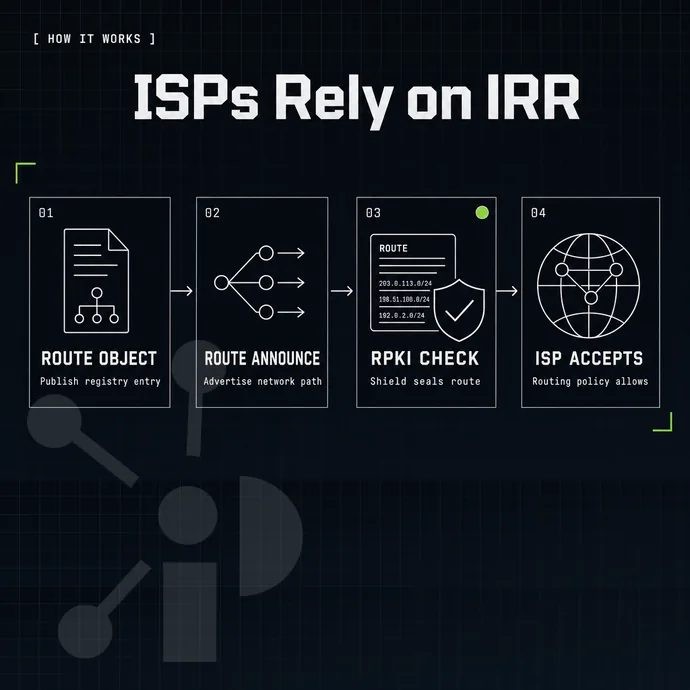
The IRR is a distributed set of databases maintained by the regional networks ARIN, RIPE NCC, APNIC and others as well as by RADb and other providers. Users query the IRR databases using WHOIS on port 43 or a frontend tool like IRR Explorer.
What are IRR entries, prefixes, and routing policies?
An IRR prefix is a route object that stores routing data, specifically a prefix and the AS number of the operator allowed to originate it. The operator publishes such route objects to inform others about his routing policy so that others can build adequate routing filters. These routing objects form part of the broader internet numbers registry infrastructure that tracks address space allocations and their authorized origins.
Routing information policies in the internet routing registry and BGP filtering
Service Providers use IRR data to configure their routers and to build router configurations for their peers and customers. A missing route object is silently dropped. Thus, accurate registration of a route using IRR data is critical to enable reachability. Operators must create and maintain these route objects proactively to avoid silent drops that disrupt connectivity. Service providers rely on these IRR entries to generate prefix filters and access control lists that routers apply when evaluating incoming BGP announcements.
When a service provider builds router configurations, each filter rule may be tailored to a specific customer based on the route objects that customer has registered in the IRR. Each filter rule may reference a routing table entry that corresponds to a registered route object, ensuring that only authorized prefixes are accepted. Routers apply these filters to incoming announcements, permitting only traffic from prefixes that match registered route objects. When routers reject announcements due to missing IRR data, downstream users experience connectivity failures that could have been prevented through proactive registration.
IRR route object and RPKI: complementary, not competing
An IRR system is operator-maintained and policy-based whereas RPKI is cryptographically signed. Many networks run both systems: RPKI is used to validate origin information, whereas other IRR databases are used to fill gaps in RPKI ROAs. Prefixx generates all necessary LOAs, RPKI ROAs as well as IRR route objects for all leases and transfers.
When working with these route registry objects you should be familiar with the corresponding RPSL object types. Operators typically import routing policy data from multiple IRR sources to construct comprehensive prefix filters that reflect both cryptographic and policy-based validation mechanisms.
How to create a route as set object step by step
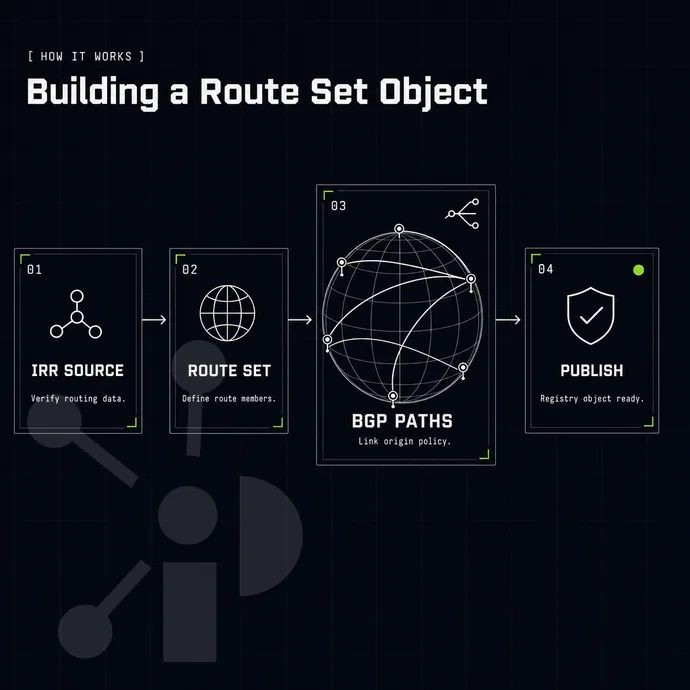
Creating an IRR route object is a very precise, registry-specific task. If you get the routing information fields right the first time, route propagation works as expected. If you get one field wrong in the route registry, upstream filters will silently discard your route announcements.
Confirm your maintainer and choose the right internet routing registry IRR
Make sure you have a maintainer object (mnt-by) at the registry you’re targeting before you submit anything. Authentication fails without it. Use the same registry for the space in question: ARIN IRR for ARIN-registered IP space, RIPE NCC for RIPE space, etc. RADb, a catch-all route registry, can store objects for any space. For community perspectives, see ISP IRR Validations : r/networking.
What is the radb and how does it manage routing policies
RADb is a public, operator-neutral IRR database. It’s the primary IRR server for many networks who are not covered by their regional registry IRR or need cross-registry visibility.
The main use case for RADb is to allow operators to add their IRR entries, if their RIR doesn’t run an IRR database itself, or if they need more visibility in tools that generate route-filters based on the entries in IRR databases. RADb functions as the primary server for routing policy documentation when regional alternatives are unavailable or insufficient for operational needs.
Assemble and submit the RPSL routing policies fields
Each route object is defined with one prefix-origin pair. Operators may update an existing object when the origin AS changes or delete it when the prefix is no longer announced.
- route: the exact prefix (e.g. 192.0.2.0/24).
- origin: the ASN in AS##### format; this field identifies which autonomous system originates the prefix, and the as name in your AS object should match.
- descr: a short human-readable description.
- mnt-by: your maintainer handle.
- admin-c: the admin-c contact NIC handle.
- tech-c: the tech-c contact NIC handle.
The autonomous system number submission can be done via the registry's web interface, via the RESTful API or via PGP-signed email. Please consult the relevant route registry's documentation before submitting.
Verify your global IP network IRR objects appear correctly
After submission check if the new objects are visible at the respective registry by running a WHOIS query. As IRR Explorer cross-checks objects across multiple databases, inconsistencies in fields like tech c and aut num attributes have to be resolved first. Then these objects can be used for route filtering, for example.
We create the LOA, RPKI ROA, and IRR route objects for you as part of our standard lease and transfer documentation. We handle the paperwork for you, and it is not left to some aut num object or a bunch of automated scripts. Creating a route object is half the problem, keeping it up to date and accurate after that is where most networks fail.
How Prefixx handles IRR preparation for every block
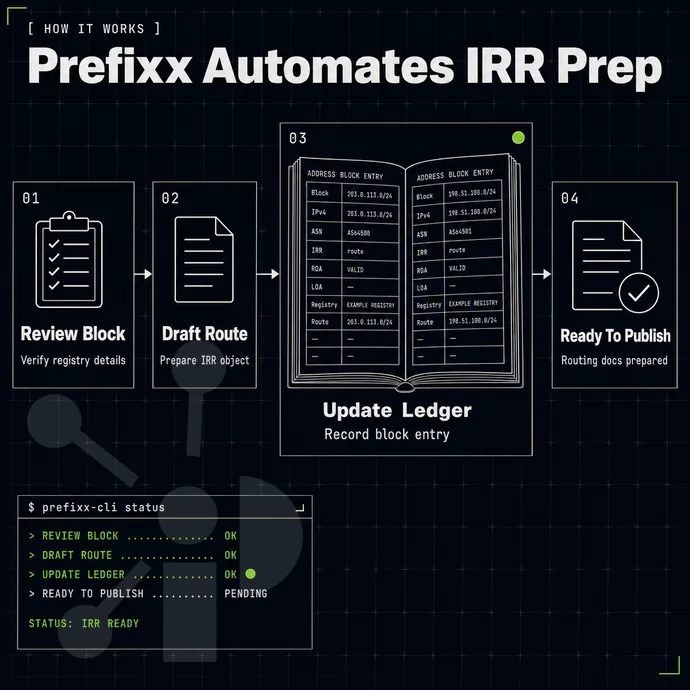
Prefixx generates IRR route objects, RPKI ROAs and LOAs as part of our white-glove service for new leases as well as for purchased address space blocks. We take care of the necessary registry updates, including the aut num object, for routing purposes, freeing you up to concentrate on the actual deployment.
- Tixx quality control is applied to every block and detects inconsistencies in IRR as well as any violations of routing hygiene prior to delivery to the buyer.
- BYOIP onto Netrouting bare metal includes full internet routing registry preparation by our team, with no per-IP surcharge. See our BYOIP page for details.
- We facilitate the brokerage of blocks across all five RIR regions (ARIN, RIPE NCC, APNIC, LACNIC and AFRINIC) helping to facilitate networks worldwide.
- Zero buyer fees and 0% commission on buyer side, only commission on seller side.
If you need a block of IP addresses, reviewed for suitable usage, and corresponding network routing paperwork completed for you from start to finish, please let us know and we’ll provide you with a quote from one of our consultants.
A well-maintained IRR route entry is crucial to enable predictable routing. Without a properly managed routing object registration, network operators acting as upstreams can (and do) filter your prefixes. RPKI does not cover all network prefix filtering and export policies in place today. Two simple habits to get you started: keep the route object for your prefixes up-to-date for the correct origin ASN. Check the route object for updates whenever you renew or transfer a block of IP addresses, as set procedures require.
If you have recently acquired IPv4 space or are preparing for a transfer, the route object is one of several routing policies and hygiene steps that need to happen in the right order. Prefixx handles the full paperwork stack on every deal, including IRR route objects, RPKI ROAs, and LOA preparation, so that configuring routers and staying compliant never falls through the cracks. Contact the Prefixx team to get your block transfer and routing setup done correctly from day one.
Contact us to discuss your IPv4 needs today
No hidden fees, free consult. A broker replies within one business day.