
By Savvas Bout, Founder of Prefixx. Last updated 5 October 2026.
Even though the last free pool of IP addresses has closed, demand for IP addresses continues to increase. Every new autonomous system, cloud-based server, content delivery network (CDN) node, and IoT device requires IP addresses to communicate online. Each cloud-based infrastructure deployment relies on properly configured routing to ensure that every server can be reached by clients and upstream providers.
Those IP addresses have to come from someone who is already using IP addresses that they can sell. So, the price of IP addresses has become tied to the supply of IP addresses in particular regions. Organizations such as enterprises and ISPs therefore compete in a marketplace where scarcity drives valuation and acquisition strategy.
Among the main functions of IP address vetting, the reputation of the block also comes into play, affecting whether you receive enough addresses that can be delivered in a timely fashion before the first packet ever reaches its destination.
And, the timelines for transferring IP addresses between registrants at ARIN, RIPE NCC, and APNIC vary noticabley from one registry to the next and can easily cause a launch to be delayed. The geographic location of the seller and buyer determines which registry policies apply to the transfer process.
This article will examine the current demand for IP addresses and outline the various aspects that affect the price per IP as well as the routing speed of an IP address. It will also outline current solutions to immediate needs for an IP block, such as buying an IP range outright, leasing IP address block until more are allocated. Understanding these market dynamics helps organizations and users alike plan for long-term connectivity requirements.
Additionally, Transferring IP allocation between RIRs to consolidate existing IP address allocation holdings. To best determine which of these solutions best suits your needs for an additional IP pool, it is first important to understand what current demand for IP addresses actually is and how it has become a commercial problem.
What purpose an IP address serves and why it matters
Demand for IP addresses from the growing pool of Internet users, enterprises and even more Internet connected devices is placing ever greater pressure on the fixed pool of public IPv4 addresses currently available. Long dormant IPv4 address space is now in high demand and is actively trading on secondary markets.
IP address and the two jobs every address does
A global internet requires all internet connected devices to have an address that uniquely identifies each host and specifies its location on the Internet with reference to the network topology.
Without a valid IP address of appropriate scope, packets will fail to complete their journey and a connection will be dropped by a router when a destination address fails to match an entry in a router’s routing table. Routers rely on the structure of an IP address to make forwarding decisions that determine the path packets take across interconnected networks.
Why supply cannot keep up
The total IPv4 address pool is around 4.3 billion addresses.
There is increasing demand for IP addresses to support additional cloud workloads, IoT sensors, and CDN nodes. However, the supply of IP addresses has not increased. Enterprises continue to deploy more servers and networking equipment, each requiring routable addresses to connect computers and other devices to the global internet.
Multicast addressing and reserved blocks
Even with 4.3 billion addresses available for public routing, not all of them are usable due to reserved ranges for private networks, loopback and multicast addressing. This further restricts the already tight supply of publicly routable addresses.
To explain how this happened we take a brief look at how the IPv4 IP subnet was consumed across networks in the first place. Certain ranges are also reserved for documentation and testing purposes, leaving only a portion of the theoretical pool available for static assignment to production systems.
How IPv4 IP address space became scarce
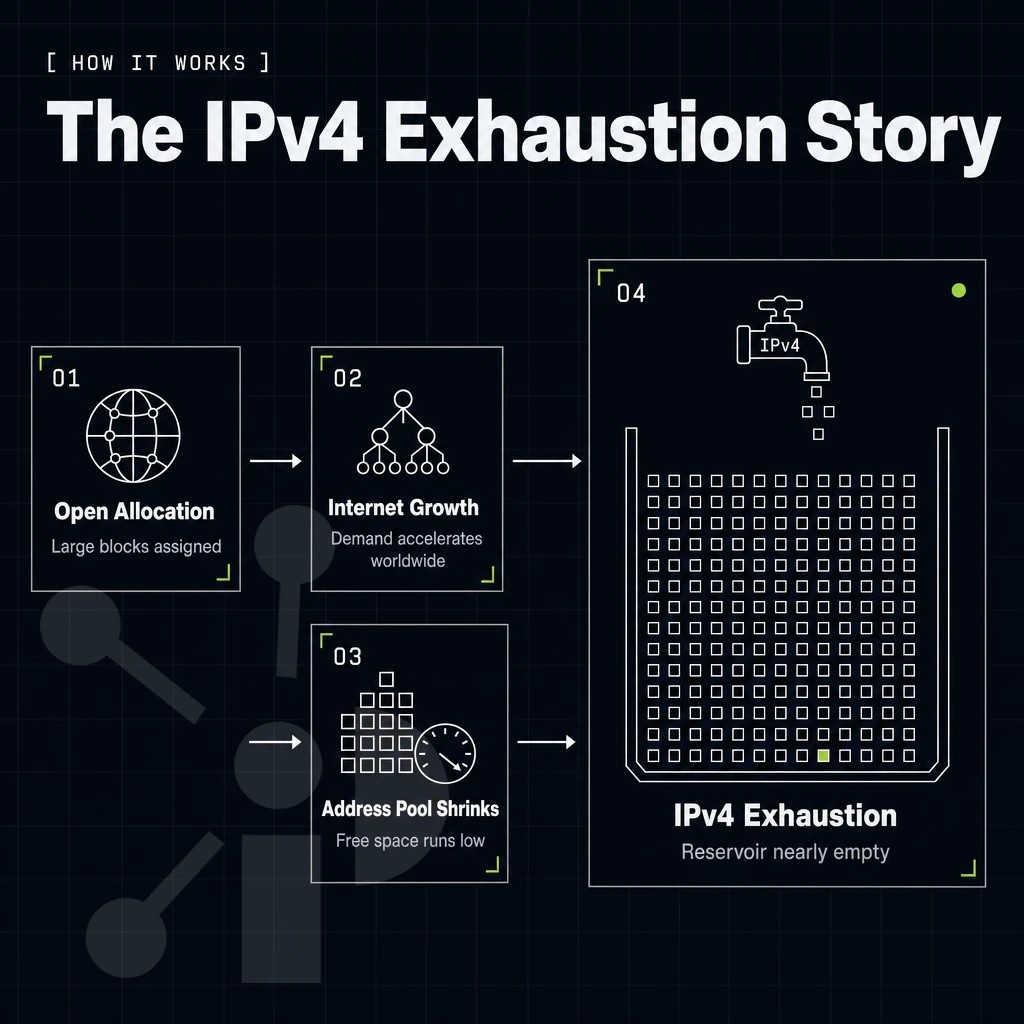
In the early years of the Internet, the number of IPv4 addresses (roughly 4.3 billion) seemed like plenty.
Dynamic IP address and cidr as early fixes
Two mechanisms were put in place before network block actually started to run out. Dynamic IP addresses are reused on a temporary basis by a ISP between different subscribers using the same address during different active sessions. CIDR, or Classless Inter-Domain Routing, replaced the old class-based system of IP addressing with variable length addressing of IP address range.
It helps reduce waste at the interface but does not create any new IP resources. Each network interface on a device requires its own unique identifier to participate in routing, which is why efficient allocation methods remain essential.
Private IP addresses ranges and the NAT delay
RFC 1918 defines three reserved blocks for use within private networks. Because so many devices exist within these private networks, millions of devices can exist on a single public IP address by the use of Network address translation (NAT). By this means, millions of internal IP addresses can communicate to the outside world via the single public IP address. This approach allows each private network or domain to operate independently while sharing a limited pool of public addresses.
Although this method extended the life of IP addresses on the internet for a long time, it was not a permanent fix. Having enough IP addresses for a local network is not the same as having enough IP addresses for the entire internet. Organizations that rely on NAT must still maintain sufficient public addresses for their gateway infrastructure and externally facing services.
How the five RIRs ran dry
APNIC was the first RIR to exhaust its free pool of IPv4 addresses in 2011, followed by RIPE NCC in 2012, ARIN in 2015, LACNIC in 2014 and AFRINIC in 2020. Once the free pool of each RIR had been exhausted, the only legitimate source of IPv4 network resources is the secondary market for already allocated IP inventory, trading at rising prices due to fixed supply and growing demand. Organizations seeking IPv4 resources must now gain access through broker-facilitated transfers rather than direct registry allocation.
If you need IP address inventory right now, you work with a registered broker. Prefixx holds these registrations with ARIN, RIPE NCC, and APNIC, and can assist with LACNIC transfers in regions where rapid expansion has driven space into active trading markets. The broker manages the technical and administrative steps on behalf of clients throughout the transfer process.
What is driving demand for IPv4 addresses today

The main function of an IPv4 address is to assign a globally unique address to connecting devices so that communication can be facilitated over the internet. The number of identities required has been increasing, driven by factors within the broader digital infrastructure, including the rapid growth of connected devices. These identities are assigned not only to servers and routers but also to computers, smartphones, tablets, and an expanding array of embedded systems.
Structural demand drivers
- We need to account for the cloud infrastructure growing, all of the VMs, load balancers, and NAT gateways. Right now, AWS charges for Elastic IPs, which is a pricing signal for a truly scarce resource. Companies with multi-region deployments consume large blocks of Elastic IPs very quickly.
- The growing number of IoT devices and connected objects, including sensors, cameras and industrial equipment that all require IP addresses and to be routed. The very rapid development of connected objects in factories and homes creates a huge and growing demand that is not yet being met by current savings in IP address use.
- Mobile broadband: Although hundreds of millions of internet users are served by carriers that have not yet fully migrated their networks to IPv6, many of them still use IPv4. Although Carrier Grade NATs (CGNATs) may “buy some time”, in the end, upstream IP capacity is still needed.
Enterprise and platform demand
- Multi-homing. Companies advertising their own IP network capacity to servers in multiple Internet service providers need to announce this provider-independent space from all of their upstreams. This requirement alone creates a steady market for /24s and larger.
- These BYOIP programs allow customers to bring their own IP space to AWS, Azure, Google Cloud, and Cloudflare. In each case, customers must bring their own owned, transferable IP addresses. By pulling more blocks into active use, these customers also increase demand in the clean IP addresses market for additional routable prefixes.
- Online services scaling globally. CDNs, SaaS services, and video streaming services obtain address segment to anchor their anycast nodes and reduce latency for end customers.
What the transfer data shows
Reports from third-party market observers indicate that 58 million IPv4 addresses changed hands in 2025. While market growth is down slightly from 2025 to 2026, the total number of addresses transferred is projected to increase by around 18% year over year. The key question is who will be using the addresses that are moved. Enterprise networks, cloud providers, and mobile operators represent the primary categories of users acquiring these transferred addresses to support infrastructure expansion.
Note: Rising transfer volume does not mean supply is loosening. The total pool is fixed. Higher volume across networks reflects competition for the same finite set of addresses, which sustains upward pressure on pricing. That pricing dynamic is worth unpacking in detail, because several variables beyond simple supply and demand move the number. Organizations evaluating acquisition strategies must recognize that market demand itself has become more sophisticated, with buyers now seeking not just quantity but specific routing characteristics and clean reputation histories.
How regional internet registries allocate and transfer internet protocol addresses
The five RIRs (RIRs) have two main roles today: allocation of IP network segment to organizations in their respective regions of the world; and governance of the secondary transfer market for used IP space between current holders. Organizations such as ISPs typically receive their allocations directly from the RIR serving their geographic area, following documented justification of their technical requirements.
How registries originally distributed dynamic IP addresses
Each of the five Regional Internet Registries (ARIN, RIPE NCC, APNIC, LACNIC, and AFRINIC) received very large blocks of address region from IANA. They then allocated parts of their blocks to applicants for space, often in a direct manner where the addresses were tied to the applicant’s registry membership. Those addresses were announced on the Internet to enable proper routing. Organizations receiving these allocations could then configure them as either static or dynamically assigned addresses depending on their operational requirements.
Legacy addresses can also be transferred.
Intra-rir versus inter-rir transfers
This means that for example an ARIN-to-ARIN transfer is very straightforward as both parties operate under the same policy, which helps enable communication and allows them to anticipate timelines. Organizations seeking to access additional IPv4 resources through transfers benefit from this policy alignment and procedural clarity.
These need approval from both registries to ensure you have enough internet protocol addresses, so a few extra steps of coordination and paperwork are required, but we handle all of this for you.
Why LACNIC transfers are more restricted
Outbound transfer of internet protocol addresses allocated under LACNIC are subject to more restrictive rules than those allocated under the other three registries. For transactions involving LACNIC-allocated addresses, whether for public or private IP addresses and network use, Prefixx facilitates the transactions; however, Prefixx is not a registered holder with LACNIC and therefore all such transactions are structured to comply with LACNIC policies and data registry requirements.
Organizations seeking to acquire or transfer allocations must demonstrate legitimate need and maintain proper access to registry documentation throughout the process.
- ARIN and RIPE NCC openly support both intra-RIR and inter-RIR transfers.
- APNIC allows inter-RIR transfers on a case by case basis according to APNIC’s own needs-based criteria.
- LACNIC restricts outbound transfers of IP addresses, across regions.
- AFRINIC addresses remain subject to ongoing policy development.
It is also important to learn about resale market participation for organizations interested in buying and selling domain names as well as leasing them. Organizations often explore both domain and IP address markets simultaneously when building their digital infrastructure footprint.
Why Prefixx for IPv4 and IP address acquisition and management
Prefixx is a boutique IPv4 brokerage. We are registered with ARIN, RIPE NCC and APNIC (LACNIC facilitated). As a boutique brokerage, Prefixx’s senior consultants are involved in every deal, acquiring, selling or leasing IPv4 addresses in a high demand market with limited opportunities in the IP address exchange.
- Zero buyer fees. Sellers pay a 3 to 8 percent commission only on a successful close. Buyers pay nothing.
- Tixx quality control. We verify ownership, blacklist status, routing information and RIR information for each block before we sell it to you.
- All Escrow-secured transactions, meaning for every deal that is concluded funds are held in escrow to protect both parties involved.
- We provide white-glove lease service and monitor geolocation, rDNS, reputation, and process abuse complaints for you as part of the lease.
- We prepare the LOA, RPKI ROA and IRR route objects for BYOIP and inter-RIR transfers. We manage transfers between all five RIRs.
- Client portal. All accounts receive BGP monitoring, 12-DNSBL reputation scanning, geolocation tools and rDNS management at no additional charge.
If your organization needs to acquire, lease or monetize IPv4 addresses, compare available blocks on the Prefixx marketplace or contact our team for a personalized quote.
Frequently asked questions
Does IPv4 scarcity affect private network IP prices needed for efficient routing?
All the five IP address authorities exhausted their free IPv4 pools between 2011 and 2020, and the total supply is capped at roughly 4.3 billion addresses. Every block in use today came from that fixed pool. The only way to acquire new IPv4 space is through the secondary transfer market, where existing holders sell or lease what they no longer need. Organizations such as enterprises, hosting providers, and ISPs compete for available blocks through brokers who facilitate these transactions.
How does regional market demand affect IPv4 IP address prices?
Each RIR operates its own transfer policy, and demand within each region reflects local growth, regulatory requirements, and how tightly supply is held. A /24 block of addresses under ARIN and an identically sized block under RIPE NCC can trade at noticeably different rates in the same month. Regional scarcity, block reputation, and transfer eligibility all push the final figure up or down. Pricing for comparable allocations can vary widely depending on which registry governs the transfer and the competitive conditions in that jurisdiction.
Buying vs leasing an IPv4 IP address block: key differences
Buying transfers full RIR registration to your organization, giving you permanent ownership and the ability to receive data routing rights, sell, or reassign the space later. Companies with short-term capacity needs or tight capital budgets often lease first and buy when demand stabilizes. Leasing provides the flexibility to expand capacity quickly without committing capital, making it an attractive option for organizations testing new markets or managing seasonal traffic spikes.
Why would a company need to acquire IP address blocks on the secondary market
The RIRs no longer issue new IPv4 space from a free pool, so any organization that needs additional addresses must source them from another holder. Common drivers include rapid infrastructure growth, entry into a new region, cloud or hosting expansion, and compliance requirements that need dedicated, clean IP region. Some operators also acquire dedicated blocks of addresses specifically to control their routing reputation rather than share space with unknown neighbors. Organizations that anticipate future growth often acquire larger blocks than their immediate requirements to avoid repeated transactions as they expand.
What is an inter-rir transfer and when is it needed?
An inter-RIR transfer moves IPv4 routing block from one regional registry to another, for example from ARIN to RIPE NCC. It is needed when a buyer and seller are registered under different RIRs and the buyer wants the block registered in their home network registry. The process requires both registries to approve the transaction under their respective policies. ARIN, RIPE NCC, and APNIC all support these transfers directly; LACNIC transfers are facilitated through a separate process.
How does IP address reputation affect demand and pricing?
Blocks with a history of spam, abuse, or blacklist listings are harder to use for online services immediately and require remediation work before they can carry legitimate traffic. Buyers and lessees pay a premium for clean space because a blacklisted block can delay email delivery, trigger firewall blocks, and damage a brand before a single packet is sent.
Clean, well-documented blocks command higher prices precisely because demand for them is concentrated across many networks while the supply remains limited.
What happens to IP address demand as IPv6 adoption grows?
IPv6 adoption reduces the pressure to acquire large blocks of IPv4 addresses for internal infrastructure, but it does not eliminate appetite for IPv4. The public internet still routes enormous volumes of traffic over IPv4, and many end users, ISPs, and enterprise networks remain IPv4-only. Operators running dual-stack environments still need IPv4 addresses at the edge. consumption has moderated in some segments, but the fixed supply and ongoing need for clean, routable IPv4 space keep secondary-market activity steady.
All new devices and networks require IP addresses which are now sourced from the finite address resale market. Price for IP addresses can vary greatly between regions and even more so based on the IP registry you buy and sell under.
If you are sizing a purchase, planning a sale, or evaluating a lease, this guide addresses the fact that the numbers you need are not published anywhere on the internet or in any official source.
They come from live market activity. Prefixx tracks that activity across ARIN, RIPE NCC, APNIC and LACNIC, runs Tixx quality control on every block, and handles the transfer paperwork end to end. Get in touch to find out what your block is worth across our networks, or what a vetted block in your target registry will cost today.
Contact us to discuss your IPv4 needs today
No hidden fees, free consult. A broker replies within one business day.