
By Savvas Bout, Founder of Prefixx. Last updated 14 September 2026.
Most people start looking for where to purchase IPv6 address space, and quickly realize that there is nothing to buy. Unlike for example IPv4 address space, which has a limited pool of addresses, which all got used between 2011 and 2020.
IPv6 was designed with a vastly larger address pool, providing an address pool so large it is effectively inexhaustible, where IPv4 offered about 4.3 billion in total. The vastly larger pool ensures that organizations can obtain sufficient unique IPs to support even the most demanding deployment scenarios without facing the exhaustion constraints that defined IPv4. For more context, see IPv4 address exhaustion.
Additionally, a secondary transfer market has developed to cover the needs for additional addresses, whereas the availability of IPv6 address space is effectively unlimited and free to everyone.
Although the market for IPv4 is established and diverges from IPv6 in crucial ways, this article covers both protocols in sufficient detail that the differences will affect all of your infrastructure and service decisions. The two protocols differ not only in their intended functions, but also in how their addresses are assigned and managed to be suitable for each use case. Understanding these protocol differences becomes the starting point for any infrastructure planning that must accommodate both address families.
Here we explain why IPv6 addresses cannot be bought on the secondary market while IPv4 can, and cover the ways organizations can get IPv6 addresses assigned to them.
What it actually means to buy an IPv6 address
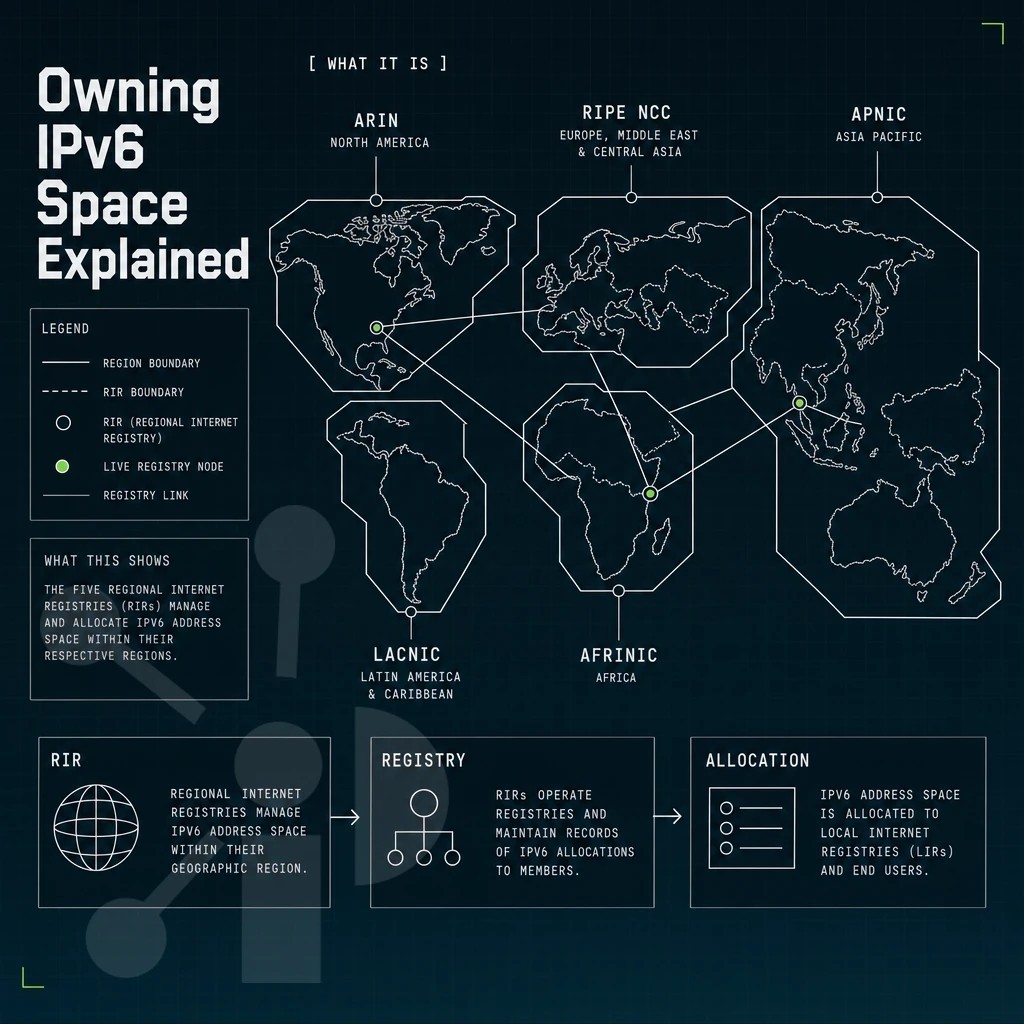
The search for "buy IPv6 address" is real but based on a wrong premise. IPv6 was not designed to be scarce, so no user demand for a secondary market has ever developed around it.
Why scarcity never developed in data centers
So, even Google with all of its servers and data centers around the globe doesn’t come close to using up even a small percentage of the addresses that are available. Because no registry ever ran out of IPv6 addresses, a business transfer market for them never emerged.
The two real paths to IPv6 complete control
Note: One does not “buy” IPv6 space. Instead, an allocation of IPv6 space is requested from a registry (e.g. ARIN) or is included as part of your service from your ISP (where you get a block of IPv6 address allocation as part of your service). Some providers, such as hurricane electric, include IPv6 allocations as a standard component of their connectivity offerings.
- Registry route: ARIN, RIPE, APNIC, LACNIC and AFRINIC distribute IPv6 to qualifying organizations. Eligibility is straightforward for most network operators.
- ISP route: Most providers assign IPv6 prefixes automatically. No paperwork, no fees.
Where Prefixx fits in testing environments
IPv4 address space is what we broker. If you need a solution for a registry application or for work related to routing, our consultants are ready to handle your request and help you with these matters. For IPv6 related matters however, your first contact would be the registry itself. The next section explains the registry application process in detail.
The real cost of IPv6 addresses: fees, leases and what you actually pay
With plenty of IPv6 addresses available, the cost is straightforward, no room for speculative secondary markets.
Understanding block size and the overall cost landscape
- Applying directly to a registry for a direct allocation requires an organization to apply for an allocation through ARIN, the RIPE, or APNIC by paying for membership or for an assignment. These are the main costs for organizations that are looking for an allocation that they can use in their own network, and there are no additional costs per IP address.
- We can lease a block of IP addresses. Leasing is the lowest-friction route, and rates are quoted per block per year rather than per address. There are many companies that offer IP address leasing. They can provision addresses quickly.
- Bundled with connectivity. Many providers include an IPv6 allocation in the base subscription at no extra charge.
Evaluating cost efficiency with technical support
- By comparison, a /48 block provides 65,536 possible subnets. In fact, most organizations will never actually use that many subnets. So you need to find the smallest block that will meet your needs and supports your routing strategy. In other words, pick the smallest block you can afford.
Note: IPv6 capacity does not carry the scarcity premium that drives IPv4 prices. Do not pay IPv4-style rates for it. That said, low cost does not automatically mean you need to acquire anything at all.
IPv6 vs IPv4: why the secondary market only exists for IPv4
If you're searching for "acquire IPv6 addresses" you are likely solving the wrong business problem, in most cases the correct solution is IPv4.
IPv4 exhaustion created a trading market
All five RIRs have emptied their free pools of IPv4 addresses, with the last having done so between 2011 and 2020. Thus every block of IPv4 addresses in use today was either allocated prior to this cut off date through a direct request or purchased on the secondary transfer market. Thus IPv4 address scarcity drives price, and buying a /24 today you are buying from another organization, not a registry.
IPv6 has no equivalent scarcity
There is no shortage of IPv6 addresses, so there is no secondary market, direct distribution by the registries remains common practice.
What this means if you need IP addresses
For Routing, Reputation or BYOIP purposes, IPv4 is the relevant solution.
Why choose Prefixx for IPv4 when IPv6 is not the answer
When IPv6 addresses are not the right choice and your business needs clean, portable IPv4 space, Prefixx is the specialist to contact.
- Tixx quality control on every block: ownership, blacklists, routing hygiene and RIR standing checked before any allocation reaches you.
- White-glove service included: our team prepares the LOA, RPKI ROA and IRR objects so you do not worry about routing paperwork.
- BYOIP deployment support onto Netrouting bare metal, no per-IP surcharge.
- Human-in-the-loop: senior consultants on every deal, not a self-serve marketplace.
If you are ready to determine the right block size or request a quote, get in touch with our team at Prefixx.net.
Frequently asked questions about stable connections
How should provider independent IPv6 addresses scale unique IP costs effectively?
Your ISP or hosting provider assigns IPv6 addresses as part of standard connectivity, and most do so at no extra charge.
Is anyone actually using IPv6 to future proof their network?
Yes, and adoption has accelerated sharply. Google publishes its own IPv6 adoption figures, and major mobile carriers in the US, India, and Germany have made it a focus by deploying it as their default protocol. Content delivery networks, hyperscalers, and most modern operating systems all support it natively. The question for most networks is no longer whether to enable IPv6, but when.
Will IPv6 from your internet service provider make it faster?
IPv4 traffic for customers on carrier-grade NAT passes through address translation layers that add latency and complicate stateful connections. IPv6 gives every device a direct, routable address, which eliminates that overhead. For end users on well-peered networks, the difference is measurable on latency-sensitive applications, though raw throughput depends on your link, routing, service packages, and configuration, not the IP version alone. Many ISP networks have observed that native IPv6 connections bypass the translation overhead entirely, resulting in cleaner traceroutes and more predictable performance for real-time applications. Deploying IPv6 can solve these translation challenges by providing end-to-end connectivity without intermediate address rewriting.
How do you generate an IPv6 address?
IPv6 addresses are not generated manually the way you might pick an IPv4 address. A device either receives one via SLAAC (stateless address autoconfiguration), which combines the network prefix advertised by your router with a locally derived interface identifier, or it gets one assigned by a DHCPv6 server. For static assignments on servers, your hosting provider or network administrator allocates a specific address from the delegated prefix and you configure it directly on the interface. These mechanisms create the address automatically based on network policy and device configuration, removing the need for manual assignment in most deployments. Understanding which mechanism applies in your environment makes sense when planning address assignment policies across your infrastructure. When configuring static assignments on a server, the administrator typically selects an address from the delegated prefix and applies it through the operating system's network configuration interface.
Can I buy IPv6 addresses the same way I buy IPv4?
IPv4 has a secondary market because the gratis pool ran out between 2011 and 2020, making every block a scarce, transferable asset that comes at a cost. IPv6 has no such scarcity: the address reservoir is effectively inexhaustible, and the registries still issue it directly to qualifying organizations.
What should I do if I need portable IP space for my business?
For portable, provider-independent stock today, IPv4 remains the practical choice. A PI block is transferable upon request, usable across any upstream, and fully supported by RPKI and IRR. Prefixx sources vetted blocks across ARIN, the RIPE registry, APNIC, and LACNIC, handles the full RIR transfer paperwork, and prepares your LOA, RPKI ROAs, and IRR route objects so the block is ready to announce the moment the transfer clears, covering the routing requirements many ISPs overlook during acquisition. Contact Prefixx.net to discuss block size, registry, and timeline for your specific situation.
As IPv6 addresses are not bought and sold in the same way as IPv4 addresses (i.e. as IPv4 'blocks') then it remains the case that registries issue availability on a direct basis to support allocation needs. As with prior versions of IP address holdings, there are modest fees for allocation of allotment and, as yet, no meaningful secondary market has developed.
The secondary market for IPv4 addresses, the transfer paperwork, the escrow process, and the broker all exist to service customers whose requests are born out of the scarcity of IPv4 addresses. Every /24 to /16 block for sale in the market today comes from the same address pools that were closed during the depletion of IPv4 addresses, which occurred between 2011 and 2020.
This scarcity of IPv4 addresses drives the price, the complexity, and the need for quality control in the sale of any block of IPv4 addresses before it can be transferred.
If you are working through an IPv4 acquisition, a lease, or a cross-registry transfer, Prefixx handles the sourcing, Tixx quality checks, escrow, and routing paperwork end to end. Get in touch to see what is available.
Contact us to discuss your IPv4 needs today
No hidden fees, free consult. A broker replies within one business day.