
By Savvas Bout, Founder of Prefixx. Last updated 10 September 2026.
IP pricing has no official exchange, no published rate card and no central authority deciding the price for IP addresses. Thus, a /24 used behind a load balancer that just sold under ARIN for a certain price might hours later trade for a completely different price on the RIPE NCC market for an identically sized block of IP addresses. Regional registry policies in Europe influence transfer timelines and documentation requirements, which can indirectly affect negotiated pricing for comparable address blocks.
They are caused by differences in registry policies and transfer conditions, differences in block quality such as static versus dynamic routing history, and by different regional markets with different demand. This can be very problematic for buyers of IP addresses. This is because they are used to check prices for deals by taking into account a reference price, such as one provided by the exchange, the rate card, or the central authority. Registry policies generally differ in their transfer approval timelines and documentation requirements, which further complicates direct price comparisons across regions. The provision of transfer services varies by registry, with some requiring legal documentation and others accepting simpler attestations. For more context, see lease vs buy.
Organizations must also configure routing policies and reverse DNS records to match the specific requirements of their chosen registry before addresses become fully operational. Organizations must also verify that reverse DNS delegation is correctly configured post-transfer to ensure proper email delivery and service functionality. Understanding the transfer process across different registries helps organizations anticipate the documentation and approval steps required for their specific region. Demand patterns also vary geographically, with organizations in North America, Asia-Pacific, and Europe each facing distinct availability constraints shaped by their respective registry ecosystems. For more context, see our inter-RIR transfer page.
To acquire or sell address space, you need a solid understanding of what determines the price of IPv4 addresses, particularly in a market driven by high demand.
This text contextualizes numbers, such as IPv4 addresses, that are calculated based on figures used for an acquisition or already provided for a quote, giving a sense of their basis.
What elastic IP address pricing actually means in 2026
"IP pricing" can mean three completely different things. A network engineer is sourcing IP address space, a developer is trying to understand his cloud bill, and a sysadmin is adding IP addresses to servers. All three search for "IP pricing" and get different results. Knowing which market one is dealing with is the first step to understanding the numbers.
The secondary market for IPv4 addresses and IP blocks
All 4.3 billion IPv4 addresses have been allocated. The 5 RIRs have all emptied their free pools of IPv4 addresses between 2011 and 2020. This means that in order to obtain the IPv4 resources it requires, an organization must acquire them by purchase or lease from a current owner of that block of addresses.
Because of the scarcity of free IPv4 addresses, high demand drives prices far exceeding what those same addresses cost during the era of free allocations by the 5 RIRs.
Market prices for IP address space vary by RIR region, block size, and reputation history. For example, a /24 under ARIN can be worth a different number of dollars than an identical /24 subnet under RIPE NCC in the same month. Prefixx brokers can request up-to-date prices on your behalf rather than relying on outdated information.
We act as a broker to trade verified blocks of IP space on the market between buyers and sellers, across all 5 RIRs. To ensure a smooth transfer, our team prepares the required documents such as LOA (Letter of Authorization), RPKI ROA (Remote Origin Verification Arbitrary Scope) and IRR (Internet Routing Registry) objects, with all transactions settled in US dollars. Our tool Tixx verifies each individual IP subnet before it is being handed over to the buyer.
Cloud platform per-ip address fees
Public IP addresses are no longer free for cloud providers and will start to charge for every address on every account, even if they are not in use.
The fees are passed on by the providers, who are also subject to the scarcity of the Internet. Thus, they charge for usage rights, not for ownership. You create an address assignment, you do not acquire a block of IP addresses. When an address is assigned to your account, the provider retains ownership of the underlying resource and you simply gain the right to route traffic through it.
The routing right enables your applications to receive inbound connections and send outbound traffic using that address for the duration of your service agreement. The provider manages the address lifecycle and routing configuration tied to your account throughout the service term.
Hosting provider IP address add-ons
Many dedicated server and VPS hosting providers will charge an additional monthly/one time setup fee for each extra IP address required on top of the included free IP address. As with the above cloud hosting scenario, the cost per IP subnet is smaller here but the underlying scenario of scarcity and resulting extra charges for public IP addresses for each IP address required to host sites on the internet, is the same.
Note that the three markets are referred to by the same label, but that does not necessarily mean they have the same structure. The subsequent sections will address each of the three markets in turn, starting with the cloud platforms where per-IP fees are most visible.
How cloud platforms price public IP addresses by IP subnet
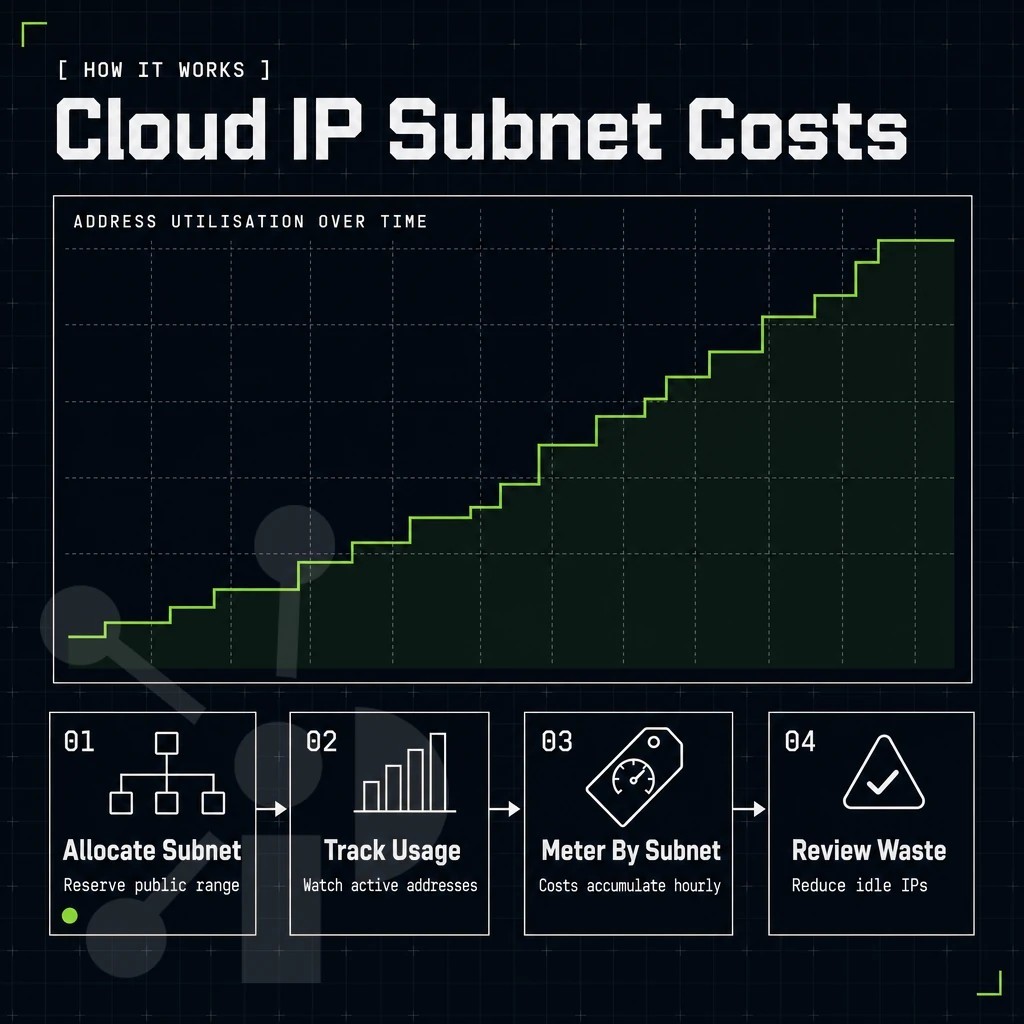
As a metered utility, cloud platforms charge for public IPv4 addresses. Initially, the costs per hour appear to be small, but quickly add up when scaled. Understanding the charges for each provider helps users to accurately model their total infrastructure costs.
Per-hour rates across major providers
The cost of a public IPv4 address is $0.005/hour, effective February 2024. This charge applies to every public IP address, whether or not it is attached to an instance and whether or not the instance is running. Google Cloud charges $0.005/hour for ephemeral external IPs.
Google Cloud's pricing model mirrors the industry trend of treating IPv4 addresses as a metered resource rather than a bundled service component. Organizations using elastic IP addressing models should account for these hourly charges in their infrastructure planning, as the metered approach applies uniformly across allocation types.
A single dynamic IPv4 address on Microsoft Azure costs $0.004/hour, whilst static IP addresses are priced at $0.0036/hour. IP addresses are available on a subscription basis from OVHcloud, with new IPv4 addresses priced at $2/month (previously available on a first come first served basis). The distinction between dynamic and static allocation types reflects how the address is bound to the resource over time. Azure also offers elastic IP functionality, allowing addresses to remain associated with a subscription rather than a specific virtual machine instance.
| Provider | Public IPv4 rate | Billing model | Notes |
|---|---|---|---|
| AWS | $0.005/hour | Per IP, per hour | Applies whether attached or idle; elastic IP billed at the same rate |
| Google Cloud | $0.005/hour | Per IP, per hour | Ephemeral external IPs on running instances |
| Azure (dynamic) | $0.004/hour | Per IP, per hour | Microsoft charges $0.012 per IP/hour for additional IPs on a load balancer |
| Azure (static) | $0.0036/hour | Per IP, per hour | Static reservation on a virtual machine or service |
| OVHcloud | $2/month | Subscription | Applied to new IPv4 allocations |
How costs scale with a load balancer and large fleets
First calculate the simple annualized value for 100 servers with one public IP each. The load balancer with several additional public IPs on Azure will increase the per-IP surcharge of $0.012/hour by several orders of magnitude.
The figures above for IP addresses only refer to the addresses themselves and do not take into account data transfer, compute, or storage. Organizations with large numbers of IP addresses should regularly audit their IP data to track unused addresses, which continue to generate charges for idle allocations until released.
SSL certificates and the public IP address cost
Cloud platforms such as Amazon, Microsoft, Google, Rackspace etc.
Buying or leasing a /24 through a Prefixx broker removes the per hour metering and allows you to own the address space.
Secondary market IPv4 prices: what a block costs to buy
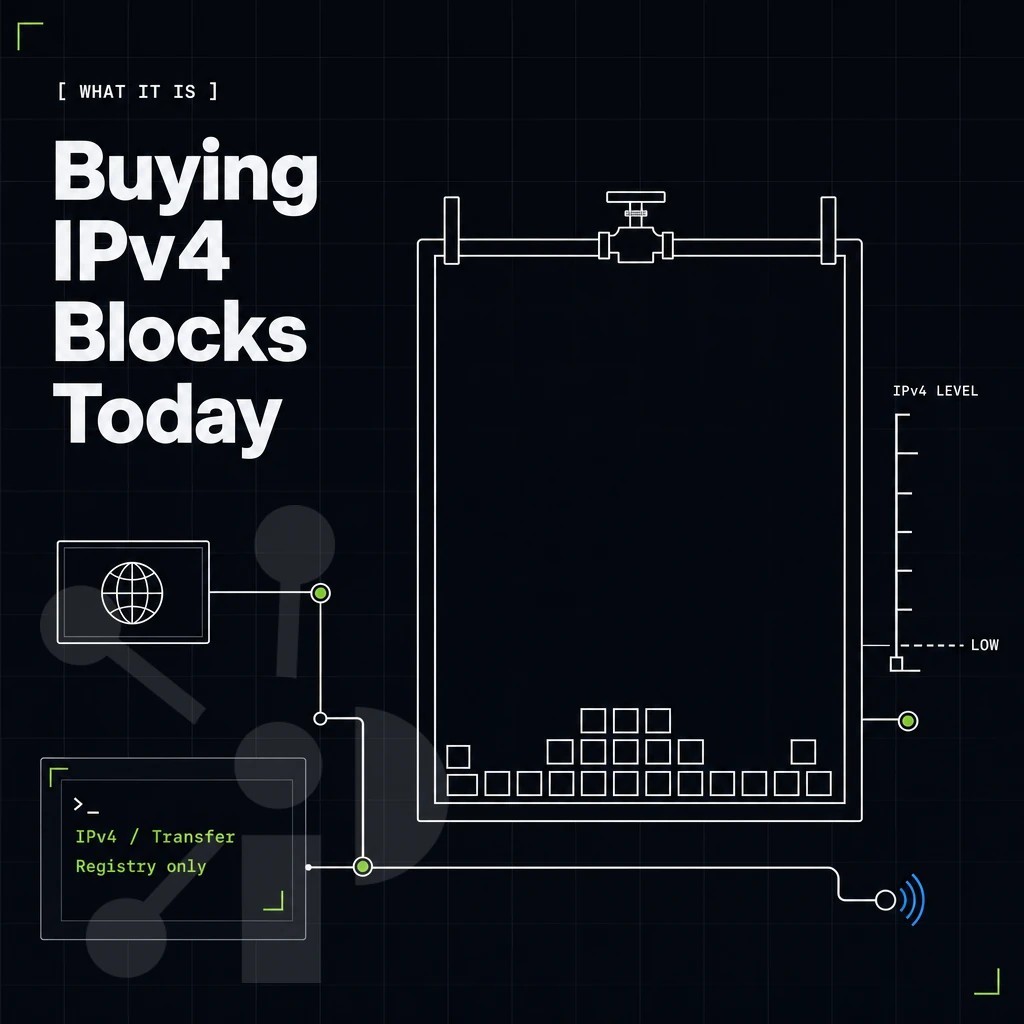
The price for IPv4 addresses on the secondary market is determined by supply and demand and the characteristics of a block of numbers. Knowing how prices for numbers are determined will help buyers of numbers plan their budget and help sellers of numbers plan and list their numbers for sale.
Brokers work with both sellers and prospective clients to establish fair valuations based on these supply-and-demand dynamics. Brokers facilitate transactions between sellers and companies seeking to acquire address space that meets their technical and budgetary requirements.
Understand what sets the per-ip address price
-
Identify the RIR region of the block.
Registry region is the single biggest price driver.
-
Factor in block size.
Large blocks carry a lower per-IP rate but a higher total outlay in US dollars. A /24 subnet (256 addresses) and a /20 subnet (4,096 addresses) are priced differently per IP. Buyers who need scale often find the per-IP discount on a larger subnet attractive, but the capital commitment rises sharply. Smaller blocks, including a single /24 subnet, tend to attract a higher per-IP price because demand for them is broad and supply is finite. Companies evaluating acquisition strategies must weigh the trade-off between per-address efficiency and the upfront financial commitment required for larger allocations.
-
Check block history and routing hygiene.
A subnet with a clean abuse record commands more than one with a troubled history. Organizations that refer to reputation data before bidding avoid overpaying for assets that need remediation work after transfer.
Estimate your total acquisition cost
-
Apply the current market range.
In 2026, per-IP prices on the secondary market range between roughly $11 and $32, depending on the factors above. A /24 subnet under ARIN sits toward the upper end; a comparable subnet under LACNIC or AFRINIC typically sits lower. Neither figure is static, and no registry publishes an official price index.
-
Add transfer and administrative costs.
RIR transfer fees, escrow fees, and broker commissions all affect the final number. At Prefixx, buyers pay zero broker fees. Budget for the full cost of the transaction, not just the per-IP rate. Sellers should confirm whether the broker will deduct commissions before or after the registry post-approval stage to avoid surprises at closing. Understanding each fee component in advance streamlines the transfer process and prevents unexpected delays during final settlement.
-
Configure your budget for long term ownership
Owning a block is a long-term capital decision. Annual RIR membership fees and ongoing routing maintenance are recurring costs. For buyers who need addresses for a defined period rather than permanently, leasing is worth evaluating as an alternative. For details on how leasing compares to buying, contact the Prefixx team directly.
Avoid common pricing mistakes
-
Don't treat any single data point as the market.
One instance of a block trading at a particular price does not define the market. Prices vary by week, by registry, and by block condition. Buyers who anchor to a single data point often overbid or walk away from fair deals.
-
Don't ignore the IP subnet's announcement history
A subnet that has never been announced publicly may face routing friction after transfer. Prefixx runs Tixx quality control on every block before it reaches a buyer, covering ownership, transfer eligibility, blacklists, and routing hygiene.
Note: No registry publishes real-time IPv4 prices. All market figures are secondary-market observations. Work with a registered broker for a block-specific valuation before committing capital.
Before jumping into the economics of buying versus leasing, we can establish a baseline price per block for purchase. Following that, we will compare the economics of purchasing a block versus leasing it out.
IPv4 lease pricing vs purchase pricing: which path costs less
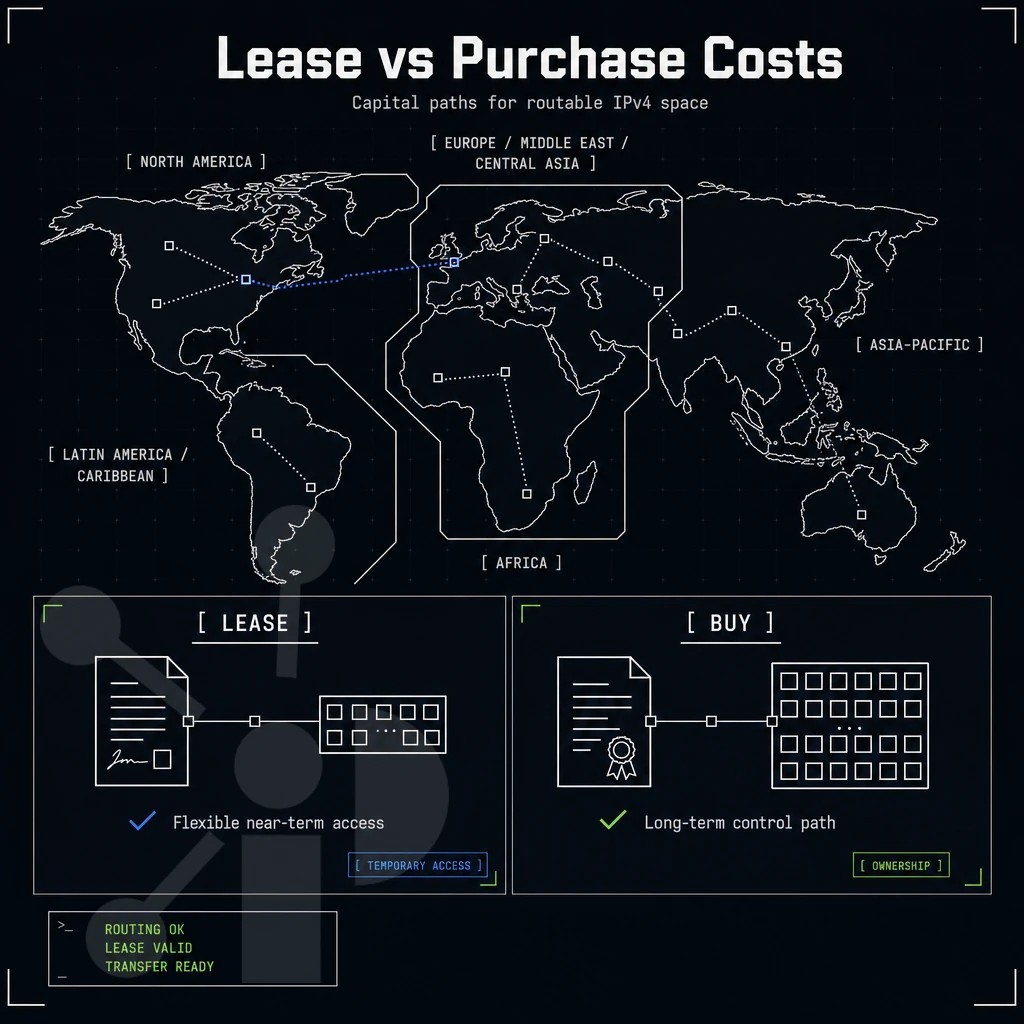
When deciding between leasing and buying IPv4 space, you are making a capital allocation decision. Both ways to get routable IP addresses have different cost structures, different time frames and different effects on your balance sheet. Knowing the break-even for both models will help you decide which way to go before you actually spend any money on either way.
The cost structure of each model
A form of payment for leasing IP addresses or blocks of IP addresses on a monthly/annual basis. As with other forms of rental, the lessee never acquires ownership and can never sell the IP addresses. The cost of the rented space adds up over time.
When you buy a block of IPv4 addresses , you pay a high upfront cost. After the RIR transfer completes, the newly acquired block of IPv4 addresses becomes an asset for your organization, something that can hold value on your balance sheet.
The value of IPv4 space has been rising rapidly since the free pools of addresses were depleted between 2011 and 2020.
The example of cloud providers such as Google is for the retail end. Here, Google charges per external IP address per hour for idle instances. These costs add up quickly. The leases for broker-sourced dedicated blocks are set up differently, but the compounding principle is the same.
Break-even logic
Based on current market prices, renting a /24 can cost more over the period of 3 to 5 years than buying the same amount of space outright. Here’s a table summarizing the main decision factors.
| Factor | Lease | Buy |
|---|---|---|
| Upfront capital | Low | High |
| Ongoing cost | Recurring subscription | None after transfer |
| Ownership / resale | No | Yes, appreciating asset |
| RIR transfer timeline | Not required | Weeks to months |
| Deployment speed | Within 24 hours | Post-transfer only |
By leasing, rather than buying and then transferring a RIR, your capital is conserved and all the delay associated with RIR transfer is completely eliminated. That agility to do short term projects, seasonal traffic peaks, testing of BYOIP, is worth a premium in the long term.
Which use case fits which model
Suits long-term infrastructure buy where the block will be used for years to come and the user wants to have IP resources as a balance-sheet asset. Clients with multi-year plans for dedicated server resources consistently find that owning servers (suits) reduces their total cost of ownership over the long term.
A lease gives you routable space without locking you into a purchased block while your traffic profile changes on a quarterly basis.
Prefixx's lease offering includes guaranteed non-revocation, RPKI, LOA, reverse DNS, and full white-glove service, provisioned within 24 hours. For a side-by-side comparison, see the lease vs buy page.
Regardless of whether you decide to lease or buy a property, the characteristics of the block on which the property is situated will determine the price. The following section will outline the various variables which affect the final price.
What drives the final price of an IPv4 block
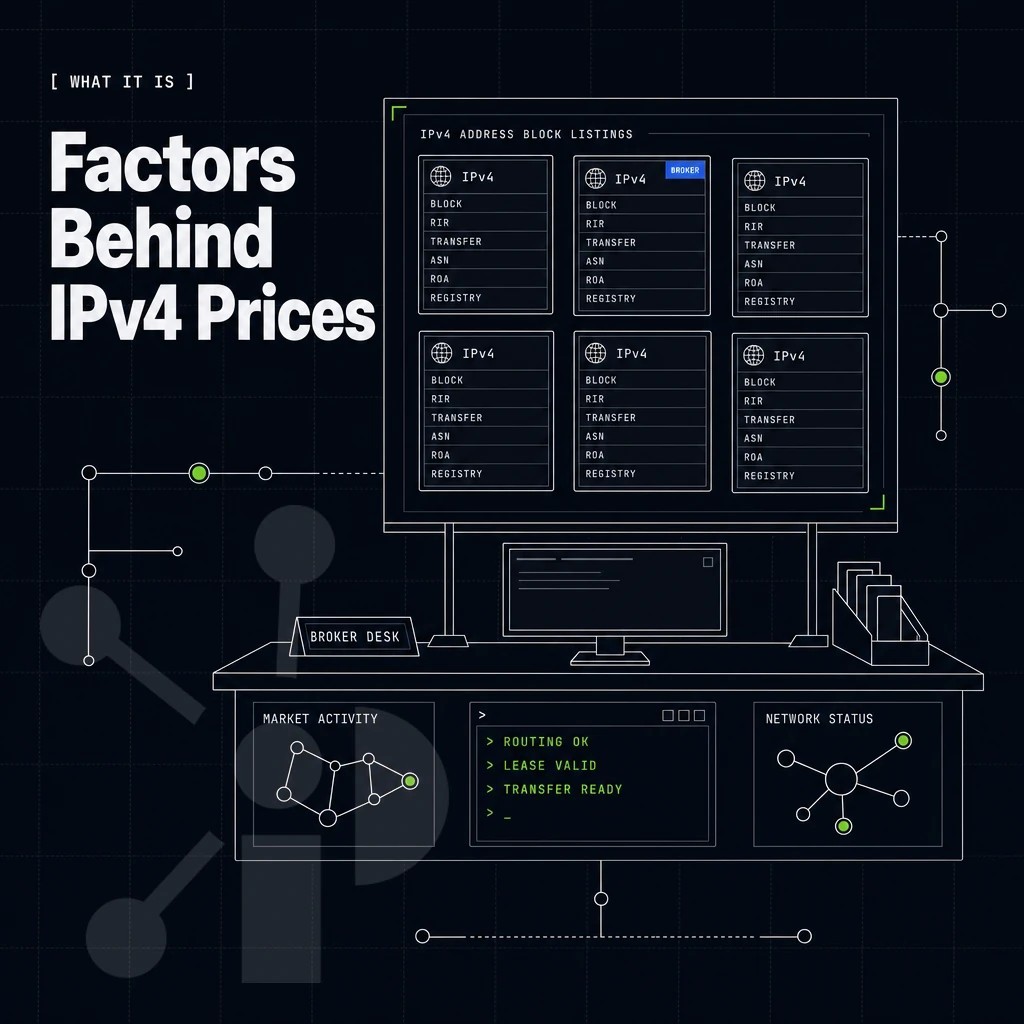
Each block of IP addresses is different, with factors such as the size of the block, the regional registry that allocated the block, the routing history of the block.
The eligibility of the current holder to transfer the block also affects the final price. To have a realistic take on the market, both buyers and sellers of IPv4 addresses must understand all of these factors.
Size, region, and routing reputation
As the size of the block of IP addresses increases, the per-IP rate tends to decrease. A /24 is going to command a higher per-IP rate than a /20 or /16 for example. A /24 is easier to absorb into an existing static IP plan and there is more competition for this block from companies that cannot fully utilize a /20, /16, etc.
RIR region moves the number significantly. For the same amount of space a /24 allocated by ARIN could trade at a different rate than an identically sized block of space allocated by the RIPE NCC. These numbers are never published anywhere official, which is why we rely on prevailing market intelligence.
A block consistently announced from a stable ASN with clean IRRs and RPKI ROAs is highly valued by immediate announcement buyers, those that don't want to spend time on remediation.
Block history and transfer eligibility
When IP assets have history, they can lose significant value. The block with active blacklists, spam/fraud blocklists, and outstanding abuse complaints tied to the address is worth less, as the buyer will have to remediate.
Transfer eligibility for remaining resources (e.g. legacy resources, resources held by organizations that are no longer meeting RIR needs-assessment requirements, “disputed holding” resources) can also be deal breakers.
How tixx protects price integrity
Tixx by Prefixx runs pre-sale quality control for every block that Prefixx brokers. Each block receives a health report and a transfer readiness score.
A clean score supports a stronger asking price. Sellers can go to market with a verified Tixx report and avoid buyer objections and last-minute renegotiations.
Timing and urgency for south america
Demand cycles affect prices of data center space across the whole market. In periods of high demand, during infrastructure build-out or the growth of a cloud BYOIP program, for example, available space compresses and asking prices rise. A buyer who needs space quickly has poor negotiating position and will pay a premium to close.
Same variables apply to get addresses from a hosting provider versus buying from the secondary market directly. This will get covered in the next section, where we outline how dedicated servers and colocation providers charge for their IP addresses.
IP subnet pricing for dedicated servers and colocation
Instead of charging by the hour, dedicated and colocation services charge on a monthly basis for each IP (or block of IPs) required. And the costs have increased recently as services providers are now having to purchase secondary market IPv4 addresses in order to provide services to new customers.
What providers charge today
This is charged on a monthly basis for dedicated servers of 1.70 for a primary IPv4 address. Additional single IP addresses are charged with a one-off setup fee of 4.90. OVHcloud for example now charges $2/month per IP for new subscriptions and there is no setup fee any more.
The setup fees for Voxility vary depending on the block size for single IP addresses, and range from $115 to $13,800. There is no ongoing monthly rate charged for these single IP addresses.
| Provider type | Monthly fee | Setup fee | Billing model |
|---|---|---|---|
| Hetzner (dedicated) | $1.70 / IP | $4.90 per additional IP | Monthly subscription |
| OVHcloud (dedicated) | $2.00 / IP | None (new subscriptions) | Monthly subscription |
| Voxility (colocation) | Varies | $115 to $13,800 by block size | One-time + usage |
Why prices keep rising
By 2011 all free address space pools were exhausted, so address space must now be purchased on the secondary market or leased before a public IP address can be assigned to a server.
The cost of this address space is then passed on by the provider, in some cases as a separate line item, charged on a per hour, or per month basis. In other cases it is included in the base price of the server and so is not apparent in the per IP cost.
As mentioned earlier, block size greatly affects unit cost. Therefore, a /24 purchase will cost more per IP address than a /16 purchase for example. Smaller providers of IP addresses will have to pay more per IP address, and then have to charge more per IP address on their servers to recoup the expense.
BYOIP as a cost-avoidance strategy
Many organizations have their own address space. Instead of renting out IP addresses from a provider, they can bring their own address space to the network. Platforms that support BYOIP (Bring Your Own IP) can charge per IP address without any additional surcharges per IP address. For example, Netrouting bare metal servers support BYOIP natively and therefore do not have any per IP surcharges.
Prefixx will prepare all of the routing documents needed for the deployment of your block. We will complete the paperwork to announce your block correctly from the onset. If required to acquire space before deploying your block of IP, Prefixx can source, verify and transfer the space before your deployment commences.
By moving a block from one registry region to another, BYOIP deployment can follow your infrastructure footprint. This process, and how moving between registry regions impacts price, is covered in the next section.
Inter-rir transfers and how registry region affects IP pricing
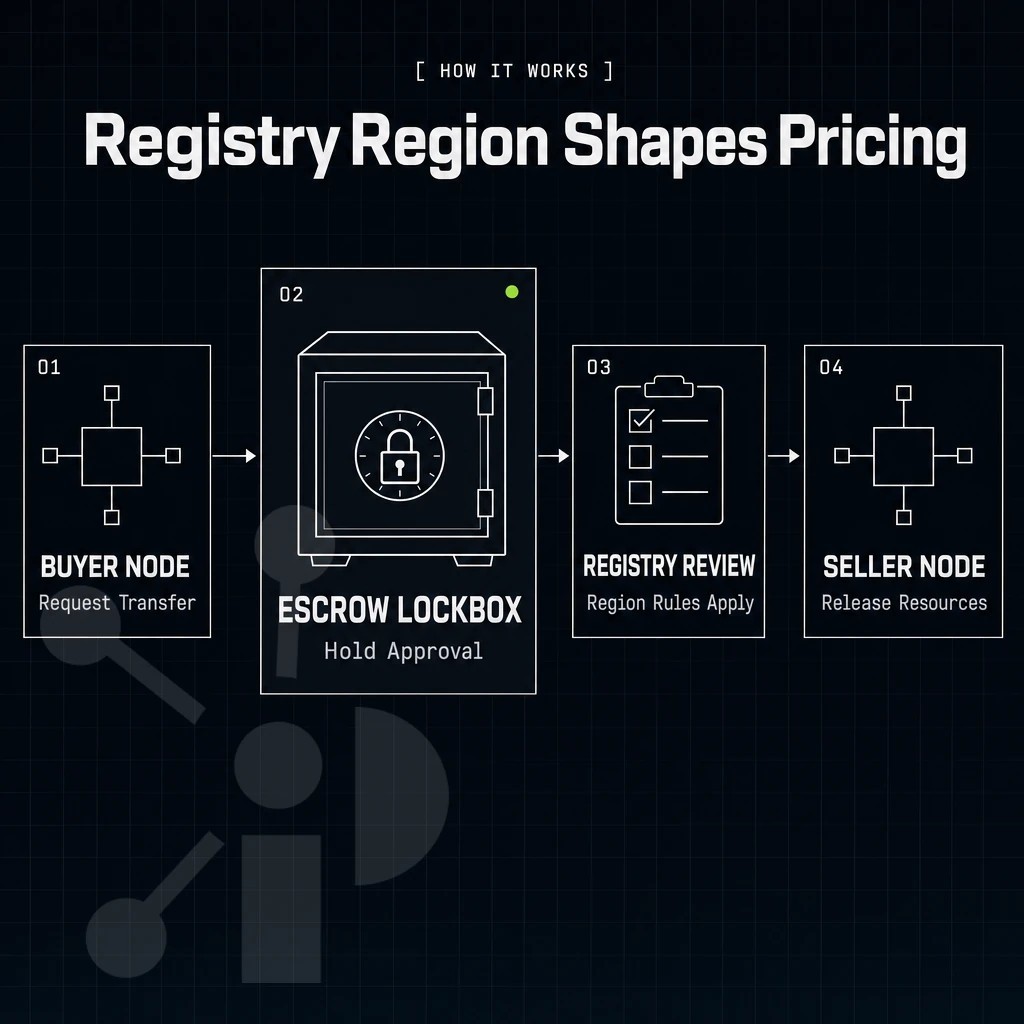
When transferring IP resources between regional registries (inter-RIR transfer) the decision of transferring the resources has significant effects on both the acquisition process and the final price for the transferred resources. Understanding the factors influencing the inter-RIR transfer decision will help to avoid adverse effects on budget and time when purchasing resources.
Why organisations transfer blocks across registries
A North American operator will typically want ARIN-registered resources because that's what upstreams and peers expect. A European carrier will want RIPE NCC-allocated resources for the same reasons.
Some jurisdictions require locally administered resources to meet regulations. If the end user is based in Europe, for example, purchasing RIPE NCC space prior to transfer avoids re-registration of the resources post transfer, keeping the process clean.
Blocks registered through an ARIN account command a premium in North American markets, while RIPE NCC space fetches higher prices in European markets. An IP address registered under the wrong registry for your region creates friction for local operators and sits at a discount.
Which registry pairs support direct transfers
AFRINIC participates in no inter-RIR transfer agreements.
Prefixx also handles LACNIC transfers for companies with operations in South America. Global transactions are coordinated to perform each part of the transfer independently and keep on time.
Note: Registry fees and processing windows differ across RIRs. Factor both into your total acquisition price before signing a purchase agreement.Routing paperwork and transfer execution
- We confirm eligibility to transfer resources at both registries. Each RIR has its own “needs policy” and transfer requirements. We check that the source resources are transfer-eligible and that the recipient organization meets the requirements to receive resources at the destination RIR before we do any transfer.
- The LOA, RPKI ROA and IRR route objects for the new destination need to be prepared. The Routing documentation has to be correct from the start for the destination registry. Our team of experts prepares the necessary documents, i.e. the Letter of Authorization, the RPKI ROA and the IRR route objects, for every transfer that we manage. If there are any gaps in the documentation, there could be announcement failures that are hard to fix.
- Processing your submissions and keeping track of progress. As mentioned, processing times vary so we will keep you updated with all developments. Payment of registry fees for the necessary searches, etc forms part of the overall costs of your proposed acquisition.
- Verify routing hygiene after transfer. After transfer is completed, verify validity of RPKI data, correct IRR data and correct BGP information for the transferred networks through our portal. Update of reputation and geolocation information for the transferred networks is made for new Registry of Record.
For a full breakdown of the inter-RIR transfer process, see our inter-RIR transfer page.
In the next section we're going to follow the secondary market prices for domains since the first free pool of domains was exhausted in 2011.
IP pricing trends: how the market has moved since 2011
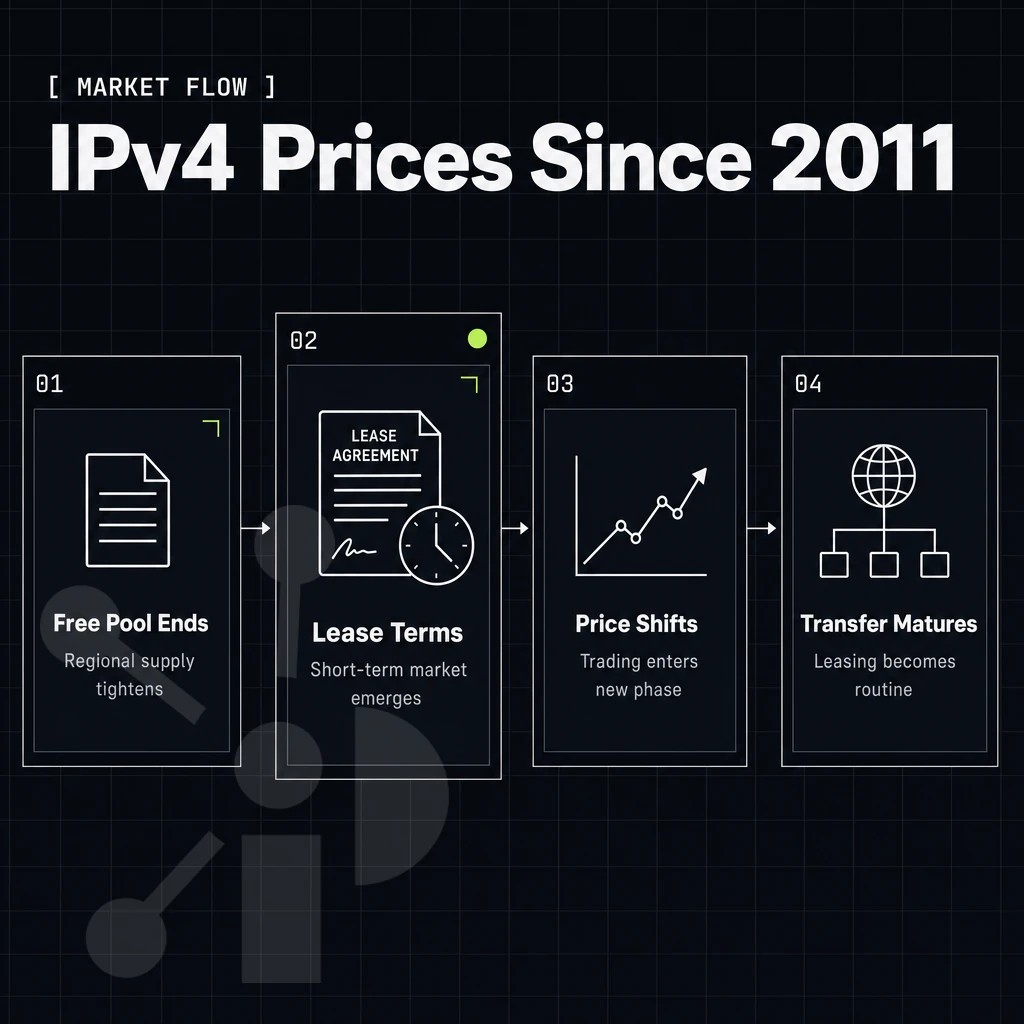
In the years since APNIC used up all of the free IPv4 addresses in 2011, the market for IPv4 addresses has gone through three phases of development: scarcity shock, price discovery as more money entered the space, and a cautious plateau. By examining each of these stages in turn, it is possible to address the current state of the market and develop an understanding of what is likely to happen next.
The exhaustion timeline and its price effect
First to run out was APNIC in 2011, followed by LACNIC in 2014, ARIN in 2015 and RIPE NCC in 2019. Each of these depletion events pushed more buyers into the secondary transfer market, the only remaining pool of assigned IPv4 address space. This resulted in concentrated demand being placed upon a fixed supply, a factor that account for prices steadily increasing throughout the mid-2010s.
By the early 2020s a clean /24 was changing hands at a clear premium to what the same block cost a decade earlier. There was genuine scarcity in the market and companies who had earlier delayed purchasing found that they were now part of a smaller group of buyers competing for the same number of available IP address blocks.
Where prices stand now
The 2026 range of $11 to $32 per IP has softened slightly from the 2025 high. The price per IP decreases with block size. IP addresses in the ARIN region (US) have historically commanded a $1 to $5/month premium over their RIPE NCC region counterparts in Europe.
Consequently, in most cases where production traffic is being moved to new servers, IPv4 is still being used by the ISPs and enterprises.
Macro forces keeping demand elevated
Public IPv4 addresses are becoming charged by cloud providers either on a subscription basis or on an hourly basis for every public IPv4 address which is allocated to virtual machines. Charges for public IPv4 addresses have been introduced by Azure, and in the last year have been increased by AWS and Google Cloud. It appears even the hyperscalers are feeling the pain of maintaining large address spaces.
Companies building out infrastructure have a simple decision tree. Leasing/buying a /16 to own outright (even taking into account the ongoing costs of holding the space) will often prove cheaper over time than paying per-IP in the cloud at scale. Additionally, Thus demand for owned space will remain strong in the long term.
We monitor the 'energy market' on a daily basis. Additionally, the price for every block of energy sold to a buyer has gone through Tixx quality check (i.e. ownership check, black list check. Routing check) and therefore corresponds to the actual amount of usable internet addresses that block contains, acting like a load balancer between what seems good on the surface and what's hiding problems underneath.
Armed with this overview of today's market, we can now address the most pertinent question: deal-make or not deal-make alone? The following section outlines the roles of a registered broker and offers public IP insight into why they serve as such a critical load balancer when facilitating deals of this complexity and size.
Why work with an IPv4 broker rather than buying direct
There is no central exchange for the IPv4 secondary market. IPv4 addresses are offered for sale on various forums and by brokers via their websites. Typically, sellers promote their offered IP addresses via direct contact with potential buyers. In order to purchase IP addresses offered directly by the owners, buyers have to take on a great deal of risk.
IP address resources offered for sale can contain blacklisted IPs, fail to qualify for transfer at the relevant RIR, or contain routing objects that cause problems in deployment. IP brokers take on this risk on behalf of buyers.
We check every block for Tixx quality control before it is sold to any buyers. All blocks go through ownership check, RIR transfer eligibility check, blacklist check across 12 DNSBLs and routing check. If a block fails any of the checks above, it will not hit the market.
All transactions are done through escrow, so both parties do not release any funds or assets until the transfer is complete. Prefixx is a registered broker with ARIN, RIPE NCC and APNIC, with LACNIC facilitated, so we handle all the necessary paperwork involved in transferring public IP resources that your team would otherwise have to manage.
- Zero buyer fees! Our 3 to 8% commission is paid by the seller only, ‘no win no fee’!
- Tixx QC verified on every block of ownership, blacklists, routing hygiene, and RIR standing before sale.
- In an escrow-secured transaction, both parties are fully covered throughout the transfer process.
- All leases receive white-glove service: geolocation correction, reverse DNS setup, reputation monitoring, and abuse complaint processing, and more.
- We have prepared LOA, RPKI ROA and IRR objects for BYOIP deployment on any supported platform by our team.
- Senior consultants assigned to each deal. With over 10 years of experience in the data center and networking industry, our team of experts is ready to assist you.
Whether you are looking to buy IPv4 addresses, sell a block, or explore a lease, our consultants can walk you through live market conditions and what to expect at each stage. See our IPv4 pricing page for context on how IP address values are calculated based on region, size and demand, then reach out to discuss your specific requirements.
Key takeaways: understanding IP pricing across every market
IP pricing spans three distinct markets, and each one works differently. Cloud providers charge per hour for every public IP address attached to a running instance, making large fleets expensive at scale. Hosting providers bundle addresses into monthly plans. The secondary transfer market sets prices based on RIR region, block size, reputation history. Additionally, Transfer eligibility, with existing market rates ranging roughly from $11 to $32 per IP address across ARIN, RIPE NCC, and APNIC.
The right path depends on your time horizon. Leasing preserves capital and gets IPv4 addresses provisioned fast. Buying builds a long-term asset whose value holds as scarcity continues. Either way, block quality and clean routing history move the final price significantly. Speak with Prefixx to get a present market quote on the IP resources that fit your deployment, with no buyer fees and Tixx quality control on every block.
Next steps: getting an accurate IPv4 price for your block
IPv4 IP pricing is not published on any official exchange. There is no central registry where buyers can look up a final price
Frequently asked questions
What is the cost of using an IP address within an IP subnet?
The fee depends on how you acquire the address. Cloud providers like AWS and Azure now charge a recurring fee per public IPv4 address, even when idle. Leasing a block from a broker gives you a predictable monthly charge without a large upfront purchase. Buying outright eliminates ongoing per-address fees but requires capital and transfer costs at acquisition.
What is the price of an IP address subnet block in 2026?
Market prices for IPv4 addresses vary by RIR region, block size, and reputation history. ARIN-region address blocks and RIPE NCC-region address blocks can trade at noticeably different rates in the same month, and no official price list exists anywhere. Prices have risen steadily since the free pools emptied between 2011 and 2020. For active market rates, the right move is to request a personalized offer from a registered broker.
How much does an IP subnet block of IPv4 cost to buy?
The total expenditure of buying a block includes the per-address market price, any broker commission, and the RIR's transfer fee. At Prefixx, buyers pay zero broker fees, commission is seller-only, ranging from 3 to 8% of the sale price. Block size, RIR region, and the block's reputation and routing history all move the final number.
Is it worth paying for a dedicated IP subnet address?
Shared IPs carry reputation risk from other users' traffic, which can trigger blacklistings that affect email delivery, API access, and ad network eligibility. A dedicated block gives you full control over routing, reverse DNS, and reputation.
Why did AWS and Azure begin charging for each public IP address they provide?
With all 4.3 billion addresses allocated and secondary-market prices rising, the tariff of acquiring and holding address space became significant for cloud operators. Charging per address also nudges customers toward IPv6 adoption. The fees apply to every public IPv4 address on your account, including Elastic IPs on AWS and public IPs on Azure, whether attached to a resource or sitting idle.
What is the difference between leasing and buying an IPv4 block?
Buying transfers full ownership of the block to you via an RIR-recorded transaction. Leasing gives you usage rights for a defined term without ownership changing hands. Buying suits organizations with a long-term, stable address requirement and the capital to invest upfront. Leasing is better for variable demand, faster provisioning needs, or when capital preservation matters. Prefixx leases include a non-revocation guarantee, RPKI, LOA, and white-glove routing support, with provisioning within 24 hours.
How does block size affect the per-ip price?
Larger blocks generally trade at a lower per-address price than smaller ones. A /24 (256 addresses) commands a premium because it is the minimum routable unit and the most liquid size on the market. Blocks of /20 and larger benefit from volume discounts, but the pool of qualified buyers is smaller, which can affect time-to-close.
It shifts with registry region, block size, reputation history, and whether you are buying outright or leasing. Cloud platforms charge per IP, per hour, whether the address is in use or idle, and those costs compound fast at scale. The secondary market trades at prices set by supply and demand, with ARIN and RIPE NCC blocks often diverging in the same month.
The decision between buying and leasing comes down to time horizon and capital. Short-term or uncertain demand favors a lease. Long-term infrastructure with predictable growth favors ownership.
If you are working through that decision now, Prefixx can walk you through going market rates, available blocks, and whether a lease or purchase fits your actual use case. Reach out and get a personalized offer.
Contact us to discuss your IPv4 needs today
No hidden fees, free consult. A broker replies within one business day.