
Every network engineer eventually searches for an IPv4 address pricing guide. The IPv4 address space trades on the secondary market like a private club, where the price for any IP block depends on various factors, including block size.
The RIR where the IP addresses are registered, the IP addresses’ routing history, and current demand.
This article explains the hidden variables that affect IPv4 pricing, provides guidance on what seems to be a fair price for a particular block size and in a particular region.
It also reveals the hidden costs and prices that must be factored into total cost of ownership when leasing versus buying IPv4 addresses on the Open Market. It covers all five regions, ARIN, RIPE NCC, APNIC, LACNIC, and AFRINIC, and explains the factors that influence the price of IPv4 addresses.
It also discusses the total cost of leasing versus buying IPv4 addresses and provides guidance on what to look for when evaluating bids for the purchase of IPv4 addresses.
The upshot is that by reading this article you will have a clear framework for evaluating any quote for the purchase of IPv4 addresses, which remain in high demand, regardless of subnet size, whether it's a small /24 for a single datacenter or a large /20 for a regional rollout. For example, a /22 block suitable for a mid-sized hosting operation would fall between those two extremes in both cost and complexity.
What an IPv4 address price list and waiting list actually shows you
People searching for an IP address price list expect to find a neat table of prices. What they often find instead is a fractured secondary market without an official prices feed, exchange or regulator that sets rates. We explain why this market gap exists in order to provide assistance to help people understand the current market.
Internet protocol version 4 and the limited supply problem
As there are only about 4.3 billion possible IPv4 addresses (every one of them allocated), the five RIRs (ARIN, RIPE NCC, APNIC, LACNIC, and AFRINIC) have been exhaustining their free pools of addresses over the last decade or so (2011-2020). There are no more free IP addresses from the registries. All the current in use IP address blocks were assigned years ago.
The structural scarcity of IP addresses versus growing demand creates a secondary market for trading IP address blocks, commonly through brokers in a peer-to-peer environment. There is no central authority to publish past prices for /24s for example, for trading on the secondary market. For more context, see IPv4 address exhaustion.
IPv4 addresses: three ways to access them
When approaching the new market, customers and businesses will have three different choices, all with different cost structures and rights. Buyers who are interested in acquiring address space should understand these options before committing to any particular approach.
- Buy: Permanent ownership via an RIR-recorded transfer. Businesses pay once and hold the block indefinitely.
- Lease: Flexible access without ownership. Companies pay periodically and return the block when done.
- Cloud rental: Services like AWS Elastic IP or Azure public IP charge per hour or per month for a single address attached to an instance.
Why no single list covers all IPv4 addresses
Prices vary by registry, by block size, and by the reputation of past use. A /24 in ARIN space may trade at a different number per month than an identical /24 in other RIRs. These numbers are never published anywhere.
Prefixx brokers all blocks across all five registries and sees the gaps firsthand. What we quote is based on current market conditions, not a static list.
Why the asia pacific region changes what you pay
The region of the target block of IP addresses is decisive for the starting price before negotiation. Supply, demand, and registry policy vary greatly across registries, and no official price list exists for any of them.
Understanding regional limited supply and demand
- Matching a block to its corresponding registry is fundamental to understanding IP address transfer. Every address block is registered under one of the five Regional Internet Registries (RIRs): ARIN (for North America), RIPE NCC (for Europe. The Middle East and parts of Central Asia), APNIC (for Asia-Pacific), LACNIC (for Latin America and the Caribbean), and AFRINIC (for Africa). The RIR of a block determines the rules for a transfer and also defines the pool of potential buyers.
- Recognize that prices for space of the same size can vary by registry (e.g. a /24 under ARIN may trade at a different price than an identical /24 under RIPE NCC in the same month). The numbers for these are not published anywhere. Space from the RIPE NCC (which serves European countries) tends to command higher prices than ARIN space, since much of the cloud and services infrastructure in Europe is deployed using space from the RIPE NCC.
- This factor is important to consider in the Asia-Pacific region given the long-term demand from growth markets. APNIC used up its free pool of IP addresses early, and secondary market supply has remained constrained since then.
Navigating transfer processes and added complexity
- Intra-RIR moves are essentially the same as transfers within a single registry. Inter-RIR moves (i.e. moves of blocks of numbers between registries) are more complex in terms of process, eligibility, and time frame and therefore cost more.
- Check for LACNIC and AFRINIC restrictions on outbound transfer of IP address space. Additional conditions apply. Allocate time for these cases as well.
Buyers sometimes assume one global market with one price.
What big companies and cloud providers charge to rent an IP
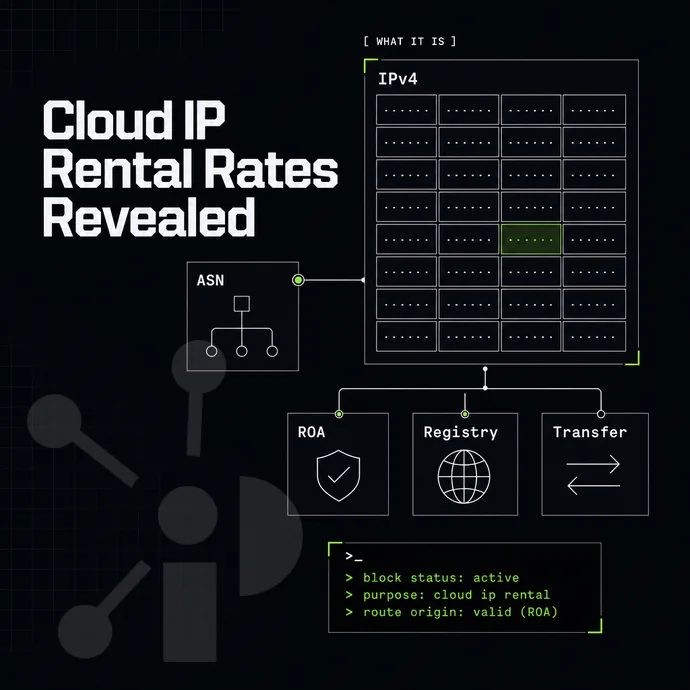
Rather, they pass on the cost to customers in the form of per-IP rental charges that multiply across all instances, regions and services. When comparing the cost of native IPv4 addresses provided by cloud providers to that charged by secondary market providers, the multiplier effect needs to be factored in.
How big companies price public IPv4 addresses
AWS now charges for all public IPv4 addresses in every region, for every hour that an instance is running, whether stopped or not, from January 2024.
For Internet service providers and hosting providers, upstream pressure to buy address space at high prices on the secondary market is passed on to new customers in the form of higher per-IP fees or even more restrictive allocation rules. Organizations operating at scale can find themselves paying for address space that serves millions of end users or devices, making per-IP economics a critical planning factor.
What you're actually paying for
When you rent Cloud IP you are buying usage rights.
You have no control over how the provider reprices the IP address, reassigns the IP address to another customer or even retires the IP address. You have no recourse with the RIR as the IP address is registered in the name of the cloud provider.
Secondary market as a flexible alternative over the past few years
On the secondary market, Prefixx can purchase or lease and transfer the registration to your name, or enter into a non-revocable lease agreement with you.
For Internet-facing applications, ownership of address space is typically better than a per-IP rental model for large-scale infrastructure applications. Why the secondary market for new address space? Ownership also insulates you from pricing volatility that can affect global cloud rental models as scarcity deepens.
Buy vs lease: which path costs more money over time
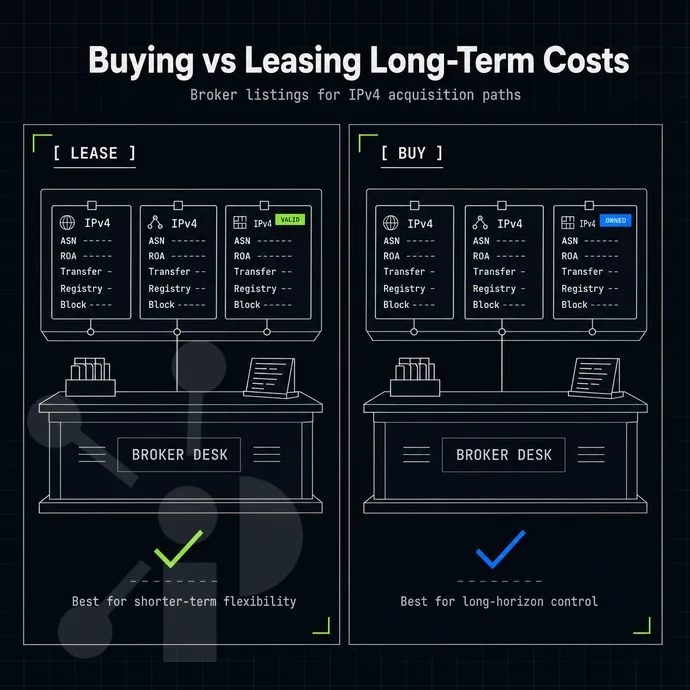
Buying and leasing IPv4 space each have their own cost profile over time. The better approach is largely a function of how long you need IP space, the prices you are willing to pay upfront, and how much capital you can commit. Organizations should expect their decision to hinge on infrastructure planning horizons and budget flexibility rather than on short-term cost alone.
Lease terms: what you pay month to month
Leasing contracts are another way to own Etherum contracts instead of the normal buying. Instead of paying full contract prices upfront in one chunk, you pay monthly installments and thus keep your capital for other projects. Even though there is a separate market for leasing and buying, the prices of leased contracts roughly follow the prices of normally bought contracts. As the price of a block increases, so does the rate for leasing a contract.
Leasing is suitable for new services, short-term scale-up needs and test scenarios. If your needs cease to exist within 12 months, a lease will cost you less in the long run than buying and then reselling on used equipment. Organizations that expect to sell or reassign the addresses before that breakeven point should carefully weigh the transaction costs of acquisition and disposal.
Buying smaller blocks as the long term solution
Buying a /24 of IPv4 addresses requires an initial investment. The price of IPv4 on the market has risen steadily since the last of the free pools of addresses closed. Prices have been particularly volatile in the first half of each calendar year as enterprises finalize their infrastructure budgets.
The price for a /24 (256 addresses) can vary greatly depending on the RIR where the block is held, the history of the block and current market conditions. That money represents an asset that can be sold later for even higher costs, used to hedge against future price rises or used indefinitely. Understanding the average price for blocks in your target registry helps establish whether a quoted figure reflects current market conditions or represents an outlier.
Buying is the long term solution when your address need is stable and multi-year. Typically you will break even with a leasing scenario within a few years, and after that you only pay for the years you own the property at current prices, plus RIR on any outstanding bond amount. Organizations planning infrastructure that will remain in production for years typically find ownership the more economical long term approach.
Which path costs more money over time
From an early-exit perspective, buying is more expensive. This table outlines the key differences between leasing and buying.
| Dimension | Buy | Lease |
|---|---|---|
| Capital required | High at closing | Spread over term |
| Ownership | Full, permanent | Usage rights only |
| Resale value | Yes, prices permitting | None |
| Best horizon | 3+ years | Under 2 years |
Prefixx supports both paths. See our lease vs buy guide and IPv4 pricing for a deeper breakdown before you decide. Whichever path you choose, the price you ultimately pay is shaped by a set of block-level and market-level variables worth understanding before you receive a quote. Understanding how sale prices are structured across different block sizes helps you interpret whether a quote reflects typical market conditions or an outlier.
Why choose Prefixx for IPv4 buying, selling and leasing
Prefixx is a boutique IPv4 brokerage, not a self-serve marketplace. We broker the buying, selling and leasing of IPv4 addresses with a senior consultant on every deal. In a market where IP address prices shift by IP registry region, IP prefix size and reputation history, that human-in-the-loop approach matters.
- Zero buyer fees. We charge sellers only, at a 3 to 8% commission. No win, no fee.
- Tixx quality control on every block. Ownership, blacklists, routing hygiene and RIR standing are verified before any IPv4 address reaches a buyer.
- Escrow-secured transactions. Funds and IP resources transfer simultaneously, protecting both sides.
- White-glove service included with leases. Our team handles geo-location correction, reverse DNS, reputation monitoring, blacklist scanning and abuse complaint processing. Provisioning within 24 hours, with a non-revocation guarantee.
- Registered broker with ARIN, RIPE NCC and APNIC. We handle inter-RIR transfers across all five RIRs and prepare every LOA, RPKI ROA and IRR route object on your behalf.
- BYOIP deployment support. We manage the routing paperwork so your IPv4 blocks announce cleanly, whether on bare metal or a cloud BYOIP program.
If you are buying, selling or leasing IPv4 addresses, contact our team to discuss your requirements and receive a personalized offer.
Core drivers behind today's IPv4 market prices
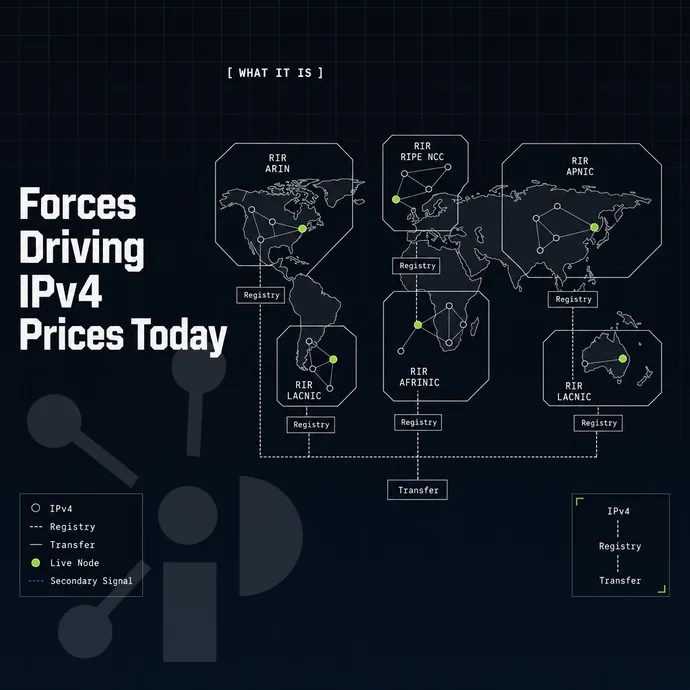
The IPv4 market today is driven by two factors: the dwindling free pools of IPv4 addresses held by the RIRs and the growing number of companies requiring IP addresses to launch new services to reach new customers. There is no official price list for IP addresses.
Prices for IPv4 addresses vary by prefix size, by address registry zone and by prior seller’s reputation history. As more businesses migrate workloads online and expand their digital infrastructure, competition for available address space continues to intensify across all registry zones.
Larger blocks are more expensive in total but less expensive on a per IP basis than smaller blocks. The time and cost to transfer IPv4 addresses to a buyer also vary. In addition to the cost of the IP addresses themselves, registry fees are charged for IPv4 address transfers. The total number of addresses in a block directly influences both the aggregate purchase price and the per-address unit economics.
Cloud rental is a flexible alternative, but the high cost compounds fast at scale. Leasing offers a long-term solution without significant upfront investment. Whatever path fits your supply situation, the only reliable number is a personalized one. Get a current market quote at Prefixx.net/IPv4-pricing. Planning for IPv4 needs means weighing today's cost against the flexibility you may need in the future.
Frequently asked questions about internet protocol version
As many businesses face compatibility issues, what is the average IP address price?
A single IPv4 address trades as part of a block, and the rate per address shifts based on address range size, regional registry, reputation history, and current market demand. ARIN-region addresses and RIPE NCC-region addresses can trade at noticeably different rates in the same month. Blocks with clean routing records and no spam history command a premium, while those with reputational issues may require significant discounts to attract buyers.
What does buying a block size of IP addresses cost?
Block prices are set by the secondary market, not by any registry. A /24 (256 addresses) is the most commonly traded unit on the internet, and its price varies by region, routing history, and whether the block carries any blacklist history. Larger blocks such as a /20 or /16 typically cost less per address but require a bigger upfront commitment. Prefixx provides personalized offers with prices valid for 72 hours based on present market conditions, with zero buyer fees on every transaction. For example, a /24 block in RIPE may command a different per-address rate than an identical-sized block in APNIC during the same trading window.
Can I buy my own public IP address?
Yes, but you buy a block rather than a single address. The smallest practical unit on the transfer marketplace is a /24, which gives you 256 addresses. You acquire it through an RIR-registered transfer at agreed prices, after which the block is recorded in your name at the relevant registry. Prefixx handles the full transfer process for businesses, including RIR paperwork, escrow settlement, and post-transfer routing setup. Once the block is registered in your name, you hold the assets outright and can route them across your own network or colocation environment.
How IP address value has grown over the last decade
market worth is driven by scarcity. All five RIR free pools emptied between 2011 and 2020, so every IPv4 address in circulation today must be sourced from the secondary exchange, where prices reflect that scarcity. A clean, routable address in a well-regarded internet registry region commands a premium. Reputation matters too: a block with an internet blacklist history commands lower prices than an identical-sized block with a clean record, which is why businesses rely on quality control checks like Tixx before any block changes hands. Scarcity has pushed the global installed base of routable addresses into a secondary market where blocks now represent assets worth collectively in the millions.
Why do IPv4 addresses vary in price by region?
Each RIR operates its own transfer policy, fee structure, and approval timeline, and demand differs across regions. North American (ARIN) space and European (RIPE NCC) space serve different buyer pools with different compliance requirements, so supply and demand reach different equilibria. These regional differences mean that businesses operating across multiple continents must navigate distinct regulatory environments rather than a single global framework.
Policy restrictions on who can receive a transfer, and how quickly one completes, also affect what buyers are willing to pay. These policy differences shape not only immediate transaction costs but also the strategic flexibility buyers retain for future transfers or reallocation.
Is leasing IPv4 addresses cheaper than buying?
Leasing internet addresses has a lower entry cost and no capital outlay, which makes it attractive for short-term projects, traffic spikes, or teams that need addresses quickly. Buying costs more upfront but gives you a permanent asset you can later sell or transfer. For long-running infrastructure with stable demand, ownership often produces a lower total cost over time. Prefixx offers businesses both paths, with lease provisioning within 24 hours and a non-revocation guarantee on every lease. Prefixx tailors its advisory and transaction services to match the specific operational requirements and budget constraints of each client.
Why is there no official IP address price list?
The registries do not set or publish prices. IPv4 addresses trade on a private secondary trading platform where every deal is negotiated between a willing seller and a willing buyer. subnet allocation, IP allocation region, routing history, reputation, and timing all move the number, so a fixed list would be outdated before it was published. Brokers like Prefixx provide current, block-specific internet prices through personalized offers rather than a public catalog, because that is the only way to give an accurate figure.
IPv4 address pricing is never listed at a single price per IP address. Instead, the price for IPv4 addresses can vary greatly based on a number of factors including the size of the IP address block in question. The RIR in which the buying takes place, the transaction history of the businesses involved, and whether they are leasing or purchasing the IPs in question all influence the prices involved.
Thus a /24 that was recently sold by ARIN will likely trade for a different price per IP at RIPE NCC. Free space is long gone from all of the RIRs, with many even maintaining a waiting list, so the only arena left for new IPv4 address space is the secondary market for transferred IPv4 numbers.
The actual transaction prices can vary depending on factors including supply and demand as well as the specific quality of the block that surfaces during due diligence.
If you are ready to buy, sell, or lease IPv4 space, Prefixx runs Tixx quality checks on every block and handles the full transfer paperwork across ARIN, RIPE NCC, and APNIC. Request a personalized offer to get a current, block-specific figure.
Contact us to discuss your IPv4 needs today
No hidden fees, free consult. A broker replies within one business day.