
By Savvas Bout, Founder of Prefixx. Last updated 15 September 2026.
As a network engineer, you know the drill: you need more IP addresses, the free pool of your RIR has been depleted for years, and the secondary market seems like a complex maze of rules for IP address transfers, a minefield of potential problems related to your reputation, and extreme volatility in pricing.
The wrong decision here could result in your IP addresses being blacklisted, your RIR transfer being stalled, or your leased IP addresses disappearing when you need them most. The pressure is on. ARIN, RIPE NCC, and APNIC all depleted their free pools of IPv4 addresses between 2011 and 2020. All 4.3 billion IPv4 addresses have been allocated to third parties and are now privately held.
In practical terms, there are three ways to address the impending address space exhaustion: buy it, lease it, or maximize current holdings. The various options all have different price points, timelines, contractual vagaries and impacts on IP routing.
In this article, we look at each of these in turn, exploring what to look for in a 'good' address pool or block of address space, how transfer of ownership is handled by the various registries, and how a white-glove brokerage can help in situations where a company does not have dedicated IP resources to bring to the task. First, we start with the basics: what does address space exhaustion really mean?
What IPv4 scarcity actually means in 2026
There are approximately 4.3 billion IPv4 addresses in existence. All are in use. The five Regional Internet Registries (RIRs) have exhausted their free pools of IPv4 addresses between 2011 and 2020. Thus, there are no more free IPv4 addresses that any organization can go to a registry and request.
What exhaustion actually means
The fact that IPv4 address exhaustion has occurred does not mean that the internet protocol has reached the end of the road. The way that addresses are supplied to users has changed, not ceased. Unique addresses were previously supplied by registries from central pools of addresses. Today all newly issued address space is made available by another party who already holds that space as a block.
The secondary transfer market is the only legitimate market to buy and sell IP addresses. All five RIRs, ARIN, RIPE NCC, APNIC, LACNIC and AFRINIC, have transfer policies that detail how IP address space can be transferred between users. Although the RIRs record all IP address transfers, they do not originate any new IP address space.
How organisations adapted in the meantime
IP masquerading (NAT) allows a single public IP address to be used to connect hundreds or thousands of private IP addresses. While it bought some time, it is not a permanent fix for providers and services that need publicly routable IP addresses at large scales and cannot rely on dual stack deployments, such as hosting, CDNs, and VPN services.
What this means for procurement in 2026
Purchasing IP addresses has become similar to buying real estate. There are different prices per RIR region, as well as by block size, and a IP address’s reputation history. We broker a variety of vetted IP address blocks from all five RIRs, and then Tixx quality control is run on each block before it is sold to a customer. We’re interested in understanding the sustained high demand for a resource that has a fixed ceiling.
Why demand keeps rising despite a fixed supply
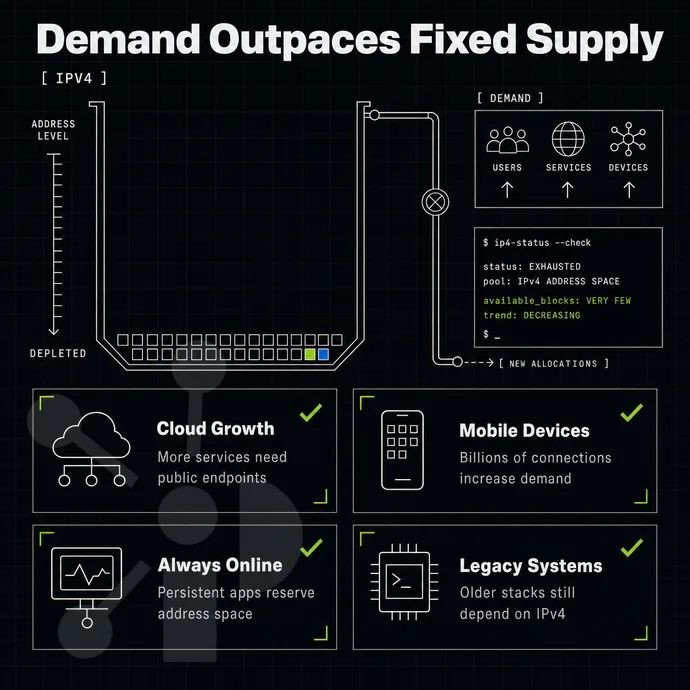
Although IPv4 address space is finite (total: 4.3 billion addresses, all of them already allocated), it is constantly under pressure due to ever-increasing demand. The pressure on IPv4 address space has not diminished and is even likely to increase. The reasons for this development can be reduced to three basic causes.
Device growth and cloud expansion
New connected device deployments such as industrial sensors and POS terminals fight for the same fixed pool of public IP addresses. Meanwhile, cloud-based infrastructure programs enormous blocks of IP addresses for load balancers, NAT gateways and geographic region-specific endpoints. As hyperscalers add new availability zones to their global footprints, large swathes of IP addresses are permanently removed from the free market.
As IoT starts to roll out, the pressure on IPv4 space increases. Managed devices often need to have a routable IPv4 address for things like management interfaces, firmware upgrades and even customer direct access. While private addressing plus CGNAT can offload a lot of this traffic from public space, it won’t offload all of it.
Why IPv6 adoption has not relieved the pressure
Yes, IPv6 adoption is happening. However, IPv4 addresses are still needed. In most networks, IPv4 and IPv6 are deployed in parallel. A large portion of the Internet is running on old enterprise infrastructure, many CDN origin servers are IPv4-only, and even APIs of third parties most often are. If you give up your IPv4 addresses you will lose connectivity to all those servers.
For the time being, new network segments will need to be assigned IPv4 addresses in addition to their IPv6 prefixes.
What this means for buyers and lessees
The structural demand against a fixed supply of IPv4 addresses translates into very high secondary market prices and a tight supply of available IP blocks. To cover immediate IPv4 connectivity needs on the primary market, companies have three alternatives: buying IP addresses on the secondary transfer market, leasing them from current holders, or re-claiming previously unused internal IP address space.
We describe all seven different ways to tackle this problem in the following section, including both demand- and supply-side approaches as well as dual stack and other deployment options. Prefixx supports all of these and also facilitates buying, leasing or re-claiming IP addresses on the secondary market via Tixx quality checking and escrowed settlements.
The seven practical solutions to IPv4 scarcity
There is no single ‘solution’ to the IPv4 scarcity problem, these seven solutions operate at different levels of your organisation and most companies use a number of them.
Demand-side techniques for a free pool
- NAT routing (NAT). A NAT gateway can multiply the address space of a private network behind a single public IP address. The solution is very efficient for outgoing traffic but does present challenges for services that require a public, reachable address for incoming traffic.
- IPv6 dual-stack deployment. IPv6 is the long-term answer to communications structuring. By enabling hosts to communicate using both IPv4 and IPv6, the use of IPv4 can gradually be reduced. The slow adoption of IPv6 is largely due to the need to update legacy hardware, software and carrier infrastructure.
- IP address reclamation. Audit your allocations and return unused IPv4 space to your RIR or release it for transfer. Many organisations hold blocks assigned years ago that are no longer routed. Note: reclaimed space must meet RIR policy requirements before it can be reallocated.
- CIDR and subnetting efficiency. Using Classless Inter-Domain Routing instead of Class-Based IP Routing means that IP address space can be allocated on an exact work load basis as opposed to oversized legacy allocations being used inefficiently across the organization. They can be replaced with far more efficient subnets of exactly the right size.
Supply-side techniques for a free pool
- Secondary Market for Buying IPv4, selling IPv4 address space on the secondary market allows an organization to sell previously unused IPv4 address space to other organizations that need them. The formal transfer of IPv4 address space in approved RIR transfers through ARIN, RIPE NCC, APNIC, and LACNIC, updates the IP address space holder in the respective RIR’s database upon completion of transfer process.
- Leasing IPv4. Leasing of IPv4 address inventory provides the holder of a lease with usage rights to a certain number of addresses within a given block of addresses, without transferring permanent ownership of those addresses. Leasing is well suited to short-term projects, to cover seasonal increases in capacity, or where an organization requires immediate use of IP address space whilst a purchase is finalized.
Network address translation NAT deployment technique
- BYOIP (Bring Your Own IP). BYOIP enables you to announce your own IP spaces (owned/leased) on cloud platforms (e.g. AWS, GCP, Azure, Cloudflare) as well as on bare-metal servers. All IP spaces announced with BYOIP are under your full control regarding IP-reputation as well as routing. You will need to prepare the respective routing-paperwork (LOA, RPKI ROA, IRR route-objects) before the actual announcement of your IP spaces.
Options five, six and seven rely on the secondary transfer market functioning. We take a look at how this actually works in practice.
How the secondary transfer market redistributes IPv4 space
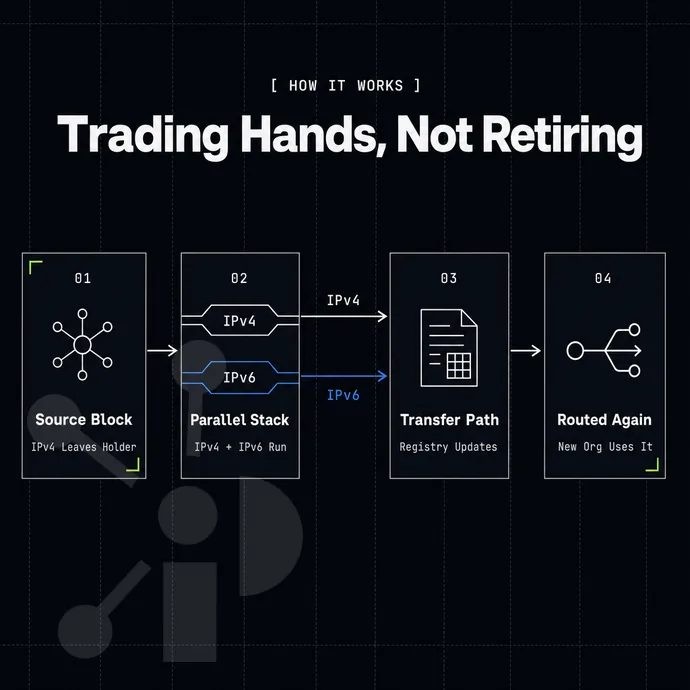
As IPv4 exhaustion depleted the free pools of IPv4 addresses held by the RIRs, the only way to redistribute IPv4 addresses to organizations still in need of them was via the secondary transfer market. Understanding how this market functions is key for any network expert evaluating options for dealing with the shortage of IPv4 addresses.
Intra-rir and inter-rir transfers
Most of the transfers are taking place within a single registry.
Inter-RIR transfers are between different registries (e.g. a transfer of a block of IP addresses from ARIN to the RIPE NCC).
The block size determines the viability of a particular path.
Opaque pricing and registry divergence
No official rate sheet exists for available IPv4 addresses. Prices are discovered through negotiation, not publication. A /24 under ARIN and an identically sized block under RIPE NCC can trade at noticeably different rates in the same month. Registry policy, block reputation, and routing history all move the number. For current market context, see the IPv4 pricing page.
The broker and escrow layer
This can include checking if the seller is registered with RIR, if he or she is not blacklisted, if a transfer is possible, and if all the addresses available for the domain are freehold.
For every block of unused IPv4 addresses available for sale, the Prefixx team runs Tixx quality control on each transaction, verifying the ownership of the buyer, running a blacklist check, and confirming the correct routing of the space. All transactions are settled through escrow, and all RIR transfer paperwork is fully handled by the Prefixx team. After learning about the Prefixx market for web hosting space, you can then decide whether to buy space or to rent space on a month-to-month basis.
Buying vs leasing IPv4: choosing the right path
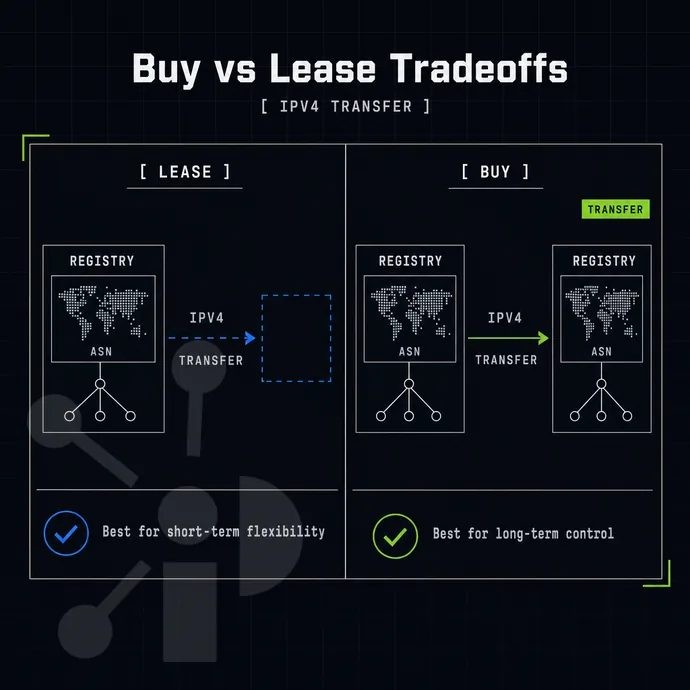
While both leasing and buying can help address IPv4 scarcity, each option presents different problems and buying or leasing IPv4 address pool is largely a function of how long you need it, how much capital you have, and how permanent you want your solution to be.
When buying makes sense
Buying is the best way to procure long-term infrastructure.
Good fits for buying:
- Core network infrastructure you plan to run for years.
- Carriers and ISPs that need portable, policy-routable space.
- Organizations treating address space as a capital asset with some resale optionality.
Tixx brokers IP blocks /24, /16 from ARIN, RIPE NCC, APNIC and LACNIC. Before any block is sold by Tixx, it is thoroughly checked for ownership, transferability, black list status as well as IP address routing sanity.
When leasing makes sense
You get connected up straight away with no large up-front transfer fee.
Any lease agreement worth signing must include:
- A non-revocation guarantee.
- RPKI ROA coverage.
- A signed LOA.
- Reverse DNS delegation.
All services are included in our leases. We also offer a white-glove setup and 24 hour provisioning. For community perspectives, see IPv4 addresses is running out! They said 20 years ago ....
Side-by-side internet protocol comparison
| Factor | Buy | Lease |
|---|---|---|
| Upfront cost | High (market rate per address) | Low |
| Ongoing cost | None after transfer | Monthly or annual fee |
| Ownership | Full RIR registration | Usage rights only |
| Best for | Long-term infrastructure | Short-term or variable demand |
If you are interested in more information on this topic, we recommend reading our detailed Lease vs Buy guide over at Prefixx.net. Regardless of what you choose to do with your block of IP space, you will need to start doing routing paperwork in order to begin sending traffic over it.
BYOIP and routing paperwork: making acquired space usable
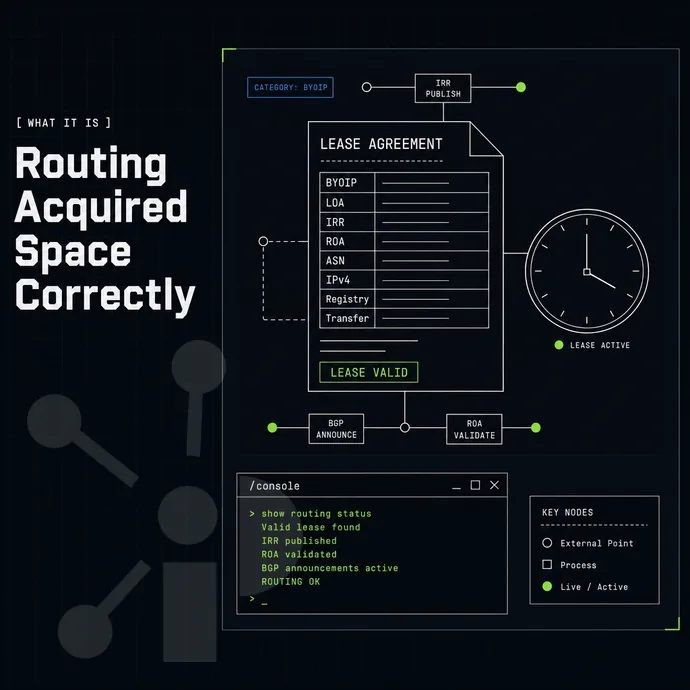
Missing one of these can be very problematic.
The three documents every block needs
A Letter of Authorization (LOA) is required to advertise a prefix and be accepted by upstream providers.
All three are needed to advertise in the full routable IP address routing table without having it get hijacked.
BYOIP across cloud and bare-metal environments
After all the paperwork has been signed, the block can be deployed. Each of the cloud platforms (AWS, GCP, Azure, OCI, Cloudflare) has its own BYOIP onboarding process that requires a LOA and signed authorization for the proposed prefix. The same process is used for bare metal via configuration of the BGP sessions. Note that each of the platforms has a review queue and it does not proceed instantly.
| Document | What it does | Risk if missing |
|---|---|---|
| LOA | Authorizes announcement to upstreams | Upstream rejection |
| RPKI ROA | Cryptographic origin validation | Prefix hijack, route filtering |
| IRR route object | Policy-based filtering compliance | Filtered by IRR-strict networks |
Where Prefixx fits
Prefixx creates LOA’s, RPKI ROA’s and IRR route objects for every deal.
All aspects of the routing paperwork are handled by Prefixx. The other aspect of IPv4 migration is IPv6. Many companies treat IPv6 as a medium to long term solution to exit from IPv4 as quickly as possible.
IPv6 as a long-term solution: progress, gaps and dual-stack reality
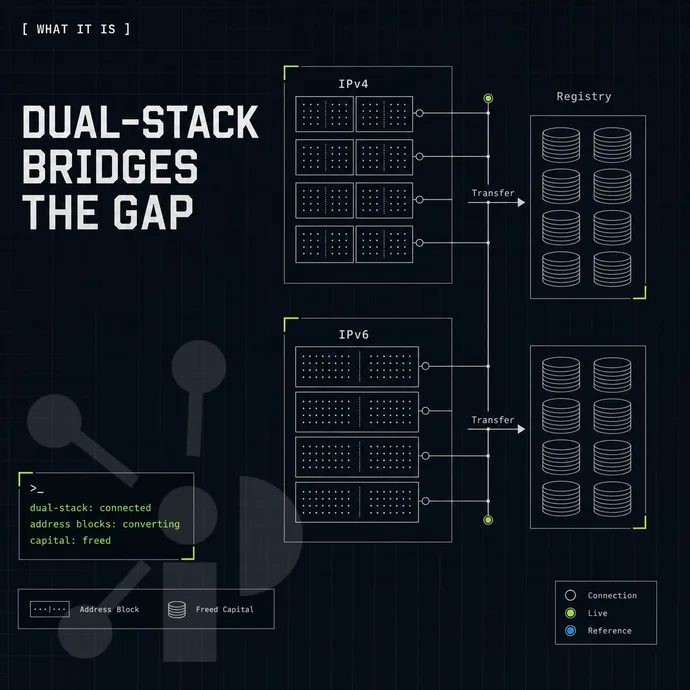
The answer to IPv4 address exhaustion is IPv6 architecture. However, there is a big difference between the answer and the deployed reality today. The vast majority of networks today are running in dual-stack mode (i.e. IPv4 and IPv6). Full IPv6-only networks are very rare today, and it is worth understanding why before you start planning for such a scenario.
Why IPv6 adoption stalls
- Compatibility with legacy applications. Many internal applications, SaaS offerings and embedded systems are written to operate with IPv4 addresses and would require expensive and disruptive rework to operate with IPv6 addresses.
- CDN and transit gaps. Not all CDN edge nodes or upstream transit providers have fully implemented IPv6. An otherwise completely IPv6 enabled path can be broken by a single IPv4 enabled hop.
- The high cost of re-engineering: Firewalls, load balancers and monitoring systems all need to be reconfigured. For big enterprises this can take months instead of weeks.
Note: Assuming your vendor supports IPv6 without testing it is a common mistake. Verify every layer before you cut over any production traffic.
The dual-stack reality
- Run both protocols in parallel. For new hosts on the network assign them an IPv6 address. This allows IPv4 to still function and allow backward compatibility while also enabling progress towards a leaner IP stack.
- Audit your IPv4 dependency and create a map of services that require IP addresses from your current IPv4 pool. Prioritise these services for migration or consolidation. The less hard dependencies you have the less pressure your services are under from the threat of IPv4 exhaustion.
What network address translation NAT means for your address strategy
This means that in the short to medium term, any organization planning a IPv6 rollout will also require a block of routable IPv4 addresses.
What to check before acquiring any IPv4 block
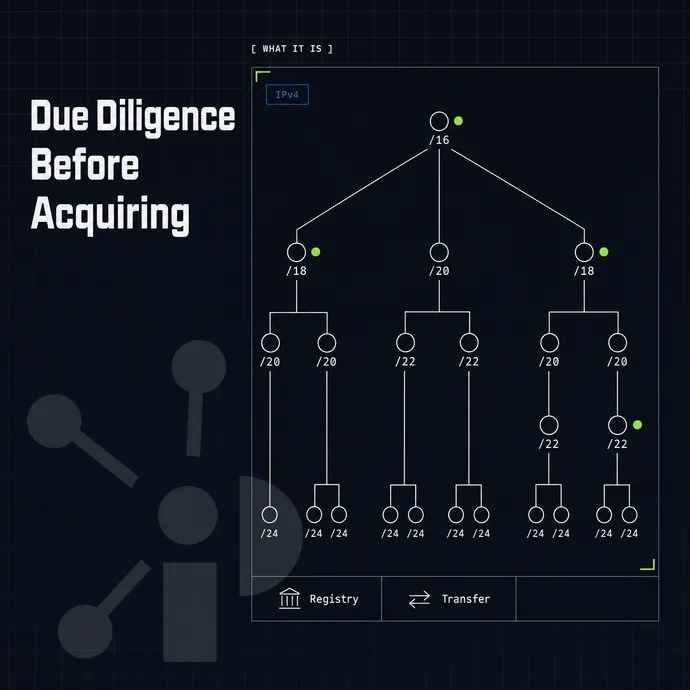
Buying IPv4 addresses in a depleted market means you will inherit the good and the bad of that block's history. A clean RIR record and good routing are non-negotiable prerequisites to start with.
Ownership and transfer eligibility
In addition to verifying this information, verify if there are any pending transfers, disputes, or policy holds.
Blocks under ARIN’s RSA or LRSA programs, RIPE NCC’s contractual framework, and APNIC membership terms vary with respect to eligibility requirements for a given block of IP address space. A block that fails eligibility for any of these programs will not transfer for any price.
Blacklist and dnsbl standing
The email sending reputation of a block of IP addresses follows the IP addresses as they are transferred from one customer to another. As a result, a receiving mail server and email security appliances used by service providers check DNSBLs against the IP address's current assigned IP address range (not the email sending company name of the current account owner).
Some of the more popular DNSBLs to check against, including those that support dual stack lookups, include the following with failures causing immediate email deliverability failure with possible weeks to remove the IP address with no guarantee of removal from DNSBLs: Spamhaus ZEN. Barracuda Spam & Virus Filter, SpamCop, SORBS, and CBL.
Free pool routing hygiene
For assessing a block, there are three key signals to consider: RPKI validity (i.e. the block has RPKI Route Origin Authorization for the correct origin ASN and prefix length), IRR consistency (i.e. route objects in relevant IRR databases announce the announced prefix), and BGP visibility (i.e. announced prefix originates from expected ASN, without conflicting announcements, or history of route hijack).
Another critical dimension for location-based services is geolocation accuracy. This affects not only ad targeting but also licensing of content and anti-fraud measures. A block long that is in the wrong region for geospatial purposes may need geofeed corrections before providers like MaxMind or IP2Location update their data.
Tixx quality control by Prefixx
Tixx gives service providers ownership verification, transfer eligibility checking, DNSBL blacklisting (of 12 different ones, stored in DNS), and routing health checking (RPKI validity, IRR consistency).
That due diligence process is core to how we do business transactions.
Why Prefixx for IPv4 scarcity solutions
The free pool of IPv4 addresses was closed several years ago and since then all available IPv4 addresses are sold in the secondary market. The quality of a transaction determines whether an IP address space arrives clean, routable and can be used without any problems. Prefixx brokers IP address space in all RIR regions. No buyer fees are charged. A seller-only commission of 3% to 8% is charged. It's no win no fee for the seller.
- Tixx QC on every block. Ownership, blacklist status, routing quality and RIR validation are checked before IPv4 addresses are sold to customers.
- Escrow-secured transactions. ARIN, RIPE NCC and APNIC registered. Inter-RIR transfers to all five registries.
- We offer White-glove leases with a Non-revocation guarantee. We provision within 24 hours and provide Geolocation correction, rDNS, Reputation monitoring and process Abuse complaints for you.
- Support BYOIP deployments. We can create the LOA, RPKI ROA and IRR route objects for you. BYOIP is included by default for Netrouting bare metal servers without any per-IP charge.
- We have humans in the loop and Senior Consultants are involved in all aspects of the transaction through the platform, rather than users having to go to a self-serve portal.
For market pricing context on IPv4 address resources, see the IPv4 pricing page. To discuss addresses available for your use case, contact our team directly. The FAQ section below covers the questions that come up most often.
The core facts about IPv4 scarcity and its solutions
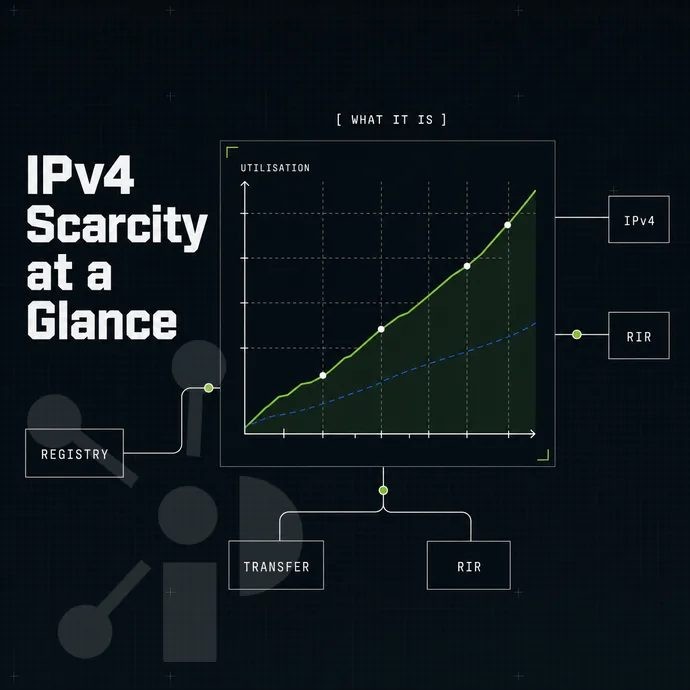
The structural and permanent nature of IPv4 scarcity means that the free pool of IPv4 addresses has been depleted across all RIRs and there are no more IPv4 addresses to allocate. All available IPv4 addresses are on the secondary market, being leased, or aggressively reused behind NATs. Exhaustion of IPv4 addresses is the current reality, not some problem to be dealt with in the future.
To conserve IPv4 address blocks, four alternatives are available on the market: purchasing unused address space on the secondary market, leasing IPv4 addresses, setting up a NAT box to make full use of already allocated addresses, or, above all, speeding up the transition to IPv6 and deploying a dual-stack architecture as early as possible.
The choice will depend on time frames, budgets and specific requirements. It is as important to carry out due care when acquiring an IPv4 address block as it is when acquiring the address space itself.
Frequently asked questions
What can expand the IPv4 address pool to handle the growing number of connected devices?
No single fix eliminates the shortage, but several approaches manage it. Organizations acquire address space through the secondary transfer market, lease blocks they do not need to own long term, or deploy NAT and CGNAT to stretch existing allocations further.
IPv6 adoption reduces long-term pressure, but it does not replace IPv4 for most production workloads today.
Is IPv4 becoming obsolete as the number of connected devices keeps growing?
Not in any near-term practical sense. All five RIR free pools emptied between 2011 and 2020, yet global IPv4 routing tables keep growing because demand has not stopped. IPv6 is the long-term successor, and dual-stack deployment s are now standard practice, but IPv4 remains the dominant protocol for internet-facing services, CDNs, and enterprise infrastructure. Prices on the secondary market reflect that ongoing demand, not a technology in decline.
How have IPv4 limitations been solved so far?
The internet community has layered several workarounds over the decades.
The secondary transfer market, governed by the five RIRs, became the primary mechanism for redistributing address space once the free pools closed.
What happened to ipv1, ipv2, ipv3 and ipv5?
They were experimental or internal IETF protocol versions that never reached public deployment.
How does leasing IPv4 differ from buying it as a scarcity solution?
Leasing provides usage rights for a defined term without an ownership transfer, which means lower upfront cost and faster provisioning.
Leasing suits organizations with short-term or variable needs, while buying makes sense when the block is a long-term infrastructure asset. Prefixx offers both paths: purchases are escrow-secured with Tixx quality control on every block, and leases include white-glove dual stack service covering RPKI, LOA, reverse DNS and reputation monitoring, with provisioning within 24 hours.
What is the difference between an intra-rir and an inter-rir transfer?
An intra-RIR transfer moves address space between two organizations within the same registry, for example from one ARIN member to another ARIN member. The process follows that registry's own policy and does not require coordination with any other RIR.
An inter-RIR transfer crosses registry boundaries, for example, when service providers make a long term move of a block from RIPE NCC to ARIN, and requires both registries to agree on eligibility and to update their respective databases. Inter-RIR transfers of unique addresses are more complex, involve longer timelines, and are currently supported between ARIN, RIPE NCC and APNIC, with LACNIC transfers facilitated on a case-by-case basis.
The permanent scarcity of IPv4 addresses means the free pools of addresses have long since vanished. All used IPv4 addresses are owned by another organization, so the only place to acquire more addresses is the secondary market. And when acquiring addresses on the secondary market, there are several important considerations that must not be neglected: quality, transfer, and reputation.
Neither buying nor leasing address blocks is safe until independent verification of the stated ownership, blacklist status, and full routing history has been completed before the contract is signed off.
If you are ready to source a vetted block, Prefixx handles every step from Tixx quality checks through escrow settlement and white-glove routing paperwork. Contact the team to get a personalized offer on the space you need.
Contact us to discuss your IPv4 needs today
No hidden fees, free consult. A broker replies within one business day.