
By Savvas Bout, Founder of Prefixx. Last updated 17 August 2026.
Leasing IPv4 space can happen fast, within hours, for example, a block of IPv4 addresses can be provisioned, an LOA issued, and the new prefixes announced.
There are many variables, dependent on how the lease has been set up and by whom it has been leased from you. For more context, see explore IPv4 leasing options at Prefixx.
In practice, managing your own RPKI ROAs, abuse reports, geolocation information, PTR records, and BGP origin information for your leased IPv4 addresses as you see fit when your lease ends, or not, are very real questions.
Who will deal with the abuse reports when some lessor less blacklist flags your prefixes? In this article, each of the control layers that make up a lease of space are described alongside applicable policies, what a good lease would grant you, and where the limits of leased space actually are. Establishing clear escalation procedures for abuse complaints ensures that each report or request receives prompt attention from the appropriate technical team.
What you control on leased IPv4 space
Leasing out IPv4 addresses allows for complete control over the leased block for the duration of the lease. For example, the lessee controls where and how the block is announced, what traffic is carried over the block, and how the block is configured.
The lessor retains title to the IP space as well as RIR registration, while the lessee has usage rights to the IP space. For community perspectives, see IPv4 Leasing vs Buying - What's Your Move? : r/networking .
Your IP address space and routing
The block of IP addresses is announced using your own ASN via BGP.
IP block configuration you manage
Operational control covers:
- Reverse DNS: Set up PTR records for each IP address, or delegate the reverse DNS zone to another name server.
- Geolocation correction: update MaxMind, IP2Location, and other geolocation providers with corrections.
- Use LOA to handle complaints and prove that use was authorized.
IP leasing market versus ownership rights
Leasing IP addresses grants the lessee usage rights, not a title to the IP addresses.
What IP leasing does not cover
When you lease IP addresses through Prefixx, the non-revocation guarantee and white-glove service ensure that you can operate without concern for ownership rights disputes or lease conditions throughout the agreed term.
Routing and BGP announcement rights on a leased block
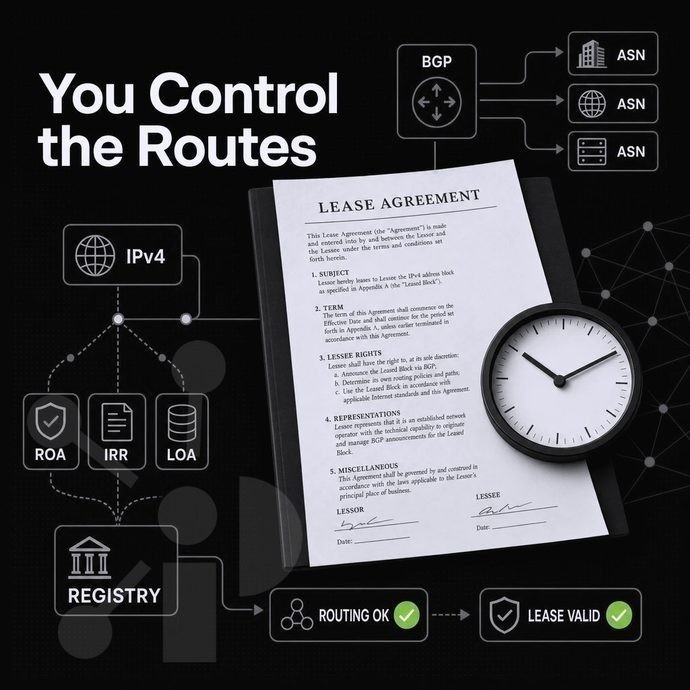
Leasing a block of IP addresses typically means that you use it at the routing layer for a certain period of time. The lessor (owner) of the block of IP addresses keeps full ownership of the IP resources, whereas the lessee (you) can use the IP resources on the internet as desired. Organizations that lease IPv4 addresses retain full operational flexibility to deploy services, configure routing policies, and manage traffic flows throughout the contract duration.
Each organization must evaluate whether the routing flexibility and lower upfront costs of leasing align with their infrastructure requirements and financial planning. Proper management of these IP resources includes maintaining accurate documentation of routing configurations, contact information, and usage patterns to ensure compliance with lease terms.
Preparation: LOA and ROA setup
- Receive your LOA (Letter of Authorization). The Letter of Authorization is used to allow a specific ASN (Autonomous System Number) to announce a specific block of IP addresses. The Letter of Authorization is prepared by Prefixx as part of our white-glove service. Upstream providers will reject an announcement without a proper LOA.
- Check RPKI ROA coverage for announced prefixes. The ROA was generated by Prefixx for the lessor and includes a binding to the ASN of your choice. It can’t be modified for the duration of the lease without coordination with us. The subnet mask and subnet size must match what you intend to announce.
Execution: BGP announcement and transit
- Originate the prefix from your ASN. Announce the same block of IP addresses from your router as specified in your LOA. Choose your own upstream ISPs. Set BGP communities as desired. Fully control prefix aggregation.
- Register IRR route objects. Prefixx files IRR objects for network operations and for Internet Protocol routing policy. Many transit providers filter on IRR before accepting a route.
Note: Announcing a more-specific prefix than the ROA covers will trigger RPKI-invalid status. Coordinate any block size change with Prefixx before reconfiguring.
Block size, IP address verification and how they work
- Verifying that RPKI validity has been checked. In order to check if a prefix is valid, you can check RIPEstat, and look for ‘RPKI-valid’ in the shown information. Invalid or unknown status may lead to your routes being discarded by your peers.
- Tracking for propagation. The announcement should now be visible on all of the Route Collectors. On Prefixx’s portal for BGP monitoring, it reports on issues such as origin-ASN mismatches and other routing issues in real time.
The next level of control to operate the newly assigned address space is how it is presented to the rest of the Internet, via its PTR records, geolocation, and reputation.
What the lessee does not own or control
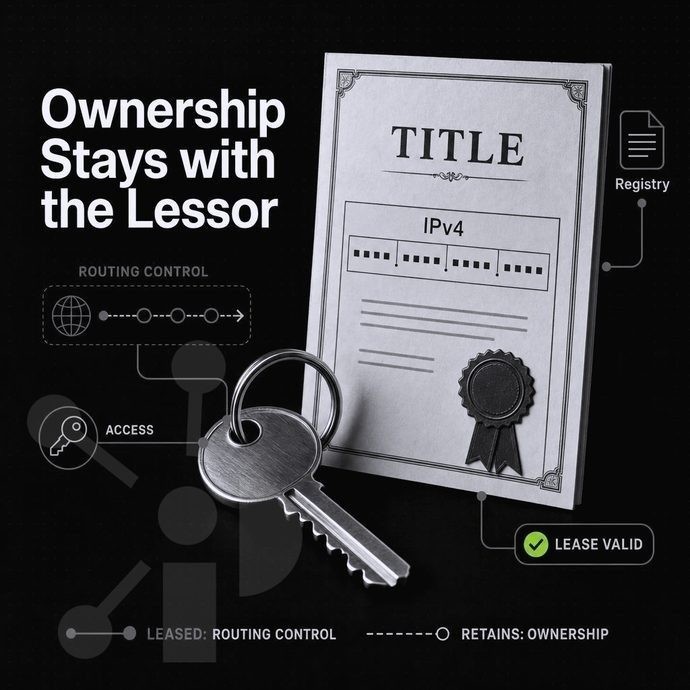
When you lease an IPv4 block, you get to control how it is routed, but you do not get to claim ownership of the block.
What stays with the lessor including the IP address
You cannot change the registrant information, transfer the whole /48 to someone else, or sublease individual IP addresses out to others without the lessor’s written permission to do so. RIRs have strict policies for who can hold registration for address space through IPv4 leasing or ownership, and those policies cannot be waived by contract between two individuals. The five RIRs each maintain their own policies governing address space registration, and lessees must work within those frameworks regardless of their contractual arrangements.
After the lease expires, you give back the space and have no further claims to it. Therefore, choosing to lease IPv4 addresses is not a substitute for long-term ownership if your physical and IT infrastructure will require a particular block of space for an extended period of time.
Revocation and operational risk
A badly structured lease can cause huge problems. A lessor withdrawing a block of space part way through a lease term can cause problems with a tenant’s routing announcements, leading to services failing. This scenario forms the core operational risk of any lease. Many ISPs structure their leases to include service-level agreements that protect lessees from mid-term withdrawals, ensuring routing stability throughout the contract term.
Many networks have experienced service disruptions when lessors unexpectedly reclaim address space, making contractual protections essential for maintaining uninterrupted operations. Many organizations now require explicit non-revocation clauses in their lease agreements to mitigate this risk and ensure predictable service delivery. Service providers must balance their duty to maintain reliable connectivity for customers against the financial and legal complexities of lease agreements.
All Prefixx leases are covered by a non-revocation guarantee.
What you do control
- BGP announcement of the block within agreed scope.
- Reverse DNS and geolocation corrections via our portal.
- Day-to-day traffic and workload assignment.
This clause also sets the stage for deciding whether IPv4 leasing, with Prefixx or other providers, is ultimately the right solution for you, or if purchasing would be more suitable despite its high costs.
Leasing vs buying: capital, commitment and control compared
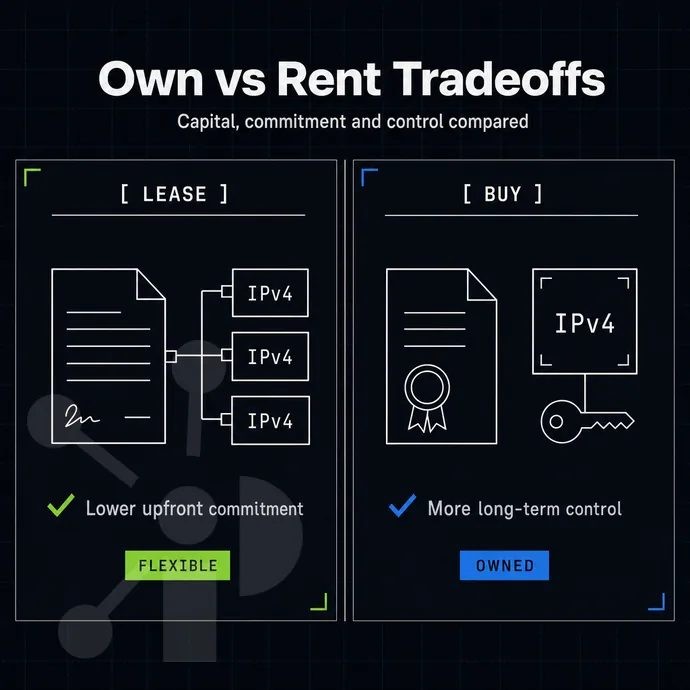
There are two ways to get hold of IPv4 addresses: buy them outright, or lease them. Depending on where you are with the three factors above, including whether you rely on data centers with dedicated address blocks, you will more than likely decide on one option over the other fairly quickly.
Ownership and registration with cloud service providers
Buying transfers gives full ownership to your organization and allows you to sell, transfer, etc.
Data centers cost and commitment
Purchasing a /24 today means paying the high price for a large capital expense up front. In many cases that big bill for IPv4 address leasing will exceed the available budget for a short term project and then be wasted when the needed space is used up in a few months. A lease pays a fixed lease rate for each period and is classed as an operating expense (as opposed to a capital expense). Organizations seeking to avoid high purchase costs often find leasing provides the address space they need without depleting capital reserves or requiring board-level approval for major asset acquisitions.
For most companies, this operational expense model aligns better with quarterly budgeting cycles and eliminates the need for lengthy capital approval processes. Most people find that leasing eliminates the financial burden of upfront acquisition costs while maintaining full routing control during the contract term. Leasing becomes especially attractive for short term projects where address requirements are temporary and purchasing would lock capital into assets with limited future utility. The IPv4 leasing market has matured significantly in recent years, with standardized pricing models and contract terms that make it easier for organizations to compare providers and negotiate favorable lease conditions.
Flexibility and exit options across hosting providers
The IP leasing market has matured to the point where a block of IP addresses can be provisioned by Prefixx within 24 hours.
| Dimension | Buy | Lease |
|---|---|---|
| Ownership | Full | None |
| RIR registration | Transferred to you | Stays with lessor |
| Upfront cost | High | Low |
| Flexibility | Low | High |
| Routing control | Full | Operational |
| rDNS / ROA | You manage | Included with Prefixx |
| Exit | Resale process | Return and stop |
Leasing can be a faster and more flexible way to get hold of addresses for a defined period of time, or to lease out IPv4 addresses before committing to capital expenditure. On the other hand, buying IPv4 addresses will give you permanent registration and long-term asset value. The IPv4 market has evolved to support both leasing and purchasing models, allowing organizations to choose the acquisition strategy that best fits their technical and financial requirements.
Why choose Prefixx to lease IPv4 addresses
Prefixx is a registered IPv4 broker with ARIN, RIPE NCC and APNIC (LACNIC facilitated), handling the entire process from sourcing to routing. When you lease IPv4 addresses through us, senior consultants manage every deal, and our multilingual team covers all five RIR regions.
- Tixx QC on every block. Each IP block is checked for ownership, blacklists and routing hygiene before it reaches a lessee.
- White-glove included. Our team prepares the LOA, RPKI ROA and IRR objects, plus geo-correction, rDNS and abuse monitoring.
- Non-revocation guarantee. Leased addresses stay routable for the defined period, with provisioning within 24 hours.
- Portal tooling at no extra cost. BGP monitoring, 12 DNSBLs, geolocation tools and rDNS management are included with every lease.
- Zero buyer fees. IP address leasing through Prefixx carries no hidden costs on the lessee side.
If you need clean, routable IP address space without a large upfront spend, explore IPv4 leasing options at Prefixx or contact our team to discuss block size, subnet requirements, and lease terms.
Frequently asked questions
Can hosting providers announce leased IPv4 addresses from local internet registries under their ASN?
A properly structured lease includes a Letter of Authorization that names your ASN as the authorized origin. You announce the block from your own ASN, and the routing is yours to manage.
Who controls the RPKI ROA for leased IPv4 addresses in a block?
During IPv4 leasing, the lessor holds the resource certificate in the RIR portal, because the registration does not transfer during a lease. You get the routing security benefit of IPv4 address leasing without needing your own LIR membership or portal access to the originating RIR account.
What happens to your leased IP address when the lease ends
The addresses revert to the lessor. Any services, reputation, or geolocation corrections tied to those addresses do not carry over to a new block automatically.
Can you sub-lease IPv4 addresses you are already IPv4 leasing?
Generally no, unless your lease agreement explicitly permits it. Most lease contracts prohibit sub-leasing without the lessor's written consent, because the lessor remains the registered holder and is accountable to the RIR for how the block size and space are used to support network growth. Attempting to sub-lease your IPv4 address leasing agreement without authorization puts you in breach of contract and can result in immediate termination of the lease.
Is IPv4 address leasing cheaper than buying?
Leasing has a lower upfront cost, which matters when capital is constrained or the need is temporary. Buying gives you a permanent asset that holds market value and carries no ongoing lease payments. For long-term, high-volume use, the total cost of IPv4 address leasing over several years can exceed the purchase price of an equivalent block. The right answer depends on your time horizon, cash position, and whether you want the block on your balance sheet.
How quickly can a leased IPv4 block be provisioned and routed?
Actual BGP propagation across the internet typically completes within a few hours of the announcement going live. Geolocation correction runs in parallel and is submitted to providers the same day.
Do leased IPv4 addresses affect your reputation and blacklist standing?
Yes, and the risk runs in both directions. With shared IPv4 address leasing blocks, you inherit whatever reputation history they carry from previous users across the internet community, which can include blacklist listings or poor sender scores. Conversely, your own traffic behavior during the lease affects the block's standing for the next holder. Prefixx runs Tixx quality control on every block before it reaches a lessee, checking ownership, blacklist status, and routing hygiene. White-glove service then monitors reputation, scans 12 DNSBLs, and handles abuse complaints throughout the lease term.
You will have operational control of IPv4 addresses leased by them, such as announcing a block of addresses under your ASN. Reverse DNS management, geolocation correction and reputation management by means of your own tools and services.
Such leased addresses shall not be owned by you, nor can you transfer them to third parties nor sub-lease them to others, without the written consent of the address holder.
A lease has two core layers of quality: contractual (non-revocation, provisioning timelines, LOA terms etc.) and ‘hygiene’ of the underlying block (e.g. blacklist history on the asset, inconsistent IRRs recorded on the property etc.). A 'dirty' set of address blocks (in terms of the above) transferred into your portfolio will give you headaches that even the best post-transfer operational 'clean-up' cannot eradicate.
If you are evaluating rented subnet, talk to Prefixx. Every block goes through Tixx quality control before it is offered, and white-glove routing paperwork, RPKI ROAs, and reputation monitoring are included with every lease.
Contact us to discuss your IPv4 needs today
No hidden fees, free consult. A broker replies within one business day.