
By Savvas Bout, Founder of Prefixx. Last updated 16 September 2026.
We hear from every U.S. network engineer who has recently tried to plan and price out IPv4 blocks: buying them outright ties up capital in a space that has very long registry transfer times, and in the meantime they have an immediate infrastructure need that IPv4 leasing can solve far more quickly. The mismatch between acquisition timelines and operational need creates pressure to find solutions that can scale with current demand.
Leasing IPv4 addresses has thus become the middle ground that allows them to immediately bring online a large block of routed, good reputation space. Note, however, that not all IPv4 lease arrangements are equally cost effective: some can be revoked with little notice, others may not come with any routing paperwork.
Additionally, Some others may even leave you blacklisted on day one. Organizations that eventually plan to purchase their own allocation often use leasing as a bridge to test address requirements and justify the capital expenditure. Immediate access to clean, routed blocks eliminates the waiting period that would otherwise delay infrastructure deployment.
We will outline key contractual protections specific to IP address leasing as well as necessary routing hygiene to account for various factors that could cause your data to get lost or filtered before it reaches its destination. ARIN policies will be outlined for you in order to explain what you can do with your allocated IP address space and Leased IP address space.
A complete understanding of these policies ensures you remain compliant while maximizing the utility of your leased address resources. Proper configuration of these technical elements ensures that your leased blocks gain immediate access to upstream transit providers and peering exchanges without delays or filtering issues.
We will also explain the key differences between leasing and purchasing IP address space with respect to your specific needs (time, money, use case) for managing IP addresses for a growing network. We start with the basics so that you will be a better consumer of IP address leases. A complete understanding of these distinctions ensures you avoid costly mistakes and select the arrangement that aligns with your operational timeline.
How to lease IPv4 addresses in united states networks
Leasing of IPv4 addresses allows an organization to use a certain number of addresses for a set period of time and does not transfer the leasing party’s RIR assigned addresses to the lessee. When the lease period has expired, all allocated addresses return to the lessor. This arrangement gives clients the flexibility to scale their address usage up or down as operational requirements change without the commitment of ownership.
Why all 4.3 billion IPv4 addresses are spoken for
All five RIRs used up their free pools of IPv4 addresses between 2011 and 2020. Today all IPv4 addresses are traded on the secondary market either as a sale or as a lease. Each RIR governs distinct geographic territories, with ARIN covering North America, RIPE NCC serving Europe and the Middle East, and APNIC regions spanning Asia and the Pacific.
Leasing IPv4 addresses for passive income vs. Buying
Buying transfers full ownership in an RIR-recorded transaction. Leasing IP addresses means paying for usage rights and there are flexible lease terms for customer-facing services that require routing capacity for now but do not need it for the long term. Lease durations typically range from a single IP month to multi-year commitments, allowing organizations to align their address allocation with project lifecycles.
When leasing IP blocks makes sense
A retailer looking to scale up for a seasonal campaign can lease IP for that short window of time and release it when the campaign is over. No need for capital outlay and no long-term commitment. The LOA, RPKI ROA, and IRR objects are prepped by our team to ensure proper block routing from the get-go.
This is why leasing IP is so commonly used by U.S. businesses. The same approach works for businesses testing new markets or deploying infrastructure in a specific location without committing to permanent address ownership.
How IPv4 leasing works: the process from inquiry to routing
The leasing of IPv4 addresses is typically arranged in a sequential fashion. Knowing what to expect from phase to phase will ensure a smooth leasing transition from your initial inquiry through to your new IP addresses being brought online and announced on the internet. Understanding these phases and preparing the required documentation in advance will help you clarify the next steps with your provider and avoid delays during onboarding.
Preparation and IPv4 leasing inquiry for testing projects
- Determine your needs and set a block size. Decide which RIR region you need (Typically ARIN for US-based deployments). Knowing your prefix length early on in the process will speed up the rest of the process.
- Send us an inquiry about your specific needs and we shall pair you with the most suitable vetted block to craft a custom offer that’s good for 72 hours.
Lease term agreements and block vetting
- Block vetting. Tixx checks ownership, transfer eligibility, blacklist status across 12 DNSBLs, and routing hygiene before any block reaches you. Note: skipping this step with other providers is a common mistake that leads to inherited reputation problems.
- Sign the agreement. A Lease Agreement is executed under a non-revocation guarantee. Your business is locked into usage for the full lease term.
Routing and provisioning via regional internet registry
- LOA, RPKI ROA and IRR preparation. We prepare the Letter of Authorization, the RPKI ROA and the IRR route objects for you. A service that keeps you within the network’s compliance from the start.
- Whois updates and rDNS delegation. We will coordinate the WHOIS updates with the registry and set up reverse DNS delegation for your block.
- Provisioning: Blocks will provision within 24 hours of execution of agreement. Entire process from initial inquiry to full routing active will complete in less than few months than would be for a typical ‘off-the-shelf’ purchase.
Knowing the process helps.
Cost effective IPv4 lease pricing: what determines the cost
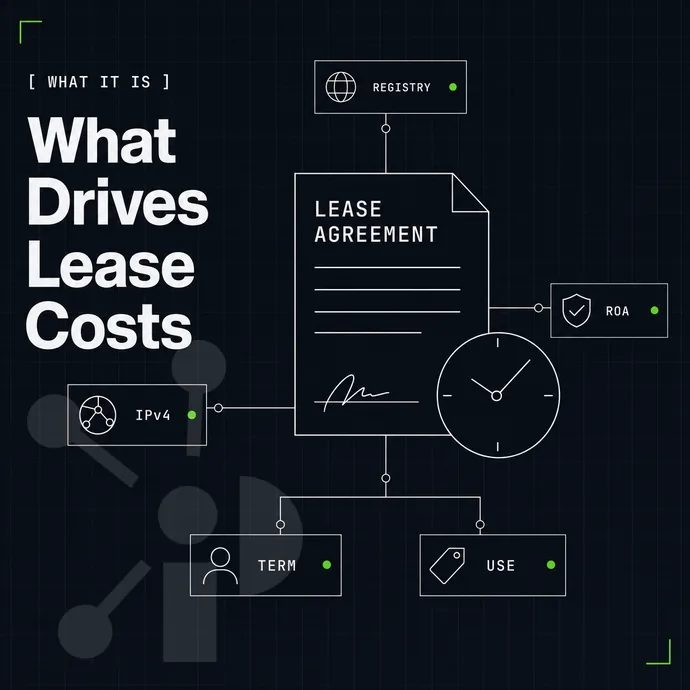
Key factors that affect IPv4 addresses lease pricing in the United States, with brief explanations to help you budget accurately.
Block size and RIR region for temporary projects
For larger blocks the lower price per IP applies for the monthly rate. A /16 is cheaper per IP than a /24 from the same supplier. Region also makes a difference. On the North American market ARIN-space is more expensive than RIPE NCC-space. Space from APNIC (Asia Pacific) and LACNIC (Latin America) can have different prices, depending on local supply and demand.
This value is based on current business and market data for IPv4 sales in 2024 (approximately $32-$36 per IP address) and forms the floor price for IPv4 leases. Market conditions and regional demand fluctuations can cause these baseline figures to shift quarter over quarter. Lease pricing structures typically reflect this floor value through monthly or annual payment schedules that distribute the cost across the term.
Reputation, contact details, and lease agreement terms
An un-blacklisted block of IP addresses will generally command a higher rate than a block with prior history of spam or abuse. Long lease terms usually also reduce the monthly rate for the same amount of IP space, just as committed-use space does. Providers typically quote rates on a monthly basis, allowing lessees to budget predictably for their IP address expenses. Some providers structure their agreements to require payment in advance for the full lease term, while others offer monthly billing cycles.
Hidden fees and transparent pricing
When browsing self-serve marketplaces for IP, the advertised rate per IP/month is almost always far higher than what your actual business needs cost when you factor in routing, paperwork, RPKI configuration, and abuse handling. At Prefixx, IP is offered on an inquiry basis. Offers are valid for 72 hours, include exactly the IP block, term and services you requested.
Prefixx provides transparent pricing and contact details through the inquiry process to ensure clients understand all costs before committing. The inquiry-based model ensures that every quoted rate reflects the complete service bundle rather than splitting costs across hidden line items that appear only at payment time.
Lease of IP includes white-glove support, LOA, RPKI ROA and IRR objects are all configured for you by the Prefixx team. So there are no 'add-on' services or line items to surprise you in the final invoice, making it easy to compare network headline rates from other providers with what you actually pay. With the pricing factors all clearly disclosed, the much bigger question remains: do you go the buying route, or consider leasing?
All lease documentation and configuration details are accessible through a secure client portal on the company website. The lease structure ensures that clients receive a single consolidated invoice covering all technical services, eliminating the need for separate payment arrangements across multiple vendors.
Leasing vs buying IPv4 addresses: choosing the right path
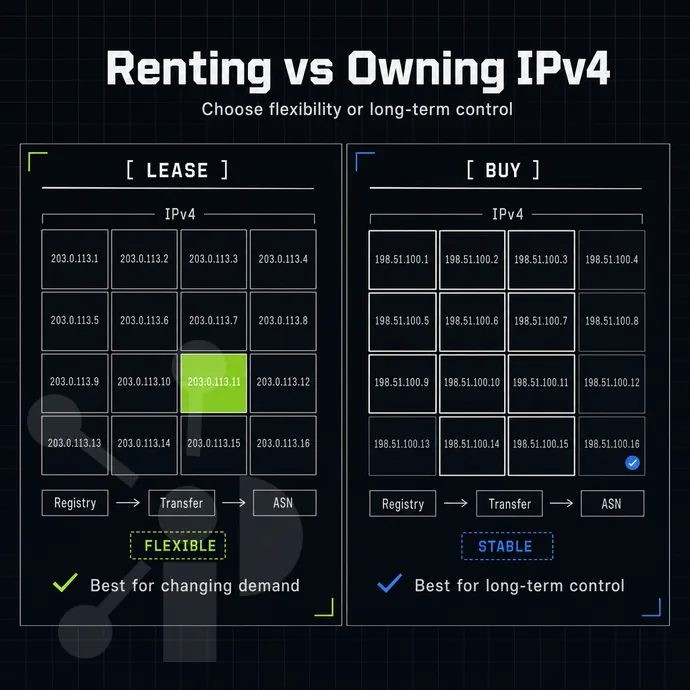
Leasing versus buying IPv4 IP block boils down to time horizon and capital. You could end up overpaying for unnecessary flexibility or locking yourself into long term contracts that don’t match your actual infrastructure growth. The decision requires careful evaluation of whether your infrastructure plans justify a long term commitment or whether shorter arrangements better match your operational timeline.
When to lease IP addresses by IP month for your network
Leasing is typically best for customers with variable or short-term requirements. A SaaS company testing out the US market or a startup that requires additional routable IP addresses but doesn’t want to commit to a large upfront capital expenditure are all examples of potential leasing customers.
Organizations running distributed applications or testing new infrastructure configurations often find that leasing provides the agility needed across multiple hosting environments without the overhead of permanent allocation. Leasing provides immediate access to routable address blocks without the delays associated with registry transfers or ownership verification processes.
Leases are generally flexible in term and fully non-revocation. Most lease agreements include provisions for renewal and clearly define the conditions under which either party may terminate the arrangement.
When to lease IPv4 vs. Buy outright
Buying delivers permanent ownership. In the long term, even spreading the cost over multiple addresses, buying is generally cheaper than repeatedly paying for the same space on a short-term lease. Organizations evaluating cost per IP month will find that ownership eliminates recurring fees after the initial purchase.
Use this as a quick reference guide to select the best solution for your business needs. Evaluating your technical requirements and available resources will help you make an informed decision.
- Short horizon or uncertain scale: lease IPv4, preserve capital.
- Multi-year infrastructure: buy, own the asset outright.
- Testing a new region: lease first, buy if the deployment sticks.
How Prefixx handles both paths
We broker purchases across ARIN, RIPE NCC, APNIC, and LACNIC, with Tixx quality control on every block. For leases, our team prepares all routing paperwork. Explore the full comparison on our lease vs. buy page. If leasing is the direction you are heading, here is why Prefixx is the right partner for it.
Why choose Prefixx to lease IPv4 addresses
Prefixx has brokered IPv4 leasing since 2018, with a team rooted in the networking industry since 2007. We are a registered broker with ARIN, RIPE NCC and APNIC, so every lease IPv4 transaction follows registry rules from day one.
- Non-revocation guarantee. Your lease agreement locks in full access to your IP blocks for the entire term.
- Provisioning within 24 hours. LOA, RPKI ROA and IRR objects are prepared by our team, not left to you.
- Tixx quality control. Every block is screened for reputation, routing hygiene and blacklist status before it reaches a lessee.
- White-glove included. Geolocation correction, reverse DNS, 12-DNSBL reputation monitoring and abuse complaint processing come with every lease IPv4 agreement.
- Flexible lease terms, transparent pricing. No hidden fees, no buyer-side charges. Lease IP blocks sized to your business needs, short or long term.
To explore current availability or discuss flexible lease terms for your organization, contact the Prefixx team at Prefixx.net.
Frequently asked questions about IP resources
Where can I find IPv4 leasing pricing from hosting providers for long-term commitments?
IPv4 lease rates vary based on block size, RIR region, and the reputation history of the addresses. ARIN-registered blocks covering the United States typically carry different leasing rates than equivalent RIPE NCC or APNIC space, and larger blocks generally carry a lower per-address cost. Prefixx does not publish a fixed leasing rate sheet, because every lease is priced to the specific block and term. Contact Prefixx for a personalized offer, valid for 72 hours.
How many IPv4 addresses remain available for leasing?
There are roughly 4.3 billion IPv4 addresses in total, and every one is spoken for. ARIN, the registry for North America, exhausted its free pool in 2015. New supply comes only from the secondary transfer and lease market, where organizations that hold unused space make it available to others. That leasing market is active, but organizations face finite inventory and prices that have risen steadily since the pools emptied.
How can I rent IPv4 addresses?
Start by contacting a registered IPv4 broker such as Prefixx, which sources vetted ARIN-registered network blocks and handles the full business paperwork stack on your behalf. As part of the plan, Prefixx prepares the Letter of Authorization, RPKI ROA, and IRR route objects, so the addresses are route-ready before they reach you. Provisioning is completed within 24 hours, and every leasing agreement includes a non-revocation guarantee. If you plan to deploy on bare metal, Prefixx also supports BYOIP onto Netrouting infrastructure at no per-IP surcharge.
Can you provide a list of US IP blocks?
Leasing listings are not published publicly with prices, because availability and rates shift continuously. Registered portal users get full block details and a personalized offer valid for 72 hours. Submit a business inquiry at Prefixx.net and a senior consultant will match you with available US-based inventory that fits your size and routing requirements. Once you submit your inquiry, a senior consultant will create an account for you in the portal where you can review block details and finalize your lease agreement. Once you finalize your lease agreement, the portal guides you through the documentation and payment steps required to activate your block.
US-based companies can lease IPv4 IPs in order to gain immediate use of block(s) of IP range with plenty of routing. The secondary market pricing for leased space is generally based upon the size of the block of IP blocks being leased, the RIR in which the space is held and the lessee’s reputation and/or history.
Importantly, the pricing for leased space is set by the actual market (i.e. the secondary market) as opposed to some published rate card. Therefore the decision between leasing or buying subnets depends upon whether the space will be required on an ongoing basis versus a flexible approach that reflects the specific needs of the company.
If your business is ready to explore IPv4 leasing for customer facing services, Prefixx handles every step: sourcing a vetted block through Tixx quality control, preparing your LOA, RPKI ROA, and IRR route objects, and provisioning within 24 hours with a non-revocation guarantee included. Get a personalized lease quote from Prefixx and have routing-ready subnet allocation in your hands within a business day.
Contact us to discuss your IPv4 needs today
No hidden fees, free consult. A broker replies within one business day.