
By Savvas Bout, Founder of Prefixx. Last updated 15 September 2026.
Deciding between RIPE NCC and ARIN, each a distinct number resource organization, affects which transfer rules apply, how long the process will take, how much your allocation will cost, and where you will be able to send traffic. In the end, choosing the wrong internet registry will drain more time and resources than anticipated, or leave you facing a regional premium you hadn't budgeted for.
There are two main registries: ARIN, serving North America, and RIPE NCC, serving Europe, the Middle East, and parts of Central Asia. The transfer policies, fees, waiting time, and inter-RIR rules set by each internet registry differ significantly and become critical when you move from planning to procurement. For more context, see inter-RIR transfer.
A /22 obtained from RIPE NCC can cost and carry a different price, and different routing reputation than a /22 obtained from ARIN, for example. However, both would give the buyer the same number of actual addresses.
This practical guide will show you how to compare policies, costs, processing times, and transfer procedures for IP addresses across the entire network of registries. We explain in detail what each registry does, the security purpose it can serve, and how it works. For more context, see Regional Internet registry.
For a complete overview, explore our ripe vs ARIN guide.
What RIPE NCC and ARIN are, and why the difference matters
Five Regional Internet Registries (RIRs) manage the worldwide distribution of Internet number resources: IPv4 addresses, IPv6 addresses and Autonomous System Numbers. RIPE NCC and ARIN are two of them, and the one your space sits under sets the rules you have to follow.
Regional internet registries and their internet number resources
ARIN services North America, while RIPE NCC services Europe, the Middle East and central Asia. Below them, national internet registries and local internet registries distribute address space down their respective chains. For the Asia Pacific region, APNIC serves as a separate body.
Transfer rules and policy obligations
Each registry has their own transfer policy, fees, and terms.
Why the internet registry choice matters for buyers
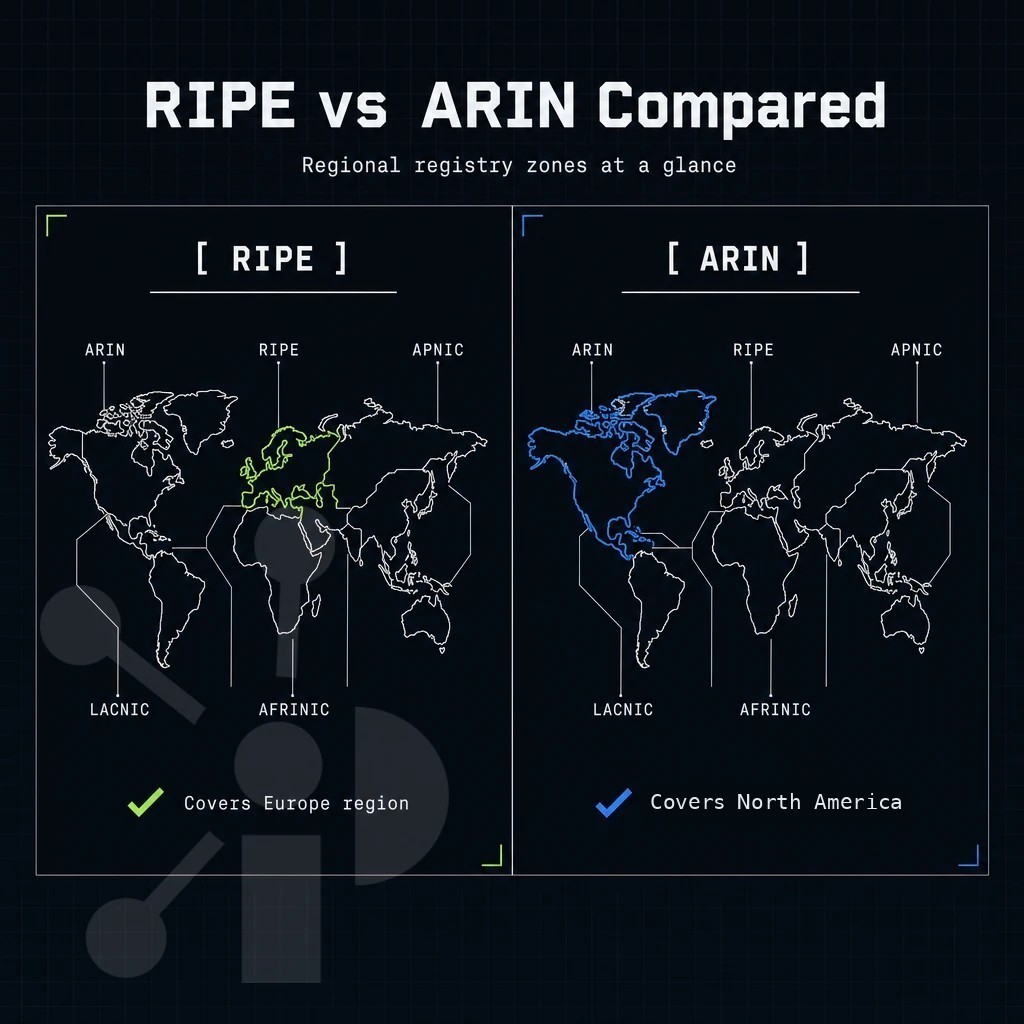
The geolocation anchor, transfer policy and market price of a range of IP addresses is often determined by the registry it is under. The team at Prefixx have experience of broking deals in ARIN, RIPE NCC and APNIC registries. The main differences between the two registries serve to be reflected in the cost of the policy.
Side-by-side comparison: RIPE vs ARIN
The policies of the RIPE NCC (for the European market) and ARIN (for the North American market) for the two largest secondary markets for IPv4 address space differ in terms of fees. transfer regulations and legacy handling. These policy differences affect the cost and time frame of acquiring IPv4 addresses. Organizations operating across both continents should evaluate how each registry's framework applies to their presence in Latin America and other territories within ARIN's service region.
RIPE NCC vs ARIN: regional internet registries at a glance
RIPE NCC charges a fixed annual membership fee of approximately $1,800/year.
Inter RIR transfers and registration data
Inter RIR transfer s are supported in both directions. As each RIR maintains its own registration data, a completed cross-registry transfer will update the WHOIS records and the appropriate routing objects. Once a settlement has been reached by the Internet service providers announcing the segment, they need to update the IRR and RPKI accordingly.
Internet number resources: IP addresses, ASNs, and the NRO
The Number Resource Organization coordinates global policy for the five RIRs. The assignment of AS Numbers by ARIN is based on a documented-need basis. RIPE NCC issues AS Numbers to LIRs and to sponsored PI-holders. For legacy resources, issued under both registries, ARIN has established the frameworks of the ARIN-Sponsored Legacy Resource Area (LRSA) and the ARIN Registered Service Provider (RSA) area, whereas the RIPE NCC manages legacy resources under a structure of legacy contracts.
| Dimension | RIPE NCC | ARIN |
|---|---|---|
| Region | Europe, Middle East, Central Asia | North America |
| Annual fee model | Flat (~$1,800/year) | Tiered by holdings (from ~$275/year) |
| Needs assessment | Not required for transfers | Abolished for transfers |
| Inter-RIR transfers | Supported (to/from ARIN, APNIC) | Supported (to/from RIPE NCC, APNIC) |
| ASN policy | Via LIR or PI sponsorship | Documented need required |
| Legacy resources | Legacy contract available | LRSA / RSA frameworks |
| Geolocation anchoring | RIPE DB + geofeed (RFC 8805) | ARIN RDAP + geofeed (RFC 8805) |
We will do all the transfer paperwork, setup of RPKI ROAs, and IRR route objects, for both intra- and inter-registry transfers. The policy and process to do a transfer is on one hand, and the cost of the chunk on the open market is on the other hand.
Why Prefixx for RIPE NCC and ARIN transfers
Prefixx is a registered broker with ARIN, RIPE NCC, and APNIC, with LACNIC facilitated. We handle the full paperwork on both sides of an inter-RIR transfer: LOA, RPKI ROA, and IRR route objects prepared by our team.
- Tixx QC checks for ownership, transfer eligibility, blacklist status and routing hygiene on every collection before it gets sold to a buyer.
- Zero buyer fees. Seller-only commission of 3 to 8%, no win no fee.
- White-glove service included with leases (geolocation correction, rDNS and reputation monitoring).
- All deals are settled via an escrow-secured payment instrument across the five regional internet registries.
We can guide you through the transfer guidelines, fees and timeframes of each registry should you be deciding between allocating address space under ARIN or RIPE NCC. Contact us for more information.
Frequently asked questions about internet number resources
Do some RIR regions like ARIN allow pi space without a sponsoring LIR?
Yes. ARIN, the American Registry for Internet Numbers, is the official Regional Internet Registry for the United States, Canada, and many Caribbean and North Atlantic territories. It is a nonprofit organization established in 1997 and recognized by ICANN as the authoritative body for IP address and ASN allocation in its region. Every IPv4 cluster, IPv6 bundle, and ASN issued in North America traces back to ARIN's registry records.
What do regional internet registries like RIPE NCC stand for?
RIPE NCC stands for Réseaux IP Européens Network Coordination Centre.
Is ARIN a number resource organization or government agency?
ARIN is an independent nonprofit membership organization, not a government body. It operates under its own policies, which serve the community through an open policy development process. No U.S. federal agency controls ARIN's day-to-day decisions, though ARIN coordinates with ICANN and other global bodies on Internet governance matters.
Who owns an IP address registered with ARIN?
Nobody owns it outright. ARIN records the holder of the block and the rights that come with it, and those rights transfer to a buyer through ARIN's own process.
Can I use RIPE NCC IP addresses with an ARIN ASN?
Yes.
What is the minimum transfer size for ARIN and RIPE NCC?
For ARIN, the minimum transferable unit is a /24 (256 addresses). RIPE NCC also sets the minimum at a /24 for most transfer scenarios. Each internet registry requires the portion to meet specific criteria, including valid allocation records and no outstanding policy violations, before a transfer is approved.
How long do inter RIR transfers between ARIN and RIPE NCC take?
The process typically runs several weeks from submission to completion, though timelines vary based on documentation completeness, internet registry workloads, and whether any eligibility review or request for additional information is required. Both registries' members must independently approve the transfer of addresses, which adds coordination steps compared to an intra-RIR deal. Working with a registered broker such as Prefixx, which handles the paperwork and liaises with both registries on behalf of its customers, keeps the process moving and avoids common delays caused by incomplete submissions. Buyers who work with an experienced broker can expect regular status updates and a single point of contact throughout the approval cycle. Brokers streamline communication between registries and their clients, ensuring that customers receive timely guidance on documentation requirements and policy compliance.
Deciding on a registry for your purchase, sale or lease of IP address space is not a mere formality. Although both ARIN and RIPE NCC provide membership to individuals worldwide, their respective models for managing resources have significant implications that directly affect the real financial outcomes.
ARIN registered IP address space is transferred based on a needs-based framework and charged at different rates depending on the size of the space in question. RIPE NCC managed number resource space is traded in a European market and can be transferred using a variety of methods, resulting in space that is neither universally cheaper nor faster to acquire and sell than that managed by ARIN.
It's worthwhile remembering that you can choose the registry where your network primarily runs and use current market rates for that region to determine the purchase price. Using the wrong RIR for a slice of IP addresses can lead to difficulties including increased routing complexity, problems with transferring IP address numbers and a future reduced resale value.
If you are ready to buy, sell, or lease a quota under ARIN or RIPE NCC, Prefixx handles the transfer paperwork, Tixx quality checks, and escrow from start to finish. Get in touch to see what is available in your region.
Contact us to discuss your IPv4 needs today
No hidden fees, free consult. A broker replies within one business day.