
By Savvas Bout, Founder of Prefixx. Last updated 17 September 2026.
The IPv4 address exhaustion problem is real.
We are left with approximately 4.3 billion IPv4 addresses, all of which have been spoken for.
For the infrastructure lead or the person responsible for assigning IP addresses, a shift in acquisition criteria exists. Factors to consider when buying or leasing an IP address block(in terms of its size, assigned by RIR. Routing history, and if it is on any blacklists) will determine if you can put the newly assigned IP address range to good use or spend a lot of time cleaning up a mess.
The following sections will go over how the IPv4 exhaustion has altered the market. Detail the options for the transfer and leasing of IP address space for the five RIRs, including considerations for dial up networks, and list the critical items to verify prior to the block in question reaching your network.
What is IPv4 address exhaustion of allocated blocks?
In basic terms, IPv4 address exhaustion (or run-out, depletion, etc.) means that all available IPv4 addresses have already been assigned. The global free pool of unassigned IPv4 addresses is empty with no more to be handed out.
How assigned IP addresses work
Internet Protocol Version 4 (IPv4) uses a 32-bit number to identify every device on a network, allowing for approximately 4.3 billion unique values.
There are not 4.3 billion possible Internet hosts. First, there are a number of reserved ranges for use of private networks, loopback, and multicast/broadcast. That reduces the number of possible Internet hosts before reaching the first public address. The reserved ranges mean that an insufficient number of the theoretical 4.3 billion values can actually serve as addresses for devices requiring direct internet connectivity.
The scale of the network address space problem
The five Regional Internet Registries (RIRs) distributed the available IPv4 addresses to ISPs and organizations for decades. All the free pools of the RIRs were depleted between 2011 and 2020. This means that every block of IPv4 addresses that are in use today has already been assigned to a prior holder. The RIRs coordinated closely with other organizations to ensure orderly distribution and prevent fragmentation of the address space.
What address exhaustion means now
As every IPv4 address is allocated to a holder, any organization that requires a block has to acquire it from a current holder. Such transactions take place in the so-called secondary transfer market. Prefixx is a brokerage firm that deals with such transactions and applies Tixx quality control to the acquired blocks.
Why IP addresses ran out: causes of exhaustion
The current market for IP addresses is what it is today for a reason. The reason for the design of IPv4 and its subsequent exhaustion was due in large part to a design built for a research network of the 1970s being applied to a global infrastructure of hundreds of millions of people today, making it clear it was never a long term solution for such scale.
This mismatch between original design assumptions and actual deployment scale has created challenges across many markets that depend on stable addressing infrastructure.
The 32-bit ceiling in the middle east
When engineers settled on IPv4 in 1981, they estimated only a small fraction of the 4.3 billion addresses would ever be allocated, long before the top million websites, billions of broadband connections, and countless connected devices existed. The Internet was, at that time, a closed, academic project. A 32-bit address space seemed ample for their purposes. It wasn't. The design decisions made in the early stages of the protocol reflected the limited scope and academic nature of the network at that time.
Demand that outpaced the design
Three factors have led to Address Consumption Rates exceeding initial predictions. First, the shift to fixed broadband connectivity, needed to reliably host or reach million websites, means that IPv4 exhaustion accelerated as every household gained a permanent IP address, rather than being assigned one on an as-needed basis.
Second, the growth in mobile connectivity has seen the number of endpoints per user increase dramatically. Third, the growth in new internet users from emerging markets has also driven up the number of address spaces required. The proliferation of hand held devices has further compounded this growth, as users now routinely carry multiple connected endpoints throughout their day.
Early allocation inefficiency among APNIC members
However, the early distribution of IP addresses exacerbated the existing demand problem. Large corporations and universities had been allocated a Class A B) block, sometimes as large as 65,536 addresses. Despite the large size of these allocations, many unused ranges were created.
These ranges were never reallocated and, consequently, were left out of the subsequent distribution, which was designed to reflect reasonable usage, when demand for IP addresses increased exponentially before the Internet had reached mass adoption. Large companies holding these early allocations often retain significant unused capacity that could otherwise serve growing networks.
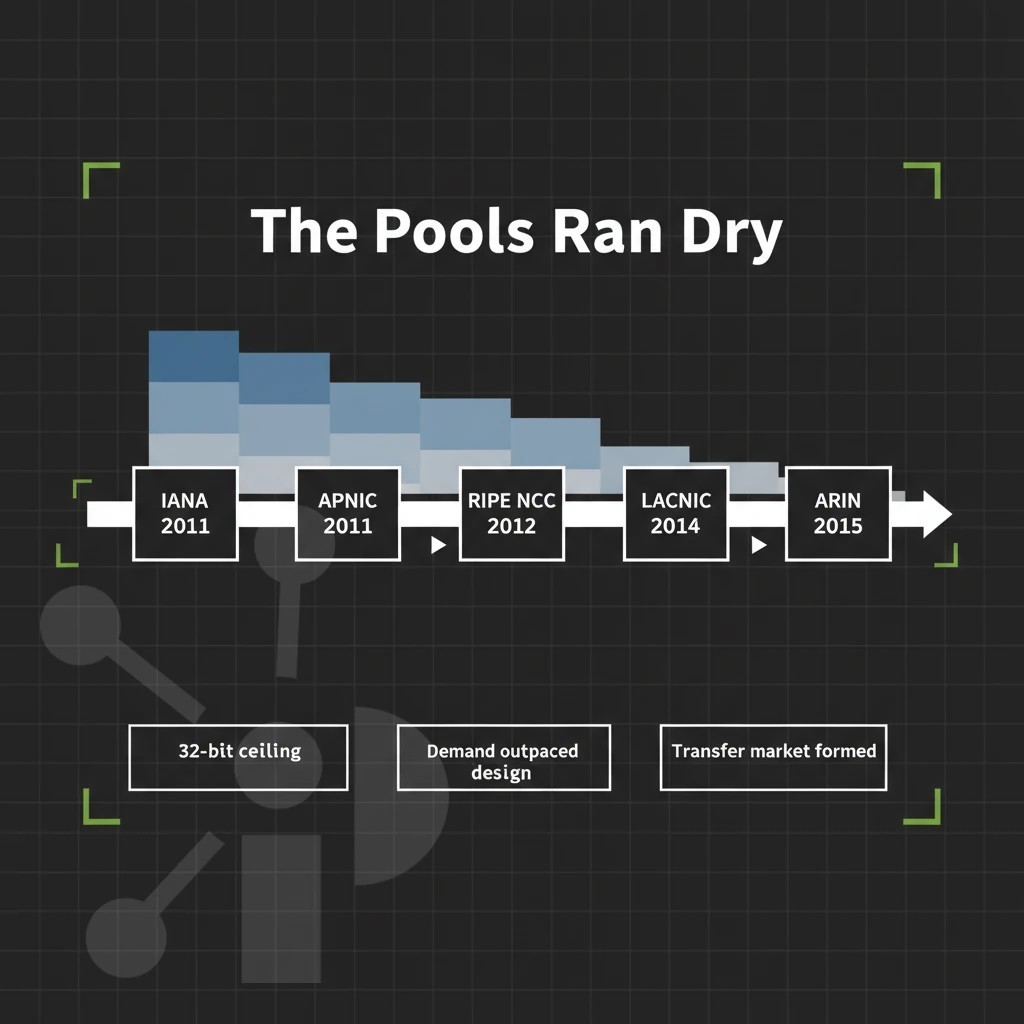
By 2011, the central free pool of address space held by IANA had been exhausted. Subsequently, the regional registries successively followed in 2020. Today, there is only the secondary transfer market for free address space.
Additionally, Prefixx is active in the acquisition, sale and leasing of needed IP address space across all four regions, i.e. in ARIN, RIPE NCC, APNIC and LACNIC. Each registry, including APNIC, operates under distinct transfer frameworks, and understanding APNIC policy requirements is essential for organizations seeking to acquire address space in the Asia-Pacific region.
How regional internet registries managed the free pool
The exhaustion of the IP address registries did not happen overnight.
How the global internet community distributed private addresses
- IANA exhausts its top-level pool on 3 February 2011. The last five /8 space allocations are made to the five RIRs simultaneously. There is no new public IP space entering the system after that.
- APNIC followed in short order, adopting policy in April 2011 to limit allocations to a single /23 per member. In practice, each member can receive only the last remaining address space allocation that member needs.
- By 2012 RIPE NCC had reached the final phase of the available pool. Each new network member would now receive a single /22. In the mean time some networks were already making use of special gateway services such as CGNAT in order to try to extend the usage of their remaining public IP addresses.
Regional internet registries and viable internet hosts exhaustion phases
- The registries for Latin America and Africa, LACNIC and AFRINIC, implemented IPv4 exhaustion a bit later. Each region eventually ran out of its free pool of IPv4 addresses around 2014. The RIRs then set their own respective timelines for the gradual phase-out of such assigned IPv4 addresses. The respective timelines have differed from region to region.
- ARIN closed its waiting list for space in IP addresses in 2015. The American registry for North America (ARIN) moved to a direct transfer model for space, thus organizations looking for space have to get it on the secondary market.
Note: Exhaustion dates vary by RIR.
What happened after the global IPv4 free pool ran out
Since each registry operates under its own post-exhaustion rules, active acquisition has emerged as the long term solution, shifting focus from allocating remaining addresses.
Free pool IP address depletion rates kept climbing as mobile and cloud-based infrastructure grew.
How RIRs responded to exhaustion
Each registry has now moved to a waiting list model for any space recovered from revocations or returns to their address space.
LACNIC manages IP number assignments for Latin America and depleted its allocation space later than ARIN and the RIPE NCC. All five registries eventually exhaust the returned or reclamation space. Today, vast numbers of unused allocated IP addresses are reserved by legacy holdings and not assigned.
The secondary market that filled the gap
Since there is no free pool any more, a transfer market is developing. The holders of unused address space can sell or even lease it to others who are looking for space. RIRs have developed transfer policies for this. To connect buyers and sellers of address space, to organize an escrow service and all the paperwork involved, there are brokers on the market.
Pricing for IPv4 address space is opaque by design, with no official published price, a /24 under ARIN can trade at a significantly higher price a few weeks later as a /24 under RIPE NCC.
What buyers and sellers need to know
Their status on blacklists, their routing, and their RIR standing.
Workarounds: NAT, carrier-grade NAT, and publicly routable addresses
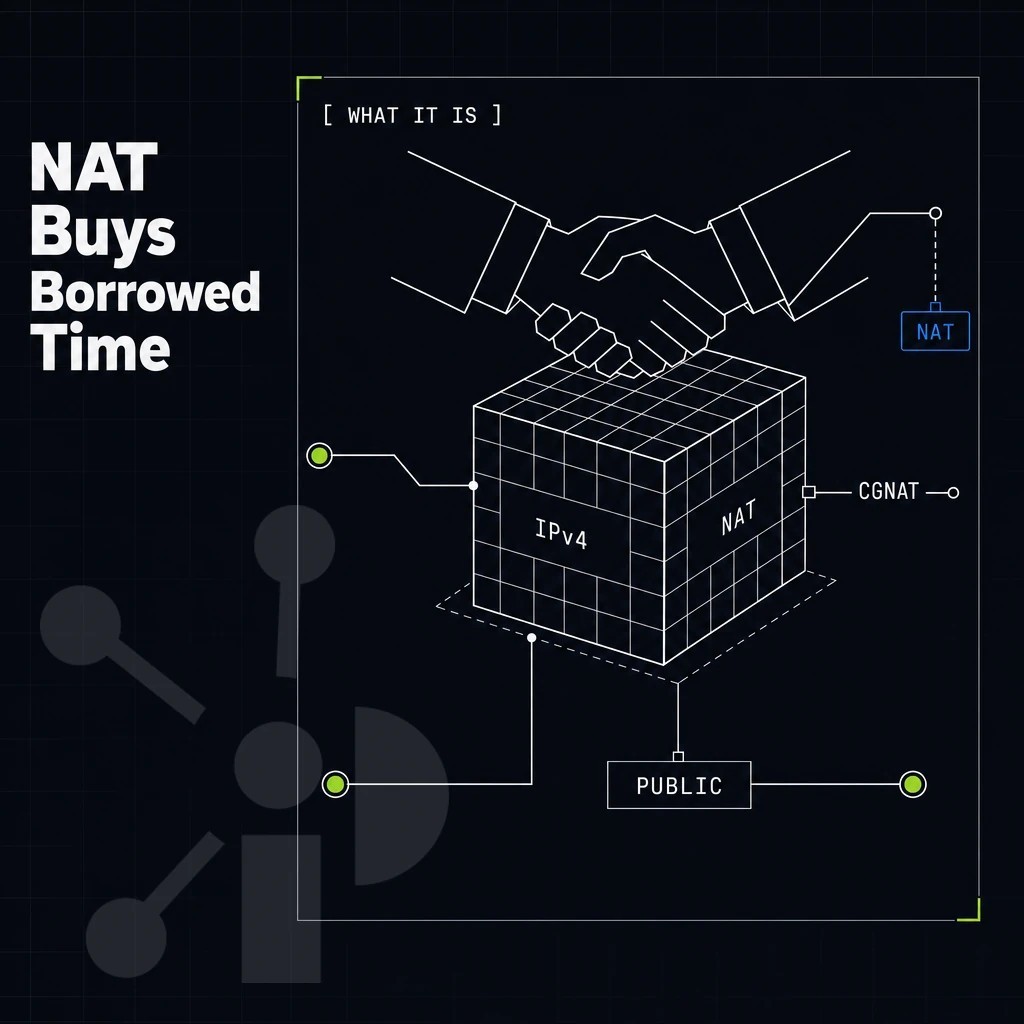
Before the transfer market for IP addresses had reached maturity, most operators relied on address translation to provide internet access while coping with IPv4 exhaustion and the limited number of addresses they had. Network address translation (NAT) was used as a stopgap measure as the supply of free IPv4 addresses decreased.
A single NAT is placed on the edge of a private network, and in place of each internal device having its own public IP address. All of the internal devices use the same public IP address, thus increasing the effective number of IP addresses available. For more context, see IPv4 address exhaustion .
Rfc 1918 private addresses and the main internet router
RFC 1918 defines three ranges of addresses for internal use. These ranges are 10.0.0.0/8, 172.16.0.0/12 and 192.168.0.0/16. A local network issues addresses from one of these ranges. The primary gateway router changes these addresses to the registered routable IP address before it sends the packets out of the local network. Devices on the internal network can initiate outbound connections through the gateway, but external systems cannot directly communicate with those internal devices without additional configuration.
Carrier grade NAT at the ISP level
ISPs extend this same idea out to Carrier-Grade NAT. There, residential customers (hundreds or more), whether using mobile phones or home connections, are assigned to use the same external IP address as their addressing group, on top of which sits the ISP's NAT, on top of the customer's home router. It saves IP addresses but adds a second layer of translation. This architecture operates at the ISP level to maximize address conservation across their subscriber base.
Trade-offs and incompatibility issues
NAT poses incompatibility issues for several workloads:
- In peer-to-peer applications communication does not work straight out of the box. Hole-punching or relay servers have to be implemented.
- Services that require a stable, reachable address such as VoIP, gaming and remote access will fail with double NAT.
- To get around this, intermediary network services like STUN, TURN and ALGs have been written to work around this problem. They add latency and make your system a lot more complex to run.
While these workarounds are sufficient for many networks, operators who need a clean, routable block of address space instead of private addresses (and are unable to get assigned directly by APNIC) can acquire or lease through Prefixx to remove the NAT dependency entirely.
Is IPv6 the long-term solution to IPv4 exhaustion?
NAT is a stop gap solution to use up available addresses, but in the end it won’t solve the problem of the shortage of addresses. IPv6 was created to put an end to the shortage of IPv4 addresses. Organizations seeking a long term solution must weigh whether to invest in IPv6 migration or continue acquiring IPv4 blocks through secondary markets.
The large addressing space of 128 bits ensures a practically inexhaustible supply of addresses for the next decades. Although IPv6 has been designed to solve the problem of the shortage of IPv4 addresses, the adoption of IPv6 is slow. Today, there is still a lot of demand for IPv4 addresses. The persistent demand reflects the reality that most enterprise infrastructure and consumer devices continue to rely on IPv4 addresses for connectivity.
IPv6 as a long term solution for IPv4 addresses
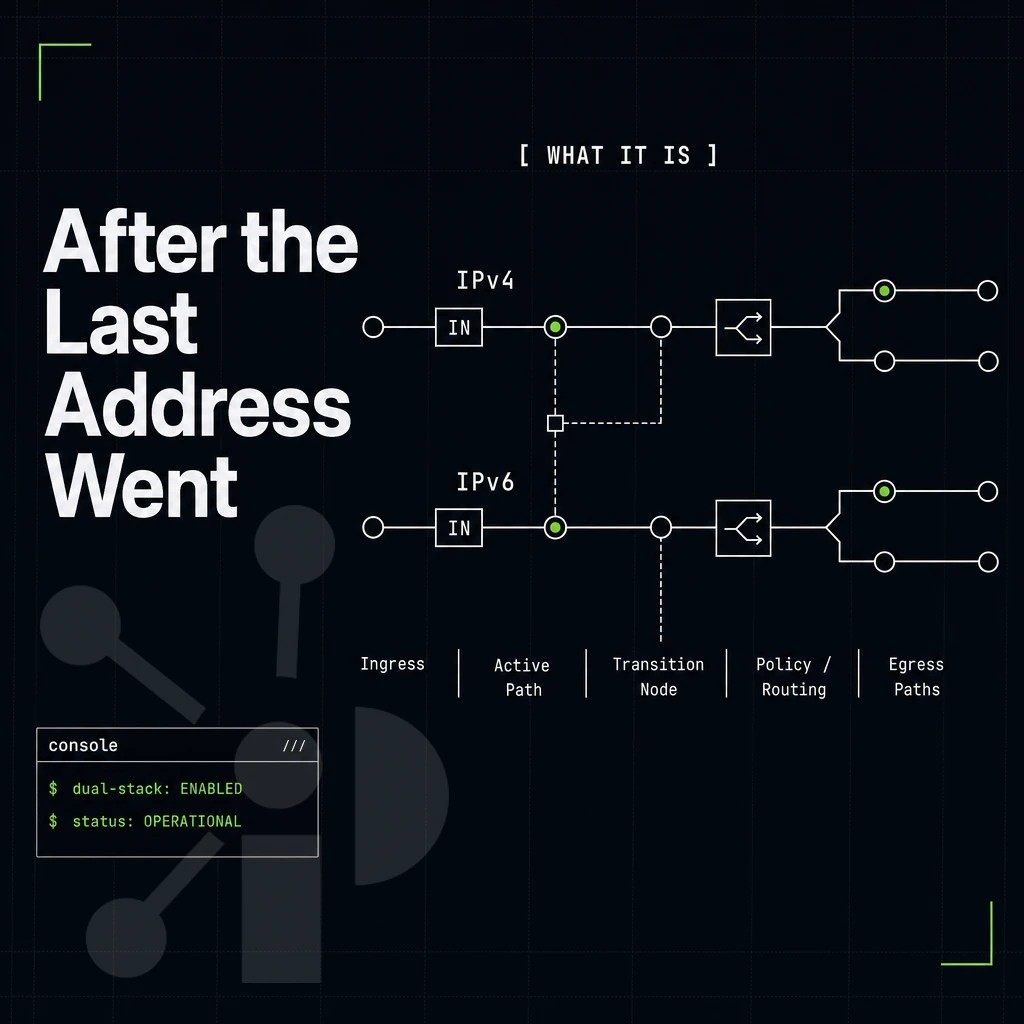
Major ISPs and mobile phone carriers have led the charge for IPv6 adoption, and many networks have by now transitioned to a dual-stacked configuration. Yet for the time being, the top million sites still offer their visitors mainly IPv4 traffic. It will take some time for the large number of Enterprise networks, mobile devices, and older systems using IPv4 address blocks to gradually transition to all IPv6-based communication, during which time IPv4 is expected to remain central.
IPv4 addresses exhaustion and the compatibility gap
IPv4 and IPv6 are not directly compatible. When running both in a data center, problems with firewalls, load balancers and applications can occur. Running both (dual-stack) adds operational complexity which most organizations currently avoid. As dual-stack deployments require careful planning and testing across every layer of the network, many organizations continue to defer full implementation until business requirements force the change.
Will IPv6 ever run out like IPv4 addresses did?
No. With 340 undecillion addresses available, IPv6 does not suffer from address space exhaustion. However, in the near term, there is a need for IPv4 Internet connectivity. Many cloud providers, CDNs, and large enterprises remain on networks routed over IPv4 addresses and, despite IPv4 exhaustion, will continue to generate strong demand for IPv4 transfers in the near term.
Frequently asked questions
When did IPv4 address space run out per access point?
The five regional internet registries emptied their free IPv4 pools between 2011 and 2020. ARIN, the North American registry, reached exhaustion in 2015. RIPE NCC, serving Europe and the Middle East, followed in 2019. By 2020, every major registry had closed its free allocation window, leaving the secondary transfer market as the only source of new address space. The closure of the free allocation window marked the end of public allocation as the primary mechanism for obtaining address space.
Are IPv4 addresses already exhausted?
Yes, at the registry level it is. No RIR issues fresh IPv4 addresses from a free pool anymore. All 4.3 billion addresses are spoken for. Organizations that need IPv4 space today must buy or lease it from existing holders through the secondary market, using a registered broker or direct transfer.
How do you resolve a shortage of IPv4 addresses?
There are three practical paths. First, buy a block outright through the secondary transfer market, giving you permanent ownership across ARIN, RIPE NCC, APNIC, or LACNIC. Second, lease address space for a predictable monthly cost, which suits organizations that need capacity now without a long-term capital commitment. Permanent acquisition establishes clear ownership rights that remain with your organization as long as registry policies are followed.
Third, deploy IPv6 alongside your existing IPv4 infrastructure to reduce pressure on the IPv4 pool over time. Brokers like Prefixx handle the sourcing, escrow, and routing paperwork for both buying and leasing, so your team does not have to navigate RIR transfer rules alone.
Will IPv6 ever run out like IPv4 addresses did?
Not in any practical timeframe.
The problem of IPv4 exhaustion is not a future problem. The regional free pools for IPv4 are all exhausted and any new IPv4 address space is now transferred on the secondary transfer market.
Sharing one globally routable address across many users through NATs and carrier-grade NATs to cope with IPv4 exhaustion has added significant complexity to the Internet. Purchasing or leasing a clean, routable IPv4 block (or blocks) remains the best solution for any organization that requires predictable, end-to-end IPv4 addressing.
The transfer market is mature, yet many new internet users still find it requires knowing which blocks carry baggage, which registries apply to your region, and how to get routing paperwork done correctly. That is exactly where a specialist broker adds value. If you are ready to buy, sell, or lease IPv4 space, Prefixx handles every step, from Tixx quality checks through escrow settlement and white-glove routing setup.
Contact us to discuss your IPv4 needs today
No hidden fees, free consult. A broker replies within one business day.