
By Savvas Bout, Founder of Prefixx. Last updated 6 October 2026.
The steps to get IPv4 lease onboarding right can cost more than time.
The process to get IPv4 lease onboarding right looks straightforward on paper but there is a huge gap between signing a lease agreement and announcing a clean, routable prefix to the Internet. The internet community expects proper authorization and clean routing before accepting announcements from leased address space.
Follow this guide step by step: verify the quality of the blocks you commit, collect the documents your upstream requires, set up RPKI ROAs and IRR route objects correctly.
Each step depends on the previous one.
IPv4 lease onboarding steps you should expect
The IPv4 lease onboarding process refers to the end-to-end process for a company to go from an initial inquiry to being able to send production traffic over the space of leased IPv4 addresses. It’s not as simple as configuring a few settings. The process involves many parties coordinating registry updates, route announcements and any necessary paperwork.
What is the difference between an IPv4 lease and a dhcp lease?
A DHCP lease is a temporary assignment of an IP address on a local area network which is automatically assigned and expires after a short time such as minutes or hours. In contrast to an IP lease in the IPv4 market, an IP lease is not a transfer of ownership of public IP addresses. An IPv4 market lease typically grants the lessee exclusive use of the addresses for a defined period, often measured in months or years rather than the ephemeral durations of DHCP assignments.
Instead, an IP lease is a rental of a block of public IP addresses by a company from an owner for a fixed period of time (e.g. months or years) and the lessee has full control of how the leased IP addresses are used during the lease period. The rental arrangement ensures that company leases provide operational flexibility without the capital commitment required for outright purchase of address space.
You can lease one or more IP addresses.
Who controls IP lease addresses and their address space?
Rented IP addresses do not transfer RIR registration, they remain registered in the name of their owner. What does change is operational control. The lessor retains legal title to the IP resources while the lessee gains the right to route and utilize them under the terms of the lease agreement.
The main parties involved in this situation are the lessee, lessor (or broker), upstream transit providers, and the relevant RIR whose records support the agreement. Some transactions involve brokers who act as intermediaries between lessees and lessors, facilitating the arrangement and documentation.
How many IP addresses does onboarding actually touch?
We build LOA, RPKI ROA and IRR route objects for the space of the lease for every block we facilitate. Provisioning documentation signed off by all parties occurs within 24 hours and we correct geolocation as well as set up reverse DNS for every IP address from the beginning in order to have the facilitated block fully operational before the first packet is sent. This documentation ensures seamless integration with external systems that rely on accurate registry data.
Once you have a clear understanding of the key features of Air Lease’s model, you can turn to the natural follow-up question of why companies would choose to lease rather than buy aircraft.
Why businesses choose an IP address lease over buying
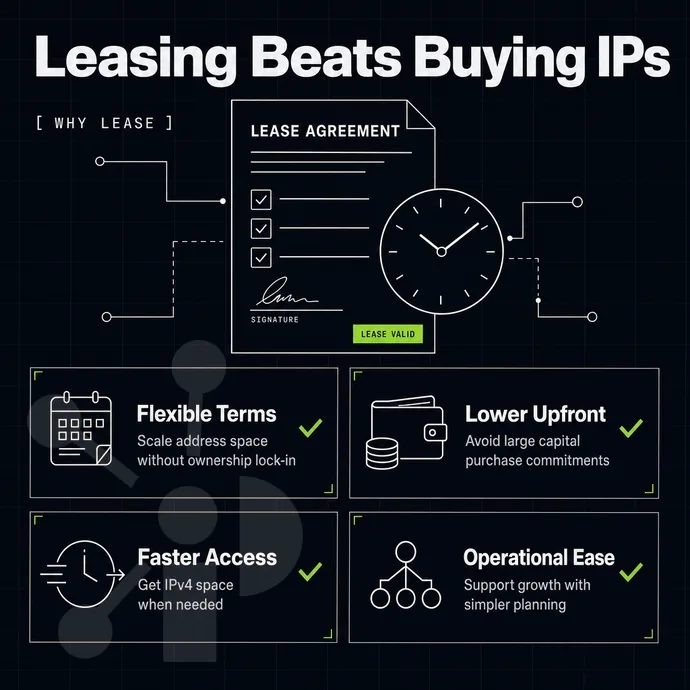
The five Regional Internet Registries (RIRs) have used up their free pool of IP addresses between 2011 and 2020. All new IP address space is now sold in the secondary market, either by buying it outright or leasing it. Leasing is usually the fastest and most cost effective way for companies to get an IP address block.
Capital efficiency and IP space management
Leasing out IPv4 addresses allows companies to transform a depreciating asset into an operating expense rather than a capital expenditure. For companies that only require a large block of IP addresses for a short period of time (e.g. for a project or for additional infrastructure for part of the year), choosing to lease IP addresses through a block rental avoids committing to buying a large IP address space allocation for an indefinite period of time, only to find out that they actually need fewer in the long run.
Organizations scaling cloud infrastructure temporarily can benefit from this flexibility without locking capital into permanent address holdings.
Speed to live traffic in data centers
Buying a block of IP addresses in bulk requires a full RIR transfer that can take weeks to complete. However, leasing IP addresses sidesteps this process altogether. Leased IP addresses can be provisioned by Prefixx within 24 hours with full LOA, RPKI ROA and IRR route objects prepared for you by our team. By the time the RIR transfer process has cleared with the relevant registry, you could have announced the IP resources provisioned by Prefixx.
Cloud and dedicated server use cases
Leased IPv4 addresses are delivered across all the major cloud BYOIP programs including AWS, GCP, Azure, OCI and Cloudflare as well as on dedicated bare metal servers. They provide a flexible short term solution for companies running brief campaigns or testing out new systems. When your requirement becomes a long term one, it can be easily upgraded to a purchase.
| Factor | Lease | Buy outright |
|---|---|---|
| Time to live traffic | Within 24 hours | Weeks (RIR transfer) |
| Capital required | Low, operational | High, upfront |
| Ownership | Usage rights only | Full permanent ownership |
| Flexibility | Scale up or exit | Resale required to exit |
How long does IPv4 lease onboarding take from inquiry to live traffic?
Prefixes are typically provisioned within 24 hours of an inquiry. Response times can vary based on provider availability and the complexity of the routing requirements.
But building the ground work before you contact a broker to list your property within a 24 hour time frame is where Step 1 starts.
Step 1 -- define your requirements before you approach a broker
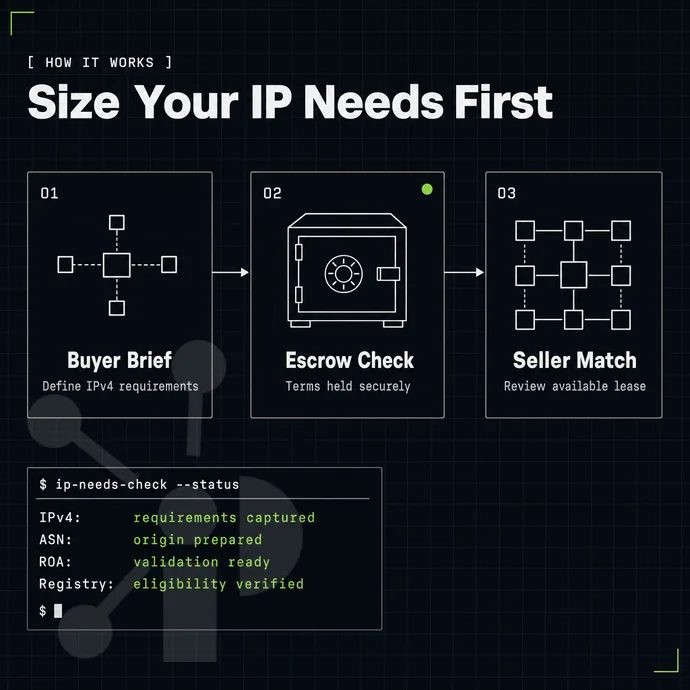
Answering these five simple questions in about an hour will help you nail down the key points of your internal brief around renting one IP address or more before contacting a broker, saving so much time and averting potential costly errors in the process. The brief should also clarify your preferred lease duration to ensure the broker can match you with blocks available for the timeframe your project requires.
Scope your IP address needs
- Determine how many IP addresses you require. A single IP address is usually sufficient for a small outbound mail server. Larger Customer Facing Services typically require a /24 or greater. The block size in CIDR prefix notation (e.g. /24, /23, /22) affects the availability of providers and what is available in the market.
- State your intended use case. Email service, Ad tech, VPN endpoint and server hosting have very different ‘reputation’ sensitivities. State your intended use case to be directed to appropriate clean IP space with suitable history.
Map your deployment region and term
- Determine the region in which you will be deploying your IP space. Each region is managed by a Regional Internet Registry(RIR) and transfer policies and fees can vary greatly between the RIRs (i.e. an IP prefix under ARIN may be listed at a different price than an identical prefix under RIPE NCC a week or more later).
- Determine your initial lease term prior to contacting brokers. Leases can be structured for a short term of three months or even as long as twelve months or more. Offers are typically structured based on the term of the lease.
What documents do I need before I can announce a leased IPv4 block?
We need an LOA from the address holder, an RPKI ROA covering your ASN and an IRR route object.
IP address history and reputation requirements
Set your IP reputation requirements before a block is provisioned (not after the block has been provisioned). Define the acceptable blacklist status and any sector specific requirements here. Address history checks are part of the Tixx quality control process for every block. The thoroughness of your reputation vetting directly affects operational readiness, and how your business depends on clean address space makes this step non-negotiable.
Note: Skipping this step is the most common onboarding mistake. A block provisioned without a reputation brief can fail DNSBL checks on day one, delaying your go-live by days.
Document your requirements, then verify that any proposed block meets your requirements during the vetting process in Step 2, which is designed to do exactly that.
Step 2 -- block vetting and quality control
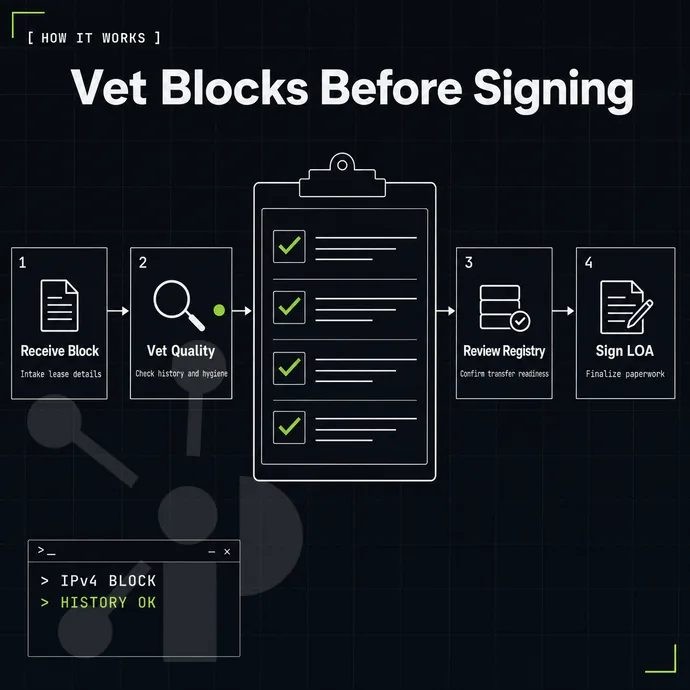
All blocks offered by Prefixx through our system are checked by Tixx, our quality-control system, before they can be leased by a lessee. This check covers ownershIP, routing, RIR and reputation systems.
What tixx checks on every block
Ownership verification against the live RIR RDAP records for the IP address lease or address block to be opened for transfer by Tixx is performed to confirm the registrant is the same as the seller and to check transfer eligibility. The RDAP lookup queries the authoritative registry databases maintained by local internet registries to retrieve current ownership and delegation status.
Blacklist scanning includes 12 of the world's most popular DNSBLs (including Spamhaus ZEN, BarracudaConnect, SpamCop, SORBS, CBL and seven others).
A routing hygiene review for a block of IP addresses can include a review of the address history for that block in BGP. A check for any rogue announcements for that block and a check of geolocation databases against the expected region for that block of IP addresses. A mismatch of geo data with a fraud filter or content delivery system can result in silent failures. In practice, few systems handle all these validation layers automatically, so manual verification remains essential.
Red flags that disqualify a block
A block will be excluded from Prefixx’s marketplace if it contains active blacklists, open abuse cases, historical hijacks or poor RIR standing.
Can I use a leased IPv4 block with AWS, Azure or Google cloud BYOIP programs?
Yes. AWS, Azure, and Google Cloud run BYOIP programs that allow you to announce your own IP address space within their cloud provider's networks on a one time basis for a time period or on an ongoing basis.
Depending on your intended workload, one program may be more suitable than another. AWS BYOIP requires a minimum /24 to be announced. Azure BYOIP requires a /24 to be announced as a public prefix. Google Cloud BYOIP can announce /24 and larger IP address space. The same prefix can be used for web hosting, email servers, or other internet facing services once properly announced through the chosen cloud platform.
The intended use of a prefix must be declared during the onboarding process for each cloud provider. ROA validity and IRR route objects for announced prefixes are verified by Prefixx before they are accepted. All necessary LOA, RPKI ROA and IRR objects for the required paperwork of cloud providers are prepared as part of the Prefixx service and handed over to the customer in due time. Customers retain full control over their prefixes and operational responsibilities while Prefixx handles the documentation workflow.
With a vetted block confirmed, attention now turns to the legal and routing documentation required to authorize the announcement of the deal in Step 3.
Step 4 -- announcing the block: BGP and upstream configuration
With LOA and RPKI ROA in place, the routing setup can start. Your network team will originate the IP prefix you leased from your ASN and advertise it to the upstream networks to get them to accept it. Once the route has propagated globally and can be seen by all, you’re done. Your upstream providers must configure their filters to permit the prefix, ensuring proper network access for the leased block across the internet.
BGP origination and IRR route objects
Announce the prefix from your own router with your own origin-ASN. Normally filtering a prefix at a border ASA/ router is a trivial thing: most common cause is missing or wrong IRR route objects.
This authorizes route origins to verify that a prefix is originated by your ASN in the RPKI. An ROA with an incorrect origin ASN or maximum prefix length set too low for announced prefixes results in RPKI-invalid status and causes other networks to block traffic due to strict RPKI validation. When network operators enforce RPKI validation policies, they will drop routes that fail these checks, preventing your prefixes from reaching their destinations.
Common IP address failure points
Prefix length mismatches occur frequently. An ROA stating /22 is not announcing /24 unless maximum prefix length for this announcement explicitly states /24. Check for IRR consistency and validate RPKI before proceeding with production modifications. These validation checks should be completed in a staging environment before applying changes to production infrastructure.
The operating relationship between your ASN and the assigned block of IP space affects every upstream. Your operating partner or transit provider must include your ASN’s assigned IP block in their routing information. Verify this prior to the route’s deployment into live network infrastructure. The operating path through which announcements propagate must be validated at each hop to ensure consistent reachability.
How do I fix geolocation errors for lease IP addresses?
Geolocation databases are updated on their respective schedules and may not reflect recent transfers or new leases. You can submit corrections to MaxMind, IP2Location, DB-IP and ipinfo.io via their respective online forms. Prefixx’s white-glove service can also submit corrections on your behalf, while the daily RFC 8805 geofeed published at Prefixx.net/geofeed.csv is propagated to all four geolocation databases.
Verifying the announcement with an IP address
As your announced routes come online, start monitoring your BGP announcements for visibility, origin ASN, full RPKI validation, and IRR consistency.
Just because a globally visible route is a good milestone, doesn’t mean that the end has been reached.
Step 5 -- reverse DNS, geolocation and reputation warm-up
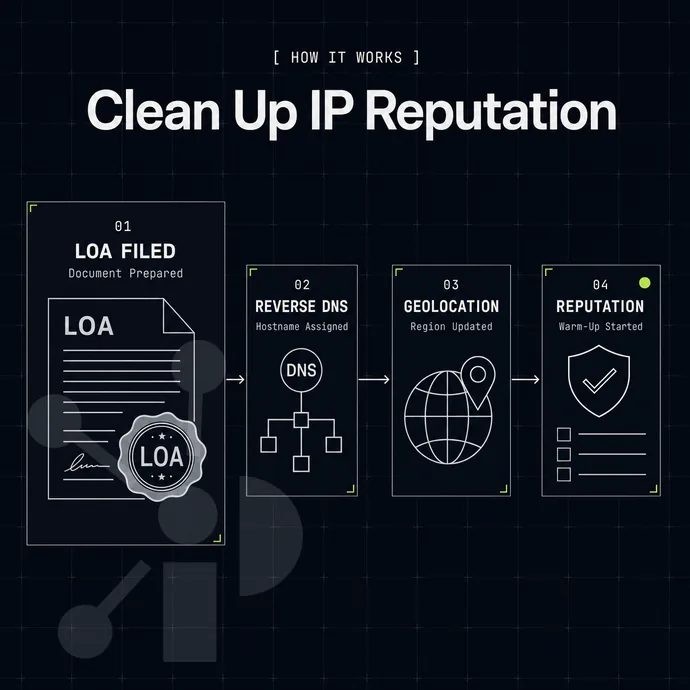
Announcing the block IP address as routable is just the start of the three key operational tasks to get to deliver Internet facing services. PTR records, geolocation accuracy and warm-up of the IP’s reputation are key to successful deliverability and geo-targeting or otherwise. Successful deliverability depends on maintaining operational ownership of these three tasks throughout the lifecycle of the block.
Ptr records and reverse DNS delegation
- Add a per-record PTR for each host. Reverse DNS for a host IP reveals the hostname of that host. Many mail servers and other internet services will reject or flag traffic from hosts lacking a proper PTR record.
- Delegation of reverse zones for /24 and larger block sizes can be done via AXFR allowing for full zone control rather than file updates one record at a time. All per-record control as well as full zone delegation is managed via the Prefixx client portal.
IP address geolocation correction
- Create an RFC 8805 geofeed for the region your deployment is in. Geolocation databases for IP addresses (MaxMind, IP2Location, DB-IP, ipinfo.io) typically take weeks to reflect changes to Internet routing. They must be actively updated or a user may end up in the wrong region for their journey.
- After you have submitted the data, verify its propagation to all four of your providers. We publish a daily geofeed at Prefixx.net/geofeed.csv and will also update the coordinates for you as part of our white-glove service.
Note: A geofeed submission is not instant. Allow several days for each database to ingest the update before relying on geo-targeting for production traffic.
IP address reputation warm-up
- Ramp up traffic gradually to newly announced space with no prior sending history. Flooding a fresh block with high-volume mail (or other customer-facing services) immediately triggers spam filters.
- Continuously monitor your reputation systems. Prefixx scans 12 different DNSBLs including the Spamhaus ZEN list and the Barracuda block list. It can also process abuse complaints. A previously abused IP address can get into your DHCP lease which in turn can get into spammer’s legacy listings that you scan before you send email.
Note: Never treat a clean scan at announcement as permanent. Reputation systems update continuously; monitor throughout the warm-up period.
Is leasing IPv4 addresses cheaper than buying a block outright?
Typically in the short term, yes.
However, a lease is ideal for a project with a defined lifetime or for someone who needs space quickly but doesn’t have the capital to spend.
With the block now clean, geolocated correctly and warming up in terms of reputation, we can now discuss where you would like to lease IP addresses and run the prefix out of, and in Step 6, we cover the various cloud BYOIP offerings from hosting providers as well as bare-metal options.
Step 6 -- BYOIP deployment onto cloud and bare-metal platforms
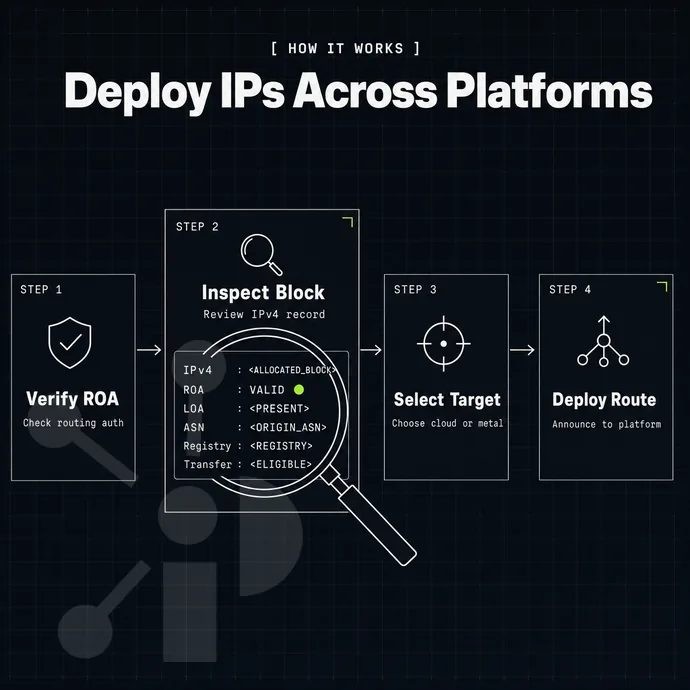
After receiving LOA and ROA from Step 3, the allocated address space block can be deployed. The way you want to operate your allocated address space after acquiring the lease is up to you. You can opt for a cloud-based BYOIP solution or go for a more classic approach with a bare-metal dedicated server from Netrouting. Both ways are supported by us and can be used at the same time as long as the allocated address space is large enough.
Cloud BYOIP onboarding across hosting providers
Each of the major cloud providers (AWS, GCP, Azure, OCI and Cloudflare) has their own BYOIP process. All of them verify ROA(s) against RPKI, confirm ASN ownership, and require a minimum prefix size of /24. The LOA and IRR route objects that Prefixx prepares in Step 3 are exactly what each of these cloud providers is looking for as input. Each document is prepared according to the exacting specification of the destination platform.
The minimum Prefix size for acceptability varies by provider: AWS and Azure accept /24 and larger prefixes, GCP only accepts /24 and larger, while OCI and Cloudflare accept /24 and larger as well.
Bare-metal deployment on Netrouting
BYOIP is native on our bare metal servers. Your BYOIP is handled by Prefixx (our operating partner for these services) for LOA/ROA/routing documents.
Deploying across multiple hosting environments
Customers with large address spaces can announce parts of it from cloud and dedicated servers at the same time.
Leases with multiple blocks can have those spread across multiple platforms, but each prefix will require a separate ROA and IRR entry for that prefix. All objects required for your prefix are prepared as part of our white-glove service for you for each lease.
While deployment of the block is a major milestone for the leasing process, the real test for the block’s ongoing commercial attractiveness is the subsequent management of the block over the lease term.
Ongoing lease management: monitoring, renewals and exits
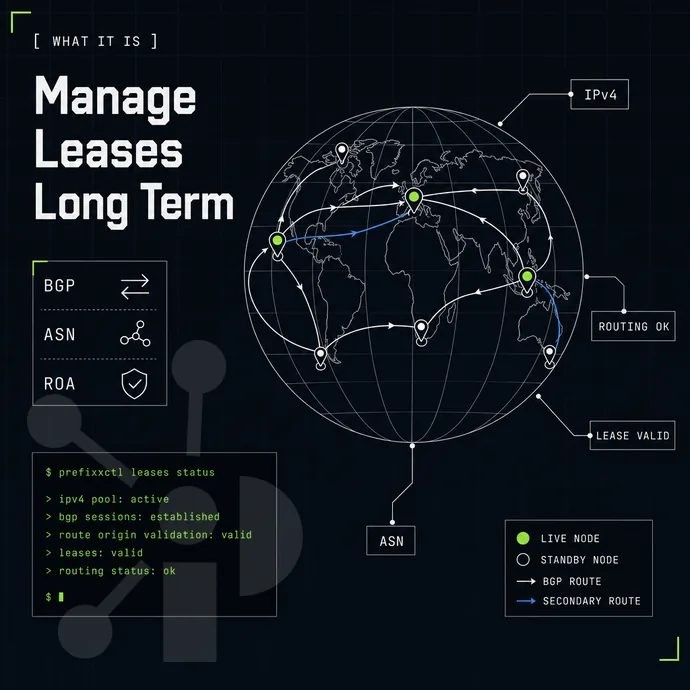
Provisioning a block of IP addresses leased by your company requires active management from the moment it is provisioned. Production traffic cleaning and control of commercial return on leased IP space is continuously managed in the background after initial setup has been completed.
Continuous monitoring and reputation hygiene
BGP monitoring at your fingers: origin ASN, RPKI validity and IRR consistency are all tracked in real time.
For delivery, we scan 12 DNSBLs including Spamhaus ZEN and Barracuda on a rotating basis. We process all Abuse complaints on your behalf to keep your IP reputation spotless.
We correct geolocation drift with our daily RFC 8805 geofeed, updated in real time in MaxMind, IP2Location, DB-IP and ipinfo.io databases.
Plan renewal and expansion decisions
When the initial lease term for your IP addresses is up, you have three choices: renew them for the same amount of time and space, increase your leased block of IP addresses in case the address capacity of your company has increased in the meantime, or rent IPv4 addresses with another, different prefix. The decision depends on how important it is for your business to have stable, own IP addresses.
Exiting a lease cleanly
When a lease expires we revoke the LOA and withdraw the corresponding RPKI ROA. We then also remove the corresponding IRR route objects from the routing registry.
However, as your capacity requires more than what you can lease, or you need to re-leasing same IPv4 space in future, buying IPv4 space in a form of an inter-RIR transfer(direct sale between two RIRs) and becoming operational owner of that IPv4 space will bring you number of advantages, including no risk of renewal and embedding of your network’s operational identity for long time to come. This transition and related advantages are outlined below.
Leasing vs buying: choosing the right operating relationship
Whether to lease or buy IPv4 address space depends on how long you need a block of IP address resources, whether you want to use registered resources to build out your network's operational identity, and how much pain you are willing to go through to transfer large blocks of IP addresses between companies.
Side-by-side IP address comparison
| Dimension | Lease | Buy |
|---|---|---|
| Ownership | Lessor retains title; you hold usage rights | Permanent ownership transfers to you via RIR |
| Cost structure | Recurring monthly fee; no capital outlay | One-time acquisition cost; no ongoing fee |
| Speed to deployment | Within 24 hours with Prefixx white-glove | Weeks; RIR transfer must complete first |
| RIR transfer required | No | Yes, across ARIN, RIPE NCC, APNIC or LACNIC |
| Flexibility | Adjustable lease duration; return or expand | Fixed; resale requires a new transaction |
| Routing paperwork | LOA, RPKI ROA, IRR prepared by Prefixx | Same structure; Prefixx handles post-transfer |
Which path fits your situation
IPv4 leasing is best suited for short- to medium-term requirements. It is used for BYOIP (Bring Your Own IP) cases and for companies that want to take control of a block which is already routed but don't wish to transfer ownership of the IP block in the RIR database. Leasing IP does not involve a broker trying to negotiate a transfer of IP registry ownership which can delay the onboarding process.
For organisations that buy IP address blocks, need a block for now and intend to use the same provider structure within their various networks for a long period of time, and wish to have their ASN registered against their own resources, IPv4 buying not leasing is the only way to replicate their registry position.
Where Prefixx fits
We handle both the lease and the buy end to end. For more information about the two models and our lease-vs-buy guide for leasing IPv4 addresses please visit Prefixx.net/lease-IPv4-addresses.
Whichever route you choose to take, the broker will determine the success of your onboarding.
Why choose Prefixx for IPv4 lease onboarding
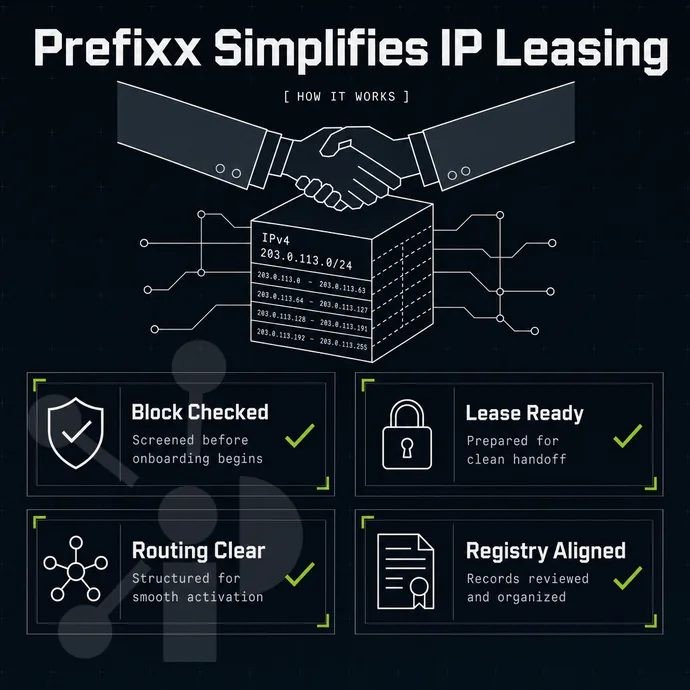
Every IP lease onboarding starts with the block itself. Prefixx runs every block through Tixx quality control before it reaches a lessee, checking ownership, address history, blacklists, and routing hygiene. You know exactly what you are renting before provisioning begins.
- White-glove routing paperwork included. Our team prepares the LOA, RPKI route origin authorization, and IRR route objects for you. Upstream providers and upstream networks accept the prefix without back-and-forth.
- Non-revocation guarantee, provisioned within 24 hours. Your production traffic runs on stable IP space for the full lease term.
- Abuse handling, reverse DNS, and IP reputation monitoring built in. The client portal covers 12 DNSBL scans, rDNS management, and geolocation databases correction from day one.
- Registered broker with ARIN, RIPE NCC, and APNIC. Senior consultants handle every deal. Zero buyer fees, escrow-secured transactions.
- BYOIP on Netrouting bare metal included. No per-IP surcharge when deploying onto dedicated servers through our operating partner.
If you are weighing renting IP addresses against buying address space outright, our consultants can walk through both paths. Explore IPv4 leasing options at Prefixx.net or contact sales to discuss your deployment region and address capacity needs.
Leasing IPv4 address space is faster and more capital-efficient than buying, but the onboarding process has real complexity. Block quality determines whether your traffic reaches its destination cleanly. Routing documentation, specifically the LOA, RPKI ROA, and IRR route objects, determines whether it reaches its destination at all. Getting both right from the start saves weeks of remediation later.
The steps covered here, requirements scoping, block vetting, and documentation, are not formalities.
If you are ready to move forward, Prefixx handles every step end to end. Tixx vets every block before it reaches you, and white-glove service covers the LOA, ROA, IRR, reverse DNS, and geolocation from day one.
Contact us to discuss your IPv4 needs today
No hidden fees, free consult. A broker replies within one business day.