
By Savvas Bout, Founder of Prefixx. Last updated 5 October 2026.
Fees charged by ARIN can surprise organizations, since in addition to charging its members. The registry charges to transfer IPv4 addresses in the free pool as well as to make changes to already-assigned address space held by the organization. Organizations should anticipate that any modification to their resource records may trigger administrative overhead and potential delays in processing the requested change.
These IPv4 IPv6 transition costs and fees can add up quickly for organizations acquiring their first IPv4 address space as well as for subsequent IPv4 address space transferred between organizations. Before closing a deal, the specific fees charged for all such activities need to be clearly tallied up and considered as another line item against your build-versus-buy budget. Organizations acquiring address space for the first time should budget carefully to account for both the upfront transfer processing costs and the recurring maintenance obligations.
In this article, we examine the different categories of fees ARIN charges for its services, including annual maintenance fees for different block sizes, as well as transfer and registration services fees charged for legacy and specified blocks of IP addresses.
We also present how ARIN’s fees compare to those of the other RIRs. We present a view of how the fees charged by the registry translate into the costs of IP addresses in a typical acquisition scenario.
We also present some cautions regarding the statements of sellers of IP addresses, particularly those who claim that a block of IP addresses is determined to be "transfer-ready". Finally, for those deciding between buying IPv4 addresses, leasing them, and bringing one's own IP blocks to a cloud or bare-metal deployment, the annual fees and other costs charged by the IP address registries are a factor that matters more than most people would expect.
What are ARIN fees and why do they exist
ARIN (American Registry for Internet Numbers) is the Regional Internet Registry for the ARIN region (USA, Canada, Caribbean and North Atlantic island nations). ARIN is a non-profit organization, funded by its customer base and not by government appropriation. For more context, see IPv4 address exhaustion.
Registration services agreement rsp overview
The registration services plan RSP is the annual fee that ARIN charges its members to access registration services. Members are placed into a RSP tier based on the amount and type of number resources that they hold. Payment in full of all outstanding fees is required by ARIN before it processes renewals or new number resource requests. Understanding which service category applies to your organization helps clarify which registration services will be available under your membership tier.
Money in the RSP is spent to run the registry on a day to day basis: to maintain databases and policy, to run WHOIS and RDAP servers, and to fund outreach to the community. The ARIN Board of Trustees sets the RSP fees each year after public comment.
What the registration services plan rsp covers
The RSP fees are not a simple overhead to run the administration. The fees go towards running the services that allow us to maintain the most up-to-date and accurate routing information. Some of the services covered are: Organizations should understand that their registration services plan tier directly determines which level of these operational capabilities they can access.
- IP address and ASN allocation and maintenance.
- RPKI certificate authority services.
- Policy development and community governance.
- WHOIS, RDAP, and DNS reverse delegation.
Legacy resources, transfer fees, and annual fees
In addition to the annual RSP fees, ARIN also charges a flat fee for resource transfers. This fee is paid by the buyer and is charged for every resource transfer regardless of whether the resources are being transferred via the primary or secondary market. The fee is accounted for by our team in all of the IPv4 IPv6 deals that we broker, and the below section outlines the fee structure for you to review against your own holdings.
Transactional fees: transfers, ASN issuance and resource requests
In addition to the annual RSP fees charged by ARIN for Registered Service Provider status, there are one-time transactional fees for items like IP number transfers, AS numbers, organization transactions, and number resource requests. All fees charged by ARIN are non-refundable, unprorateable and must be paid in full before ARIN can process your request.
Transfer processing across 3x small service categories
- For registration of transfer of IPv4 and IPv6 resources, expect to pay a non-refundable fee of $500 per transfer request. The transfer fee typically needs to be paid by both the source of the transfer and the organization requesting the transfer, and can vary depending on the type of transfer being requested.
- Resource transfers for reorganizations (including internal reorganizations and mergers) should be accounted for separately from other resource transfers. Each transfer request for a reorganization will have the same per-request fee as for other transfer requests.
Note: One deal can involve multiple transfer requests.
Autonomous system numbers and ASN issuance
- This fee is due at time of request for issuance of new ASN. It is a one-time charge for issuance of the ASN by ARIN and is in addition to the annual maintenance fee.
Organization and resource annual fees and request costs
- Fees for organization create and recovery transactions also exist and are charged as a separate transaction. This would be to create a new organization or to recover a deleted organization, each transaction having its own associated fee.
- Make sure to request the correct type of resource request. Each of the different categories of resource requests have their own fees. The fees for wrong types of resource requests are forfeited by ARIN because they cannot be refunded or transferred.
These transaction charges apply to all transactions.
Recipient transfer processing fees explained
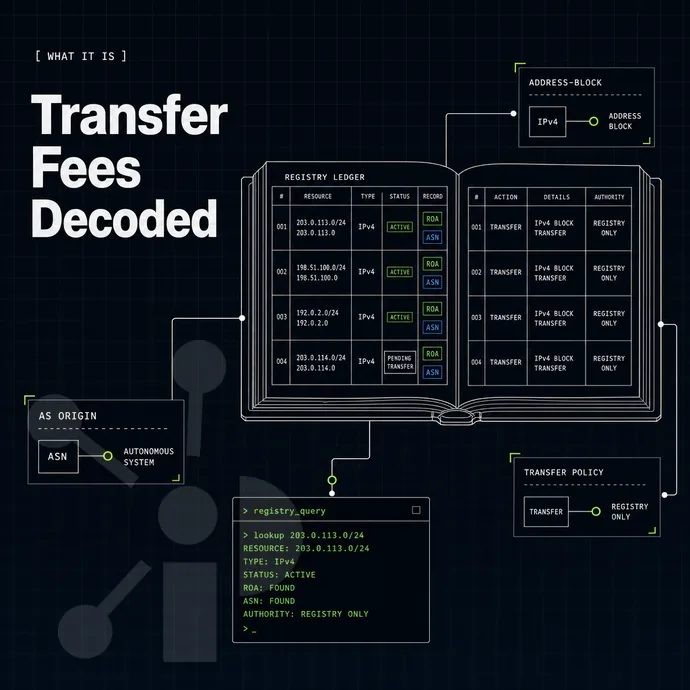
When transferring an IP address to an ARIN region, a flat, non-refundable processing fee is paid by the incoming party to ARIN. This fee is typically fixed for specified recipients and the way the processing fee is calculated as well as the resulting holdings and their effect on your annual registration fees need to be clear before you complete the transfer.
IPv4 IPv6 transfer processing fee schedule
ARIN charges a flat $500 non-refundable fee for each transfer request to register Internet number resources. The $500 fee applies whether you are purchasing a single /24 or large aggregate of Internet number resources. The $500 fee is charged at the time of submission of a transfer request, not at the time the transfer is approved. Once the request is approved, the recipient organization assumes responsibility for the resources under the terms of its registration services agreement.
Specified recipients, organizations that have pre-qualified with ARIN prior to the transfer close, go through the process more quickly, as their eligibility has already been determined and verified by ARIN. However, pre-qualification does not waive or reduce the processing fee. Pre-qualification simply confirms that the recipient meets the eligibility criteria and is allowed to receive the resources under policy.
Transfer listing service category and how listings affect recipients
The same $500 fee to ARIN for processing the transfer of IP number resources applies whether the block is sourced via ARIN’s transfer listing service or elsewhere by the buyer. The function of the listing service is to facilitate contact between would-be buyers and sellers.
Inter-rir transfers and rsp tier changes
An inter-RIR transfer of resources from ARIN to another RIR (RIPE NCC or APNIC) or vice versa has a one-time processing fee of $500 for the ARIN-side recipient of the transfer. The greater downstream cost is the shift in RSP tier.
After an inter-RIR transfer is completed, ARIN re-calculates your annual registration service fee based on your total aggregate resources held across all of your accounts with ARIN.
Check your aggregate block size after any transfer to ensure you’re at the current RSP fee tier. Tier changes take place at the billing cycle end and can have a significant impact on your annual charges.
The recipient transfer rules above apply to modern RSP holders.
How ARIN fees compare to secondary market costs
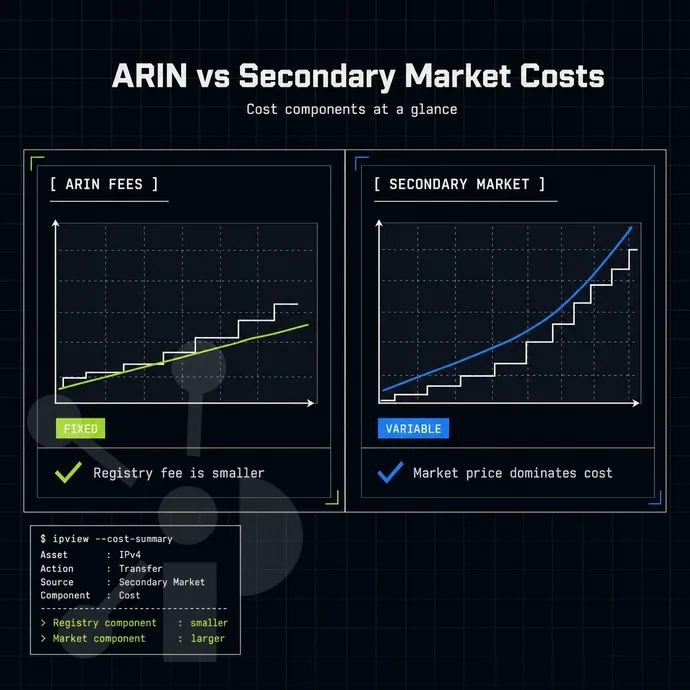
While the ARIN registration fees associated with acquiring IPv4 addresses are real, they are typically not the greatest component of cost for a buyer, who will typically find that the cost of the block(s) they are purchasing on the secondary market will constitute the lion’s share of the expense in modeling out a proposal to acquire routable addresses.
Registry annual fees: fixed and predictable
There is a one-time charge of $500 for the transfer of any block size to ARIN.
The fee for ASN registration is separate from the above fees and should be listed as a separate line item when ordering an ASN with a block of IPv4 space.
These costs are simple to reference, as ARIN publishes them.
Secondary market price: the variable that drives the difference
In nearly all IP acquisitions, the market price of the block far exceeds the cost of registration. A /24 block registered under ARIN might trade at a vastly different price than an identical block of /24 registered under RIPE NCC in the same month.
Regional premiums or discounts exist based on the RIR that holds the registration record for these legacy resources, current supply, and the block's reputation. The listing price reflects not only the block's technical characteristics but also the administrative jurisdiction under which it is registered.
In addition to the price at market, broker commissions, escrow charges and legal review add to the costs and none of these are set by ARIN.
Total cost comparison by registration services plan
| Cost component | Set by | Fixed or variable | Relative weight |
|---|---|---|---|
| ARIN transfer fee | ARIN | Fixed ($500) | Low |
| Annual maintenance (ASN or block) | ARIN | Fixed by size tier | Low to medium |
| Secondary market block price | Market | Variable by region, size, reputation | High |
| Broker commission | Broker | Variable (% of sale) | Medium |
| Escrow and legal | Third parties | Variable | Low to medium |
Treat registry fees as a known constant. Focus your negotiation efforts on the block price and broker fees. Prefixx charges no buyer fees and handles the escrow, Tixx quality check, and all of the transfer paperwork for variable costs which we attempt to keep transparent. A knowledgeable facilitator streamlines the registry interaction and ensures compliance with all procedural requirements.
Why choose Prefixx for ARIN transfers and IPv4 transactions
Prefixx is a registered broker with ARIN, RIPE NCC and APNIC (LACNIC facilitated), acting as your facilitator for resource transfers across every major RIR region. We handle the full ARIN transfer paperwork end to end, including recipient transfer processing fee guidance, so your team never has to decode the pricing schedule alone.
- Zero purchaser charges. Sellers pay a 3-8% commission. Buyers pay nothing to Prefixx.
- Tixx quality control. Every block is checked for ownership, blacklists, routing hygiene and RIR standing before it reaches you.
- White-glove routing paperwork. Our team prepares the LOA, RPKI ROA and IRR route objects on your behalf.
- Escrow-secured transactions. Funds and number resources change hands only when both sides are satisfied.
- Inter-RIR transfers supported. ARIN, RIPE NCC and APNIC transfers handled directly; LACNIC facilitated.
If you are buying, selling or leasing IPv4 address space in the ARIN region, explore our transfer services or reach out to our consultants for a personalized quote.
Registration services plan frequently asked questions
What annual fees do ARIN customers pay for a /24
ARIN's rate schedule places a single /24 in the X-Small category, which carries the lowest each year maintenance fee tier. As of the most recently published ARIN billing schedule, that tier is set at $250/year for ISP members and $100/year for end-user registrants. End users holding only a /24 for internal use typically qualify for the lower end-user rate. Check the current ARIN pricing table at ARIN.net before budgeting, as ARIN reviews its schedule annually. Organizations with minimal address requirements often find that smaller customers benefit most from the end-user rate structure when their usage remains internal.
Who pays the $500 ARIN transfer fee and annual fees, the buyer or seller?
ARIN charges the $500 transfer processing fee to the recipient, meaning the acquirer pays it directly to ARIN at the time the transfer request is submitted. The seller does not pay this fee to ARIN, though a broker's commission is a separate matter between the parties.
How do annual fees affect my rsp tier after I acquire a new block?
ARIN recalculates your registration services plan tier based on your total IPv4 holdings after a transfer completes. If the new block pushes your aggregate block size consists of enough space to land in a higher size category, your 12-month fee increases at your next billing cycle. ARIN does not pro-rate mid-year tier changes in most cases, so the higher rate typically takes effect at renewal. Review your projected total holdings against ARIN's size categories before closing a deal so the fee impact is not a surprise. Once the transfer is approved, the recalculation becomes binding and your organization is responsible for the adjusted tier rate going forward.
Are ARIN annual fees refundable if a transfer falls through?
ARIN's transfer processing fee for network address blocks and autonomous system numbers, which contributes to its operating revenues, is generally non-refundable once a request has been submitted and reviewed, even if the transfer is ultimately denied or withdrawn. twelve-month maintenance costs already paid are also non-refundable for the period in question. This makes it important to complete thorough due diligence before submitting a transfer request to ARIN. Working with a broker that runs pre-transfer quality checks on potential recipients, such as Tixx by Prefixx, reduces the risk of submitting a request that fails on eligibility grounds. Gathering complete documentation and verifying eligibility criteria in advance ensures that all necessary information is available when the request is filed.
Do legacy resource holders pay the same fees as rsp members?
Legacy resource holders have historically operated under a separate Legacy Registration Services Agreement (LRSA) with a different, generally lower fee structure than standard RSP members. Holders who have not signed an LRSA or RSA with ARIN are not subject to once-per-year pricing, but they also receive fewer contractual protections and services.
Once legacy holders who are recipients of an RSA sign the agreement or transfer their block under the standard 8.3/8.4 process, the block moves into the standard rate card service category. The practical difference in once a year cost depends on block size, but legacy status is a meaningful variable when modeling total holding costs. Organizations that choose to remain under legacy terms can continue operating without signing formal agreements, though they forgo certain registry protections.
Did ARIN fees increase in 2026?
ARIN proposed and adopted a fee structure update effective in 2026, raising year-long maintenance rates across most RSP tiers. The increases were part of ARIN's ongoing effort to align revenue with operational costs as its free pool management workload has shifted toward reorganizations resource transfers, transfer processing, and registry maintenance. Always verify the current IPv4 IPv6 schedule directly at ARIN.net, since ARIN publishes any changes well in advance of their effective date.
What is the IPv6 fee waiver and who qualifies?
ARIN offers a fee waiver that covers the full-year registration fee for an IPv6 block when the holder already pays for an IPv4 registration in the same or a higher fee tier. Organizations holding resources in the 2x small tier benefit from this waiver when they add an IPv6 allocation to their existing IPv4 registration.
End users and ISPs with an active IPv4 registration in good standing are eligible; the waiver applies to the first IPv6 allocation or assignment of equivalent or smaller size. Applicants must request the waiver explicitly through ARIN's online request system rather than receiving it automatically.
ARIN tariffs are not a simple line item in your budget. There are calendar-year registration service plan assessments, transactional levies for IP number transfers and for autonomous system number requests, and then recipient processing dues which are charged to the recipient in all transactions.
The key point to note is that transfer costs are known in advance and therefore can be budgeted for. The sender’s RSP tier needs to be checked prior to initiating a transfer. The recipient processing fee must also be allowed for in the sender’s budget.
If you are buying, selling, or leasing IPv4 space and want someone to handle the registry paperwork alongside the deal itself, Prefixx manages the full process, from Tixx quality checks on every block to LOA, RPKI ROA, and IRR preparation, with zero transferee billing amounts.
Contact us to discuss your IPv4 needs today
No hidden fees, free consult. A broker replies within one business day.