
By Savvas Bout, Founder of Prefixx. Last updated 5 October 2026.
ARIN /24s for sale may initially appear to be an easy find. Transfer timeframes, blocked IPs, and pricing all negotiate against you until you can confirm a routing problem. Given the fast-moving nature of the secondary market, blocks of IPs that appear to be clean may harbor months of remediation work, provided someone performs the due diligence in the first place.
This guide aims to cover the essential knowledge any network engineer and IP address manager should gather before buying IP addresses: the ARIN transfers, the pricing for a /24, the block history. We go over the key quality checks, the required paperwork to get a transferred IP block announced, and where leasing is more cost effective than buying. Organizations should plan their acquisition timeline carefully, as the approval and announcement steps can span several weeks depending on registry workload.
Whether you are purchasing your first block of IP addresses or adding to an existing allocation of IP addresses, the decisions you make before you sign off on the purchase are far more important than the ones you make afterwards.
So we start at the very beginning and explain what a /24 is, how it ties into your org id, and why it is by far the most common block size on the market. These considerations apply whether you are expanding through organic growth or planning strategic acquisitions that will increase your infrastructure footprint.
ARIN /24 in reorganizations resource transfers and why it matters
The A /24 is probably the most traded IP address space on the secondary market. It contains 256 IPv4 addresses and is the smallest routable prefix that most networks accept via BGP.
What your ARIN online account receives and the registry it covers
ARIN is the registry that provides assistance for North America, covering the United States, Canada and many Caribbean islands. ARIN reviews transfer requests to verify the rightful owner of the space and to ensure compliance with ARIN policy before updating the database records. The registry maintains authoritative records for all number resources assigned within its service region.
Why the free IP address pool is gone
ARIN used up its last block of free IPv4 addresses in 2015. By 2011 the five RIRs had exhausted their pools of free IPv4 addresses. Since then all new IPv4 addresses have come from the secondary transfer market. The exhaustion of free allocations forced organizations to turn to the secondary market to acquire the IPv4 space they needed.
ARIN /24 for sale: what makes this size the market standard
For the price, a single address block at /24 is large enough to be meaningful in BGP announcements and small enough to be liquid. The buyer gets a clean, routable prefix of IP addresses. Organizations looking to sell a /24 often find ready interest from hosting providers and content delivery networks seeking exactly this prefix size.
To help ensure each /24 block of IPs transfers properly, we verify every single one through Tixx before we sell it to you, checking for ownership, blacklists, and routing issues.
ARIN customers guide to transfer fees and annual registration costs
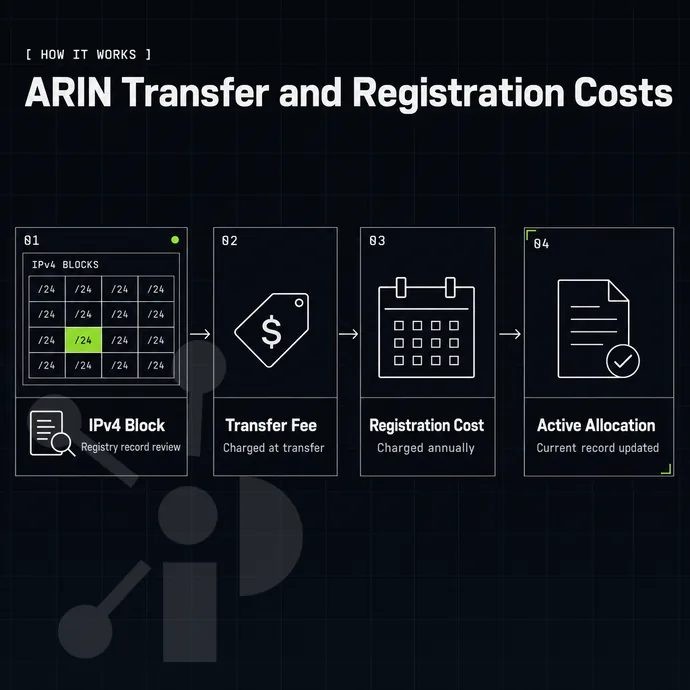
Fees are charged by ARIN at two different times during a transfer.
Org id registration services fee for smaller customers
- Please make sure the organization in question has an ARIN Online account set up prior to placing an order. The bill will be sent by ARIN to the recipient, so it is their responsibility to pay for the order.
- To process a transfer of IP numbers between organizations, ARIN needs you to submit the transfer request online and ARIN will charge a one-time processing fee.
Note: ARIN's fee schedule is public. Check it before signing a purchase agreement so the total cost is clear upfront.
Annual fees for autonomous system numbers
- Identify your post-transfer service category. ARIN categorizes organizations into tiers based on their aggregate block size (i.e. total IPv4 block held by an organization across all of their ARIN accounts, not just the newly transferred block(s)).
- Budget the recurring costs of your service in a similar fashion. The aggregate block size of your data determines which of the tiers your data falls into, and it is the characteristics of the tier that determines your annual maintenance costs.
Note: Acquiring a /24 may push your total holdings into a higher tier. Verify your current holdings before closing. Check the registry records to confirm the effective registration tier and fee schedule that will apply on the closing date.
Verification service category for IPv4 addresses
- Verifying that the transfer completed successfully and can be found in the ARIN RDAP and Whois databases after transfer completes. IP address is registered and billing to reflect correctly.
The fees for approval of a block of IP addresses are only a part of the process to transfer the addresses. The recipient must also show a legitimate need for the internet addresses in their operational structure. Organizations must demonstrate that the requested addresses will be used for active network operations rather than speculation or resale.
Why choose Prefixx for an ARIN /24 purchase
Prefixx is a registered ARIN broker that handles the full transfer process, from sourcing a vetted ARIN /24 for sale to submitting the transfer request and preparing LOA, RPKI ROA, and IRR objects. Zero procurer fees. All documentation and routing configurations are handled with strict attention to data integrity and security.
- Tixx quality control on every address block: ownership verification, blacklist checks, routing hygiene, and RIR standing before any IP addresses reach a end user.
- Escrow-secured transactions protect both sides through the full ARIN transfer process.
- White-glove routing paperwork included: our team prepares the LOA, ROA, and IRR objects on your behalf.
- Senior consultants on every deal, not a self-serve marketplace. We broker ARIN IPv4 addresses, inter-RIR transfers, and leases with the same hands-on approach.
Reach out via Prefixx.net/buy-IPv4-addresses to discuss your requirements or compare options.
Frequently asked questions about IP address
How long is the waiting list for an ARIN /24 block transfer to complete after payment?
Most ARIN-to-ARIN transfers fulfill in two to four weeks once both parties have submitted the required paperwork and ARIN has verified the transaction. Delays almost always trace back to incomplete documentation or outstanding ARIN registration service agreements, not the registry process itself. Working with a broker who carefully reviews all paperwork details before submission keeps the approval timeline tight.
Can a requesting organization outside north america buy an ARIN /24?
Yes. ARIN does not restrict transfers to North American organizations, but the receiving party must have a signed ARIN Registration Services Agreement and meet ARIN's needs-assessment requirements. An inter-RIR transfer is the more common path when the customer wants to hold the block under their own regional registry, such as RIPE NCC or APNIC. If the client is comfortable holding ARIN-registered space and meeting ARIN's ongoing obligations, a straight ARIN transfer works fine.
ARIN specified recipients vs inter-rir transfer process differences
A specified-recipient transfer moves a block from one ARIN member to another within the ARIN registry. An inter-RIR transfer moves the block out of ARIN entirely and re-registers it under a different registry, such as RIPE NCC or APNIC. Inter-RIR transfers involve both registries, take longer, and require the receiving registry to approve the transaction under its own policy. The right path depends on where the incoming registrant's organization is registered and where they plan to announce the space. Some organizations also coordinate with AFRINIC or LACNIC depending on their geographic footprint, though RSA policies vary by region.
Do I need an ASN to announce a /24 I purchase through ARIN?
Yes. To announce a /24 via BGP on the internet you need an Autonomous System Number, either your own or one belonging to a provider who will pay to originate the route on your behalf. If you do not already have an ASN, it can be sourced alongside the block deal. Alternatively, if you are deploying the space on a cloud platform or bare metal provider that supports BYOIP, that provider's ASN handles the announcement and you do not need your own.
What does tixx quality control check before a block reaches a buyer?
Tixx verifies ownership and confirms the seller has clear title to transfer the block. It checks transfer eligibility under ARIN policy, scans the block against blacklists and reputation databases, and reviews routing hygiene including existing ROAs and IRR objects. Every block receives a health report and a transfer-readiness score before it is listed or offered to a new registrant. The health report score is determined by weighing routing history, reputation signals, and policy compliance across all verification checks.
What annual fees does ARIN charge after a /24 transfer completes?
ARIN charges an annual registration fee based on the size of the network block held and the category of the registration services agreement. A /24 falls into ARIN's smallest fee tier for end-user registrations. For the current fee schedule, check ARIN's published fee table directly at ARIN.net, as registry fees are set by ARIN and can change. These are fees paid to ARIN, separate from any brokerage or transfer costs. The registry fee is distinct from the one-time payment made to the seller for the IP space itself.
Should I buy or lease an ARIN IPv4 /24 block?
Buying makes sense when the need is long-term and you want a permanent, transferable asset and resources on your balance sheet. Leasing makes sense when the requirement is short-to-medium term, capital is better deployed elsewhere, or you need space provisioned quickly without going through a full ARIN transfer.
Leased ARIN number resources from Prefixx come with a non-revocation guarantee, RPKI, LOA, and white-glove routing support, and provision within 24 hours. If you are unsure, the buy-versus-lease decision usually comes down to how long you need the space and whether ownership matters to your organization.
Buying an ARIN /24 involves justifying your needs to ARIN, determining transfer eligibility, paying ARIN fees, and configuring routing. Thus, failing to perform proper due diligence on even one of these issues, whether it's a contact record or a broader data concern, will put you on a waiting list of costly fixes that would have been far cheaper to address correctly at the top of your priorities from the start.
Prefixx handles every part of that procedure: Tixx quality control on every block, escrow-secured settlement, and white-glove preparation of the LOA, RPKI ROA, and IRR route objects your upstream will require. If you are ready to source a vetted ARIN /24 block of IPs, start with a listing inquiry at Prefixx.net and a senior consultant will put together a personalized offer within 72 hours.
Contact us to discuss your IPv4 needs today
No hidden fees, free consult. A broker replies within one business day.