
By Savvas Bout, Founder of Prefixx. Last updated 6 October 2026.
The IP rental contracts are intended to fill the gap between needing to have a routable IPv4 address block right now and the transfer queue taking weeks to move. However, not all IP address lease agreements are created equal and the actual terms and conditions in the contract can lead to a lot of headache. For organizations facing immediate connectivity requirements, rental arrangements offer a practical solution that avoids the delays inherent in formal transfers.
You could end up with a nice, clean, routable block of IP addresses, or you could get a bunch of IP addresses with some prefixes blacklisted, some of them revocable.
This guide to IP leasing will outline the essential clauses of an IP leasing agreement, including those which help to ensure that your routing will continue to work. The important difference between a non-revocation guarantee and a simple lease, RPKI ROAs and IRR route objects. A well structured lease clarifies routing responsibilities and ensures both parties understand their obligations regarding network announcements and prefix maintenance.
It also outlines scenarios where leasing IP addresses makes sense versus buying them outright, avoiding a large upfront investment, as well as key operational questions that most organizations encounter when leasing IP addresses and moving to newly leased IP space. We start with the basics of what a lease actually is. Organizations evaluating whether to lease or purchase must assess their current infrastructure capacity and determine if temporary access to additional IP resources aligns with their growth trajectory.
What is an IP leasing agreement
An IP leasing agreement is a contract between a lessor who owns a block of IPv4 addresses and a lessee who wants to use them for a certain period of time. The lessee pays a recurring fee to access the addresses. When the agreed upon time period for the lease has expired, the lessor regains ownership of the IP addresses. The lease period can range from monthly rolling contracts to multi-year commitments depending on the lessee's requirements.
The core parties involved
All leases involve three roles: the lessors who hold the IP address and registration for the block of IP addresses for the whole lease term. The lessee who gets routing rights for the lease term; and the broker who structures the commercial agreement, completes the due diligence and ensures that the agreement is enforceable. The broker's role in structuring the commercial arrangement includes verifying that both parties understand their respective rights and obligations throughout the lease term.
Our team of specialist consultants review the proposed block, which often consists of unused IP addresses, for IPv4 leasing, and prepare the LOA as well as the RPKI ROA (Route Origin Authorization) and IRR route objects for the respective parties. This thorough vetting process ensures that IP blocks meet routing and reputation standards before deployment.
What a well-structured lease covers
A well-structured lease agreement does more than specify the rent to pay, it details all the other important terms too.
- Permitted use, including any traffic-type restrictions.
- Lease duration and renewal options.
- Payment terms, including billing cycle and late-payment conditions.
- Non-revocation protections for the lessee.
- Conditions for early termination.
How IPv4 leasing differs from buying
A lessee can route a leased block and build out infrastructure on it but the RIR record for that block will remain with the lessor. The lessor typically coordinates with infrastructure providers to ensure the routing announcements remain valid throughout the lease term.
The scenario above describes situations in which leasing IP address blocks temporarily, without committing hard acquisition dollars, is important to a company, and so an understanding of how the individual block or blocks in question were carved out and allocated would be useful.
Key IP address clauses every IP lease agreement should include
A well-drafted IP license agreement will protect the interests of both parties but it is the lessee who will bear most of the risk where the relevant provisions are unclear or absent. It is therefore essential to establish the key points in the IP license agreement prior to agreement and verify them before signing. The lessee must verify that the lessor has proper authorization to lease the addresses and that all contractual obligations align with registry policies, ensuring compliance throughout the lease term.
Core commercial and routing terms
- Review the lease term and options for renewal. Identify the commencement and expiration dates of the lease and whether the renewal is automatic or if there are any notification requirements. Several disputes regarding continued service of a tenant have occurred as a result of ambiguous language in the renewal options of a lease.
- Permitted use and AUP. Description of permitted use and reference to the AUP in the agreement. Violation of the AUP may result in immediate suspension of service. The responsibility for compliance with the AUP lies with the lessee.
- Payment terms and hidden charges. Ensure that all charges are specified including setup, routing, abuse processing and renewal. One hidden charge could end up costing a great deal of money over the term of the lease.
- BGP routing rights and LOA issuance. These must be explicitly granted in the contract and the lessor must commit to issuing a Letter of Authorization for the announced block. Otherwise upstreams will not announce the block.
- RPKI ROA authorisation: get lessor to create/delegate a ROA for ASN + prefix. Announcements without RPKI-valid ROA coverage will get filtered as RPKI-invalid.
Operational protections
- This should also cover PTR records for your IP addresses and the reverse DNS delegation down to /24 level. This is important for correct email deliverability.
- Abuse handling obligations: Clearly define who is responsible to receive, log, and respond to reports of abuse. A shared or undefined responsibility to respond to reports of abuse results in delays and blacklisting.
- Non-revocation clause. This is the single most important protection for the lessee. It prevents the lessor from withdrawing the route mid-term without cause. Note: a lease lacking a non-revocation clause exposes you to sudden route withdrawal with no contractual remedy.
Contact details and governing terms
- Applicable laws and jurisdiction: The relevant law and the jurisdiction where disputes are to be resolved must be specified. Cross-border leases lacking such a stipulation are unenforceable.
- Contact information for Technical Support and Escalation. Include the names of the contacts and the expected time to respond. Also include the expected escalation path. At Prefixx white-glove service means direct access to the team that created your LOA, ROA, and IRR objects.
Once you understand the contract terms, you can draw on your IP resources to decide whether leasing a car is the right thing for you or if you should opt for buying a car outright.
IP address leasing vs long-term ownership: choosing the right model
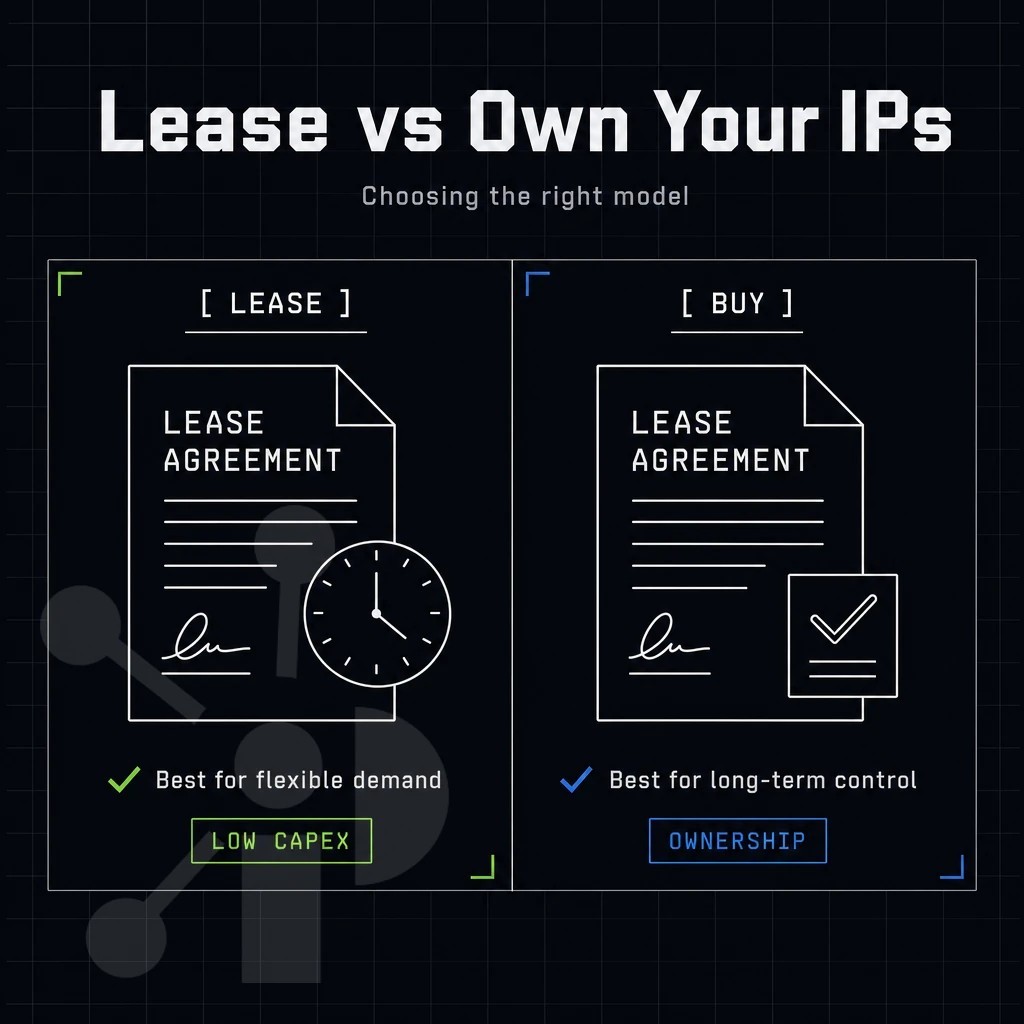
The choice between IPv4 leasing and buying IPv4 address space involves factors including the amount of capital that will be exposed, the operational flexibility required, and how long the space will be needed. Pricing structures for both options can shift based on market conditions, so organizations should evaluate their network requirements against current availability.
The cost and capital trade-off
Large upfront capital investments are typically required for purchases. Prices vary by RIR region and for different block sizes. For example, ARIN blocks and RIPE NCC blocks of identical prefix length may trade at vastly different prices. Leasing expenses can be capitalized and then spend in reasonable periodic installments to preserve capital for other parts of your infrastructure.
Long term ownership of assets builds value.
When leasing is a cost effective solution
Leasing is ideal for short-term projects, pilot environments, and fast-growth scenarios where address demand is unknown.
Our white-glove service includes online reputation monitoring and geolocation correction during lease term.
When ownership suits data centers and large-scale operators
Large and stable internet infrastructure operators with a consistent IP address plan benefit from long-term ownership. IP address holders such as data centers engaged in IPv4 leasing with stable, long-term capacities and corresponding routing stability benefit from full control over their RPKI ROAs, IRR-Objects, and transfer eligibility. There is no risk of lease expiration and no dependency on the holder of a third party. These operators typically maintain predictable capacity requirements across their data centers and can justify the capital expenditure for outright purchase.
And, no matter which model you choose to acquire, the block’s reputation and initial operational hygiene is your problem from day one.
IP address reputation, abuse handling, and operational support in a lease
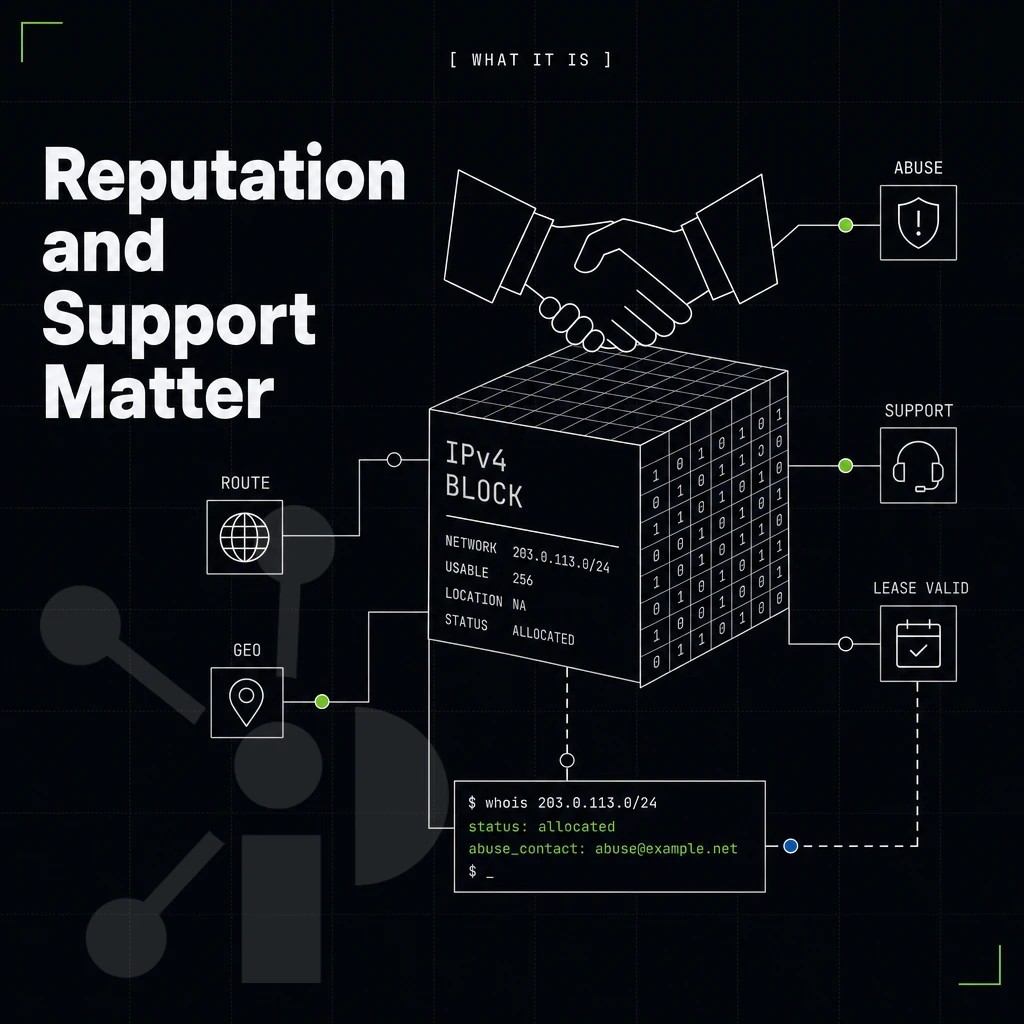
A leased block of IP addresses comes with a history. That means blacklists, misconfigurations and incorrect geolocation data follow IP address ranges from lessee to lessee. So it’s not optional to conduct due diligence before signing a lease.
What to verify before you sign
The most common error when leasing IPv4 addresses is skipping a bad-reputation history check on the IP address.
- Perform a Blacklist check against the following Spamlists: Spamhaus ZEN, Barracuda, SpamCop, SORBS, CBL.
- BGP origin and RPKI validity confirmation.
- IRR route object consistency check.
- Verification of ownership and transfer eligibility via the appropriate RIR.
For all lessees, Prefixx's Tixx quality control checks the following before the block is sent: the list of 12 DNSBLs is checked to see if a block fails to clear any of them.
Abuse handling and ongoing monitoring
Provisioning is only the start. The operational requirements continue for the whole term.
When leasing IP addresses, PTR records matter for managing IP addresses.
Operational support and regulatory compliance
Being left to struggle with operational issues after renting IP address space is not acceptable.
In addition to these tasks, organizations leasing IP address space are responsible for compliance with a host of regulatory issues regarding abuse. Our infrastructure is set up to allow your network team to focus on their jobs. The length of time you lease a block, and on what terms, affects cost and flexibility. Many organizations find that delegating these compliance and monitoring responsibilities allows their technical teams to concentrate on core network operations.
How Prefixx structures IP leasing agreements for IPv4
Prefixx is a one-stop shop for leasing IPv4 addresses.
All leases are guaranteed non-revocable and delivered within 24 hours.
- White-glove included: geo-location correction, PTR records, abuse handling, and reputation monitoring on every lease.
- IP address management portal: BGP monitoring, IP reputation scanning, rDNS tools, and geolocation updates in one place.
- We offer flexible lease terms to cover all your IPv4 leasing needs, whether you need a short-term solution for a project or a long-term contract. No hidden fees.
- Zero fees for buyers. Multilingual support team serving all RIR regions (North America, Europe, Asia, Australia, Latin America).
For organizations evaluating leasing IPv4 as a cost-effective alternative to acquisition, our consultants can match the right block size and lease term to your business needs. Reach out via Prefixx.net/lease-IPv4-addresses to discuss options. To see where leasing fits specific workloads, the scenarios below cover the most common cases.
Common use cases for IP space leasing
address rental agreements cover many more scenarios than what network staff typically expect. Leasing address block is not simply a matter of cost. Leasing IPv4 block also involves timing, flexibility, and a longer-term analysis of whether or not you really need to control the address space for the given work load. Understanding the full cost picture requires evaluating not only monthly fees but also the administrative overhead and potential opportunity cost of tying up budget in address space that may not be needed long term.
Hosting providers and data center capacity scaling
Enterprises need to get started with a colocation or cloud service provider very quickly, often within days. Leasing IP addresses is used to bridge this time gap. After a lease has been announced by BGP, the reverse DNS and the RPKI ROAs for the leased IP addresses can be set up. Proper configuration of reverse DNS records and WHOIS updates ensures that the leased addresses are correctly attributed to the lessee throughout the announcement period.
Short term leases allow companies to test demand at new locations before committing to buy a field. If not, the block is returned at the end of the lease term and no asset is left stranded.
Time-sensitive and temporary deployments
A company running a cutover from one Autonomic System (AS) to another requires a clean block of addressing space through IPv4 leasing for the entire process of the transition window, typically on the order of weeks. Leasing provides the business with temporary access to the space needed for the migration without them having to go through the full transfer process of buying the space.
Another example of temporary IoT use cases are IoT device deployments, such as a manufacturer of a seasonal logistics campaign using IPv4 leasing to deploy a large fleet of IoT connected devices for a limited period of time. They need a large contiguous IP range to fit their devices within a certain range.
It would be a waste of IP addresses if they leased a block for a year and then released it after three months, as opposed to leasing it for three months and then releasing it.
Regional constraints and rapid growth
The free pool for LACNIC (Latin America and Caribbean IP addresses) was exhausted several years ago. Organizations that require address range faster than the secondary market can supply for transfer, or where the cost to purchase is excessive, consider leasing of a /24 or larger block of IP addresses. Such a block is operational within 24 hours, and can be routed, put into service, and grown as necessary without waiting for registry updates.
Our clients using new services for some time can benefit from leasing IPv4 addresses. The leasing of IPv4 addresses for pilot projects helps to avoid the costs and risks of purchasing IPv4 addresses. When the service does scale, Prefixx can then transfer the same block of addresses or a similar one as a purchase with full documentation for transfer being provided end to end. Leasing IPv4 addresses proves particularly valuable for short term projects where the duration and scale remain uncertain at the outset.
Frequently asked questions
How does IPv4 leasing of address space actually work under a typical agreement?
An IP leasing agreement is a contract in which the owner of a registered IPv4 block grants a lessee the right to use that address space for a defined period, without transferring ownership. The contract establishes the lessee's rights and responsibilities for that specific period while the lessor retains full title to the resource.
A reputable broker coordinates the paperwork, confirms the block is clean before handover, and provisions the space within an agreed window. Prefixx, for example, includes a non-revocation guarantee with every lease and provisions within 24 hours.
How does IPv4 leasing compare to outright buying IPv4 addresses?
Buying transfers full RIR registration to the buyer, who owns the block outright and can hold, sell, or sub-allocate it indefinitely.
Buying requires a formal RIR transfer, which takes weeks and carries a one-time cost. Leasing is faster to provision and carries a recurring cost, making it the better fit for hosting providers and other organizations when the need is temporary, when capital is constrained, or when a company wants to test address space before committing to a purchase. The recurring cost structure of leasing spreads expenses over time, improving cash flow management for organizations that need to preserve working capital.
How long can an IPv4 leasing term last?
Lease terms vary widely across the market, from short-term arrangements of a few months to multi-year contracts. The right IPv4 leasing term depends on the lessee's use case: a campaign or seasonal workload suits a shorter arrangement, while infrastructure that underpins BGP advertisement or mail delivery benefits from a longer, stable commitment. Prefixx structures its IPv4 leasing agreements with a non-revocation guarantee, so the term you sign is the term you keep, without the risk of the block being pulled mid-contract.
Who is responsible for IP address abuse handling under an IP lease?
Operational responsibility for traffic generated from the leased space sits with the lessee. If the lessee's infrastructure sends spam, participates in a botnet, or triggers abuse complaints during an IPv4 leasing arrangement, those complaints route to the contact information in the LOA and in the RIR's WHOIS record.
A good IPv4 leasing agreement spells out the obligations clearly: the lessee must respond to abuse reports promptly and must not use the space for activities that violate the lessor's acceptable use policy. Prefixx's white-glove IPv4 leasing service includes abuse complaint processing throughout the lease duration, which helps lessees manage incoming reports without letting them accumulate into a delisting event.
What should a lessee check about IP reputation before signing a lease?
Before signing, verify the block against major DNS-based blocklists, including Spamhaus ZEN, Barracuda, SpamCop, SORBS, and CBL. Check whether any prefix in the block carries an active RPKI invalid or unknown status during IPv4 leasing, and confirm the routing history shows no hijacking or unexpected origin changes.
Review the block's spam and abuse history in public databases before committing to IPv4 leasing, since a block that has been used for bulk mail or credential stuffing can take months to rehabilitate even after the bad actor leaves. Prefixx runs every block through Tixx quality control before it reaches a lessee, covering ownership verification, blacklist status, routing hygiene, and RIR standing with no hidden fees on top of listed purchase prices, and provides a health report and transfer readiness score.
Can leased IP blocks be used for BGP routing and announced to the internet?
Without those three documents, upstream providers will filter or reject the announcement.
The lessee's network team then configures the prefix in their router and submits the LOA to their transit provider. Prefixx prepares all three documents as part of its white-glove IPv4 leasing service, and also supports BYOIP deployment onto Netrouting bare metal with no per-IP surcharge.
What happens to ptr records and geolocation when you lease an IP block?
PTR records are controlled at the DNS level by whoever holds the reverse delegation zone for the block. Under a properly structured IPv4 leasing arrangement over a delegated IP space, the lessor hands off the reverse zone to the lessee, who can then set per-record PTR entries to match their hostnames. Geolocation is a separate layer: databases such as MaxMind, IP2Location, DB-IP, and ipinfo.io maintain their own mappings, and those do not update automatically when a block changes hands.
Correcting geolocation for IPv4 leasing requires submitting update requests to each provider, publishing an RFC 8805 geofeed, and waiting for the providers to ingest it.
Leasing IP addresses is not simply renting out a bunch of numbers. The clauses and conditions of a lease agreement prior to signing. The state of the IP addresses’ reputation and the level of after-sales support that a provider is able to offer in the event of any abuse.
All play critical roles in determining whether or not a leased block of IP addresses will work for production use.
We will deliver the block(s) clean and free from any debris, it’s the provider’s duty to maintain the block(s) in a clean and safe condition throughout the lease term.
Prefixx IPv4 leasing comes with Tixx quality control on every block, white-glove routing paperwork (LOA, RPKI ROA, IRR), reputation monitoring across 12 DNSBLs, and a non-revocation guarantee. Contact the Prefixx team to get a personalized offer on the space you need.
Contact us to discuss your IPv4 needs today
No hidden fees, free consult. A broker replies within one business day.