
By Savvas Bout, Founder of Prefixx. Last updated 6 October 2026.
The price for IPv4 is increasingly uncertain and there are many procurement decisions for IPv4 in 2026 that will be taken in a restricted environment of limited supply and rising demand. The trends for the secondary market for IPv4 in 2026 show a transfer ecosystem in increasing strain, with the free pools of IPv4 at the Regional Internet Registries (RIRs) having already long been exhausted. This scarcity reflects the fundamental exhaustion of a finite resource that cannot be expanded to meet growing connectivity requirements.
The availability of entire IPv4 blocks for businesses is decreasing at ARIN and RIPE NCC, while the number of IPv4 lease transactions is increasing. This is because Many organizations prefer to rent IPv4 addresses rather than to purchase them for cash upfront. Understanding these trends is essential for planning future network capacity and infrastructure investments.
If you are a network engineer or manage IP addresses for your company, this article will cover some practical considerations for buying and leasing IP address space. We will examine current pricing for /24s and /20s, look at how the valuation of IP address space by ARIN and RIPE NCC compares. Careful planning ensures that the block size you acquire aligns with both current operational requirements and anticipated growth over the next allocation cycle.
Additionally, Cover some of the factors that influence pricing, including whether or not. leasing IP address space is now more cost effective than buying it .
We will also look at the impact of a block’s reputation on its effective acquisition cost and attempt to provide some clarity on the current state of the IP address space market and what that means for your next acquisition or lease of IP address space. Understanding these dynamics now helps position your organization to navigate future shifts in availability and pricing with greater confidence.
For a complete overview, explore our ipv4 market trends 2026 guide.
IPv4 market trends 2026: what is driving prices and demand
2026 is a turning point for the IPv4 market.
What is driving demand for security platforms in 2026
Three main factors are currently compressing supply.
Finally, large Enterprise networks are growing in part due to the hybrid work model and edge computing.
On the Internet, many transit networks and big content providers are running dual-stack, i.e. they have to hold their existing IPv4 addresses for a long time while they slowly start to deploy IPv6. Organizations maintaining dual-stack configurations must carefully plan their deployment timelines to ensure seamless connectivity across both protocol versions.
IPv4 addresses: the data scarcity dynamic
There are roughly 4.3 billion IPv4 addresses in total and they won’t grow any further. The prices for these address space blocks reflect this fact. An analysis of current IPv4 address transactions, as recorded by active transfer registries. Also shows a clear trend: the price per block significantly varies depending on the RIR region in which the address space was allocated, the size of the block and the respective IP routing history.
A /24 registered under ARIN and the exact same IP block registered under RIPE NCC can have vastly different valuations in the same month. We outline this regional pricing in more detail below in the pricing section.
What this means for buyers and sellers
The market for buyers of real estate has grown thinner as the number of motivated sellers on the market has decreased. The value of appreciated real estate has increased consistently for sellers of real estate. REX consultants work with both sides of the market and identify quality real estate “blocks” and pair them up with qualified buyers in escrow-secured transactions.
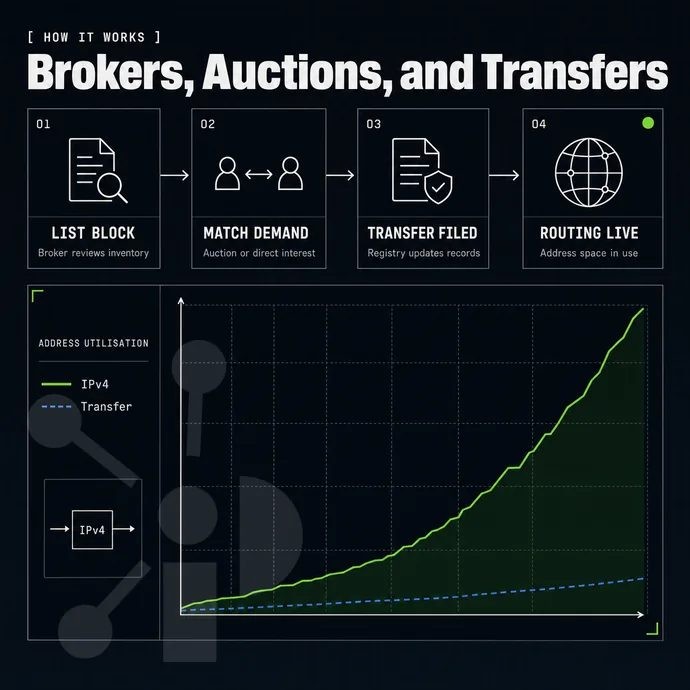
To understand how these transactions work, it is first necessary to understand the mechanics of the transfer market. REX consultants remain committed to transparency and compliance throughout every stage of the transfer process.
How the IPv4 transfer market works in 2026
The only way to get IPv4 addresses on the secondary transfer market. The free IPv4 addresses pools of the RIRs have all been depleted between 2011 and 2020. Therefore every IPv4 address block in use today was allocated and is now being transferred from one party to another through a recorded registry transfer. Organizations that delay their acquisition strategy may find themselves waiting longer as available inventory continues to shrink.
IPv4 market mechanics for network operators
Intra-RIR transfers are limited to the one registry while Inter-RIR transfers cross registries (e.g. a block of IP number resource is being moved from ARIN to the RIPE NCC). All such transfers require registry policy approval, verification of the identity of the businesses and parties involved, and a formal inter-RIR transfer request. Five registries support the transfer of IPv4 address space as well as AS Numbers, including legacy numbers.
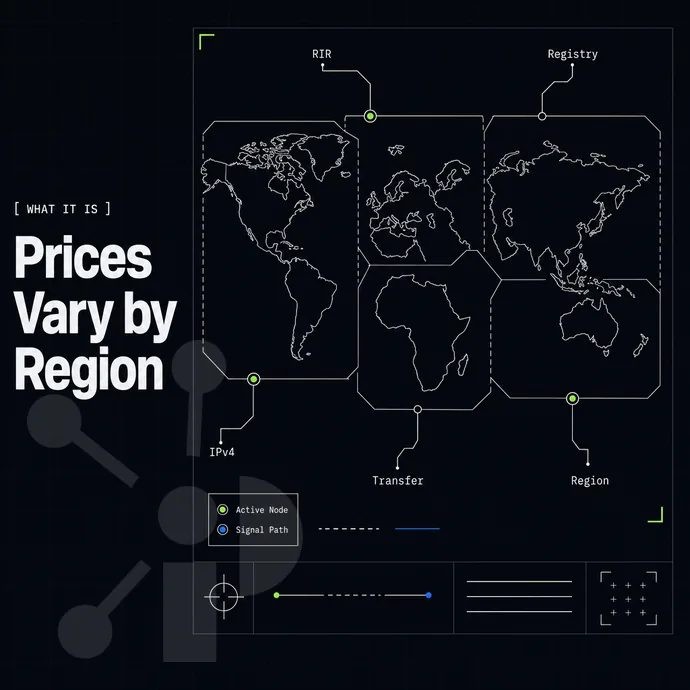
Prices for IP space vary by region. A /24 under ARIN may trade at a different price to an identical /24 under RIPE NCC in the same month. Price also varies with block size, buyer reputation, and IP routing history.
Transfer activity and who drives it
The demand for IP space comes from cloud operators, carriers and enterprise networks looking to add capacity. The seller typically is a company looking to consolidate their services or exit a particular region. A good broker handles the escrow for the buyer and negotiates the complex routing documents that most businesses and potential buyers find to be a significant obstacle. Organizations evaluating their infrastructure roadmap often weigh lease-to-own models that support gradual expansion without large initial outlays.
Where Prefixx fits in the data industry
| Transfer type | Registries involved | Typical complexity |
|---|---|---|
| Intra-RIR | One (e.g. RIPE NCC) | Lower; single policy set |
| Inter-RIR | Two (e.g. ARIN + APNIC) | Higher; dual policy, longer timeline |
As Prefixx is registered with ARIN, RIPE NCC and APNIC (with LACNIC facilitation) the best route for a transfer in this market is via Tixx, and that distinction matters, with full quality control running on each block prior to sale. As with all transfers in this market the above points are critical for a smooth transfer. Having covered how the transfers work in the Prefixx market, we can now look at what you can expect to pay.
IPv4 address prices by block size and region
The prices of IPv4 addresses are not equally priced by all registries and can vary greatly based on the region of the registry of the block in question. The size of the block, as well as current market demand.
There is no centralized authority to guide prices, thus buyers must be aware of the prices’ variables to avoid overpaying or misreading an offer. Pricing disparities between regions reflect differences in local regulatory frameworks, transfer velocity, and the concentration of legacy allocations held within each registry's jurisdiction.
Block sizes and competitive pricing per IP
Pricing is usually quoted on a per IP basis.
Small blocks of IP addresses carry a high per IP premium.
Regional variation in smaller blocks vs larger blocks
The price for a /24 under ARIN versus the same size block of IP under RIPE NCC varies greatly month to month, and neither number is officially published.
Working with incomplete market data on growth
There is no exchange that publishes live transaction prices.
Note: Quoted per-IP rates can look similar across regions while total block costs diverge significantly.
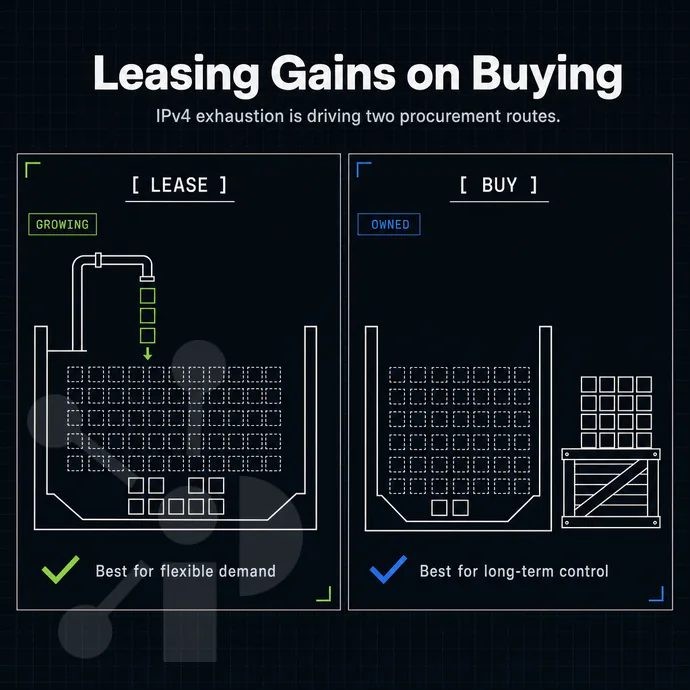
While price is one factor to consider in the decision to rent or buy, for many networks in 2026 the question of whether to buy at all versus leasing is likely to be far more significant. Organizations evaluating these options should consider not only immediate costs but also how each approach positions them for future network expansion and operational flexibility.
Leasing vs buying IPv4 addresses: which trend is growing
The IPv4 market is branching out into two different procurement routes.
Why leasing is gaining ground and growth
Per-IP charges for cloud providers have become the norm over the years. Monthly charges for Elastic IPs, for example, as well as for Azure public prefixes, are business as usual. Therefore, leasing IP block from a broker follows the same pattern. Normalizing IP range charges for seasonal campaigns, regional rollouts or short-term migrations to the cloud over long periods of time simply doesn’t make sense.
Procurement times for leasing are also greatly reduced when compared to purchasing as transfer paperwork can take weeks to process in some RIR regions. Organizations considering lease agreements should understand that processing times vary by registry, though most transfers are expected to complete within documented timeframes.
When buying still wins for long-term growth
We believe that buying is best suited for high utilization / long-term requirements. Anchoring core parts of your IT-infrastructure to a block of IPs allows networks driving global adoption to enjoy the typical benefits of ownership: no risk of having to renew, full transfer rights, optimal cost in the long run. Ownership ensures that critical resources remain under direct control without dependency on third-party lease renewals or availability constraints.
Inventory and utilization considerations for monitoring platforms
Rather than selling underused space, many owners list it for lease. Many buyers require space to grow to a certain block size, but start off by leasing the space and converting to a purchase later. Organizations often lease blocks initially to test infrastructure requirements for specific projects before committing to ownership.
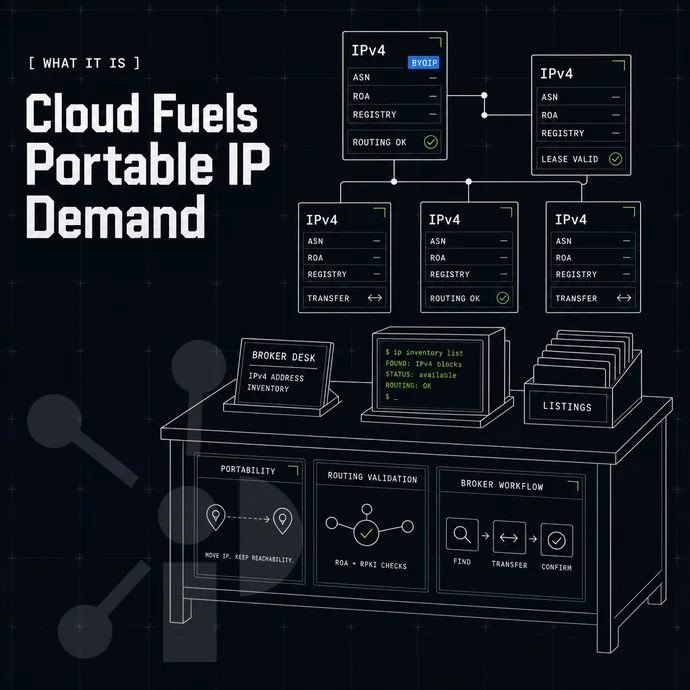
Prefixx supports both models of purchase, provides white-glove service for all leases to support your growth, and has a non-revocation guarantee for the full term of the lease agreement. As cloud services become more relevant to Prefixx customers, the typical lease vs. buy calculation changes, especially for those with existing BYOIP workloads running in the cloud. This flexibility allows organizations to create scalable infrastructure strategies that align with their operational requirements and financial constraints.
Cloud providers, BYOIP, and the demand for portable address space
Cloud infrastructure growth is reshaping IPv4 demand. As AWS, GCP, Azure, OCI, and Cloudflare expand their BYOIP programs, operators increasingly want portable blocks they own outright, not addresses rented per-resource from a platform.
IPv4 demand and the BYOIP shift among customers
BYOIP allows you to announce your own IP allocation within a cloud provider’s network. It’s your IP inventory, and you’re the owner.
There’s a simple cost model at play here. While you pay per Elastic IP or equivalent for a Cloud Provider, the cost at scale is very high. Purchasing or leasing a block of IP addresses converts a variable cost into a fixed cost. Organizations that lease or purchase blocks can create predictable budgets and avoid the per-unit charges that scale unpredictably with usage.
What BYOIP requires in practice
Onboarding processes on all platforms differ from one another. Typically, an LOA (Letter of Authorization), RPKI ROAs (RPKI Route Origin Authorizations) and IRR route objects (Internet Routing Registries) must be created and accepted by the announcement prior to propagation. My team assists businesses with preparing these documents, as well as completing the paperwork for announcements across regions on AWS, GCP, Azure, OCI and Cloudflare.
BYOIP is native on Netrouting bare metal hosting and is not charged per IP on the hosting platforms built on top of this infrastructure.
Future-proofing your address strategy
The portable IP resources we provide enables maximum flexibility in the evolving IT infrastructure. An address block, sourced through Prefixx, can be used by businesses in all cloud environments as well as on bare metal or in a colocation. This portability ensures that organizations can migrate workloads seamlessly across different infrastructure platforms without renumbering.
Why work with a registered IPv4 broker in 2026
Not every block on the transfer market is clean. Unvetted IPv4 addresses carry real risk: blacklisted space, failed RIR transfers, and routing hygiene issues that follow buyers into production. A registered broker removes that risk before it reaches your infrastructure.
- We work with registered holders (with ARIN, RIPE NCC and APNIC number allocations) to transfer IP numbers between parties in all five RIR geographic regions. We have particular experience of IP number transfers that involve facilitation with LACNIC.
- We at Tixx exercise quality control for every single block. That means we check for ownership / transfer eligibility / blacklists as well as proper routing. Also, we provide a transfer readiness score before you can buy the block from the creator.
- We are doing Escrow-secured transactions. We charge ZERO to buyers. The sellers only pay a 3% to 8% commission on the close of a successful transaction.
- We include white-glove service in leases and handle geolocation correction, reverse DNS, reputation monitoring, IP blacklist scanning and handle abuse complaints for you.
- BYOIP deployment support. This includes LOA (Letter of Authorization), RPKI ROAs (Resource Public Key Infrastructure Route Origin Authorizations), and corresponding IRR route objects ready for use by your team on your choice of bare metal or cloud providers.
Whether you’re purchasing, leasing or planning to transfer a service between RIRs, we’d be happy to talk through your needs with you. Careful planning ensures that your allocation aligns with both current operational requirements and future network architecture decisions.
Frequently asked questions that remain steady
How does global internet adoption among customers affect IPv4 transfer activity and prices in 2026?
The five RIRs exhausted their free pools between 2011 and 2020, so every block traded today comes from the secondary market, as expected. Demand keeps climbing as cloud deployments, hosting providers, and enterprises expand their routable footprints. Supply is structurally fixed at roughly 4.3 billion addresses total, and large holders rarely release significant inventory at once. That imbalance between growing demand and a hard ceiling on supply is the primary engine behind prices. Each new deployment typically requires a contiguous block of routable addresses, further tightening the available pool.
Will IPv4 prices for customers keep rising or stabilise in 2026?
The consensus among market participants is continued upward pressure, not stabilisation. No new supply mechanism exists, and the organisations sitting on legacy allocations have little incentive to sell at current rates when prices have trended higher year over year. Leasing has absorbed some demand that would otherwise push purchase prices higher, which may moderate the pace of increases without reversing the trend. Organizations that delay their acquisition strategy risk waiting through successive price increases as the structural imbalance persists.
How does block size affect the IPv4 address prices that customers pay?
Smaller blocks, particularly /24s, typically command a higher per-address price than what's expected for larger allocations such as /20s or /16s. purchasers of small blocks are often willing to pay a premium for the exact size they need, while large blocks require a narrower pool of acquirers with both the capital and the operational expansion capacity to absorb them.
Routing policy and data from global BGP tables also plays a role: a /24 is the minimum prefix most networks will accept, making it independently usable and therefore more liquid. Block quality, RIR region, and reputation history layer on top of size to produce the final market rate. Different RIR regions impose varying transfer policies and documentation requirements that can affect block liquidity and final pricing.
Is leasing IPv4 addresses cheaper than buying in 2026?
Leasing carries a lower upfront cost and converts a capital expenditure into a predictable operating expense, which suits organisations with short-term or variable IP needs. Buying transfers permanent ownership and eliminates recurring lease fees, so businesses typically enjoy a lower total cost over a multi-year horizon. Organizations with predictable long-term utilization patterns typically favor ownership, while those facing uncertain growth or project-based deployments often choose leasing to match expense with actual usage.
The crossover point depends on current purchase prices, lease rates, and how long you actually need the space. If your requirement is temporary, seasonal, or tied to a single project, leasing is almost always the more cost-effective path. Organizations with predictable, long-term utilization patterns may find that ownership delivers better economics over a multi-year horizon.
Why hasn't IPv6 adoption reduced demand for IPv4 addresses?
Most public internet infrastructure, legacy applications, and customer-facing services still require IPv4 reachability to function correctly. Dual-stack deployments add IPv6 alongside IPv4 rather than replacing it, which means IPv4 demand does not shrink even as IPv6 grows. Until the majority of end-user networks, CDNs, and enterprise applications are IPv6-only, IPv4 addresses remain operationally necessary. Organizations planning their network architecture must account for the continued operational necessity of IPv4 in any deployment strategy.
What is an inter-rir transfer and how long does it take?
An inter-RIR transfer moves an IPv4 block from one regional registry to another, for example from ARIN to RIPE NCC, changing both the administrative data on record and the routing origin. ARIN, RIPE NCC, and APNIC all support cross-registry transfers directly to accommodate growth; LACNIC transfers are facilitated rather than executed through a standard bilateral policy.
Timelines vary by registry pair and the completeness of the data submitted in your paperwork, a distinction that matters here, so working with a registered broker who handles the LOA, RPKI ROA, and IRR objects reduces delays significantly. Prefixx manages inter-RIR transfers across all participating registries as part of its brokerage service.
How do I know if an IPv4 block is clean before I buy or lease it?
A clean block has clear ownership records at the relevant RIR across all block sizes, no outstanding blacklist listings across major DNSBLs, consistent routing history, and no abuse complaints that could trigger carrier filtering. You should verify RPKI validity, check IRR route objects for accuracy, and run the prefix against reputation data from lists including Spamhaus ZEN, Barracuda, and SpamCop before committing.
Prefixx runs every block through Tixx, its pre-transaction quality control process, which covers ownership verification, transfer eligibility, blacklist scanning, and routing hygiene, with all data checked before a single move is made. The result is a health report and a transfer readiness score delivered before any deal closes.
In 2026 the IPv4 market will continue to be characterized by three main factors: the secondary market will remain as the only channel to acquire IPv4 addresses as the free pool has already run out, prices will vary extremely based on the IP block size as well as the RIR where the IP addresses are registered and the growing demand for IPv4 address leasing as an alternative to purchasing IP addresses.
Whether you are acquiring one of the larger block sizes for long-term infrastructure or leasing addresses to meet a short-term capacity need, the details matter: RIR eligibility, transfer timelines, blacklist history, and routing hygiene all affect what you pay and how quickly you can route.
Prefixx handles every one of those industry variables, a trend toward full-service brokerage, to support companies' growth, from Tixx quality checks before a block changes hands to white-glove LOA, RPKI ROA, and IRR paperwork after.
Contact us to discuss your IPv4 needs today
No hidden fees, free consult. A broker replies within one business day.