
By Savvas Bout, Founder of Prefixx. Last updated 23 September 2026.
Choosing between a lease dedicated IP and BYOIP will affect more than just your routing table.
What additional paperwork you'll need, and whether you can bring your own IP addresses to new providers or not.
When choosing between leasing a dedicated IP block and bringing your own IP (BYOIP) to a new infrastructure host, there are four key variables to consider: ownership of the IP space, operational control of that space, the time to announce (or provision) the space, and the total cost of carrying that space over time. These considerations span the entire network stack, from the address layer up through routing policy and application configuration.
A leased dedicated IP block comes with a ready-to-deploy block of IP address space that has already been configured for basic monitoring and includes reverse DNS and RPKI. The block is cryptographically signed using resource public key infrastructure to validate origin authenticity.
BYOIP enables you to use addresses you already own to provision space on whatever host you select, such as Google Cloud, with LOA. ROA and IRR objects possibly left to be configured by the host or its provider, or by you. This approach is common when migrating workloads between cloud infrastructure providers while preserving existing network configurations.
Both models have their validity, and no single approach is necessarily better than the other. Below we will explore each model in greater detail and discuss the key variables that influence the choice for network engineers and IP address managers making a budget-year decision.
What leasing a dedicated IP address actually means
Dedicated IP leasing is renting out one or more public IP addresses to their current holder(s) for a fixed time span. Leasing Dedicated IP addresses grants you full control over the routed IP addresses for the term of the lease. Keep in mind that you don’t actually own the IP address space, it will revert back to the IP holder(s) once the agreed-upon time span has expired. The lease arrangement typically includes routing support and basic monitoring at no extra cost during the term.
What you actually receive from a cloud provider
We set up the LOA for you when the lease starts. We set up the RPKI ROA and IRR route objects for your announced IP prefixes so they route cleanly under your ASN. We also set up reverse DNS delegation for you so you can manage the PTR records for your announce within the Prefixx portal.
The regional internet registry records are kept under the original holder's name. This is a fundamental difference between leasing and buying IP addresses: you are operating the block under the cloud provider's ASN, but the RIR records will always list the original owner of the block, not you. Organizations that eventually want to own ASN resources typically begin by leasing under a provider's infrastructure before transitioning to their own registry allocations.
IP address rights and the non-revocation guarantee
This clause prevents a holder from revoking a block of IP addresses during the lease term. Provisioning of IP addresses occurs within 24 hours of lease agreement signing.
When leasing fits better than bring your own IP solutions
Leasing is suitable for companies that need a clean, routable IP address quickly and do not want to buy hardware. Cases are:
- Short-term infrastructure projects or seasonal capacity.
- Testing reputation before committing to a permanent block.
- Bridging the gap while transfer clears at RIR.
But if ownership and portability matter more than speed, BYOIP is a completely different approach.
Pros, cons and trade-offs of each approach
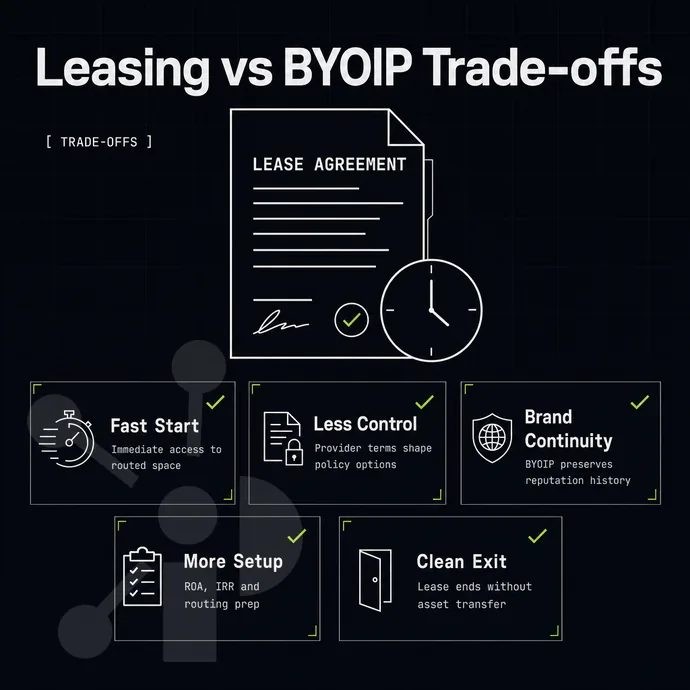
These two strategies solve the same problem but from opposite angles. Leasing Address Space provides immediate access to clean IP Address space without the need to spend your capital. Bring Your Own IP (BYOIP) allows you to own your IP block and take your reputation with you to other environments. Organizations seeking more control over their networking infrastructure often prefer ownership models that allow portability across platforms.
Leasing IPv4 addresses: strengths and limits
- Fast provisioning with white-glove setup. We can provision your leased blocks of IP in less than 24 hours, with geo-location correction, rDNS, and reputation monitoring across 12 DNSBLs. We handle all the RIR paperwork for you.
- No ownership risk. Any blacklisting issues of a block leased are the lessor’s problem. You will not have any long term issues with a leased block as it will be returned to the lessor at the end of the service period.
- Ongoing cost with no equity. The monthly payment continues for the life of the lease. Unlike purchasing a piece of equipment and building value over time, with a lease you have spent money on something with no value after the lease ends. Many SaaS platforms use leasing for addresses that are only needed for a short period of time. But for long-term use of infrastructure to support your SaaS, the cost really adds up.
Note: Confirm non-revocation terms before signing. A lease without a non-revocation guarantee on your IP prefixes can leave load balancers and outbound mail flows dark mid-contract. Registry policies typically impose a maximum prefix length that can be announced, so verify your block meets those requirements before committing to a lease.
BYOIP: IP address strengths and limits
- Keep a consistent network identity across all your migrations. Your own block of IP addresses travels with you from on-premises to cloud and back again. No re-IP’ing, no updates to allowlists, and your partners who filter by source IP address will continue to work with you too.
- Paperwork and minimum prefix size. All cloud BYOIP offerings require a signed message for message ownership and a BYOIP prefix of minimum /24 size (some even require /23 or larger). Minimum prefix size varies by region and provider.
- Initial capital expenditure to acquire the block prior to being able to deploy it. With free pools now exhausted, secondary market acquisition becomes the only option, incurring additional cost prior to day one of deployment.
Note: Watch for the pending advertisement state during cloud onboarding. Some providers hold the prefix in that state for hours while they verify ROA and IRR records. Plan for that window in your cutover schedule. The verification process applies equally whether you are working with an imported range or a newly allocated prefix.
It's nice to read about the trade-offs in the abstract, but to really understand how they play out across a particular workload's address range and access patterns within your chosen cloud provider, you need to see them in action.
Common use cases: when each option fits
The right choice between leasing a dedicated IP and bringing your own prefix depends on your situation and how fast you need to move.
When leasing a dedicated IP address fits
A small team validating an email delivery service benefits greatly from leasing a clean, routable block of IP addresses for a short period of time.
Additionally, they don't have any capital to throw at the problem, nor do they want to deal with the paperwork involved in establishing a network identity through a RIR or switching to a new cloud provider to obtain a fresh block of IP addresses. Services like amazon ses often require stable sender reputation, making a leased block an attractive option for teams focused on transactional messaging.
For companies without existing IP addresses, we make the perfect tenant. The lessee gets a fully reputation-checked address range prefix ready for routing, without having to deal with the registry to manage the objects. Registry verification steps typically require applicants to prove control through technical demonstrations or documentation before any transfer can proceed.
When BYOIP fits your IP address needs
Additionally, organizations are required to maintain allow lists covering every approved address range and other forms of proof of compliance with laws governing email communications. All of this can be thrown down the drain when workloads move but keep the same addresses, whether running on virtual machines on new cloud providers or across many regions within AWS. When infrastructure spans multiple internet service providers, maintaining consistent addressing becomes critical for firewall rules and access policies.
Organisations in financial services and healthcare are required to adhere to strict partner allowlisting of public IP addresses and auditing. An imported address range with a history is far more likely to meet these requirements than a newly leased or assigned block of addresses. Regulatory frameworks in certain industries mandate that third-party integrations be pre-approved at the network layer, making address portability a compliance requirement rather than a convenience.
Disaster recovery and migration scenarios
When a primary environment goes down, a standby environment can begin to re-advertise the same prefix and address range, all without a DNS cutover or partner notification cycle. The same use case exists for on-premises to cloud migrations, where IP continuity preserves an established reputation and is critical to allowing the maximum amount of existing integrations to function within a specific window. Organizations executing a cloud migration often rely on this address portability to minimize downtime and preserve service continuity during the transition.
For highly regulated industries, IP continuity is a matter of compliance. Prefixx can assist in preparing LOA, ROA and IRR objects for BYOIP deployments. All the necessary routing paperwork will be completed before the first BGP session is brought online.
The use cases described above follow a similar structure and can be compared in a Google Cloud comparison table with the essential dimensions.
Side-by-side: lease dedicated IP vs BYOIP
Leasing a dedicated IP address versus BYOIP migration has three main factors at play: who controls the address space and its regional internet registry records, how quickly you need to bring up service, and how much control over routing you actually need. BYOIP offers greater control by keeping registry ownership in your hands, while leasing trades that autonomy for speed and simplicity.
IP prefixes at a glance
| Dimension | Lease dedicated IP | BYOIP |
|---|---|---|
| Ownership | Provider retains title; you get usage rights | You own the block outright |
| Upfront cost | Low; no acquisition spend | High; purchase price plus transfer fees |
| Speed to deploy | Within 24 hours with Prefixx white-glove | Days to weeks; RIR transfer must complete first |
| RIR paperwork burden | Minimal; LOA and RPKI ROA handled for you | Full transfer: LOA, ROA, IRR route objects required |
| Cloud compatibility | Works on any provider's network; cloud BYOIP programs accept imported addresses | AWS, GCP, Azure, OCI, Cloudflare all support imported ranges |
| IP reputation control | Shared history; Tixx scans 12 DNSBLs before handover | Full control; history travels with the block |
| Block portability | Cannot re-advertise outside the lease arrangement | Portable across partner networks and clouds |
| Minimum block size | /24 typical | /24 minimum for BGP announcement |
| When the arrangement ends | IP space returns to lessor; you lose the prefix | Block stays yours; move it anywhere |
IP address space and cloud migration fit
Leasing is suitable for teams that require immediate deployment of clean, routable IP addresses, without the need to purchase an entire IP address block. BYOIP is suitable for operators who already own a block of IP addresses and require the ability to announce those from bare metal or within a cloud region. BYOIP is particularly valuable when workloads must remain portable across different infrastructure types or when a consistent addressing scheme is required in a hybrid cloud environment.
BYOIP migration: what our team handles
Our consultants will create LOA’s, RPKI ROA’s and IRR route objects for you. We enable BYOIP on our bare metal servers without any additional per-IP cost. For cloud servers we support BYOIP for AWS, GCP, Azure, OCI and Cloudflare.
Now you know how to compare models like route origin authorization and bring your own IP, here are three diagnostic questions that will help you decide which one is best for you. Route origin authorization relies on RPKI validation to ensure that announcements match the legitimate holder of a prefix.
How to choose between leasing and BYOIP
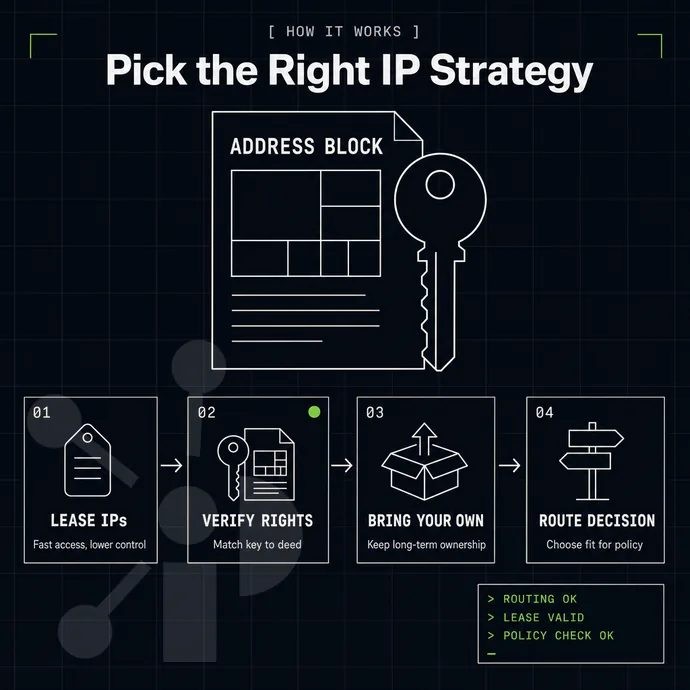
Three key questions to distinguish between the right choice and the overpriced option.
Do you own a registered block?
If you already own a registered /24 or greater, the BYOIP approach can work for you. Your infrastructure provider can complete the LOA, RPKI ROA and IRR route objects for you, and announce your IP address on the global internet under your own ASN. Leasing an unregistered /24 is often much faster than going through the RIR transfer process, and can be provisioned in 24 hours or less with proper vetting, all without any RIR transfer paperwork needed.
Some operators first lease IP addresses and then convert them to BYOIP after a while when their traffic volume is big enough to warrant buying the IP addresses for the long haul. Once ownership transfers, operators can then re advertise those blocks under their own autonomous system number with complete routing autonomy.
IP reputation and address history
Leased IP from a good source can be sent to you with a clean slate and no history. This would typically be used for email delivery or payment processing where the reputation age of public IP addresses is a significant factor. However for general access control or compute workloads a freshly vetted block of IP would typically be sufficient.
Google cloud infrastructure, provider options, and time horizon
Cloud BYOIP programs, such as Google Cloud’s, usually require a minimum size for the prefix to be brought to cloud and proof of ownership. These programs are best suited for long-term hosted infrastructure in a single cloud provider’s environment. Leasing is better for shorter to medium-term needs across multiple AWS regions where flexibility is worth more than owning.
| Dimension | Leasing | BYOIP (own IP) |
|---|---|---|
| Ownership required | No | Yes, registered block |
| Time to provision | Within 24 hours | Days to weeks (RIR + LOA) |
| Reputation history | Clean but no prior record | Preserves existing record |
| Best horizon | Short to medium term | Long-term infrastructure |
| Cloud compatibility | Via cloud provider BYOIP programs if owned | AWS, GCP, Azure, OCI, Cloudflare |
In contrast, if you own IP addresses in a clean block and are building out a long-term infrastructure, you can bring them with you via BYOIP and we handle all the necessary routing paperwork for you. This approach ensures continuity when migrating workloads between hosting environments or negotiating terms with a new infrastructure provider.
Why choose Prefixx for IPv4 leasing and BYOIP support
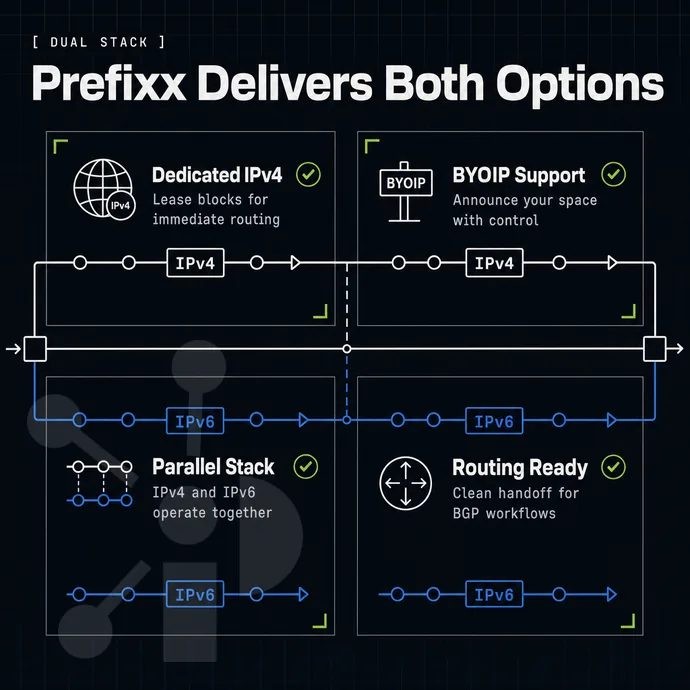
Prefixx is a boutique IPv4 brokerage and bring your own IP specialist registered with ARIN, RIPE NCC, APNIC and LACNIC (facilitated), operating since 2018. Whether you need to lease dedicated IP addresses or bring your own IP range into a cloud provider, our senior consultants handle every detail.
- Lease with confidence. Every block passes Tixx quality control before provisioning. Leases carry a non-revocation guarantee, provisioning within 24 hours, and white-glove service including reverse DNS, geolocation correction and reputation monitoring across 12 DNSBLs.
- BYOIP, fully handled. Our team prepares the LOA, route origin authorization (ROA) and IRR route objects. BYOIP is natively included on Netrouting bare metal with no per-IP surcharge. AWS, Google Cloud, Azure, OCI and Cloudflare programs are all supported.
- Clean RIR records, every time. We verify ownership, regional internet registry (RIR) standing and routing hygiene before any address range changes hands or goes live.
- Zero buyer fees. Sellers pay a 3 to 8 percent commission. Buyers pay nothing extra.
If you are weighing a lease against a full IP portability transfer, explore IPv4 leasing options or review BYOIP deployment support and reach out to compare options for your address space.
Leasing a dedicated IP gives you speed and simplicity: a vetted block, routing handled, and a predictable monthly commitment with no transfer paperwork. BYOIP gives you ownership continuity and full control over your imported prefix reputation history, but it demands more coordination across LOA, RPKI ROAs, and IRR objects before a single packet moves.
The decision usually comes down to one question: do you own IP block you need to move, or do you need IP range fast? Most operators start with a lease and graduate to ownership once their routing posture matures. A leased address with a dirty reputation, or BYOIP IP prefixes stuck in transfer limbo, costs more than it saves.
Prefixx handles both paths. Whether you need a clean leased block provisioned within 24 hours or white-glove BYOIP support covering every routing document, reach out to the Prefixx team to discuss which option fits your infrastructure.
Contact us to discuss your IPv4 needs today
No hidden fees, free consult. A broker replies within one business day.