
By Savvas Bout, Founder of Prefixx. Last updated 13 October 2026.
Locating the best IPv4 Marketplace with clear pricing is not as easy as it should be.
Additional hidden costs are then disclosed at closing by way of commission etc. This creates considerable budget risk and slows down the buyer’s procurement process. Network engineers and IP address managers need clear and transparent information in order to make an informed purchasing decision in a timely manner. Clear pricing allows IP address managers to manage their budgets effectively and avoid unexpected expenses during the procurement cycle.
The secondary IPv4 market operates without an exchange rate fixed for all.
There is no single, reliable source that posts a consolidated current price for IPv4 address space. What differentiates a fair and reliable marketplace from a bunch of useless and even highly frustrating web pages is whether or not the web site explains all the variables, including geolocation support for IP addresses, that affect the price of IP addressing. A marketplace committed to transparency will openly explain how each of these factors influences the final quote rather than obscuring the pricing logic.
Additionally, the lease provider equips the buyer with the best quality and quantity of information about the IP resources in question so that the buyer can make an informed decision before committing to a purchase. This approach ensures organizations receive complete visibility into address quality, routing status, and compliance requirements before finalizing any transaction.
In this article we explain what we call open pricing for IPv4 address space, explain the variables that affect the price of IPv4 address space and review the brokers and other marketplaces that operate in the four main RIR regions.
What makes the best IPv4 marketplace for transparent pricing
There is no public price list for IPv4 in transparent markets. A given block is sold at a negotiated price by a platform network and the huge gap between the price advertised by the platform and what the client actually pays comprises the various hidden charges. For community perspectives, see I am planning to make a small investment into IPv4 ....
Why the secondary market has no fixed prices
There are only about 4.3 billion IPv4 addresses and all of them have been allocated.
In any given month, differing transfer policies mean a /24 offered by ARIN and an identically sized block from RIPE could trade at very different prices.
However, in IP leasing or sales transactions, burying commission in the spread or layering in charges after the agreement is signed to inflate the final cost to the client are not legitimate business models. Transparent disclosure of all costs upfront allows buyers to budget accurately and avoid surprises that derail procurement timelines.
The criteria that define a transparent marketplace
Evaluate any IPv4 marketplace on these four points:
- Disclosure of any fee or charge up front. Clear commission structure outlined prior to review of any data.
- Escrow-secured settlement. All money is held by a third party, neutral to both parties, not by the single point of control that is your broker.
- We have Registered Broker status and full verified accounts with ARIN, RIPE NCC and APNIC, safeguarding the interests of both parties to a transaction.
- No buyer-side fees. A clean business model charges the seller, not the buyer.
How Prefixx approaches choosing a lease provider
Our commission is a flat seller-only charge of 3-8% (which we disclose up front), and you’ll never pay a commission as a buyer. Every sale on the platform is completed through escrow, which protects both the seller and the buyer. We do not charge buyers any setup fees or administrative costs beyond the agreed purchase price.
Our quality control infrastructure, Tixx, verifies ownership, checks for blacklisted senders, and analyzes the routing data of each block before it hits your buyer's inbox. By establishing these criteria for what quality looks like, we can better understand how the market arrived at a given price.
How IPv4 marketplace pricing actually works
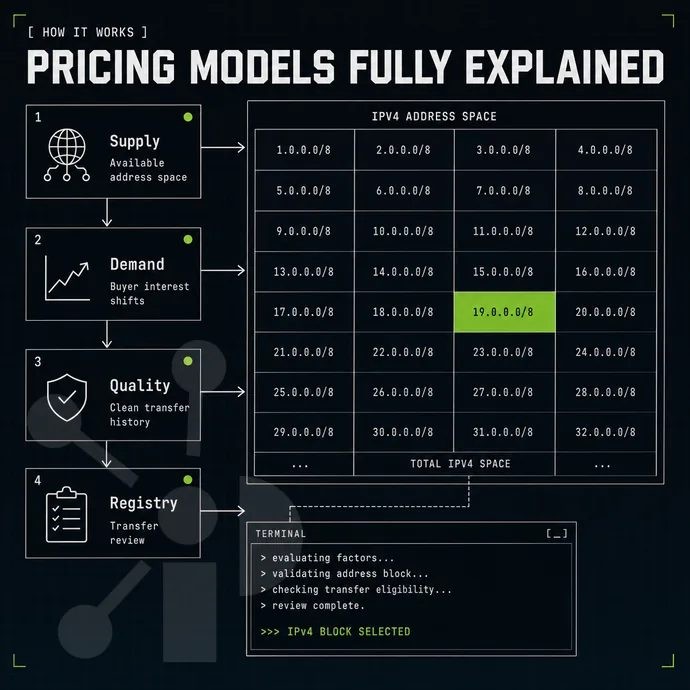
The price for IPv4 address space has never been fixed and is today mainly determined by supply, demand, quality of the address space, and whether the addresses are held in the RIPE registry region or another registry. This article aims to inform buyers and sellers of IPv4 address space how to benchmark offers in the many IPv4 marketplaces that have sprung up.
How address space is priced by block size
While a /24 of 256 IP addresses will command a higher per IP price than a /20 or /16 of IP addresses, for example, no single point of comparison tells the whole story, as the total value of larger IP blocks can actually move more than smaller ones. However, there are fewer buyers qualified to purchase larger blocks of IP space. Buyers evaluating address blocks must weigh both the per-unit economics and their operational readiness to absorb and route the allocation.
| Block size | Addresses | Per-IP premium | Typical buyer |
|---|---|---|---|
| /24 | 256 | Highest | SMB, hosting |
| /22 | 1,024 | Moderate | ISP, cloud |
| /20 | 4,096 | Lower | Carrier, enterprise |
| /16 | 65,536 | Lowest per-IP | Large operator |
Regional internet registries and price variation
The price for the same amount of IP space in the Registry regions differs from the price for the same amount of IP space in the blocks.
What else drives price in the IPv4 marketplace
Four key factors influence the value of a block of IP addresses: routing hygiene, IP address reputation, transfer eligibility and scarcity. Blocks of IP addresses which have been flagged by a registry as transfer-ineligible (TI) are essentially unsellable until the issue has been resolved with the original registry. Resolving transfer-ineligibility typically requires the current holder to address outstanding contractual or legal obligations with the registry before the block can change hands.
We apply a similar logic to lease rates, too. Instead of paying for ownership of a block, you pay for the right to use it. A block with poor reputation will have a lower lease rate but less productive for you in the long run. When evaluating options, consider whether a lease provider offers flexible terms that align with your network's growth trajectory and usage patterns.
To help you make sense of all this, Tixx by Prefixx breaks larger network ranges into smaller blocks and rates every block on the criteria of ownership, blacklist status and routing health prior to it being sold to a buyer or leased to a lessee. We encode the quality of a block in every deal we do.
Knowing how rates are set for buying or leasing, we can then decide whether buying or leasing would be more productive for you. Whether you work with a lease provider or pursue an outright purchase, understanding block quality ensures you allocate resources appropriately for your network's needs.
Buying vs leasing IPv4 addresses: cost and flexibility compared
Deciding between buying and leasing out IPv4 addresses depends on several factors, including capital, time frame and needed flexibility of your current infrastructure.
IP leasing versus outright purchase of IP resources
- Review the ownership models. Buying RIR registered IP addresses transfers full registration to you. Leased IPs on the other hand transfer usage rights to you, while the block in question remains registered to the lessor. This affects the routing registration.
- Compare your upfront costs to your ongoing costs. The cost to buy something upfront versus the ongoing cost of payments, such as a lease, can be significant. For short-term projects, leasing is generally the best way to go.
- Please note that the transfer procedure needs to be checked. A purchase usually triggers a formal RIR transfer which needs to be documented and usually takes several weeks. A lease however doesn’t trigger a RIR transfer and is usually provisioned within 24 hours at Prefixx.
Contract terms, lease terms, and IP addresses resources
- Make sure you read the lease agreement thoroughly. The lease terms should include a non-revocation clause. Non-revocation guarantee means that the block cannot be pulled mid-contract. The reason you would care about this is for production routing stability.
- Find out what the initial setup fees are. Reputable providers list out all charges prior to signing up. You should also ask if RPKI ROA configuration, LOA issuance and rDNS delegation are included in the white-glove handling offered by Prefixx or if they are charged on top.
Choosing the right path for IP resources
- Choose a model to match your timeline (e.g. lease as a pilot to test out a model for a few months to see how it works for compliance windows or seasonal capacity. Buy a model that will anchor your long-term infrastructure and you want to put in RIR (rate limiting per IP address) registration).
| Dimension | Buy | Lease |
|---|---|---|
| Ownership | Full RIR registration | Usage rights only |
| Upfront cost | High | Low or none |
| Recurring cost | None after purchase | Monthly fee |
| Transfer process | Formal RIR transfer required | Not required |
| Flexibility | Low (resale to exit) | High (contract exit clauses) |
| RPKI/LOA handling | Buyer arranges post-transfer | Included at Prefixx |
| Typical use case | Permanent infrastructure | Projects, growth, compliance |
Note: Always confirm exit clauses before signing.
IP resources, reputation, geolocation, and routing quality disclosed
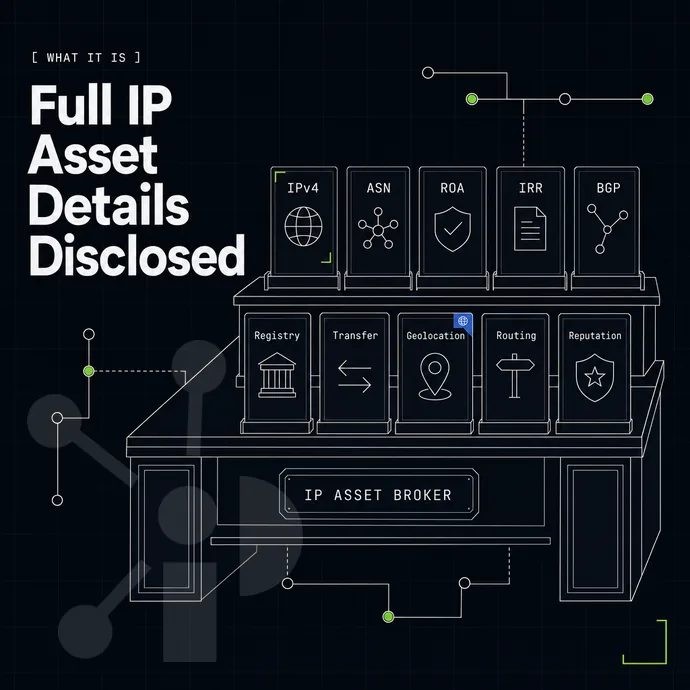
Other factors like reputation baggage, stale routing objects, incorrect geolocation data, and outdated records can make otherwise cheap IP addresses nearly useless in practice. Buyers should verify that IP geolocation records align with their intended deployment region to avoid connectivity or compliance issues.
Lease provider reputation, blacklists, and email deliverability
Blacklisted IPs instantly cause damage to your email deliverability and trigger all global spam filters the moment you announce the block. That block of IPv4 addresses that looks okay on paper can hold years of abusive IPs with histories dating back years or more on Spamhaus ZEN, Barracuda, SpamCop, SORBS and CBL lists. Proper abuse handling procedures by previous holders can prevent such reputational damage, but many blocks lack documented remediation efforts.
Many network security teams block entire IP address ranges based on DNSBL blacklists, so the operational risk of unknown blacklist entries is a real concern when buying IP addresses.
RPKI validity and IRR route objects
For modern Internet routing, enabling RPKI support is non-negotiable. An invalid ROA can cause global transit providers to drop announcements originated by you. In addition, IRR route objects (route objects in databases like ARK, RIPE Database, ) have to be up to date. Outdated route objects cause filtering by upstream ASNs, which in turn creates a lot of problems for peering teams.
We also create LOA, ROA and IRR objects for our customers who require them. Our team works directly with customers to create the documentation needed for their specific routing and authorization requirements.
Geolocation accuracy and how updates propagate
Geolocation database support matters for sites using geolocation for CDN selection, ad targeting, or compliance purposes, especially when the IP block will host a domain or serve region-specific content.
Geolocation data is published via our daily RFC 8805 geofeed.
Inter-rir transfers and what they mean for IPv4 marketplace buyers
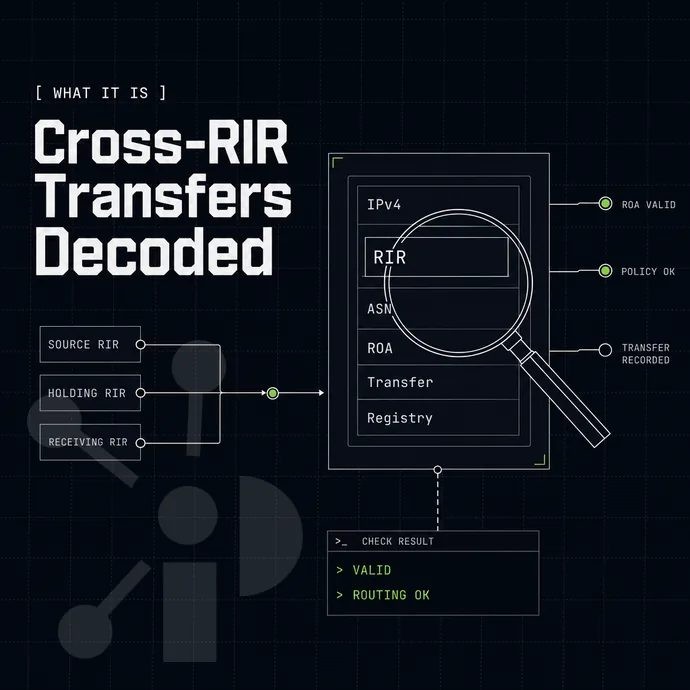
Find out the transfer rules of each registry before you commit. It could save you weeks of misery and avoid completely failed transactions.
How registry regions shape your options
The five Regional Internet Registries for address space on the Internet are ARIN (North America), the RIPE registry (Europe, Middle East and Central Asia), APNIC (Asia-Pacific), LACNIC (Latin America/Américas) and AFRINIC (Africa). All of these organizations can transfer IPv4 addresses including so called legacy address space. However, for cross-registry transfers of leased IPs or IPv4 addresses, the approval of both the originating and receiving RIR is required, which typically leads to additional rounds of documentation and requires more time.
APNIC policies and LACNIC lease provider facilitation
The APNIC policies regarding inter-RIR transfers are quite strict. The recipient must have an APNIC account that is in good standing, and the data on resources to be transferred must meet the relevant thresholds for justification. LACNIC transfers are facilitated, meaning that they are done by a broker on your behalf, as opposed to being direct-registered. This is something to keep in mind when planning out the transfer.
| Registry | Inter-RIR transfer | Typical additional time vs intra-RIR | Key documentation |
|---|---|---|---|
| ARIN | Supported | 2-4 weeks | LOA, RPKI ROA, IRR route objects |
| RIPE NCC | Supported | 2-3 weeks | LOA, legal entity verification |
| APNIC | Supported | 3-5 weeks | Account, justification, ROA |
| LACNIC | Facilitated | 4-6 weeks | Broker coordination required |
| AFRINIC | Supported | Varies | LOA, member standing |
What buyers should verify before signing
Verify that your broker is registered with the relevant RIRs (i.e. registered brokers can submit transfer requests directly). Prefixx Networks is a registered broker with ARIN, Europe's regional internet registry and APNIC. For LACNIC registered blocks, Prefixx can facilitate the transfer for you as well.
The team at Prefixx prepares all LOA’s, RPKI ROA’s and IRR route objects for you so you have the most flexibility with how you choose to host and connect using your purchased block. The registry in which a block is registered will have an impact on the types of routing services offered as well as where the IP block is geolocated.
All of this paperwork is taken care of by a full service provider for you. Proper configuration of these routing credentials ensures that your block will be accepted by upstream providers and that end users can reliably access services hosted on your addresses.
BYOIP deployment and routing paperwork your lease provider handles
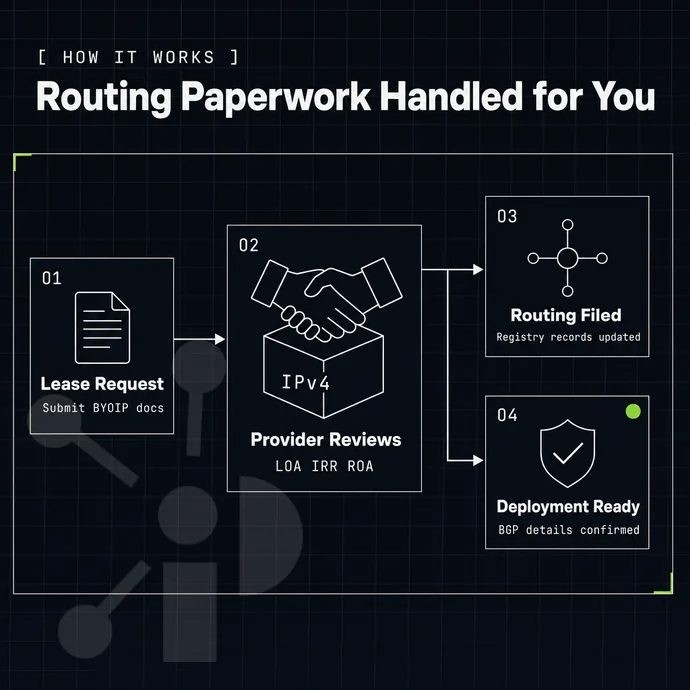
Acquiring the right IP address space is only half the battle. Most new organizations underestimate the amount of routing-related documentation and network security considerations that come with announcing new IP space, and can have a full-service broker handle this for them. A full-service broker can streamline these operations by coordinating the technical documentation, registry submissions, and routing configurations that new address space requires.
Preparation: the three documents you need
- Letter of Authorization (LOA), This document authorizes a network to send traffic from an address block that you own. Without a LOA your announcement will be denied by upstream providers.
- RPKI ROA. Route Origin Authorization (ROA) confirms that a prefix is announced by a specific Autonomous System (ASN). A missing or invalid ROA indicates that a prefix is not valid any more. Most global network operators require RPKI support nowadays.
- IRR route objects for the network filtering of prefixes by means of policy databases for the single routing entries record with a single entry in the appropriate registry for the announcement on the global network.
Note: Skipping the IRR step is a common mistake. Some providers only submit the ROA and assume that is enough. Many upstream filters still rely on IRR independently.
Execution: cloud BYOIP programs and abuse handling
Each cloud provider (AWS, GCP, Azure, OCI, Cloudflare) has their own BYOIP program. Each program requires a signed LOA and verified ROA to add an IP address / prefix to your account. Minimum prefix sizes and verification steps vary by cloud provider. It is best to contact each cloud provider directly to confirm.
Prefixx can create LOA, RPKI ROAs and IRR objects for your as part of our service offering.
What a full-service broker actually does differently
The key difference between a self-serve marketplace and a full-service broker is that while the marketplace may give you a block of IP addresses and leave you to manage the data on your own. A full-service broker helps you manage routing configurations, registry updates, and technical documentation throughout the ownership lifecycle.
If an announcement to an upstream carrier is rejected, the full-service broker will be available to sort out the problem. Prompt troubleshooting ensures your network maintains uninterrupted access to the routing infrastructure you need.
Why choose Prefixx for IPv4 marketplace transactions
Prefixx is a boutique IPv4 marketplace broker, not a self-serve platform with public listed prices. We broker vetted IPv4 addresses across ARIN, the European RIR and APNIC, ensuring all data on listings is verified, with zero buyer fees and a seller-only commission on a no-win-no-fee basis.
- clear pricing model: No hidden fees for buyers. Sellers pay a 3 to 8% commission only on a successful close.
- Escrow-secured transactions: Every deal settles through escrow, reducing operational risk for both sides.
- White-glove lease service: Our team handles IP reputation monitoring, geolocation support, abuse handling, rDNS and LOA, ROA and IRR paperwork on every lease.
- Non-revocation lease guarantee: Leased IPs are provisioned within 24 hours with a non-revocation commitment.
- Portal tooling included: BGP monitoring, 12-DNSBL reputation scanning and geolocation updates at no extra cost.
Clients including M247, ExpressVPN and Ultahost rely on Prefixx for address space across all five RIR regions. See IPv4 pricing guidance or contact our consultants for a personalized quote. The questions below address what buyers most commonly ask before starting a deal.
Frequently asked questions about IP resources
How do lease providers define transparent pricing for IP reputation geolocation resources?
In practice, that means knowing whether the buyer or seller pays the broker commission, what escrow costs apply, and whether registry transfer fees are included or billed separately. Buyers should expect full transparency regarding all cost components before signing any agreement.
A genuinely transparent marketplace separates those line items clearly so you can compare total acquisition cost, not just the per-address figure. Transparency in fee structure allows buyers to assess whether a quoted price represents genuine market value or includes hidden markup.
What does a lease provider charge for a /24 IPv4 block with IP geolocation support?
Lease rates depend on block size, lease term, and included services such as RPKI, LOA preparation, and reputation monitoring. Contact a broker directly for a current, personalized offer, since market rates shift and any published figure goes stale quickly. Providers often bundle hosting infrastructure support with the lease to simplify deployment for clients who lack in-house network operations teams.
What hidden fees should I watch for when buying IPv4 addresses?
At Prefixx, the broker commission is seller-only, so buyers pay zero fees on top of the block price.
What is the difference between buying and leasing IPv4 address space?
Buying transfers full ownership of the address block to you through the relevant RIR, giving you permanent control and the ability to resell later. Leasing gives you a single point of access to announce and use the addresses for the lease term without owning them, which suits companies that need space quickly or want to avoid the capital outlay of a purchase. Leasing provides immediate operational access without the administrative overhead of completing a full registry transfer.
A well-structured lease includes a non-revocation guarantee, RPKI ROAs, an LOA, and reverse DNS management so the block maintains strong IP reputation and behaves identically to owned space from a routing perspective. The trade-off is that a lease is an ongoing operating cost rather than a one-time asset acquisition. Many organizations choose leasing when they need address space for cloud infrastructure or hosting environments where flexibility and predictable monthly costs outweigh the benefits of ownership.
How long does an inter-rir IPv4 transfer take?
Timelines vary by registry pair and the completeness of the documentation submitted. ARIN-to-RIPE NCC and RIPE-to-ARIN transfers involve both registries reviewing the request, which adds coordination time beyond a same-RIR transfer. APNIC cross-registry transfers follow a similar dual-review process. No broker can guarantee a specific calendar outcome because registry staff workloads and policy compliance checks are outside anyone's control. Working with a registered broker who has accurate data across ARIN, Réseaux IP Européens Network Coordination Centre, and APNIC reduces delays caused by incomplete paperwork.
What is RPKI and why does it matter when leasing IPv4 addresses?
RPKI (Resource Public Key Infrastructure) is a cryptographic framework that serves as a single point of confirmation, letting the legitimate holder of an IP block publish a Route Origin Authorization, or ROA, confirming which ASN is authorized to announce those addresses. Without a valid ROA for your IPv4 addresses, your prefix can be filtered by RPKI-validating networks, reducing reachability and making the block effectively invisible to a growing portion of the internet.
When leasing, you need the block owner to create the ROA on your behalf, since only the registered holder can do that. A lease that includes RPKI setup and data validation, like the white-glove service Prefixx provides, ensures the ROA is in place before you start announcing the prefix. This arrangement is especially important for clients running cloud infrastructure or hosting services that depend on uninterrupted global reachability.
How do I check the reputation of an IPv4 block before I acquire it?
Also check BGP routing history to see whether the prefix has been hijacked or announced by unexpected ASNs, and verify RPKI validity to confirm the current ROA aligns with the registered holder's infrastructure, lease terms, and ownership records.
Prefixx runs every block through Tixx, its pre-sale quality control process, which checks ownership, delegation eligibility, blacklist status, routing hygiene, and capacity planning suitability before any block reaches a buyer.
The term straightforward pricing in the IPv4 market means more than just writing a number on a page. It also includes the reputation of the block of IP addresses, the IP address routing, the migration to the buyer and all other related costs and fees.
Many of these hidden costs are revealed after the transaction has closed. Therefore, checking the transparent disclosure practices of a potential provider, including their approach to IP reputation, before you enter into an agreement to acquire or lease the IP address is probably the most important step of the process.
A cheap address list that arrives blacklisted or routed poorly will end up costing much more to clean up than you saved by buying it.
If you are ready to buy, sell, or lease IPv4 space with no buyer fees and full visibility into what you are getting, submit an inquiry at Prefixx.net and receive a personalized offer within 72 hours.
Contact us to discuss your IPv4 needs today
No hidden fees, free consult. A broker replies within one business day.