
By Savvas Bout, Founder of Prefixx. Last updated 16 September 2026.
Buying IP addresses online today is just as painful as it was when the free IP address pools ran out.
Paperwork for transferring existing IP addresses to new owners can take weeks to complete and cause huge delays in launching services. Because the secondary market for existing IP addresses is now the only game in town for businesses running websites and online services, finding your way through it without a clear process can cost a lot of money. Navigating the transfer requires careful attention to procedural details that vary by registry and jurisdiction.
This in-depth guide follows the full acquisition process in detail. It explains the internet transfer market in detail for the four RIRs (ARIN, RIPE NCC, APNIC and LACNIC) and what makes prices for IP addresses differ between registries. It also explains how to evaluate IP address blocks prior to their acquisition. Buyers should examine the reputation and announcement history of any allocation before committing to a purchase.
The transfer process from contract to announcement is also explained in detail. Lastly, this guide explains and compares buying and leasing IP addresses . It shows how to choose the best method of acquisition for the specific needs of a network operator.
How much IP space do you need? Buying a single /24 or a larger allocation of IP space at the sourcing stage will determine your traffic forwarding hygiene, your reputation baseline and your total cost of ownership for years to come. In this article we explain what buying IP space actually means.
What does it mean to buy IP address space
Buying an IP block typically refers to purchasing a routable IPv4 block through the secondary transfer market. This is fundamentally different from buying a proxy or a VPN in order to hide your traffic. For business organizations building production infrastructure, the difference is crucial. For more context, see IPv4 address exhaustion.
How to request static IP vs. Routable IPv4 addresses
The static IP address from your ISP will be a fixed address on their network, which you can use, and they own it. Acquiring a routable block of IP addresses and transferring them to your organization in the RIR database.
As well as announcing those addresses using BGP under your own ASN, are rights that static IP addresses from an ISP do not grant. Organizations seeking full control over their addressing often prefer acquiring routable blocks because they provide permanent static assignments rather than temporary allocations subject to ISP policy changes.
Why the waiting list drives the secondary market
Regional Internet Registries (RIRs) stopped issuing IPv4 addresses from their free pools between 2011 and 2020. By then, all RIRs, ARIN, RIPE NCC, APNIC, LACNIC and AFRINIC, had exhausted their allocations of IPv4 addresses. Today, secondary transfer market is the only channel through which organizations can acquire a routable IPv4 block.
What you actually get with internet access
As a business asset, a purchased block is not a shared pool of addresses, to be allocated to and then released by other users as they need them. Instead, a block you purchase is yours to use for reputation, for packet forwarding, and for geolocation. The exclusive control granted to the owner means that every device, application, and service can be configured according to the specific requirements of that user without interference from external parties.
This block can be used for city-level targeting. Our expert broker service for the full transfer of your block, including Tixx quality checks, escrow settlement and LOA preparation by Prefixx experts. Once the transfer completes, the registry updates the WHOIS record to reflect your organization as the registered account holder for that resource.
Having established the prior work, this is how the actual transfer work is conducted from sourcing to network traffic forwarding.
How to buy IP blocks: the transfer process step by step
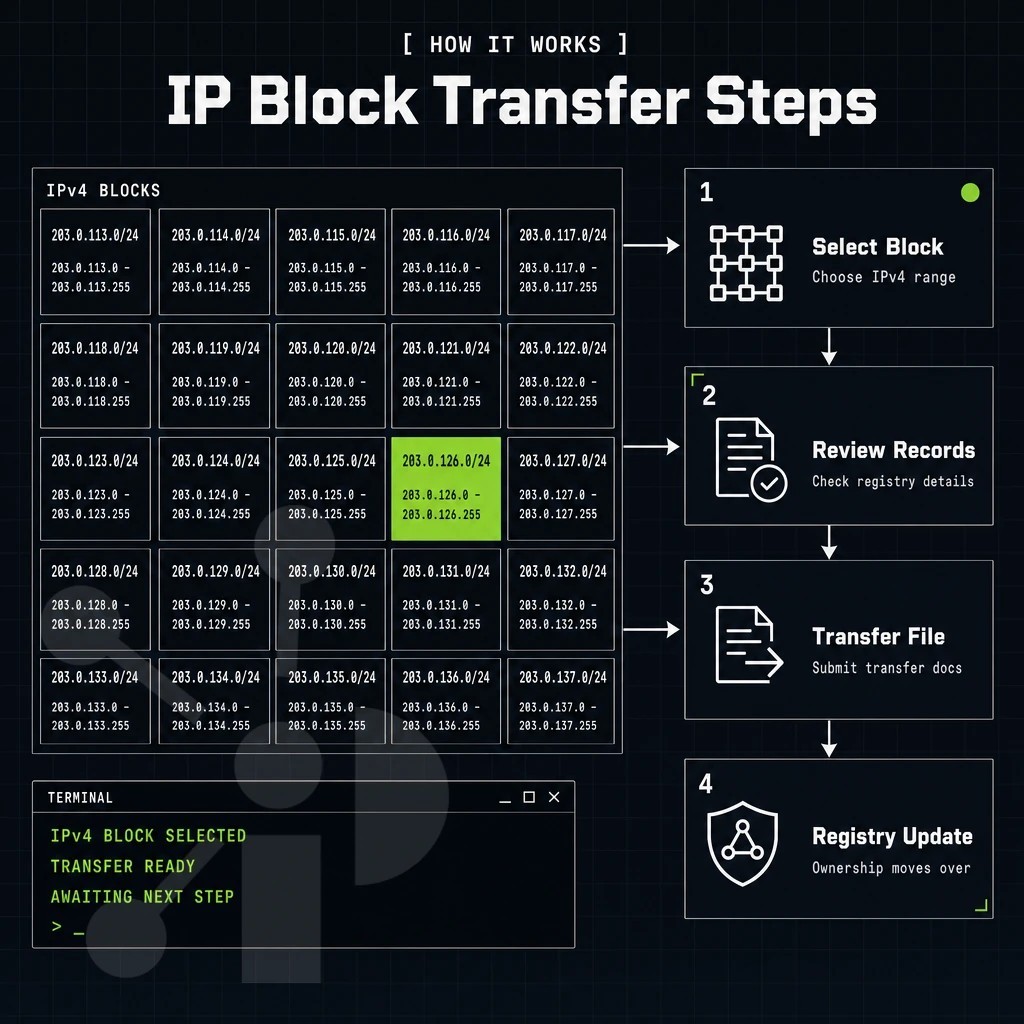
Purchasing an IP address block involves a specific process. Each step in the process of purchasing an IP address block is designed to protect the buyer’s interests. Skipping any step in the process can lead to problems related to IP address IP packet forwarding as well as potential legal issues. Buyers should verify all contractual details before finalizing the purchase to ensure clarity on ownership rights and obligations.
Evaluating an address block before you commit
Tixx by Prefixx performs due diligence for you, covering three main points of inquiry: ownership verification using RIR WHOIS lookups, check for listings on major DNSBLs, and a check for path selection health (is it announced? Hijacked? Dark?). A IP address with a dirty history can follow a block of IP addresses for years. Tixx by Prefixx performs this check on every block of IP addresses that it offers up to potential buyers.
IP address transfer: escrow and registry submission
After the agreed price has been paid via escrow (for example via an online payment service) the RIR transfer request can be filed.
Post-transfer internet routing setup
Just because you own an IP block does not mean you can route it. You need a Letter of Authorization (LOA) from the prior holder of the block of IP addresses, an RPKI ROAsigned with your unique ASN identifier. Additionally, IRR route objects published for the block of IP addresses. These cryptographic objects work together to create a secure chain of authorization that prevents unauthorized parties from announcing your prefix.
Without these, your ISP, or the upstream service provider for your prefix, will not connect your prefix to the global table of Internet-routable IP addresses. Some buyers of IP blocks use the block for proxy infrastructure purposes, and thus it is very important to have clean reputation records for the range from the very first day that you acquire it. Clean reputation records ensure that the IP addresses can be used effectively for applications that rely on trusted data transmission and user authentication.
| Block size | Typical use | Routing requirement |
|---|---|---|
| /24 (256 addresses) | Single-site, small ISP, proxy service | Minimum routable unit; ROA + IRR required |
| /22 (1,024 addresses) | Mid-size operator, CDN edge | ROA covers all sub-prefixes |
| /16 (65,536 addresses) | Large network, carrier, cloud | Full LOA, ROA, IRR; escrow complexity increases |
Work with a broker to create LOA, ROA and IRR objects for you.
Account management after you buy IP space
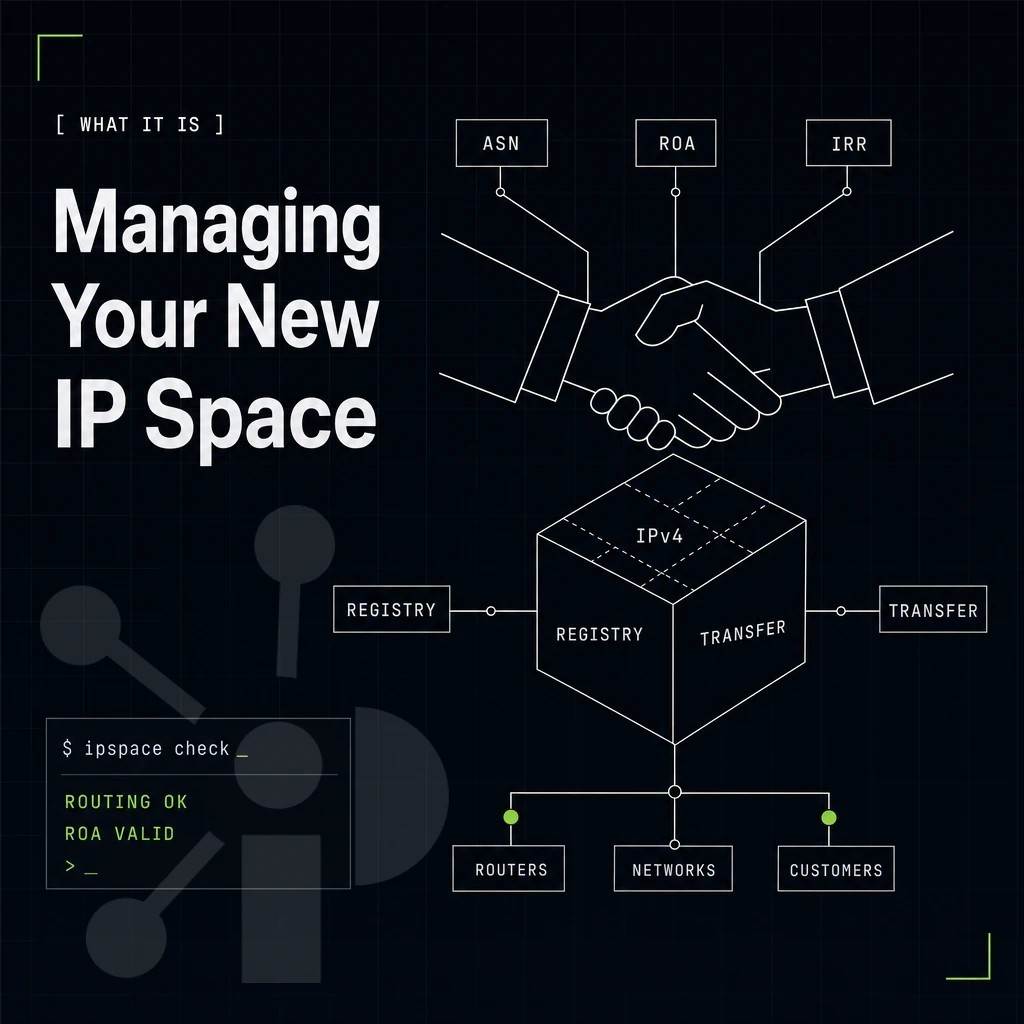
While buying IP space is the start of your work with it, the assigned allocation of space for your organization then requires a number of tasks on an ongoing basis in order to continue to be routable, reputable and geographically correct on the networks that matter to you.
Account management: register, connect, and route
- RIR records for your organization must be kept current. As contact information changes for your organization, update the corresponding information in your WHOIS and RDAP records to keep it current and prevent it from becoming stale information. Stale information can prevent timely processing of reported abuse, and trigger additional compliance reviews by your registry.
- Set up Reverse DNS management for all active IP addresses to include PTR records. Accurate Reverse DNS information is a basic trust information and mail servers and security scanners will often deny service to IP addresses in missing or mismatched reverse DNS information for IP address blocks.
- Track BGP announcements for your prefixes. Verify that your announced prefixes are present with correct origin ASN and proper RPKI ROA in place. Unannounced or hijacked prefixes mean your networks are unreachable or impersonated.
Note: Skipping the initial setup of RPKI ROAs leaves your prefix vulnerable to route hijacking from day one.
IP reputation and geolocation resources
- Set up a scan to check for listings on various DNSBLs on a regular basis. A listing on a major list can severely impact deliverability and trigger firewall rules across thousands of networks. It can quickly go from being a single issue to a large problem if not caught early and disputed.
- This publication generates an RFC 8805 geofeed, which is required by most providers to place correct prefix action (e.g. pool instead of throttle) for correct country or city. Geolocation errors also lead to incorrect CDN traffic direction, possible non-compliance and very poor user experience.
Using the Prefixx portal to manage IPv4 addresses
For Prefixx clients, we provide BGP monitoring, scanning across 12 DNSBLs, rDNS management, and geolocation tools, all designed to be used as part of a single task, to monitor your segment after it has gone live.
While ongoing management is an important consideration, it's equally worth taking time to connect with the initial decision of buying outright versus leasing, and whether a leasing service would have served you better.
Buy IP vs lease IP: costs, commitment and control
Purchasing and leasing an assigned IPv4 chunk can solve the same problems for organizations using very different financial structures. There are various ways to deal with the need for a certain amount of IP allocation for a certain period of time using different amounts of capital. Additionally, Different models for dealing with IP assets on a long-term basis versus keeping one’s options open. Organizations must evaluate how IP holdings fit within their broader technology portfolio and balance sheet treatment of digital assets.
Capital outlay vs monthly cost on request
There’s a lot of upfront capital spent when purchasing IP. Smaller blocks of IP such as /24s typically cost different amounts in different RIR regions. The pricing for ARIN and RIPE NCC can vary greatly from month to month due to regional demand. Leasing converts that large upfront capital investment into a very predictable and affordable monthly cost. Organizations that anticipate growth should consider how their chosen acquisition method will scale with their expanding infrastructure needs.
When you buy something outright, you automatically get to resell it. So if you are trying to create a long-term IP strategy and then eventually sell off the IP, you would want to buy it outright rather than leasing it.
Ownership and compliance burden of IPv4 addresses
Ownership of IP (RIR transfer, RPKI ROA s, IRRs, reputation) becomes a much heavier burden with large blocks of IP. Leasing provides an alternative service model where most of the work is performed by the provider (LOAs, network path management doc, abuse cases).
Flexibility and commitment with IPv4 addresses
For a defined term, a lease does not lock up any capital long term, whereas a purchase of equipment is a permanent investment. For a business with stable multi-year demand, buying a VPN plan will work out cheaper in the long run. Organizations with fluctuating capacity requirements may find leasing offers the flexibility to scale resources up or down in response to dynamic operational demands.
This is why VPN operators and hosting providers first lease and then buy once demand for their services has proven to be stable. Organizations often lease initially to test market demand before committing capital, then expand their owned allocations as their service footprint stabilizes.
Prefixx handles both paths of securing future space needs. These include escrow-secured purchases of future allocations of space (on ARIN, RIPE NCC and APNIC) and guaranteed leases with white-glove packet switching paperwork included.
So you decide to buy domain names. Next, you have to choose a registry to transfer your new purchases to. Each registry maintains its own member account portal where you will manage the transferred resources and update contact records.
Why choose Prefixx to buy IP address blocks
Prefixx is a registered IPv4 broker with ARIN, RIPE NCC and APNIC. We source vetted IPv4 addresses across all regional internet registries, handle every transfer end to end, and charge zero buyer fees. Sellers pay a 3 to 8% commission only on a successful close.
- Tixx quality control. Every address network is checked for ownership, blacklists, IP forwarding hygiene and RIR standing before it reaches buyers.
- Escrow-secured transactions. IP assets change hands only after funds are confirmed and transfer paperwork is complete.
- White-glove traffic network forwarding provisioning. Our team prepares the LOA, RPKI ROA and IRR route objects so your network is reachable from day one.
- BYOIP deployment support. Bring your allocated routable CIDR range directly onto Netrouting bare metal, with no per-IP surcharge.
- Senior consultants on every deal. Expert advice from people who have worked in the networking industry since 2007.
Ready to acquire IP space address blocks or explore what IP resources is available? Visit our buying page or contact our team for a personalized offer.
Frequently asked questions about IPv4 addresses
Is it legal to request and collect network IPv4 addresses for city level targeting?
Yes, buying and holding IPv4 address range is entirely legal. The five Regional Internet Registries (ARIN, RIPE NCC, APNIC, LACNIC and AFRINIC) each operate a formal migration market with published policies governing how blocks change hands. Each registry serves a distinct geographic region, and policies for transfers can vary slightly between countries within those regions.
Ownership is recorded in the registry's WHOIS service database, which anyone can request to confirm the holder's documented, enforceable rights to that space. The secondary market exists precisely because the RIRs exhausted their free pools between 2011 and 2020, and trading through that market is the standard way organizations acquire network addresses today.
Where can I submit a request to buy an IP address for my network online?
The most reliable route is through a registered IPv4 broker. Prefixx lists vetted blocks from /24 to /16 across all RIR regions, runs every IP range through Tixx quality control and security checks before it reaches a buyer, and handles the full RIR reassignment paperwork end to end. Working with an established broker ensures reliability throughout the transfer process and reduces the risk of acquiring problematic address ranges.
How do I request ownership of an IP address?
Ownership is established by completing an RIR-approved conveyance that moves the address range's registration into your organization's name in the relevant registry's WHOIS database, which is where the real money changes hands. Once the registry records your organization as the holder, you assume full responsibility for maintaining accurate contact information and ensuring the range remains compliant with registry policies.
A broker like Prefixx manages the handover paperwork, including the LOA, RPKI ROA and IRR route objects, and also vets IP reputation so the technical and administrative steps are handled for you. Leasing gives you network traffic management rights but not registry ownership; buying is the path to full title. Organizations running a VPN service or proxy infrastructure often prefer buying to ensure stable, dedicated address assignments that remain consistent across client connections.
Who sells IP address blocks?
Sellers are typically business enterprises, ISPs, or legacy holders who acquired more space than they now need.
Prefixx works with sellers and every ISP across all five RIR regions, charges a seller-only commission of 3 to 8% (with no fee if the address range does not sell), and runs every listing through Tixx to confirm ownership, portability eligibility and path IP forwarding hygiene before any buyer sees it. That vetting process protects buyers from acquiring blocks with hidden blacklist or reputation problems. This vetting process relies on a proprietary reputation-checking tool that scans multiple threat intelligence feeds and blacklist databases before clearance.
The decision to purchase IP IPv4 range is a long-term capital decision. The routing prefix of space that is purchased, the registry into which an IP address is transferred. Additionally, the quality of service checks performed before the transaction closes all connect to the ability to use the purchased space on day one and five years later. The registry into which space is transferred varies by region, and organizations must evaluate which registries serve the geographic markets and countries where their infrastructure will operate.
The buyer of IP network range can easily inherit the reputation problems of a prior owner by failing to perform due diligence on issues such as past use as a source of spam, or RIR standing.
First you need to make sure that both sides have been fully prepared to move forward with the request, clean WHOIS information, a registered broker, an escrow service set up to hold payment until closing, etc. Next you would set up the data forwarding paperwork (Letter of Authorization, RPKI ROA, IRR files, etc) that the client needs to file with the respective registry before the relocation is announced.
As for which registry to use, the three main internet registries for IPv4 addresses (ARIN for North America, RIPE NCC for Europe, and APNIC for Asia) each carry different market rates for transfers, have different policy requirements, and have different implications for downstream route propagation.
If you are ready to source a vetted netblock, submit an inquiry to Prefixx. Every address pool is assigned through Tixx quality control before it reaches you, and there are no buyer-side fees.
Contact us to discuss your IPv4 needs today
No hidden fees, free consult. A broker replies within one business day.