

By Savvas Bout, Founder of Prefixx. Last updated 10 September 2026.
Leased or announced IPv4 block resides determines what you can do with the IP address space you have purchased or leased, how fast you can start using it.
If you fail to understand this layer of IP address space management, a transfer may fail, a lease may not be approved, or a paid-for IPv4 block may remain stuck in whatever queue the RIR holds for exceptions, affecting everyone from startups to educational institutions, while administrative negotiations drag on for weeks. In some cases, a block may even revert to the RIR's available pool by default if documentation requirements are not satisfied within the prescribed window.
The five Regional Internet Registries (RIRs) for IP addresses, namely ARIN, RIPE NCC, APNIC, LACNIC, and AFRINIC, each have their own policies for IP number transfers, eligibility, and even waitlists. For example, an allocation may clear at the RIPE NCC in a few days but take months to clear at ARIN. RIPE NCC governs IP resources across Europe, the Middle East, and the north atlantic islands under a unified policy framework.
Thus, for network engineers or organizations making an acquisition or lease offer today, it is essential that they understand how the control of the RIRs affects not only time, but also cost and legitimacy to announce (to route) from newly assigned space.
Below we explain the policies of each RIR to facilitate how a transfer of IP number space can be structured to survive each RIR's policies and rules. The ability to navigate these varying policies directly impacts whether an organization can deploy its purchased address space on schedule.
What is an RIR and why does it control IP addresses
The regional internet registries (RIRs) play a key role in the assignment and tracking of IP addresses on a global scale, which is why claiming a block or other address space is not enough.
How regional internet registries work with internet service providers
RIRs manage, distribute and register internet number resources in defined geographic regions.
Regional internet registries RIRs and their local internet registries
There are the five IP registries which divide the world into geographical zones.
- ARIN covers North America.
- RIPE serves Europe, the Middle Eastern region and Central Asian region.
- APNIC covers Asia-Pacific.
- LACNIC covers Latin America.
- AFRINIC covers Africa.
The five organizations listed here are all affiliated with the Number Resource Organization (NRO), which manages shared resources for the Internet and coordinates a common position on policy issues worldwide. The NRO serves as a coordinating body that helps align the five RIRs on matters of internet governance and policy development.
RIR control of IP addresses: why it matters for transfers
Different RIRs have their own registries. As a result, the rules for IP number transfers are governed by the RIR in whose region a given block of numbers has its origin. The Prefixx team handles all the resources and paperwork for transfers between the ARIN, the RIPE registry and APNIC registries. The Prefixx team's experience with APNIC ensures smooth handling of transactions across the Asia Pacific region.
We can thus proceed with the transfer of your customers' IP numbers without any delays arising from procedural reasons. With this in place, you can also easily see which RIR governs a particular region of the world. Coordination between registries on joint projects has also streamlined cross-region policy alignment in recent years.
IPv4 exhaustion and what it means for RIR control
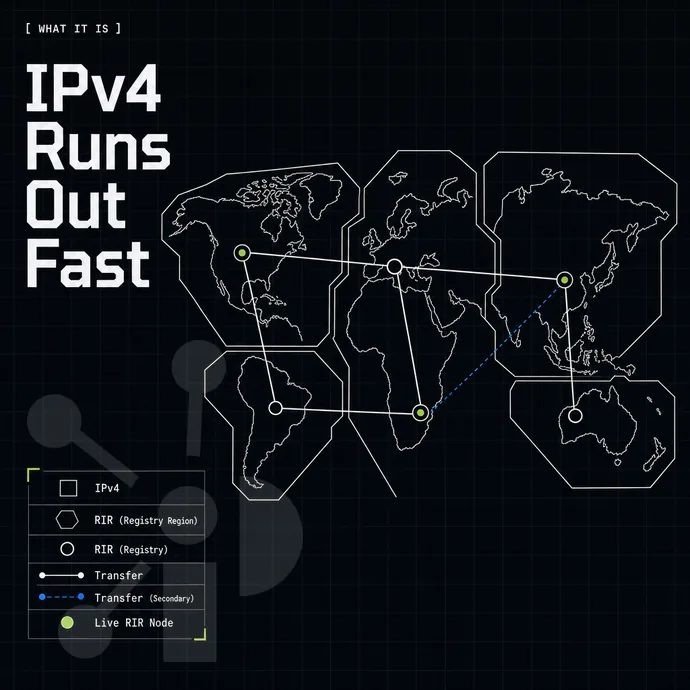
The free IPv4 pools of the five RIRs were all depleted between 2011 and 2020. All approximately 4.3 billion free IPv4 addresses have been assigned and there is no more free IPv4 address space available from a single large pool.
How RIRs still control the registry
RIR authority was not extinguished by exhaustion.
Resources such as IPv4 addresses and IPv6 addresses must be recorded in the database of the RIR for the region where the holder is located. A change of resources to another holder must be recorded in the database of the RIR for the holder's zone with an approved registration update. Holders must submit a formal request to the appropriate RIR to update the database when ownership changes.
IP addresses as the primary transfer mechanism
In most regions of the world the secondary market for new IP inventory has become the primary source for new address inventory. Thus an organization that requires a block or similar block of IP resources today has to buy it from a current holder of IP address resources. Many organizations now rely on brokers or consultants to navigate the complexities of identifying suitable blocks and negotiating transfer agreements with current holders.
The transfer policies of the American Registry for Internet Numbers (ARIN), the RIPE Network Coordination Centre, APNIC and the other regional internet registries (RIRs) vary.
What registry information actually controls
Registry information for a block determines issues such as routing legitimacy, RPKI validity, and accuracy of contact information for potential abuses of that IP address namespace.
Such information can cause problems with network reachability and can break RPKI ROA validation for the allocation. Keeping registration data current is not administrative overhead, it is what enables use of assigned routing space. Information for source and destination of transfer are typically in different registry regions, and since each RIR operates under its own policies for managing assigned resources, this only adds complexity, making inter-RIR transfers particularly critical.
Inter-rir transfers: when IP addresses move between registries
A block of IPv4 address resources registered in a single RIR can be moved to a new holder in a different RIR area via an inter-RIR transfer. A change in the registration in the originating RIR’s database and the new holder’s receiving registry takes place and this change propagates to geolocation providers in due course with the resulting change in apparent location of the block of addresses.
Which paths are supported by RIPE NCC
ARIN, the EMEA regional registry, and APNIC support direct bilateral inter-RIR transfers. LACNIC facilitates transfers but does not natively register them. AFRINIC does not currently participate in inter-RIR address space transfers. An ISP or internet operator can transfer IP real estate between registries as long as both sides’ policies are satisfied before any change is recorded by the registries.
Why the same /24 trades at different prices by registry
A /24 allocation in ARIN space can trade at a very different price to an identical /24 in Europe's RIR space. The big variables are demand from customers wanting to build out internet in a particular country, transfer policy hurdles and block reputation. In North America, pricing dynamics differ between the United States and Canada due to variations in market demand and available inventory within ARIN's service region.
How we handle it
We manage the entire transfer process for you. That includes checking eligibility according to policy, creating LOAs, updating your RPKI ROA s, and correcting your IRR route-objects. We also fix up your geolocation and rDNS after the transfer has completed. Our goal is to have traffic allocation routing correctly to the destination of your choice from day one. The end-to-end management of the transfer process is the core of the Prefixx service model.
Why Prefixx for rir-registered IPv4 transactions
Prefixx is a registered IPv4 broker with ARIN, the European RIR and APNIC, and facilitates LACNIC transfers. We handle all of the paperwork associated with IP and network resource sales, including LOA's, RPKI ROA's and IRR route objects, all prepared by Prefixx.
- Tixx performs various quality control measures on the block, including checking ownership and transfer eligibility, blacklists, and routing, prior to it hitting a buyer.
- No fees for buyers. Sellers only pay a 3% to 8% commission on the close of sale.
- White-glove service is included with every lease: geolocation correction, reverse DNS and reputation monitoring all handled for you.
- We are fully covered at the 5 RIRs for regional Internet number resource transfers (including inter-RIR and LACNIC-assisted deals).
Our consultants manage every deal end to end. If you are ready to buy, sell or lease IP addresses, explore available address space or contact sales for a personalized quote.
Frequently asked questions
How does the caribbean internet addresses registry link resources to autonomous system numbers?
An RIR IP address is a block of IPv4 or IPv6 space allocated or assigned by one of the five internet number registries: ARIN (North America), the RIPE registry (Europe, Western Asia, and the Central Asian territories), APNIC (Asia-Pacific), LACNIC (the Latin American territory), or AFRINIC (Africa). Each RIR receives address block from IANA and distributes it to ISPs, enterprises, and other network operators within its geographic area. This hierarchical distribution model ensures that address space is allocated efficiently across regions while maintaining centralized coordination through IANA.
The RIR maintains authoritative records confirming that one party holds each block, which underpins routing policy, transfer eligibility, and abuse reporting. When all five regional registries, including the Asia Pacific registry, exhausted their free pools between 2011 and 2020, the secondary transfer market became the only way to acquire new IPv4 space. Each registry is responsible for maintaining the accuracy and integrity of these records within its designated region.
How does 169.254.169.254 differ from autonomous system numbers in network routing?
169.254.169.254 is a non-routable link-local address used by cloud platforms, including AWS, GCP, Azure, and OCI, to expose an instance metadata service. A virtual machine queries this address over HTTP to retrieve its instance ID, geographic zone, IAM role credentials, and other runtime configuration of global importance without ever leaving the host. This metadata service provides essential runtime functionality that allows instances to self-configure without requiring external network calls or hardcoded credentials.
The address allocation is reachable only from within the instance itself and is never forwarded beyond the hypervisor. It is not registered to any organization through an RIR and cannot appear on the public internet.
How do I find which RIR controls specific IP addresses?
The fastest method is a WHOIS query: run WHOIS from a terminal, or use a web-based WHOIS tool such as RIPEstat for the regional Internet registry for Europe network space. The response identifies the RIR, the registered holder, and the allocation date. Each RIR concontol IP address records through its own WHOIS database, which serves as the authoritative source for ownership and allocation details within that region.
For a programmatic lookup, IANA publishes a delegated-stats file that maps every prefix assigned or allocated to its RIR, and each RIR publishes its own delegation file as well. If you need to verify routing hygiene alongside registration data, tools backed by RIPEstat's Routing Information Service can show origin ASN, RPKI validity, and IRR consistency for those resources in one view. Each query returns a structured data object containing the prefix, registry, country code, and assignment type for the requested resource.
What IP addresses is 100.64.0.0/10 used for?
100.64.0.0/10 is the Shared IP block space defined in RFC 6598, specifically reserved for use between a carrier-grade NAT (CGN) device and a subscriber's CPE router. ISPs and similar organizations use it internally when they exhaust RFC 1918 private space and need additional internet number resources to number the access-facing side of their NAT network infrastructure. This block provides a standardized way for carriers to manage their internal addressing without conflicting with other internet resources or customer networks.
Addresses in this range must not be routed on the public internet and are not allocated through any RIR to individual organizations. If you see 100.64.x.x in a traceroute, you are looking at a hop inside a carrier's CGN network fabric, not a publicly registered address.
RIRs (Regional Internet Registries) govern the space of IP addresses. That means they decide who holds what IP network address range, under which rules, and where in the world. Since the free pool of IPv4 addresses has by now been completely exhausted at each of the five regional registries, every single IPv4 IP address range now in use has an owner.
This owner also has a history of the IP address allocation and a registry file which must not get mixed up with in the process of a transfer or a lease.
Inter-RIR transfers have their own complexities. A block of IP addresses needs to be transferred between RIRs such as ARIN, the RIPE registry, APNIC, and LACNIC. Unlike other regions, the policies of two organizations need to be satisfied simultaneously, and a single error in documentation can lead to months of inactivity.
If you are buying, selling, or leasing IPv4 space, or planning a transfer across regional internet registries RIRs, Prefixx handles the full process end to end: Tixx quality checks, escrow-secured settlement, and white-glove routing paperwork including LOA, RPKI ROA, and IRR. Start your inquiry at Prefixx.net to get a vetted block and a clean transfer.
Contact us to discuss your IPv4 needs today
No hidden fees, free consult. A broker replies within one business day.