
By Savvas Bout, Founder of Prefixx. Last updated 26 August 2026.
One major limitation of every single infrastructure decision ever made, is that the cost of IP addresses has been increasing consistently, since the last free pools of IP addresses were handed out. And to make matters worse, there is no official price list, making it impossible to compare prices. Navigating this opaque market requires consulting multiple sources and often visiting each registry's information page to gather current rate details.
A /24 offered by ARIN, for example, can have a vastly different price than an identical-sized block of IP addresses offered by RIPE NCC. Lease prices also change consistently and unpredictably, making it very hard for network engineers and IP address managers to budget for necessary infrastructure. For more context, see our lease vs. buy guide.
There are a number of variables that affect the number, once you know what to look for. Block size, RIR region, address reputation, transfer eligibility, and whether you need to own the asset or just have routing rights to it all affect the number. Understanding how each variable influences the final quote requires careful analysis of market conditions and direct communication with brokers to gauge their response to specific requirements. For more context, see IPv4 pricing.
Once a request is created with specific parameters, brokers can provide quotes that reflect current market dynamics for that exact configuration. Brokers often maintain a dedicated page on their website where customers can view current inventory and submit requests for specific configurations. Organizations with limited resources often prioritize transfer eligibility and routing rights over outright ownership to minimize upfront capital requirements while maintaining operational flexibility.
Leasing allows you to keep capital off the balance sheet, but it has its own cost structure. Buying an asset allows you to lock in a return on your capital investment, but it ties up your budget upfront and can cost extra in transfer services to move the asset to a new public address or owner.
This piece looks at each of the major cost drivers for IPv4 address space, then looks at buying versus leasing across a number of different registries. We also explore what you need to look for when evaluating a block for purchase, in order to get the price per address that you expect. We start with the basics: what IPv4 pricing actually covers, and why it varies so much.
What is IP address cost and why does it vary so much
IP cost is what you pay for publicly routable IP addresses, which can cost a lot depending on whether you get them from a cloud provider, an ISP for a static IP address. Alternatively, Buy IP address space on the secondary market. First, you need to figure out which of these models you are in order to start to try to cut costs.
Three distinct cost models
Cloud providers charge by the hour for public IP addresses attached to accounts, which adds up quickly across dozens of services in regions around the world. Static IP addresses are typically bundled into business plans or charged as a flat-rate add-on by ISPs, and regional pricing variations mean total spend differs significantly depending on which part of the world hosts infrastructure. Some platforms also meter elastic IP addresses separately, applying charges when they remain allocated but unattached to running instances.
The secondary market for IPv4 addresses works differently. Buyers of addresses can purchase a block and then either sell them on or lease them out, including as a dynamic IP address, to holders of addresses, with a one-time transfer cost and then on-going monthly payments. Once a transfer is created through the registry, the new owner can begin announcing the address space through their own autonomous system.
Each model grants different rights. Cloud and ISP models are usage-based licenses whereas secondary market purchases for existing accounts transfer the actual registration of the account to your account at the respective registry.
Why scarcity drives the number up
A while back, the Internet Assigned Numbers Authority (IANA) assigned the last IPv4 address space to the RIRs.
Price is significantly affected by the block size and registry region. Addresses in the ARIN space and in the RIPE NCC space are each trading at somewhat different prices in any given month. With a clean, well-routed block in high demand regions commanding a premium over similar but poorly-received blocks.
Domain of ownership versus rented access
When deciding between ownership and access to space and connectivity. The decision domain is that of the possible trade-off points between the two extremes of renting a public IP from cloud platforms with low capital-expenditure and thus vendor-lock-in (in terms of being tied to the same address space in particular) and buying space from a broker like Prefixx.
Many companies face this decision when scaling infrastructure, weighing the flexibility of cloud-based addressing against the long-term economics of owning their own address space. Brokers facilitate these transactions by connecting buyers with sellers, often providing market intelligence and handling the technical transfer process to streamline sales.
With the possibility of connecting up your own space to any number of different providers. Including of course your own registered space with no per-address charge and without being locked into a single provider for each address. Where per-address charges are visible (i.e. in cloud platforms), it is worth working out in detail how each of them bills.
How cloud providers price elastic IP addresses
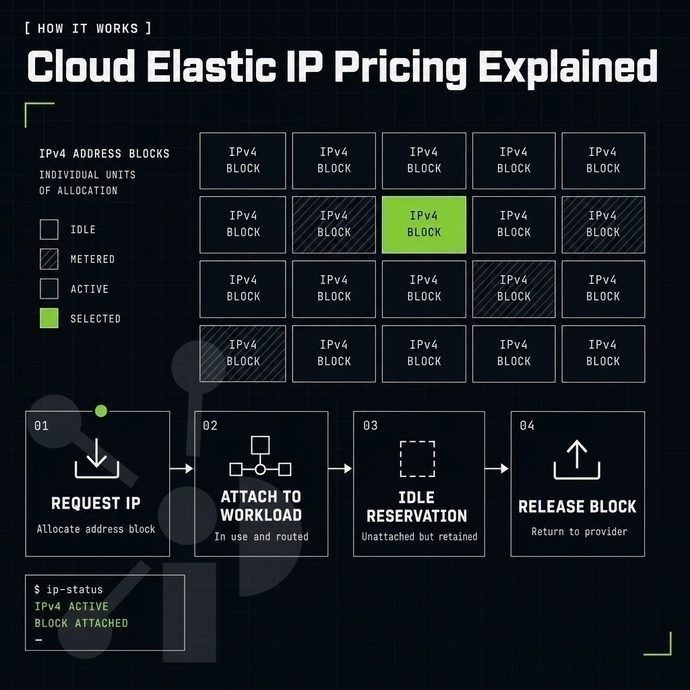
In the public cloud, IPv4 has become a metered utility. To decide whether assigning IP addresses makes sense for your workloads or if you're better off renting addresses or leasing ranges, you need to understand the billing models, including the option of buying your own IPv4 addresses outright.
Elastic IPv4 address options in AWS
In 2024, AWS changed pricing for public IPv4 addresses again.
In the domain of our original pricing, Elastic IPs associated with a running instance were free; charges only applied when they sat idle. Now, instead of zero charge for public IPs in use, AWS accounts with dozens of public IPs will see a sizable new line item on their bill. Organizations with complex AWS deployments that rely on elastic IP addresses to maintain consistent endpoints across instance replacements will feel this meaningfully in monthly infrastructure spend.
Azure static IPv4 addresses pricing
We bill on an hourly basis for Azure services, just like for Windows Azure services. A static IPv4 address costs $0.0036/hour, Instance-level public IP addresses (ILPIP) cost $0.004/hour. There is no standing charge for dynamic assignments, but the associated costs of each attachment and detach include a stop/start cycle, making it unsuitable for production workloads.
NAT gateway as an alternative path
Cost reduction is achieved by outbound traffic being consolidated by a NAT gateway instead of each resource having its own public IP address. The cost of a gateway and per GB of processing is offset by very low per address cost across large numbers of addresses in a fleet.
Organizations with high-volume workloads should model how much outbound traffic passes through the gateway monthly, as processing charges scale with usage patterns. Some organizations route traffic through a proxy layer to centralize security policies and logging before packets reach the NAT gateway.
| Provider | IP type | Rate per hour | Approx. annual cost |
|---|---|---|---|
| AWS | All public IPv4 | $0.005 | ~$43.20 |
| Azure | Static IPv4 | $0.0036 | ~$31.54 |
| Azure | ILPIP | $0.004 | ~$35.04 |
If you have more than a handful of public IP addresses in your fleet, the cost of cloud-platform billing can quickly add up. Leasing or buying a block of IP addresses and using BYOIP can reduce your recurring overhead.
Prefixx takes care of the LOA, RPKI ROA and IRR objects, so the actual routing paperwork does not become a bottleneck for you. Note that the cost structure changes completely if you currently source your IP addresses via an ISP rather than via a cloud platform. These routing protocols ensure that your address space is properly announced and reachable across the global internet without manual intervention at each peering point. Organizations bringing their own address space must ensure their upstream provider or colocation facility supports BGP announcements from customer equipment, whether through a dedicated border router or managed peering arrangement.
Proper DNS configuration is essential when announcing your own address space, as reverse DNS records must be delegated correctly to avoid deliverability issues with email servers and other services that validate ptr records. Organizations bringing their own address space must ensure their upstream provider or colocation facility supports BGP announcements from customer equipment, whether through a dedicated border router or managed peering arrangement that maintains stable internet routing. The routing configuration page in your registry portal displays the current status of these delegations and allows you to verify that announcements are propagating correctly across peering relationships.
What isps charge for a static public IP address
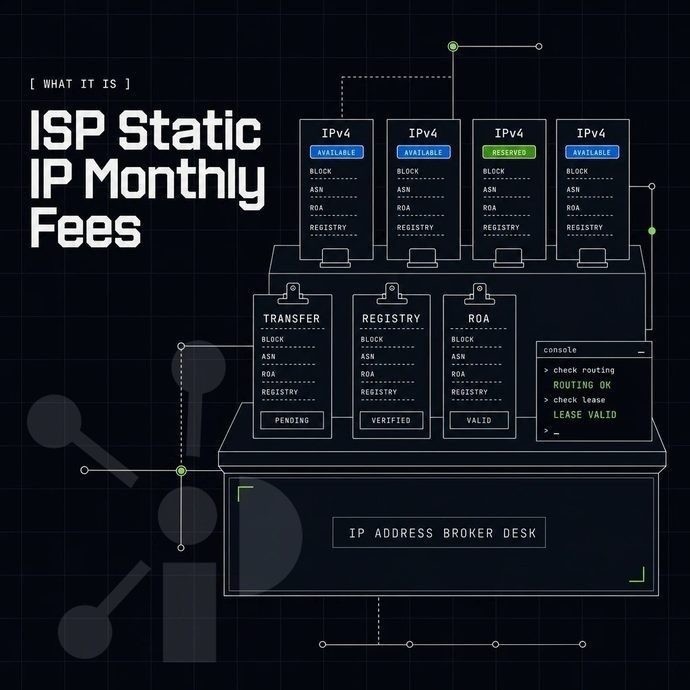
A dynamic IP address is usually assigned to your internet connection by default. The address changes every time your router reconnects back to the internet, which is fine for browsing the internet, but not for services that need a constant and reachable endpoint. Fixed IP addresses are available for an additional charge, which can vary greatly between provider types. Your internet service provider determines whether dynamic or fixed addressing is available and what the associated charges will be for your connection type. Hosting services and VPN gateways require a public IP that remains consistent across sessions to maintain reliable remote access.
Some users configure a proxy service on their fixed address to route traffic securely when the primary connection uses dynamic addressing. When your router reboots or loses connection, the ISP's DHCP server assigns a new address from its available pool, which can disrupt active sessions. Many residential users configure dynamic DNS services to map a consistent hostname to their changing address, allowing remote access without manual updates. Reliable internet access depends on consistent addressing when running servers or remote desktop services from home networks.
Residential and business ISP pricing for elastic IP addresses
Residential services typically charge a small additional monthly fee for a static IP address. Business services of the tiered type usually include one static IP address in the base plan cost, then charge for each additional static IP address required.
- Find out what tier your current plan is on. Check if you’re on a residential account or business account (most business accounts have at least 1 static IP address included in the price of the account, often on a residential account as well)).
- Request a static assignment. This can be done by contacting your ISP directly. They will reserve a fixed address on the ISP’s network and tie it permanently to your account. For residential lines, the typical fee is a few dollars per month. For business lines, the typical fee is in the tens of dollars per month depending on the specific plan.
- Is the address routable? Is the IP address being distributed as a public IP address or is it behind a carrier grade NAT? Only public IP addresses that are assigned from public IP address pools and are true public IP addresses are reachable from the public internet.
Note: Some ISPs advertise "static" addresses that are still shared or NATted.
Data center and other providers
When a data center provider (as opposed to a consumer ISP) prices static public IP addresses, they are charged differently. The cost for static public IPv4 addresses is based on the block size and the current market price for IPv4 addresses. Typically IP addresses are allocated in blocks.
- Compare the allocation models. Some providers include a few public IPs in a server plan, others charge per address beyond the first one or two.
- There is also paperwork required for transfer and routing of your own block of IP addresses to a new provider. This includes obtaining an LOA, creating a RPKI ROA and updating the IRR. Prefixx take care of all the required paperwork as part of their white-glove service and when all is complete, all the required addresses will be ready for use.
This applies across all of our provider types. Dynamic IP addressing costs less than static, and the cost difference increases as you move from a single IP address to a full /prefix. Once you are assigning full /blocks of IP addresses, the cost is now determined by the secondary market.
Secondary market prices: what a /24 or larger block costs to buy
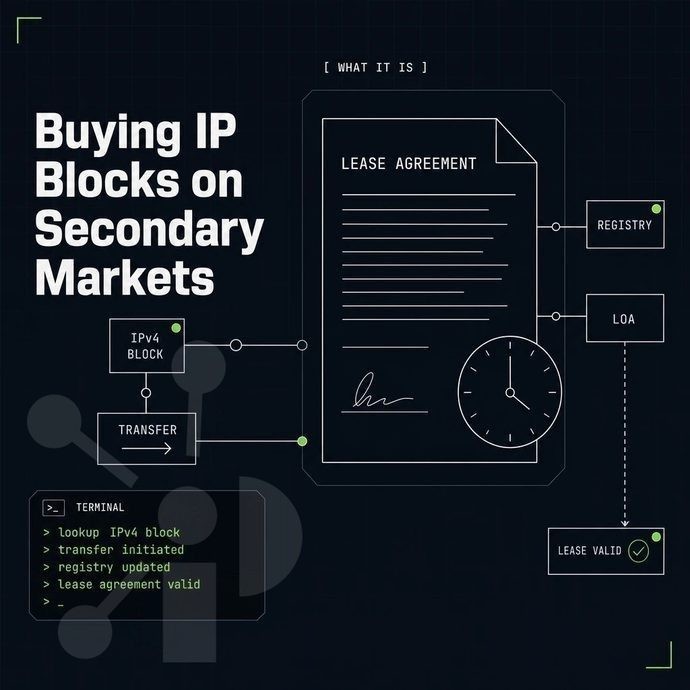
By 2011 all 5 RIRs had exhausted their free IPv4 addresses. Since then, all secondary transfers of IPv4 address space have occurred on the open secondary transfer market overseen by regional internet registries, with prices determined by supply and demand and no official published price.
How block sizes shape per-ip address pricing
The per-IP address cost is directly affected by the block size. For example, a /16 is going to be less expensive per IP than a /24. This is due to efficiency of the seller as well as reduced administrative overhead per IP address that is transferred. At larger scales, the per-IP address pricing will decrease.
Note that a /24 contains 256 addresses, a /20 contains 4,096 addresses, and a /16 contains 65,536 addresses. Therefore, when buying IP space, companies who require space at the /20 level and above will generally see a lower cost per IP than those buying /24s.
Elastic IP addresses regional pricing differences
Note that a single /24 can trade at vastly different prices within the same month depending on the RIR region in which it is listed. In most cases, the size of the block, the age of the block, and a long history of stable routing are all major factors that can place a given IP address on the price curve.
Lease rates are quoted per address per month and move with demand, so there is no single going rate to point at. The registry the block sits in, its size and its reputation history all pull the number around. Ask for a current quote rather than working from a figure you found online.
How to identify a fairly priced block
There is no public exchange trading in spot prices. Hence, a block of pristine reputation and which is not blacklisted will trade at a premium to an abusive block. Tixx is Prefixx's pre-sale quality control process, designed to verify ownership and transfer eligibility, to check against blacklists and to verify routing quality and high availability within an ISP's network.
Each of these can form a basis for a price both parties will fight over, and helps decide between buying the block outright or leasing it.
Lease vs. Buy: how the cost model differs
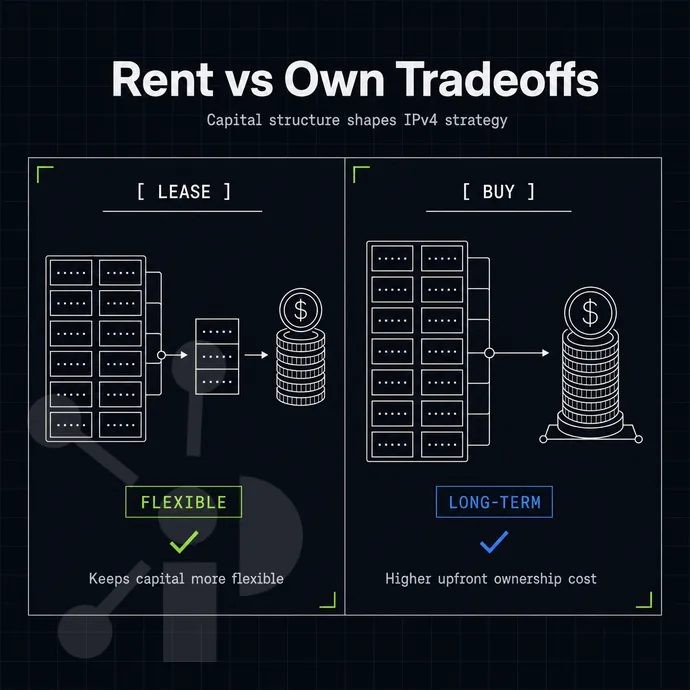
Leasing or buying to use IPv4 address space can be decided on the basis of time horizon and the capital structure. In leasing, the costs are fixed and repeat on a regular basis. In buying, the money spent on using IPv4 address space is converted into assets with all costs upfront.
When leasing makes financial sense
Leasing is for any organization that needs to connect to address space in a very short time frame and does not have to spend too much capital. Thus a start-up which is quickly setting up servers to launch a new product or a team running a short campaign will be connected and routed within 24 hours through our lease program.
The typical RIR transfer process is not required. We provision the block of IP address space, create the required LOA and RPKI ROA, and provide white-glove support for geolocation, reverse DNS, and reputation monitoring from day one.
The leasing model fits capex-constrained environments perfectly. Hosts and ISPs scaling out in particular regions don't want capital tied up in fixed assets, the space becomes an operating expense instead.
When buying is cheaper over time
When it comes to long-lived infrastructure, total cost of ownership (TCO) means owning something rather than leasing it for extended periods of time. Once a range of IP addresses is transferred, there are no further lease payments to be made. While there is a lot of trading of IPv4 addresses going on, each of these addresses is finite. Thus, buying a allocation of them is a very valuable asset.
Buy-side cost breakdown: RIR transfer cost and sell-side broker commission. At Prefixx, the cost for the buyer is $0, sellers are charged only, on a no-win-no-fee basis. Each subnet is checked by Tixx QC before sale, and settlement is escrow-secured for all parties.
Choosing the right model for your block sizes and timeline
- Short-term or uncertain need: lease, request a non-revocation guarantee, avoid transfer overhead.
- Three-plus years of steady use: buy, treat the prefix as a balance-sheet asset.
- Testing or staging: lease a /24, validate routing, then decide on a larger purchase.
See our lease vs. buy guide and IPv4 pricing for a deeper breakdown by region and pool size. The broker you choose determines how much of that cost goes toward address space versus overhead.
Why Prefixx for IPv4 cost management
I wish every dollar spent on IP address costs had gone to purchasing address space rather than paying broker markups. Prefixx's model is centered around this principle.
- No buyer fees are charged, just the market rate for IPv4 addresses, which have no additional markup.
- For seller-only commissions, we charge between 3-8% (no win no fee) which means the seller only pays when a deal closes. The higher end of the percentage for smaller segment sizes.
- Tixx quality control for every batch of public IP address space that we sell. We check for ownership, blacklist status and good routing hygiene before we let a buyer purchase the public IP address for his own use. As a result, You don’t have to pay market rate for a chunk of IP addresses that are full of problems and cost a lot to fix.
- Our white-glove service is included with your lease. This means that LOA, RPKI ROA, IRR objects, geolocation correction and reputation monitoring is all taken care of by our team. There are no hidden operational costs for any of this.
- Deploy your BYOIP on our bare metal servers running Netrouting without a per-IP surcharge. This means you can bring your own IP addresses without having to pay extra for each IP address.
- Inter-RIR transfers across ARIN, RIPE NCC, APNIC, and LACNIC regions are handled start to finish by our consultants.
All transactions are escrow-secured, protecting both sides through settlement. See how IPv4 pricing works and our process, or reach out to compare options for your specific IP address requirements.
Frequently asked questions
What is the cost for a large block of elastic ips from an ISP?
IP address fee refers to the price paid to acquire, lease, or use IPv4 address space. It covers three distinct scenarios: buying a group outright on the secondary transfer market, leasing addresses for a recurring fee, or paying an ISP or cloud provider for a static IP on a service plan.
Because free pools at all five regional registries emptied between 2011 and 2020, every address now carries a market price set by supply and demand, not a registry fee schedule.
How do you calculate the IP cost of a public address?
Start with the per-address market rate for the RIR region and set size you need, then multiply by the number of addresses. A /24 contains 256 addresses, a /23 contains 512, doubling with each prefix step.
Add any applicable transfer fees charged by the registry, broker commission on the seller side, and the cost of routing paperwork such as LOA and RPKI ROA preparation. For leases, factor in the monthly rate multiplied by your intended term rather than a one-time purchase price.
What do elastic IP addresses stand for in networking?
IP stands for Internet Protocol, the foundational set of rules that governs how data packets are addressed and routed across networks. Every device connected to the internet is assigned an IP address, either version 4 (IPv4) or version 6 (IPv6), to identify its location on the network. IPv4 addresses are 32-bit numbers, expressed in dotted-decimal notation such as 192.0.2.1, and their scarcity is what drives the secondary market services that brokers like Prefixx operate in.
What is the price of elastic IP addresses today?
There is no single published price. Market rates vary by RIR region, cluster size, reputation history, and transfer eligibility. ARIN-region addresses and RIPE NCC-region addresses routinely trade at different per-address rates in the same month, and neither registry publishes an official price index. Because the market is private and inquiry-based, especially for larger blocks, the most accurate current figure on running instances of live deal flow comes from a broker who tracks activity across all registries.
How much does a static IP address cost from an ISP?
ISPs typically charge a small monthly add-on for a single static IP on a business broadband or hosting plan. The exact figure varies by provider, country, and plan tier. This is a usage right, not ownership: the address stays with the ISP if you cancel. For organizations that need portable, routable address space they can carry between providers, buying or leasing a large bundle on the secondary market is a fundamentally different arrangement.
Is it cheaper to lease or buy elastic IP addresses?
Leasing has a lower upfront cost and converts capital expenditure into a predictable recurring expense, which suits short-term projects, seasonal capacity, or teams embracing dynamic cloud computing who want to avoid locking capital into an asset on their account. Buying costs more at the outset but builds equity in an appreciating domain and eliminates ongoing lease payments over a long enough horizon.
The crossover point depends on current market rates, your intended hold period, and whether you need the flexibility to connect the space back to the landlord's domain. Prefixx offers both paths and can walk you through the numbers for your specific lot size and region.
Why do IP address prices differ between ARIN and RIPE NCC?
Each RIR operates an independent transfer market where buyers connect with available blocks through its own policy rules, eligibility requirements, and registry services. Demand patterns differ too: North American cloud and enterprise buyers seeking a large tranche of public address space drive ARIN pricing, while European and Middle Eastern demand shapes the RIPE NCC market.
Transfer timelines, documentation requirements, and the volume of public IPs coming to market at any given time all create regional price divergence. A slice under ARIN and an identically sized portion under RIPE NCC can trade at noticeably different per-address rates in the same month, with no official internet index tracking either.
Costs for IP addresses vary depending on the source, amount of IP addresses in a swath, registry where space is being rented or purchased and other factors. In the cloud, external IP addresses are charged by the hour and in most cases would be replaced by IP address space that one controls.
In the secondary market, prices for IP addresses are determined by supply and demand and there is no official rate card for trades of IP addresses. In fact, no two IP address blocks trade identically.
When deciding between a lease and a buy for routing capacity, there are really two different questions to ask. First, do you need the flexibility of routing your network connectivity on a per-hour charge basis, or do you need a permanent asset on your balance sheet that will appreciate in value over time? The answer to these two different questions will depend on your growth timeline and your budget structure.
If you are ready to explore what a vetted band would expense to lease or buy. Prefixx can put a personalized offer in front of your traffic within 72 hours, with Tixx quality control and zero buyer fees on every deal.
Contact us to discuss your IPv4 needs today
No hidden fees, free consult. A broker replies within one business day.