
By Savvas Bout, Founder of Prefixx. Last updated 22 September 2026.
ARIN IPv4 transfers for all IPv4 address space transferred between entities in North America go through ARIN IPv4 transfer processes, often unbeknownst to the engineering team, and are not easily flexible.
Alternatively, Unclear ownership of a block of IP addresses can result in a hold being placed on the transfer by ARIN.
For network operators, the process of ARIN transfers can be generally categorized into two types: Intra-ARIN Organization Transfers and Inter-RIR Transfers between ARIN and RIPE NCC, APNIC, and LACNIC. Each of the paths to transfer IPv4 addresses have their own set of Eligibility, Needs-Justification, and Time Line requirements. Each internet registry enforces its own procedural requirements for validating transfer requests and updating registration records.
Block size, the age of the registration, and whether legacy space is involved in the transfer all impact the transfer process from start to finish. This article describes in detail the steps of ARIN in region transfers from contract to routing, and highlights the common problems that arise during the process and how a smooth transfer deal is completed. The accuracy and completeness of the registration details held by ARIN directly affect how quickly staff can validate the transfer request.
What is an ARIN IPv4 transfer and why it matters
An ARIN IPv4 transfer is the process to transfer IPv4 addresses in the ARIN region. ARIN (American Registry for Internet Numbers) is the regional internet registry for IP address space in the US, Canada and the Caribbean and North Atlantic island nations. An IPv4 address transfer within the region or into the region is done through an ARIN IPv4 transfer.
Why the transfer market exists
When ARIN used up its free pool of IPv4 addresses in 2015, the only way to acquire IPv4 address space in North America was through the secondary transfer market. Today, organizations can acquire additional IPv4 address space from other organizations that hold IPv4 addresses and are willing to sell or lease them.
Because IP address space is scarce, the transfer of IP address space from one holder to another is a consequential event. Each such transfer is registered with the ARIN registry to create and update accurate records, to enable legitimate Internet routing, and to comply with policy. For more context, see IPv4 address exhaustion.
The two types of ARIN IPv4 transfer
ARIN policy defines two distinct transfer paths:
- Section 8.3 (specified transfer): A direct transfer between two organizations both operating within the ARIN region. The recipient must demonstrate a justified need for the block size requested.
- Inter-RIR transfer: A cross-registry IPv4 transfer between ARIN and another registry, such as RIPE NCC or APNIC. These involve additional policy alignment and coordination between registries.
In addition to managing AS numbers and other number resources, ARIN manages IPv4 address space blocks, which remain the most actively traded set of resources by volume. Each internet registry maintains its own policies governing how these address blocks may be transferred between organizations within its service region.
Navigating address blocks and address space complexity
The transfer eligibility, required justification and time frame vary depending on the size of the block and the direction of the transfer. Our Prefixx consultants deal with all of this for you from finding a suitable block through to completion of the LOA and registry paperwork. Understanding the nuances of each pathway within the IPv4 transfer process ensures that organizations select the most efficient route for their specific circumstances.
ARIN IPv4 transfer types: specified recipients and inter RIR transfers
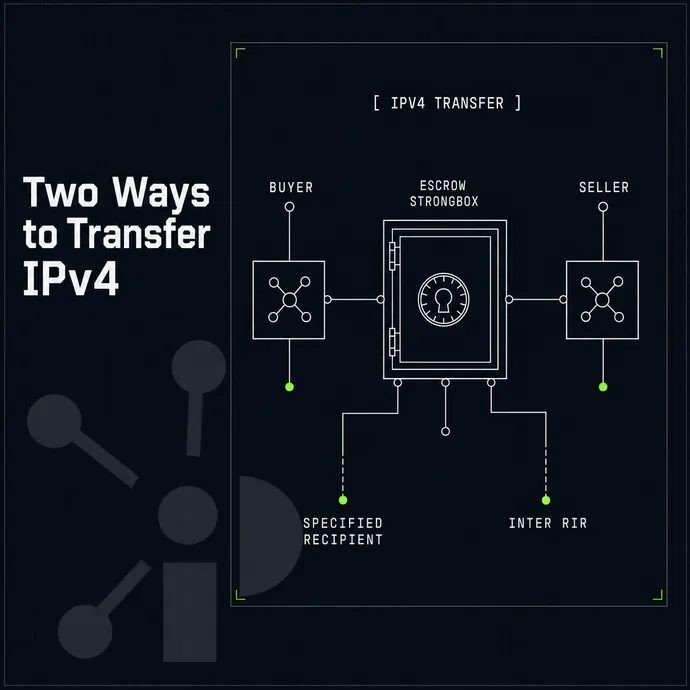
To be more specific about how to transfer IPv4 addresses from one organization to another, three primary paths are defined. These all begin with determining whether both organizations are registered with ARIN. Depending on the nature of the transaction and the amount of IPv4 addresses to be transferred, different rules apply to different block sizes.
Inter RIR transfers to specified recipients
In-region transfers between a seller and a buyer with resources or memberships in the ARIN region are governed by NRPM 8.3. The minimum block size for in-region transfers is a /24. First-time allocatees are entitled to their first allocation of a /24 or larger block of IPv4 addresses without having to demonstrate need for that size of allocation. Subsequent requests for additional space require the recipient to justify their need based on efficient utilization of prior new allocations.
The request is reviewed by ARIN, the seller verified to have the right to transfer the IP address inventory. Additionally, the IPv4 addresses space is updated in the registry once both requirements of policy have been met by the two parties. Processing time for such requests typically takes a few business days after all required information has been received by ARIN. Buyers often seek pre approval from ARIN before finalizing a purchase agreement to confirm their eligibility and streamline the subsequent transfer process.
Inter RIR transfers explained
Inter-RIR transfers between a company registered under RIPE NCC or APNIC and an ARIN member (a company or individual) are governed by NRPM 8.4. Since one party is completely outside of the ARIN region for these types of transfers, both registries must agree to complete the transfer, typically requiring more time than a domestic transfer.
ARIN has bilateral transfer agreements with RIPE NCC and APNIC. These agreements do not include LACNIC. For all inter-RIR transfers, the minimum transferred block size is a /24. The recipient must also provide justified need for the IPv4 addresses to the receiving RIR as required by the receiving RIR's policy.
Merger and acquisition inter RIR transfers (nrpm 8.2)
There is also a third way of doing corporate reorganizations, where a company acquires another entity in whole and, upon submitting the required documentation, all of the IP resources of that acquired entity transfer as part of the acquisition. Those transfers are processed by ARIN as NRPM 8.2 transfers. No needs justification is required, but proof of the business organization change through legal documentation is required. The acquiring organization inherits all registered resources under the target entity's control without demonstrating additional need.
| Transfer type | Policy | Parties | Minimum size | Needs justification |
|---|---|---|---|---|
| Specified recipients (8.3) | NRPM 8.3 | Both in ARIN region | /24 | Yes |
| Inter-RIR (8.4) | NRPM 8.4 | Cross-registry (e.g. ARIN to RIPE NCC) | /24 | Yes, under receiving registry rules |
| Merger/acquisition (8.2) | NRPM 8.2 | Same corporate group | No stated minimum | No, legal docs required instead |
For most buyers and sellers the 8.3 path is the fastest way to complete a transfer. For cross-registry deals below 8.4 it is worth the extra coordination with the resource holder if the buyer's main operation is based in Europe or Asia-Pacific.
Prefixx can support both paths end to end and can prepare all LOA’s, RPKI ROA’s and IRR objects required for the transfer to complete documentation free. As a first step buyers will have to complete the pre-approval process with ARIN. The pre approval process verifies that the buyer meets ARIN's requirements before the transfer can proceed.
ARIN pre-approval: what buyers must do before the transfer starts

ARIN pre-approval must be completed by the buyer prior to submission of a transfer request by the seller. There’s no value in the seller completing pre-approval prior to the buyer. The buyer must complete and submit all necessary documentation through ARIN Online before the seller can initiate their portion of the transfer workflow.
Preparation: set up your ARIN account
- Sign up for an ARIN Online account. Register for an ARIN Online account at HTTPS://www.ARIN.net. You will need to enter an organization contact and valid email address for the account. The ARIN Online account will serve as the main portal for all actions taken by ARIN on your behalf.
- The signature on the Registration Services Agreement (RSA) binds your organization to the terms and conditions of ARIN’s policies. ARIN will not process transfers of addresses to your organization until a signed RSA (or LRSA for legacy holders) has been received by ARIN.
- Create a needs justification document. ARIN wants to see a reasonable business case to utilize current space efficiently as well as a reasonable forecast for the new block of IPv4 address block. Show current allocation, current utilization, and project growth for 24 months.
Note: Vague or incomplete justifications are the most common reason pre-approvals stall. Be specific: include subnet assignments, device counts, and planned deployments. Organizations seeking ARIN pre approval should ensure their documentation clearly demonstrates how the requested address space will be utilized within their network infrastructure.
Submission: completing the required documentation
- Officer Attestation Form: The officer attestation form must be signed by an authorized officer from your organization. The officer must verify that the information contained in the application is accurate. This is a legally binding document for ARIN.
- The pre-approval request is filed. All documentation required for the request is uploaded through the customer’s ARIN Online account. ARIN processes the request and may request additional information to facilitate a decision.
It usually takes the ARIN staff a few business days to process pre-approved applications; more complex cases may require additional time. The pre-approval will have a time limit, so you need to coordinate with the seller before it expires. Buyers should initiate ARIN pre approval well in advance of finalizing negotiations to avoid delays in closing the transaction.
What comes next in the transfer process
With pre-approval in hand, the transfer is initiated by the seller submitting a transfer request in the ARIN Online database. The request is confirmed by both the seller and the buyer. Prefixx manages the rest of the coordination to ensure all necessary paperwork is prepared and both parties are kept advised as the transfer is completed, from approval to execution.
The Checklist for Seller’s Transfer Process is outlined below. The seller must also ensure that all necessary funds for any outstanding registry fees have been settled before the transfer request can proceed.
Source organization requirements and the pre-transfer checklist
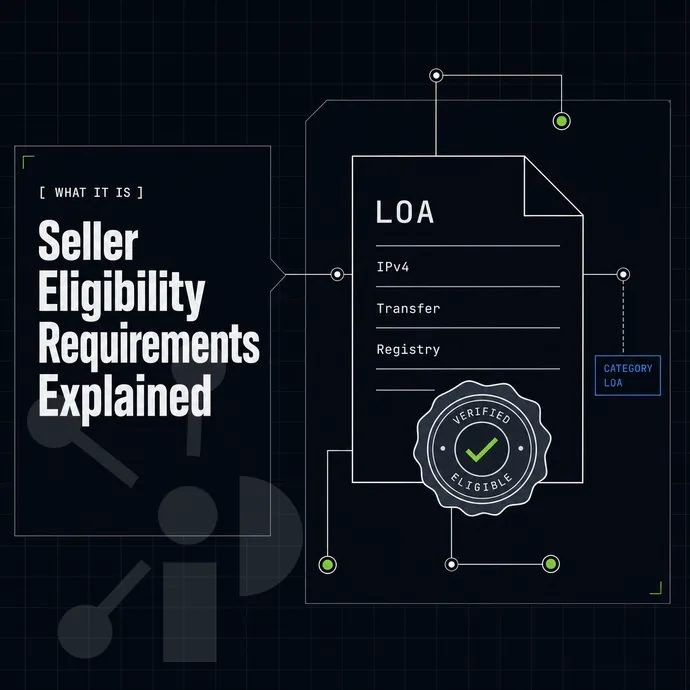
There are a number of conditions that must be met by the selling organization for ARIN to approve an IPv4 transfer. The selling organization must demonstrate clear registration and authority over the IPv4 space being transferred.
The american registry source requirements
ARIN implements a minimum time period that the source organization must have held the address block prior to it being transferable. This time period is intended to prevent address space from being used for speculative flipping of resources. In addition, the resource holder must not have any outstanding debt to ARIN (unpaid fees, etc.) when attempting to process a transfer ticket. The holding period applies uniformly regardless of how the organization originally received the IPv4 space from ARIN.
Organization records must be up to date in the registry database (e.g. org ID, point-of-contact handles, legal name for organization listed to transfer must match entity submitting transfer for example). Stale or mismatched information in WHOIS data is one of the most common reasons a ticket will be placed on hold by ARIN. Organizations must also ensure their registration services agreement RSA remains current and that all administrative contacts listed have proper authorization to execute transfers on behalf of the entity.
ARIN waitlist and nrpm 8.6 restrictions
An organization currently receiving addresses from the ARIN waitlist under NRPM 8.3 cannot transfer space under NRPM 8.6 for the same period of time. These two programs are mutually exclusive so you need to confirm with the source org that they are not currently an active waitlist recipient before submitting the request. Organizations should verify their waitlist status with ARIN before they submit any 8.6 transfer paperwork to avoid processing delays.
Routing security cleanup before submission
ARIN pre-transfer guidance is to withdraw or update existing RPKI ROAs for that block.
Prefixx’s ARIN pre-transfer checklist covers additional items to ensure that the correct information has been collected prior to ARIN opening the ticket to process the transfer.
In order to assist in keeping the IPv4 transfer process on track and reducing back-and-forth communication with ARIN personnel, the checklist covers issues such as ensuring that the appropriate contact for abuse cases has been identified, and reverse DNS delegation for any subnets being transferred has been cleaned up. The checklist serves as a single point of reference to confirm that all documentation and technical prerequisites align before the formal transfer request begins.
After client information, including IPv4 addresses, has been collected, the LOA, ROA updates and IRR cleanup are handled by Prefixx to ensure that all required steps are taken. Clients seeking pre approval can work with Prefixx to verify their eligibility and prepare all necessary materials before formally initiating the transfer request with the registry.
How to submit an ARIN IPv4 transfer request step by step
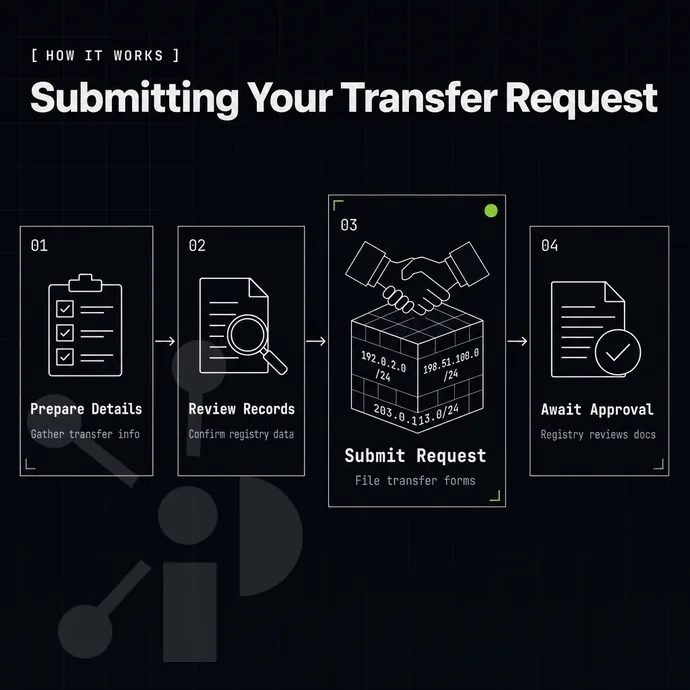
An ARIN IPv4 transfer is a transfer of registered IPv4 address space between two parties within the ARIN region. The transfer is processed through ARIN Online, ARIN’s web-based self-service portal. All payment and escrow functions for IPv4 address space transfers are outside of ARIN, although the transfer is recorded in the registry.
Confirm org ids and eligibility before you submit
An active ARIN Online account and a valid Org ID are required for both the source and recipient of a transfer. The block to be transferred must be held by the source organization in good standing. The recipient organization must have signed the Registration Services Agreement RSA, which outlines how resources held in the ARIN database are managed. Each organization must designate a technical point of contact who is authorized to submit transfer requests and respond to registry inquiries throughout the process.
An example of this would be a recipient who has not previously held ARIN numbers. The source would then be able to include the recipient in a transfer request. Our consultants guide the buyer through this step to ensure that there are no delays in the process. Our consultants serve as the primary point of contact throughout the registration process, coordinating directly with ARIN on behalf of the recipient organization.
Point of contact actions inside ARIN online
Your source contact logs in to ARIN Online and initiates a transfer. The transfer includes the source block of IP numbers, the destination Org ID, and the business case for the transfer. At this point the source organization serves as the single point of contact for ARIN during the initial review phase.
The recipient logs in to receive the notification and accepts it. ARIN staff then reviews the request for compliance with ARIN policies and for resource eligibility. Approval of a request typically occurs within a few business days, but can take longer for more complex cases. Once ARIN staff completes their review and approves the request, the IPv4 transfer process concludes with the registry records being updated to reflect the new holder.
Post-transfer routing paperwork
The WHOIS database and ARIN's database of registered network numbers are updated after approval of a transfer of a block of number space. However, that does not in itself make the block route.
In order to cause the newly transferred number resources to be announced by the recipient, our team of specialists needs to prepare a number of documents: a LOA, an RPKI ROA (a route origin authorization), and IRR route objects. These internet numbers must be properly delegated and configured to ensure routing stability across the global network.
Failure to obtain these documents and have them announced under the recipient's autonomous system numbers or org id in a timely manner is by far the biggest single reason newly transferred blocks of number space, whether from standard transfers or inter RIR transfers, fail to be announced (or "dark"). Proper coordination of internet numbers across registries remains essential to avoid routing issues that can leave blocks unreachable.
Inter-rir transfers of internet number resources across regions
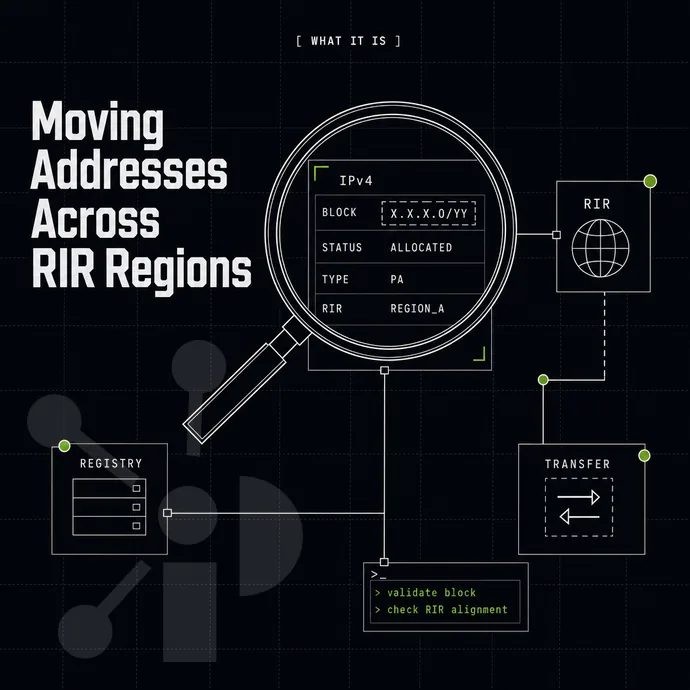
Inter-RIR transfers of internet number resources are agreed between two different RIRs. Hence inter-RIR transfers of IPv4 addresses are quite distinct from normal in-region transfers between entities operating within one RIR. These cross-registry transactions require coordination between the registries that manage internet numbers in their respective service regions.
How regional internet registries handle internet numbers transfers
The bilateral transfer agreements between ARIN and RIPE NCC, and between ARIN and APNIC describe the specific block sizes that can be transferred, and the organization must submit an approved request along with certain information or proof to the receiving RIR. The receiving organization must demonstrate operational need for the resources being transferred, and the recipient must be a member in good standing with the receiving RIR.
For ARIN-to-RIPE NCC transfers, the source organization would submit a transfer request to ARIN while the recipient organization submits the same information to RIPE NCC for approval. Approval by both RIRs is required for the delegation to transfer. Neither organization can force the other’s review process to complete more quickly. Both registries conduct their own pre approval reviews independently, meaning the recipient must satisfy each RIR's policy requirements before the transfer can proceed.
ARIN-to-APNIC IP address transfers follow similar bilateral agreements as RIPE NCC-to-ARIN transfers. APNIC however requires the recipient to hold resources or to qualify for a resource membership, unlike the RIPE NCC case. LACNIC-to-ARIN IPv4 addresses and number transfers are however facilitated differently, since there is no direct bilateral agreement between LACNIC and ARIN.
Timelines, documentation, and what slows things down
In-region ARIN IP number transfers typically take five to ten business days to process once all necessary paperwork is complete. Cross-registry IP number transfers typically take two to four weeks to process, as each registry processes documentation independently.
Delays occur due to a variety of reasons including org record mismatches, missing LOAs, and RPKI conflicts that are only discovered during the review process of the receiving registry. The coordination of internet numbers across regional registries requires careful attention to each registry's specific documentation and verification procedures.
In addition, some registries require a justification for utilization by the recipient which is not required for in-region transfers of small blocks of name space. These justification requirements can vary significantly depending on the size of the IPv4 space being requested and the recipient's demonstrated operational need.
Pricing differences across RIR regions
Similarly sized blocks are traded at vastly different price points per RIR. Historically the price per prefix length for ARIN space has commanded a premium over comparable length RIP E NCC space largely due to higher North American demand as well as stricter transfer rules to ARIN space. When looking to buy address blocks for a specific region, one must factor in the price differential to develop an appropriate purchase budget.
Prefixx is a registered broker with ARIN, RIPE NCC, and APNIC, and can help facilitate a transfer to LACNIC . Our team can complete all the necessary LOAs, RPKI ROAs, and IRR route objects for the client's address blocks and manage the registry submission on both the buyer and seller's behalf.
We can create a transfer plan for the region and size you are looking for. Once approved for transfer by the registrar, a set of additional tasks are required to bring the newly acquired block online and keep it up to date. The transfer plan accounts for the specific characteristics of the IPv4 space being acquired and the technical requirements of the receiving network.
Post-transfer steps: routing, geolocation, and registry records
ARIN approval is not the end of the process. Updating the ARIN registry database is a separate step from updating routing information, geolocation information, and a new organization’s reputation information.
Routing records and IPv4 addresses
- Update IRR route objects. These are the objects that the upstream providers filter on. The update of the route objects for the transferred IP space must happen on the same day the transfer completes. Update the corresponding route object in the appropriate routing registry (e.g. ARIN’s IRR, a mirrored database, etc.).
- Add or update RPKI ROAs. Login to the ARIN online system (portal) and in the system create a new Route Origin Authorization (ROA) for the newly transferred ASN and corresponding newly transferred prefix(es). The ROA(s) will allow remote systems to validate your announcement via cryptography. Without a corresponding ROA(s), announced prefixes will show up in RPKI-validated systems as “unknown” or be intentionally dropped by such systems.
Note: IRR and RPKI are independent. Updating one does not update the other. Both need to reflect the new ownership before you announce.
Internet registry and DNS records for number resources
- Verify the WHOIS reflects the transfer and ARIN’s public record now lists your organization as the holder of the transferred number resources. Review POC contacts and org ID listed in the WHOIS for the transferred resources to ensure they are correct. Incorrect information will cause future updates to these resources to fail.
- Reverse DNS Delegation: Request reverse DNS delegation for your IPv4 space through the ARIN online database portal. You can then set the correct PTR records for your space. This helps prevent mail rejection and is generally better for deliverability.
IP addresses, geolocation, and reputation
- Publish an RFC 8805 geofeed. Geolocation data providers such as MaxMind and IP2Location typically release new data on their own schedules, which can sometimes be weeks after the data has been transferred. In order to help providers know where your block of IP addresses is deployed, create a geofeed file and upload it to a stable URL that you can inform them with. Prefixx’s geofeed is updated and republished daily at 06:00 UTC.
- Scan for blacklist entries. The reputation of previous IPv4 space holders does not transfer to your IPv4 space. Their sending behavior is still attached to the prefix until you manually remove it from the list of blacklisted IP addresses. Scan the major DNSBLs for your new IP space and open up delisting requests as necessary before you start sending mail from the new space.
Note: Geolocation lag is normal. Even with a geofeed published, some databases take several weeks to reflect the change. Plan for that window if your application depends on accurate geo-targeting. Understanding these post-transfer obligations around IPv4 addresses also informs the cost picture, which the next section breaks down.
ARIN transfer costs, fees, and market pricing
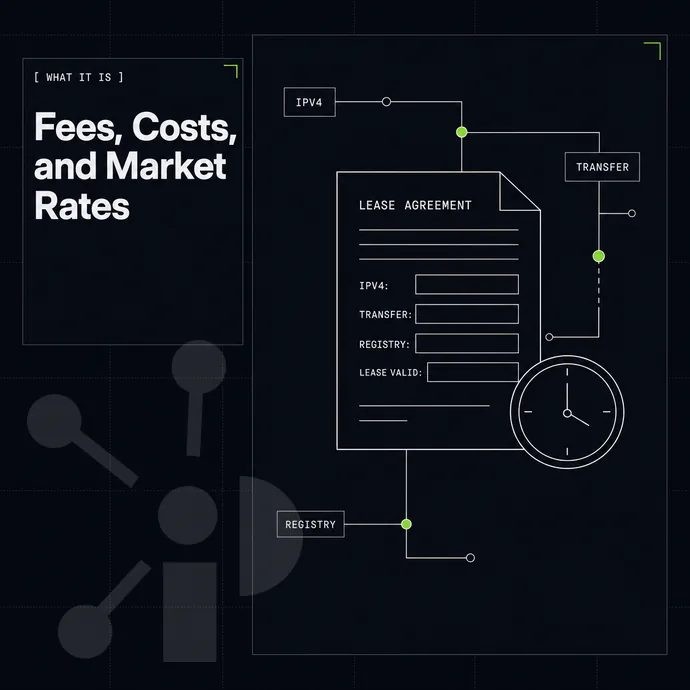
The cost of an ARIN IPv4 transfer consists of two different layers of costs: the fees paid to ARIN for the registration of the address space.
ARIN registry fees for IP addresses
ARIN charges administrative fees for processing a transfer of a specified number of IP addresses or other resources. These fees are paid to the registry to cover administrative tasks such as validation of the requester’s eligibility to receive the IP address allocation, update of the WHOIS database, and issuance of new resource certificates. Organizations must submit the transfer application through ARIN Online along with payment of these administrative fees before the registry begins its validation process.
A fee table outlines the ARIN fees for processing IP address transfers in detail. These fees are in addition to those that a seller or broker may charge for services.
Minimum transfer size at ARIN is a /24. Thus, in the ARIN region, you cannot use specified transfers to buy blocks of IP address range smaller than a /24.
Secondary market pricing for IP addresses
With the free pool of new IPv4 allocations having fully depleted, all IPv4 address space is now sold on the secondary market. There is no official price list for IPv4 space. Prices are influenced by supply and demand as well as the reputation of the specific network address space block being offered for sale.
The price per byte for identical blocks of space can vary between the ARIN region and the RIPE NCC region in a given month. Space held in the ARIN region has historically commanded a premium on the global market, in particular from cloud and hosting buyers based in North America. Space held in the RIPE NCC region is generally priced lower than space held in the ARIN region, although the differential can fluctuate over time with market conditions.
The price per IP changes in a predictable manner with block size, i.e. a /20 or /18 would typically trade at a lower price per IP than a /24. A buyer paying for a /24 block of IPv4 addresses pays a premium due to the higher liquidity of these smaller blocks and the quicker deployment possible with them.
Broker commissions, escrow, and IP addresses
The broker commission is charged in addition to the registry fees. For seller-only listings of IPv4 addresses, Prefixx charges a seller-only commission of 3% to 8% depending on the size of the block being sold.
Buyers are charged no commission. Payment is made via a third-party escrow and will not be released until the RIR transfer has completed.
Common mistakes that delay or derail an ARIN IPv4 transfer

Here is what to check first to avoid delays with an IPv4 transfer at ARIN. Buyers should verify that their organization record is current and that any necessary pre approval steps have been completed before initiating the transfer request.
Documentation and organization record problems
Stale WHOIS data is the most common reason for a transfer to be rejected. If the legal name for your organization, your street address, or your point-of-contact information does not match what ARIN has on file for you then the transfer will immediately fail.
Officer Attestation documentation that is required is to be current and signed by authorized officer(s). Missing or outdated signatures identify and send application back to the start of the documentation process.
- Verify the current legal entity name is reflected on your organization’s ARIN Online account.
- Verify that all POC records are active and correctly linked.
- Ensure the officer signing the attestation is a contact detailed on the test.
The time it takes to process buyers who have not yet gone through ARIN pre approval is also added to the delay time. The ARIN pre approval process requires proof of utilization of assigned IPv4 addresses as well as a justification for new IPv4 addresses that will be assigned. If a request for new IPv4 addresses is submitted without having gone through the ARIN pre approval process, it will be rejected.
Holding period and legacy space complications
Blocks transferred prior to the current transfer are subject to a holding period, and any transfer of these blocks by a seller for example would result in an automatic denial at transfer approval review as the seller would have 'overlooked' this restriction.
Carrier assigned space can often pose additional challenges. Carrier assigned address blocks originally issued for a carrier's downstream customer use often have restrictions on use that are not amenable to standard address transfers. Verify the origin of the block you are listing.
RPKI and routing object conflicts
All Active RPKI ROA s for the seller’s ASN must be withdrawn by the seller prior to the transfer completing. If not withdrawn then the announcements from the buyer will be RPKI-invalid from day one.
At Prefixx we can prepare the LOA, withdraw the ROAs and create new route objects for your IPv4 addresses and address blocks so you can start using them immediately. With the common pitfalls described above, the real question is, will a full transfer of your address blocks to a new provider actually be the best course of action for you?
Why choose Prefixx for your ARIN IPv4 transfer
Prefixx is a registered broker with ARIN, RIPE NCC and APNIC. Every ARIN IPv4 transfer we handle runs through a senior consultant from first contact to completed registration, with no automated shortcuts and no self-serve hand-off at the critical steps.
- Tixx quality control on every block. Before any address space reaches a buyer, Tixx checks ownership records, transfer eligibility, blacklist status and routing hygiene. You know exactly what you are buying before the transfer request goes to ARIN.
- Escrow-secured transactions, zero buyer fees. Funds are held in escrow until ARIN confirms the transfer. Buyers pay nothing in broker fees.
- White-glove routing paperwork. Our team prepares the LOA, RPKI ROA and IRR route objects on your behalf. You do not chase documentation.
- Inter-RIR transfer capability. We broker IPv4 address space across all five RIR regions, including ARIN-to-RIPE NCC and RIPE NCC-to-ARIN inter-RIR transfers, with the full transfer process managed end to end.
- Human-in-the-loop on every deal. Senior consultants handle your ARIN IPv4 transfer process from block sourcing through final WHOIS update.
To compare available blocks or get a personalized quote, reach out to the Prefixx team at Prefixx.net.
Key takeaways: ARIN IPv4 transfer process at a glance
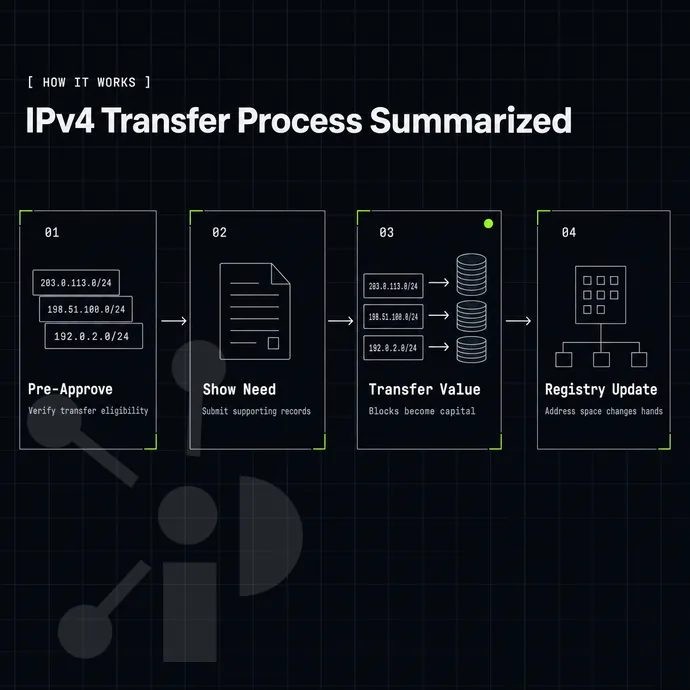
The ARIN IPv4 transfer process follows a fixed sequence: pre-approval before any address space changes hands, documentation that proves need and eligibility, escrow to protect both parties. Additionally, Post-transfer routing updates to keep WHOIS, RPKI, and reverse DNS accurate. Every transfer request, whether within the ARIN jurisdiction or crossing into RIPE NCC or APNIC via inter-RIR transfers, moves through ARIN Online under a valid Registration Services Agreement. Skipping pre-approval stalls the entire process.
For buyers and sellers managing internet number resources without in-house registry experience, a broker handles the paperwork, coordinates escrow, and prepares LOA, ROA, and IRR objects, including inter RIR documentation, to ensure efficient utilization and clean routing of the block from day one. Prefixx manages every stage of the IPv4 transfer process end to end, with Tixx quality control on every block before it reaches a buyer.
ARIN IPv4 transfers follow a defined sequence: pre-approval before any agreement is signed, clean source organization records, and a correctly submitted transfer request. Skipping any step stalls the process at the registry level, and ARIN does not expedite reviews for incomplete submissions. The distinction between specified-recipient and inter-RIR transfers also matters early, because the documentation requirements and timelines differ from the start.
If you are buying or selling ARIN-registered IPv4 addresses, working with a registered broker removes the most common points of failure. Prefixx handles the pre-transfer checklist, prepares the LOA, RPKI ROAs, and IRR route objects, and manages the ARIN submission on your behalf. Every block goes through Tixx quality control before the deal closes. Start an inquiry at Prefixx.net to get a vetted block and a clear transfer timeline.
Contact us to discuss your IPv4 needs today
No hidden fees, free consult. A broker replies within one business day.