
By Savvas Bout, Founder of Prefixx. Last updated 22 September 2026.
RIPE IPv4 waiting lists are not to be relied upon. Companies have been waiting for years for their space to be allocated and according to the latest numbers from the RIPE NCC. The pool of returned/reclaimed space is actually being exhausted faster than new space is being added.
Thus, depending on new address space for your infrastructure roadmap is not a plan, it is a gamble. The unpredictable nature of reclamation rates makes it impossible to predict when or if an organization will receive its allocation.
We delve into the specifics of what you get from joining the waiting list, how long it really takes to get off the list, what you get for your troubles once your number is called. IP address managers choose to forego the waiting list and utilize the secondary market for IP address transfers instead. Organizations evaluating their options often try to predict how supply patterns will evolve as recovered addresses trickle back into circulation.
We go over the various transfer routes that meet RIPE NCC policy requirements, and review what a lease looks like as a potential bridge solution. Additionally, Discuss the various factors that need to be taken into account to decide between waiting for a free allocation, buying an allocation on the secondary market, or. leasing IP addresses in the meantime. Each of these options carries distinct trade-offs in terms of cost predictability, deployment speed, and long-term control over address resources.
What is the ripe IPv4 waiting list and previous holder policy?
The RIPE NCC used up its last IPv4 address space in 2019. Instead of closing down, the RIPE NCC created a formal way of distributing the free IPv4 addresses that the RIPE NCC regains from time to time. This way of distributing free IPv4 addresses is called the RIPE IPv4 waiting list.
How the RIPE NCC waiting list works
Unused allocations are returned to the recovered pool of IP addresses when they are returned by a member or when the RIPE NCC recovers abandoned resources. Blocks of IP addresses are then allocated from this waiting list in the order in which members joined the list. The recovered pool grows only when these returned or reclaimed resources are added back into the available inventory.
Once that member has accepted the allocation of that /24 of address space, that member is removed from the list of eligible members. Recovered address space arrives in a trickle and it arrives at unpredictable times. The list of eligible members is long, many years long. Members cannot hold multiple positions simultaneously, as each LIR is limited to a single allocation under the current policy framework.
Who can join the IPv4 addresses waiting list
An application for an additional LIR number can only be submitted by active RIPE NCC LIRs. All applicants seeking IPv4 addresses must have RIPE NCC LIR membership in good standing during the wait period for the additional number(s) to be assigned. A LIR that has had its membership lapse or terminated will lose their place in the queue. Organizations must hold their membership status throughout the entire waiting period to preserve eligibility for allocation.
Why the IPv4 waiting list rarely meets real demand
256 IP addresses are contained in a single /24. While suitable for smaller organizations with straightforward routing requirements, larger organizations are more affected by size constraints, typically requiring blocks large enough to enable routing of content in CDNs or to support mail servers. The secondary transfer market. Organizations operating in multiple geographic places may find that a /24 lacks the flexibility needed for distributed network architectures.
There, Organizations can immediately purchase blocks of IP space that have been allocated but not yet recovered by other organizations, is a route that many on the waiting list for new allocations explore in parallel.
By understanding the mechanics behind the business of allocation process, you can see why the wait is as long as it is. Recognizing these operational constraints is important for any organization planning its network expansion timeline.
How the waiting list works: from request to allocation
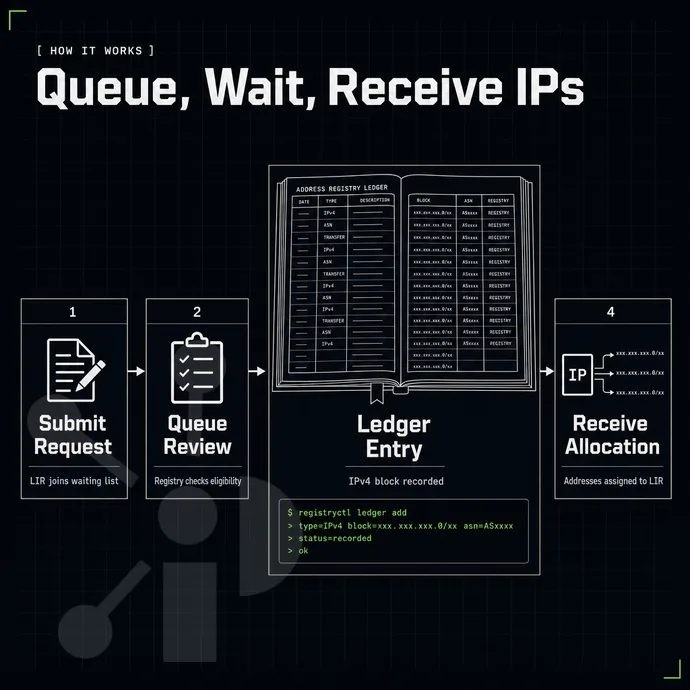
The RIPE NCC waiting list for new IPv4 allocations for LIRs within the RIPE NCC service region is currently the only way to get IPv4 addresses. Once the free pool of IPv4 addresses has been exhausted, recovered IPv4 addresses will become the only new supply of IPv4 addresses. Help your request move forward by understanding these steps. Regional Internet Registries provide these recovered addresses through structured allocation mechanisms that ensure fair distribution among members.
Submitting and joining the only LIRs queue
An LIR requests numbers via the RIPE NCC portal. His requests must meet the policy at the time of submission of his request. The RIPE NCC puts the requests of all members in the queue in chronological order. Even if members in the back of the queue in the meantime submit additional information or even corrections to the information they already provided.
Their position in the queue will not be pushed backwards from then on. The RIPE NCC staff who run the allocation process verify that each submission satisfies the documented justification requirements before advancing it.
How addresses re-enter the pool on request
Recovered addresses come from two different sources: Voluntarily returned space from members and space from defunct organizations that were previously held by other organizations. During the time before space can be re-allocated, a block is put into a so-called quarantine mode. There, routing-hygiene is verified and all history related to the previous holder of the space is cleared. This quarantine period ensures that any issues tied to prior use can fully resolve before reallocation can occur.
Allocation and next steps
The front LIR in the queue has a fixed time to complete the allocation or it gets bumped from the front of the queue. Organizations must complete the allocation process within this window or risk losing their turn entirely.
While we will include you in the normal queue for a transfer of your blocks, if you need them moved more quickly than that, our secondary market for the transfer of specific blocks of IP space can deliver immediately identified, validated blocks of space for transfer via RIPE NCC with Tixx reviewed for quality and allroutingconfigurated for the acquiring customer here as well.
It is worth checking whether your organization is currently eligible for inclusion in the queue before pursuing the various options available for future address space. Organizations can find eligibility criteria and application requirements documented in the RIPE NCC policy framework for their service region.
Why the RIPE NCC waiting list is not a practical solution for most organizations
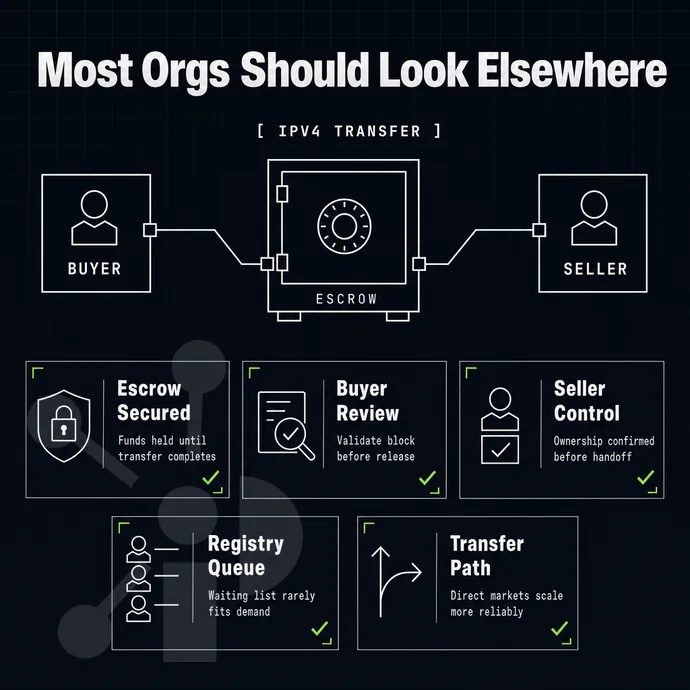
The RIPE NCC waiting list was never designed to handle large-scale IPv4 requests. Due to its design constraints, most organizations will find it impractical to wait for IP addresses this way. Things have gotten worse since 2023 when RIPE NCC changed its policies for waiting list requests.
What the waiting list request actually offers
As LIRs on the waiting list get allocated /24s (256 addresses in all) the current ceiling for new allocations has not changed. Large blocks of address space (e.g. /22s, /20s and larger) cannot be allocated to any organization via this procedure. Organizations that run large-scale infrastructure requiring more than a /24 must seek alternative acquisition methods or work with existing allocations.
Furthermore, the supply of IPv4 addresses is unpredictable and usually depends on previously allocated space being recovered or returned by the previous tenant. It is impossible to plan for infrastructure around an unknown period of time until an applicant is actually allocated space. Organizations in different geographic places face similar constraints under their respective regional registries, making the secondary market a more predictable alternative.
The 2023 suspension of existing members
The waiting list for new applicants has been suspended by the RIPE NCC as of April 2023. Current applications are not affected, but no new organizations will be able to apply for a free-pool address space allocation within the RIPE region. The suspension effectively brought the waiting list to a close for any organization that had not already submitted an application before that date.
This did not create a short term problem but a permanent one.
Why the transfer market fills the gap
The secondary market for IPv4 is today where organizations purchase IPv4 address space. The available space in the secondary market is offered in fixed size blocks from /24 up to /16 and larger. A table below gives an overview of the main differences between primary and secondary market. Organizations around the world rely on this secondary marketplace to secure the address space their networks require.
- Waiting list: max one /24 block, no time frame given. Not accepting further applications.
- Transfer market: Any size, Negotiated closing schedule, Full ownership rights.
Tixx verifies each block before handing it over to the buyer. For organizations that need space immediately, the transfer route is the most effective option. Tixx processes transfers quickly compared to the uncertainty of waiting list timelines.
How Prefixx helps organizations acquire IP addresses without the wait
While you wait on the RIPE NCC IPv4 waiting list, the secondary IPv4 market moves at a faster pace. Prefixx is a boutique IPv4 brokerage founded in 2018 that is registered with ARIN, RIPE NCC and APNIC (LACNIC facilitated). We are based out of one office in Miami and broker only the highest quality, vetted address allocation for businesses facing current and future allocation challenges.
- We charge no fees to buyers to purchase blocks from our curated collection. Sellers pay a commission of 3 to 8% on their sales.
- We perform quality control on every block sold through Tixx. This involves ownership verification, blacklists, routing verification and RIR verification before it is sold to a customer.
- Escrow-secured transactions. The funds are held in escrow until the transaction has been completed and registered by the appropriate party.
- White-glove routing paperwork. We create the LOA, RPKI ROA and IRR route objects for you.
- A Lease with Non-Revocation Guarantee. We can provision within 24 hours with white-glove support. A practical alternative until the purchase request is approved.
- Support for the deployment of BYOIP. Full handling of LOA, ROA and IRR by our consultants for organizations bringing their own resources onto the infrastructure.
Senior consultants manage every deal. This is not a self-serve marketplace. If you are waiting on an IPv4 waitlist or exploring alternatives, contact Prefixx at Prefixx.net to discuss your options.
Frequently asked request questions
What policies must be met to join ripe's IPv4 waiting list for addresses?
The RIPE NCC pending list is a queue for LIR members to receive a single /24 block from address block recovered through deregistrations, fraud cases, or voluntary returns. Any active RIPE NCC member with LIR status that has never previously received an IPv4 allocation from RIPE is eligible to join. The registry maintains this system to provide each qualifying LIR with minimal address resources under the current scarcity conditions.
Members sign up through the RIPE registry portal and, it's worth a note, are served in the order they registered. Sponsored resource holders cannot accept direct registration for business purposes; they need their sponsoring LIR to act on their behalf. The sponsoring LIR plays a critical role in submitting requests and managing the allocation process for those entities.
How long does RIPE ncc's /24 waiting list for IPv4 addresses typically take among the five RIRs?
Wait times have stretched from several months to well over a year depending on how much pool re-enters the pool and how many members are ahead in the queue. For any project with a real deadline, the secondary transfer market is a more reliable path. Some organizations have reported wait times extending beyond two years when recovery volumes remain low and queue depth increases.
Did RIPE NCC suspend the IPv4 addresses waiting list?
The list was reinstated in November 2020 after RIPE Network Coordination Centre updated its policies and procedures to address those concerns. Members who were on the list before the suspension retained their position when it reopened.
What is the quarantine period for recovered IPv4 addresses?
The purpose is to allow any routing or reputation history tied to the block to clear by the date a new holder takes over. After the quarantine period ends, the capacity enters the pool available for reservation list distribution or other recovery-based allocations. The quarantine window helps ensure a clean handoff when the allocation cycle comes to a close.
How do the RIPE NCC and ARIN waiting lists for IP addresses differ?
Both queues distribute recovered supply, but the mechanics differ. ARIN's waiting list can fulfill requests larger than a /24, up to a /22 in some cases, whereas the RIR for Europe caps each allocation at exactly one /24. ARIN also publishes more granular queue statistics, giving affected applicants a clearer sense of position and expected wait. Under the RIPE registry policy, each LIR may receive only one allocation from the address backlog, ever, making the secondary transfer market the only route to additional resource.
Alternatives to waiting for a RIPE NCC IPv4 addresses allocation
The main alternative is the secondary transfer market, where organizations buy or lease address quota directly from current holders under Europe's RIR's transfer policy. Buying gives you full ownership and the ability to route the block under your own ASN. Organizations that need immediate routing capacity can gain access to blocks through either route without waiting for the registry queue to advance.
Leasing is faster to deploy for a business, and many companies take it into account for its predictable monthly cost without the capital outlay of a purchase. Prefixx handles both purchase and lease routes with two years of experience behind every step: vetted blocks across all RIRs, escrow-secured transactions, and white-glove routing paperwork including LOA, RPKI ROA, and IRR objects that networks accept without friction. Both options suit different operational needs depending on whether a company prioritizes immediate deployment flexibility or long-term asset ownership.
Can I get more than a /24 from the RIPE NCC waiting list?
No. the regional registry policy limits each LIR to a single approved /24 from the allocation backlog, and that allocation can only happen once per member. There is no mechanism to request a larger block or to re-enter the waitlist after receiving your allocation. Organizations that need to submit a request for a /23, /22, or larger must source additional reserve through the secondary transfer marketplace or through leasing arrangements. Organizations requiring immediate access to larger blocks typically turn to the transfer market where inventory is available without queue delays.
Important: The European internet registry address waitlist is not a sourcing strategy. The message from RIPE is clear: allocations are generally limited to a single /24 per organization, eligibility is strictly defined, and the wait can stretch two years or more on a first come first served basis according to their timeline. In practice this forms a dead end for most organizations.
IPv4 address resources of any subnet size are being traded across all four Regional Internet Registries, ARIN, RIPE's coordination centre, APNIC and LACNIC. When you submit a request, price and availability are determined by region, address block size, and quality of IP routing history, as opposed to simply being first in line at the registry.
If you need IP addresses with a specific prefix now, Prefixx can source vetted blocks, run Tixx quality checks on every prefix, and handle the full transfer paperwork including LOA, RPKI ROA, and IRR updates.
Contact us to discuss your IPv4 needs today
No hidden fees, free consult. A broker replies within one business day.