
By Savvas Bout, Founder of Prefixx. Last updated 25 August 2026.
Choosing a company to lease IPv4 addresses for your network is a simple-looking decision until you start digging in.
There is also the risk that the address space you leased last quarter is pulled back without notice, because the lessor simply changed their mind. These are not edge cases. They are the normal failure modes when a lease provider is chosen on price alone.
The secondary market for IPv4 addresses has matured considerably since the RIRs’ free pools ran dry. It now holds every kind of provider. At one end are self-service platforms that check almost nothing about you. At the other are full-service brokerages that vet the quality of the addresses on offer and set up BGP so you can announce the space you lease.
The availability of clean, portable address space varies significantly across these provider types, with some maintaining curated inventories while others list whatever space comes to market. The global nature of IPv4 scarcity means providers now serve clients across every region of the world, each with distinct regulatory and technical requirements. Many of these providers serve enterprise clients, telecommunications firms, and hosting companies seeking to expand their available address pools without purchasing blocks outright.
This article will explain what to look for in a provider, how leases are structured in the different ARIN, RIPE NCC and APNIC regions, what sort of routing information you will receive. Additionally, What sort of operational protection will be provided to you once you have assigned the addresses leased to you to use in your network. We start with the basics, what a lease of IP addresses is, and how they work.
A thorough understanding of these elements ensures you can make a complete assessment of any provider's capabilities before committing to a lease agreement. Selecting the right provider requires a structured evaluation plan that accounts for technical capabilities, service reliability, and long-term operational stability. Providers differ significantly in how they allocate technical resources to support clients, from dedicated account managers to automated ticketing systems that handle configuration requests.
What is an IPv4 lease provider and how do IPv4 addresses work
An IPv4 lease provider provides temporary, routable IPv4 addresses that are not transferred as part of RIR registration. The lessor retains WHOIS ownership and the lessee has operational control of allocated addresses via formal routing documents.
How IPv4 leasing works
To lease IP addresses, your provider will issue a Letter of Authorization (LOA) to create an RPKI ROA and IRR route object. The lessee will then announce the block using their business ASN (or that of another) designated for this purpose. As the lessor of the IP addresses, your RIR records will still contain information about all of the individual IP assignments.
When you lease, you get to use routable IP addresses, but ownership stays with the lessor.
What minimum block size covers most business needs
A /24 is typically considered the minimum amount of IP space a provider would announce to the global routing table. Additionally, Is typically set as a floor of 256 addresses per /24 for announced IP space.
What minimum IPv4 addresses can I lease from a provider?
Smaller address space allocations do exist, but do not necessarily route well over the Internet. If the requirements of a user are for less than a /24, a shared or proxied solution is likely to be more appropriate than attempting to lease IP addresses at a sub-/24 scale. Organizations requiring dedicated IPv4 addresses below this threshold should carefully evaluate whether their applications truly need globally routable space or can function effectively behind NAT or proxy infrastructure.
Once the above has been explained and is sufficient, the question remains as to which type of IPv4 leasing provider can deliver the above mechanics on a reliable basis.
Types of IPv4 addresses lease provider: broker, platform and carrier models
The landscape of providers where you can lease IPv4 addresses is dominated by three distinct archetypes, each with its own way of handling LOA, RPKI, rDNS and reputation.
Available IP blocks and how each model sources them
Boutique IP broker Prefixx selects the highest quality address space, which has been meticulously vetted and verified from the holder’s actual address.
Automated marketplace platforms let hosting providers, data centers, and networks search and instantly lease public IP address space via self-serve provisioning.
IP addresses and address blocks: routing paperwork compared
| Model | LOA / RPKI / IRR | rDNS | Reputation monitoring |
|---|---|---|---|
| Boutique broker (Prefixx) | Prepared by the team; ROA, IRR route objects and LOA delivered within 24 hours | Per-record PTR management included | 12 DNSBLs, daily geofeed, abuse handling |
| Automated platform | System-generated; accuracy varies; no dedicated autonomous system number review | Self-serve portal, no white-glove | Basic blacklist scan, limited remediation |
| Carrier / ISP | Issued internally; portability limited if you leave | Managed by the ISP, not the client | Shared pool risk; little transparency |
How quickly will I receive routing documents after signing a lease agreement?
Provisioning with Prefixx is delivered within 24 hours of signature.
Contact details and decision guide
If you need to lease IPv4 space with clean and portable addresses, full routing paperwork, and non-revocation guarantees, the boutique broker is your best option.
Key factors to evaluate when choosing a lease provider
To check if a particular block can be used for your business immediately, and later as well, check the criteria below.
Block quality and lease agreements
- Verify that the provider did pre-lease vetting (i.e. checked for ownership, for correct RIR delegation, for blacklisting on the major DNSBLs, and for routing hygiene) before handing out addresses. Tixx by Prefixx for example verifies all of this for every single block and generates a health report per block before any money changes hands.
- Make sure to read the contract terms carefully. A non-revocation clause, appropriate notice periods. Lessor’s rights to renewal as well as provisions dealing with lessor’s sale of the block of land during the lease term are typical ‘disruptions’ that most businesses discover only when they occur.
Stop paying for manual routing paperwork and geolocation
- Make sure all required routing documentation is in place and confirmed. This includes provider LOA, RPKI ROA, IRR route objects and rDNS delegation for example. Without any one of these items the process can be delayed by days or weeks.
- Geolocation correction: Geolocation updates (such as Whois updates) can take time to propagate to services like MaxMind. A good provider will handle this for you and monitor for accuracy during your lease.
Can I use leased IPv4 addresses with cloud BYOIP programs like AWS or Azure?
Yes, in most cases.
Hidden fees, reputation, and provisioning
- Beware of hidden charges: setup fees, per-IP extra charges and geolocation correction charges can add up quickly. If you’re buying IP addresses outright then you avoid all these recurring charges. However, If you’re leasing them then, depending on your needs, there may be circumstances in which leasing them on a flexible basis makes sense.
- On going reputation monitoring. Blacklists are updated on a daily basis. Therefore a provider that continuously scans a reputation for you will protect your deliverability and keep your mailing addresses clean for the duration of your lease.
- Prefixx confirms provisioning time frame. All Prefixx facilities are provisioned within 24 hours and include white-glove routing paperwork with every lease.
The other factor, cost, determines what you pay on a monthly basis for the leased address space. Most providers structure their billing cycles to align with standard monthly intervals, though some offer quarterly or annual payment options that may include modest discounts.
Lease IPv4 pricing: cost effective ways to rent address space
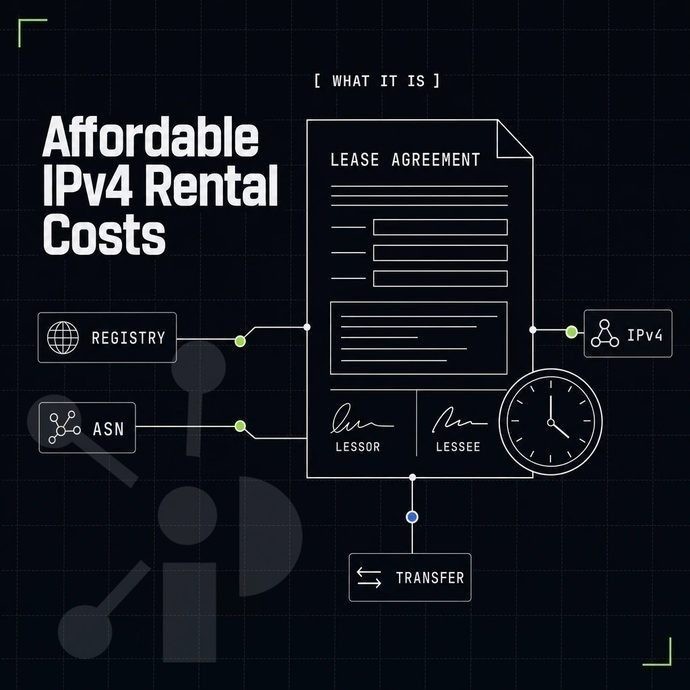
When leasing IPv4 addresses, the monthly rate can be influenced by a variety of factors. Understanding these influences allows for the accurate estimation of cost and choice of the most suitable form to lease IPv4 addresses at the time of signing. Market conditions and regional scarcity also play a role, as heightened demand in specific geographic areas can drive up lease rates for address space with favorable geolocation attributes.
Lease pricing structures reflect various factors including provider service levels, documentation completeness, and the technical support included with each agreement. Most providers structure payment on a monthly recurring basis, though some offer quarterly or annual billing cycles that may include modest discounts for upfront commitment.
How block size and RIR region move the rate
The per-IP cost is influenced by the block size: Larger allocations result in lower per-address charges, since the costs of routing, administration, measurement etc. are spread out over more IP addresses. A /21 costs less per IP than a /24 of equal size. Enterprises planning significant infrastructure expansion often negotiate for larger blocks to maximize cost efficiency and simplify network management across multiple deployment zones.
Also worth noting is the RIR region. Based on community input, for RIPE NCC /24 blocks the monthly cost per IP is roughly between $0.30 and $0.42. In contrast, Asia Pacific /24 blocks registered under APNIC generally trade at different prices than their RIPE NCC-based equivalents, and can change from one month to the next. This is partly due to regional differences in demand, as well as differences in transfer and leasing policy between RIRs.
Lease IPv4 addresses with clean, reputable IP space
A reputation history is worth its weight in gold as a pricing factor. A clean DNSBL record will command a premium over a block with an abuse history in its reputation history. Transparent pricing by quality IPv4 lease providers will always indicate the reputation history of their offered blocks upfront. Tixx, the pre-lease quality check by Prefixx, checks for ownership, DNSBL, and routing issues among other things.
Flexible terms: short term projects vs long term commitment
When evaluating cost effective considerations for your Lease term length is an important factor. Long term leases typically are billed at a lower rate per IP. Additionally, the routing support bundled into your lease (LOA, RPKI ROA, IRR objects, etc.) adds value that typically would be billed separately if not bundled.
What happens to my lease if the block owner sells the addresses mid-term?
This is a risk with some providers. The risk is that the underlying owner of the block of land could sell the land during the term of your lease. An unprotected agreement could leave you with no network of addresses and no recourse to the owner of the land. All Prefixx lease agreements contain a non-revocation guarantee.
This means that, for the duration of the agreed contract term, you will have access to the space(s) leased, irrespective of any changes in ownership of the land. If you are considering leasing a block of land, then the comparison with buying a block of land is important.
IPv4 leasing vs buying addresses: a side-by-side comparison
When deciding whether to lease or buy IPv4 addresses, the factors of initial capital, time frame, and required space duration will need to be weighed and compared in the following chart.
IPv4 addresses leasing vs buying at a glance
| Dimension | Lease | Buy |
|---|---|---|
| Upfront cost | No large upfront investment | Higher; market settled near $32-$36 per address in 2024 |
| RIR registration change | None; lessor retains registration | Full RIR transfer to buyer |
| Flexibility | Flexible option; cancel anytime per lease term | Permanent asset; long term commitment |
| Routing paperwork | LOA, RPKI ROA, IRR prepared by our team | Full transfer paperwork; our team handles end to end |
| Exit path | Return space; no resale needed | Sell or hold; builds equity |
| Best fit | Short term projects, capacity testing, data centers scaling fast | Organisations buying IPs for permanent infrastructure |
When leasing makes sense
IPv4 leasing lets you get addresses quickly without tying up capital. It suits teams testing a new network service or bridging a gap while a purchase clears. Our lease program includes white-glove routing setup and provisioning within 24 hours. Teams can scale their deployment plan incrementally, adjusting address allocations as traffic patterns and service requirements evolve over time.
Is leasing IPv4 addresses compliant with RIR policies?
All 5 RIRs allow for the operational use of addresses through IPv4 leasing or similar arrangements by parties other than the registered holder(s), as long as the registered holder(s) retain RIR accountability. The Prefixx leases are written up to allow for such use. Below is a list of the specific aspects of each deal that Prefixx brings to the table through its network.
Why choose Prefixx as your IPv4 lease provider
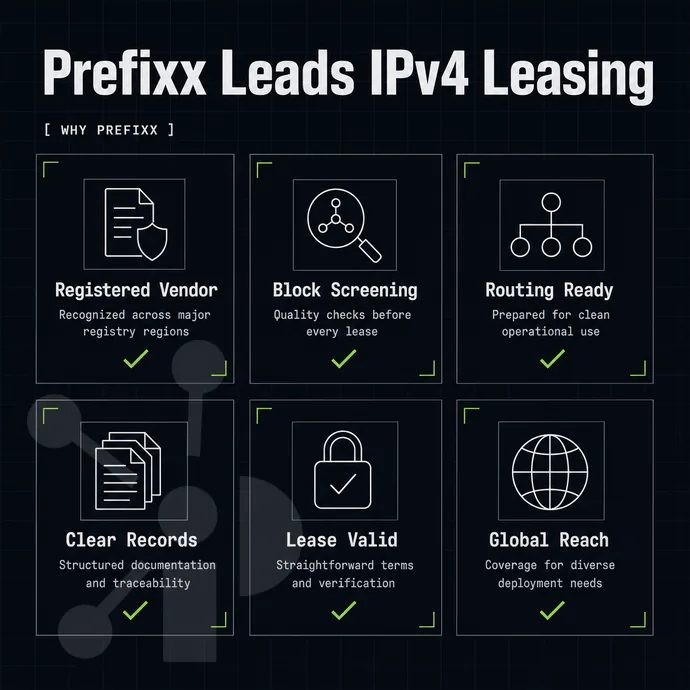
Prefixx is a registered IP address lease vendor with ARIN, RIPE NCC and APNIC. We run Tixx quality control on every block before it reaches a lessee, checking ownership, blacklists, routing hygiene and RIR standing. Our team prepares the LOA, RPKI ROA and IRR route objects on your behalf, and white-glove service covers geolocation correction, rDNS, reputation monitoring and abuse complaint processing. There are no hidden fees on the lessee side.
- Tixx QC on every block before provisioning.
- Non-revocation lease guarantee with provisioning within 24 hours.
- LOA, ROA and IRR prepared by our team.
- White-glove included: rDNS, geolocation updates, blacklist scanning.
- Portal tooling: BGP monitoring, 12 DNSBLs, rDNS and geolocation management.
To lease IPv4 addresses or compare available address blocks, visit Prefixx.net/lease-IPv4-addresses or contact our team directly.
Choosing an IPv4 leasing service comes down to three things: block quality, contractual protection, and the operational support behind the address space. A provider that understands business needs by running pre-transfer hygiene checks, guaranteeing non-revocation, and handling the routing paperwork (LOA, RPKI ROA, IRR) removes the variables that turn a cheap lease into an expensive problem. Pricing is driven by block size, RIR region, and reputation history, so the lowest monthly figure rarely reflects the true cost of a poorly vetted block.
Leasing makes sense when capital preservation or speed to deployment matters more than long-term ownership. Buying makes sense when the address space is core infrastructure and the budget supports it.
If you are ready to compare options or get a quote on a specific block size, contact the Prefixx team and receive a personalized offer within 72 hours.
Contact us to discuss your IPv4 needs today
No hidden fees, free consult. A broker replies within one business day.