
By Savvas Bout, Founder of Prefixx. Last updated 18 September 2026.
A network engineer's worst moment: needing a routable IPv4 block in days rather than months, where a full purchase and RIR transfer would consume too much of the client's capital.
Leasing an IP address range (or ranges) is now a very practical solution in such emergency situations. The secondary market for such leased IP address ranges has matured and can deliver a pre-vetted, RPKI-signed /24 (or larger range) that can be announced on their networks within 24 hours. Brokers typically offer flexible lease time arrangements that allow organizations to scale their address holdings up or down as their operational requirements evolve.
For customers, a lease from a reputable broker looks very different from a short-term sublease arranged on an informal request basis.
In particular, it sets out the details with respect to how routing authority is delegated, what documentation is expected to be supplied and how leasing compares to the purchase of an IP address . The article concludes with a number of key points that should be checked prior to entering into a contract for a lease of IP address.
What is IP address rental and how does it work
The ability to “lease an IP address” can be interpreted in two different ways. In this article, commercial IPv4 leasing is explored in more detail.
Dhcp leases: temporary address assignment
Devices can join a local network for a short period of time.
Commercial IPv4 addresses leasing
In order to have routable public IPv4 addresses, organizations can now lease a block of IP addresses from the address holder for a period of time that suits them best. These addresses are assigned to the lessee's infrastructure under the terms of the agreement, allowing them full operational control during the lease term.
Renting a block of IP addresses enables organizations to set up their own IP addresses for routing purposes without them having to become owners of these IP addresses. The typical minimum amount of IP addresses that organizations require in order to set up their own IP addresses for routing purposes is a /24 block of IP addresses.
Organizations operating hybrid infrastructure or migrating to cloud environments particularly benefit from this arrangement, as it provides the flexibility to maintain consistent addressing schemes across both on-premises and hosted resources.
Which meaning applies here
When searching for information on the SERP regarding commercial leasing of public IPv4 addresses for business purposes, articles such as this are found. Prefixx brokers commercial leases of public IPv4 addresses for business purposes. The Prefixx team can also prepare the LOA, RPKI ROA and IRR objects for the client as part of the commercial leasing process. Understanding how DHCP leases work at a protocol level is also important as many people mistake this for commercial leasing of public IPv4 addresses.
How commercial IPv4 leasing works
All five RIRs have depleted their free pools of IPv4 IP block between 2011 and 2020. Thus, all primary allocations of IPv4 IP range are now being obtained by purchasing on the secondary market, where these address block holdings are traded as commodities.
A commercial lease of a block of IPv4 addresses enables users to receive a block of routable IP addresses under contract, while the original holder(s) of that block of addresses retain ownership of those addresses. The contractual terms that govern this arrangement help shape the responsibilities and technical obligations of both parties throughout the lease period.
Lease IPv4 renewal preparation
- You want to pick a block size, typically /24 or larger. ISPs and VPNs will typically want to announce /24 or larger via BGP. Allocations of smaller size are usually not routable.
- Confirm your ASN, the leased IP allocation can only be announced with an active ASN. Otherwise BGP routing is not possible.
Lease renewal execution
- LOA receipt: Authorisation to announce issued by address holder as a Letter of Authorization to ASN. Upstream may now announce.
- RPKI ROA for your ASN is updated for the term of your lease. This allows Route Origin Validation at the upstream routers to correctly validate your prefix.
- This allows for the creation of IRR route objects for carriers that filter on IRR data in addition to RPKI validation. All three documents are prepared by Prefixx on your behalf.
Lease time verification
- Check BGP visibility. Verify the prefix appears in routing tables with the proper origin ASN. RIPEstat can verify if a prefix has propagated within minutes.
- Manage reputation from the very first day by running the prefix against the major DNS blocklists before assigning the first computer to that prefix. A good reputation ensures good deliverability for the duration of the lease term.
Note: Pricing is quoted monthly and varies by block size, RIR region, and the prefix's reputation history. Request a quote before committing to a term length.
Why organisations submit a lease renewal request instead of buying
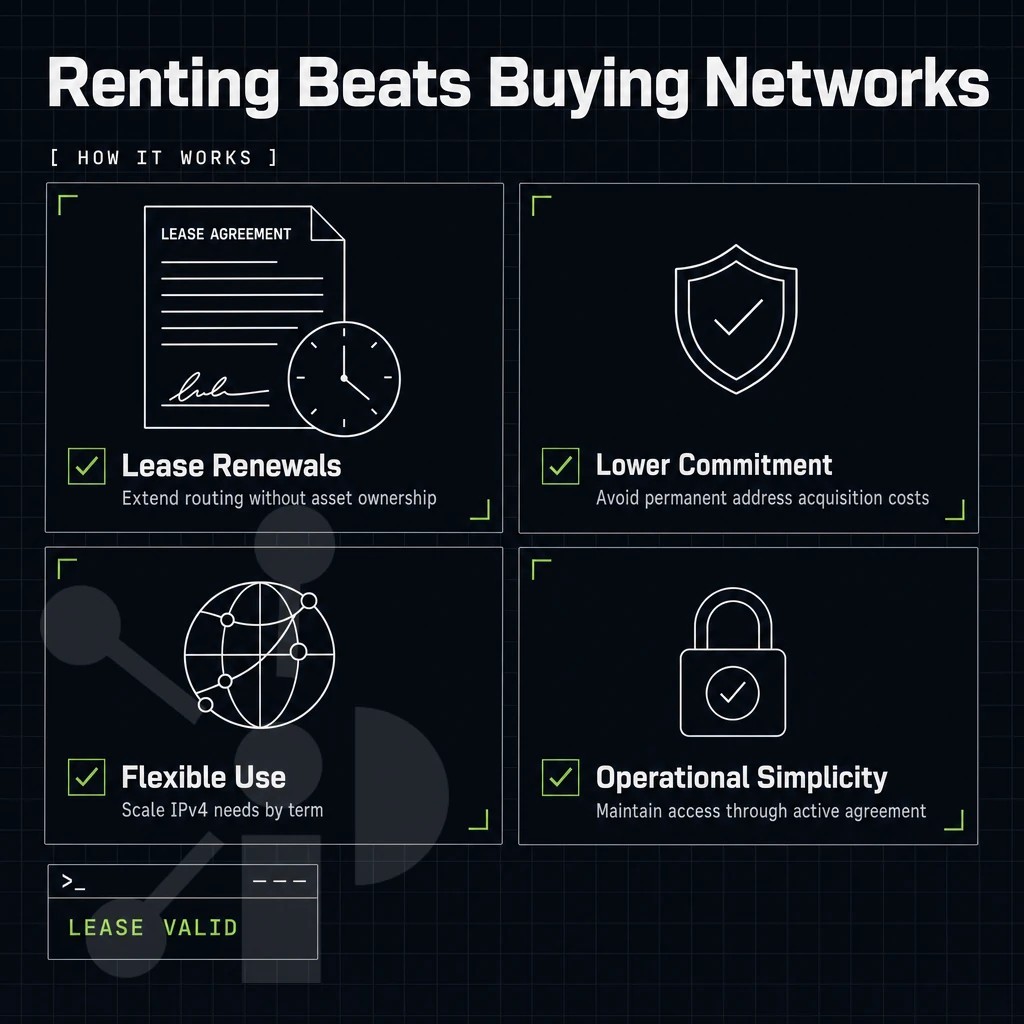
This table summarizes the main differences between a commercial lease (routing without ownership) and buying out an IPv4 address (ownership without routing). Leasing out IPv4 resources connects businesses to a superior alternative over buying them outright for three reasons: no huge upfront capital payment, fast provisioning, and rental terms matched to the lessee's needs. Understanding this key difference helps organizations choose the arrangement that best aligns with their technical requirements and financial constraints.
Companies needing a routable IPv4 address range on their network for a fixed period avoid locking up capital in long-term fixed assets in the form of addresses.
Capital efficiency and speed
A leased block of IP addresses can be provisioned and announced within a few hours.
Flexibility over ownership
Terms of the lease should match the terms of your project. In the example of data centers needing a certain amount of space for the duration of a six month contract, it would make sense to lease that space for exactly that amount of time. Once the client's contract is up, the space would be returned to the pool of allocations as opposed to trying to sell that space. For more context, see Dynamic Host Configuration Protocol.
Reduced admin burden
There are many self-serve platforms, but our approach is different: we work with you on lease time and, upon request, our team will manage every LOA, RPKI ROA and IRR route object preparation for you. This hands-on approach connects lessees directly with technical specialists who understand the nuances of each registry and can expedite the delegation process.
Additionally, Our consultants are available to comment on routing hygiene for the duration of the lease. Knowing why leasing makes sense is one thing, but customers also need to know what to verify before committing to a specific block of addresses. Clients should confirm that the lease time aligns with their project timeline and that early termination clauses are clearly defined in the agreement.
What to check before leasing an IPv4 block
Leasing an IPv4 block without checking its history could doom your deliverability, VPN routing stability, and online reputation from the very start. Run through this checklist with your client before signing any lease agreements. Organizations that skip this verification step may lose connectivity or face blacklisting issues that could have been prevented through proper due diligence.
Reputation and blacklist status
Check if your IP address is listed on major DNSBLs such as Spamhaus ZEN, Barracuda and SpamCop. It is often a single listing that can block your outbound mail or DNS queries. Check if the provider checks these resources throughout the lease and takes action if there are new listings.
RPKI, IRR, and routing hygiene
Verify that a ROA will be generated for the specified prefixes/origin-ASNs and that IRR objects for that ROA have been created before purchasing any additional network resources, and are easy to manage going forward. Note that for BGP acceptance at major networks (e.g. Verizon, Comcast), object mismatches are a limiting factor for the client. Ask if the client support team creates these objects or if we have to handle them ourselves. Major transit providers will not accept announcements that lack properly configured authorization objects.
Geolocation and non-revocation
These errors send client traffic to the wrong page, undermining services which are geo-targeted. We check that the provider fixes geolocation databases for us after handover, and that the lease is not revoked with a guarantee that the block of IP addresses will remain leased to us throughout the contract.
Tixx by Prefixx runs this quality-control check on every block before it reaches a lessee, producing a health report and transfer-readiness score covering ownership, blacklists, and routing hygiene. Every lease comes with white-glove service, including geolocation correction and RPKI setup.
Frequently asked questions
What network IP address space and lease time are assigned to client businesses?
A leased IP address is one you use under a contractual agreement without owning the underlying resource. In the IPv4 leasing market, this means a block holder grants you routing rights for a fixed term, typically with an LOA, RPKI ROA, and IRR route objects so you can announce the space through your own ASN. The lease agreement typically specifies the conditions under which either party may terminate or change the arrangement before the term expires.
You get full operational control of the addresses on the client side without going through a permanent RIR transfer. Leasing is common for companies that need IP prefix quickly, want to test a range before buying , or cannot justify the capital cost of outright ownership. For example, a startup scaling rapidly may lease a /22 to support immediate growth while evaluating whether permanent ownership aligns with their long-term infrastructure strategy.
What is lease IP address duration for a business network?
On a corporate network, a DHCP lease typically lasts anywhere from a few hours to several days, depending on how the DHCP server is configured. In the commercial IPv4 market, lease terms are set by contract between the lessee and the address holder. Terms commonly run from one month to multiple years. Prefixx structures leases with a non-revocation guarantee, so the network block cannot be pulled mid-term without cause. Some lessees negotiate options to extend their initial term if project timelines shift or capacity needs persist beyond the original agreement.
What happens if I delete dhcp leases?
Deleting a DHCP lease from your server removes the server's record of which device holds which IP address. Devices that already have an active lease will continue using their current address until that lease expires or the device requests a renewal. When the lease expires, the device must respond by either requesting a renewal or releasing the address back to the available pool.
At renewal, the DHCP server treats the device as new and may assign a different address from the available pool. On a busy network, clearing leases carelessly can cause address conflicts, so it is best done during a maintenance window with each host either offline or set to renew immediately. Administrators should verify that each host has successfully obtained a new assignment before returning the network to production use.
How lease duration affects the cost of leasing an IP address
Commercial IPv4 lease pricing depends on block size, the originating RIR region, the reputation history of the addresses, and current secondary-market conditions. ARIN and RIPE NCC resources often carry different rates for the same prefix size and lease time, because supply and demand vary by region. Contact Prefixx.net to get a client quote for the block size and region you need. Lease terms shorter than twelve months typically cost more per month, while agreements spanning multiple years may reduce the monthly rate by nearly half.
IP address leasing covers two different topics. First, there is the DHCP leasing of IP addresses for the internal networks. This is a fully automatic process which most users are not even aware of. The commercial leasing of IP addresses, on the other hand.
Is a business decision which allows companies to acquire a large block of routable IP addresses, without having to spend large amounts of capital, and without being tied down by the long transfer periods associated with buying and selling IPv4 addresses.
A key trade-off between leasing and buying resources is that leasing allows for speed, flexibility and fixed ongoing charges while buying allows for long-term ownership and associated economics (particularly for larger, more stable deployments). Therefore, organizations are generally split down the middle, leasing resources first to test a project, then deciding whether to buy for the long-term.
If you need routable IPv4 space with RPKI, LOA, and routing paperwork handled for you, explore Prefixx IPv4 leases. Provisioning starts within 24 hours, with white-glove service included on every block.
Contact us to discuss your IPv4 needs today
No hidden fees, free consult. A broker replies within one business day.