
By Savvas Bout, Founder of Prefixx. Last updated 23 September 2026.
The real value of any IPv4 address space, much like intellectual property valuation more broadly, can only be established in relation to the purchase price and hence the key question in any IPv4 acquisition decision. Be it for buying or selling, the present value is what determines the true value of the space being proposed for sale or purchase.
The income method represents one approach to establishing present value by projecting the revenue or cost savings the address space will generate over its useful life. The market approach represents another valuation method, establishing present value by analyzing recent comparable sales of similar address blocks in the secondary transfer market.
Estimating the value of these intellectual property assets accurately requires an understanding of the various factors influencing the space, including the relevant registry policy, historical use of the space, and the size of the block. Getting it wrong will cost ‘real money’, for an overpaid block it could take years to recoup the excess while underpriced space for sale will contain considerable value. Achieving accurate IP valuation therefore depends on rigorous analysis of these technical and policy dimensions before any transaction proceeds.
The secondary market for IPv4 has matured since the free pools of RIRs ran out. The monetary value of a /24 under ARIN and the same size of IP addresses from RIPE NCC can differ significantly in the same month and will not be listed in official publications of the registries. The IP valuation for a number is influenced by the reputation of the holder, the transferability, the black-list status and the current state of the routing.
We dissect the many variables influencing IP valuation of IPv4 address space, expose the interplay of these influencing factors within RIR regions. More importantly, show what network operators and IP managers should look for in a deal to protect asset value before they commit. buy, sell or lease IPv4 address space.
What is IP assets valuation and why it matters
Typing “IP address valuation” into a search engine yields a deluge of mostly mediocre articles that focus on the normal aspects of Intellectual Property: patents, trademarks, trade secrets, etc. And IP protection. In contrast, this article will focus on something different, namely IPv4 address space and the process of valuing IP assets as a tradeable commodity.
Why IPv4 addresses have significant asset value
The free pools of the five RIRs have been depleted between 2011 and 2020. All new RIRs are now traded on the secondary market. The scarcity leads to high prices and the high prices generate a value for the assets. For more context, see List of countries by IPv4 address allocation.
Three primary methods used in practice
There are three types of methods appraisers use to determine value: market approach (using recent sales of comparable blocks). Income approach (estimating the value of a block based on the additional revenue a holder of the block can receive). Additionally, Cost approach (estimating the cost of a replacement block). Market data typically is the most significant of these, as active transfer records are available from ARIN, the RIPE NCC, and APNIC.
Future benefits drive the income method number
The value of a block can be thought of in terms of a claim on prospective returns, namely the block’s future routing capacity, deliverability and avoided procurement cost. This value can vary based on three dimensions of a block, size, RIR region and reputation history. Importantly, the same three dimensions also determine how valuable assets will be treated on your balance sheet, so the same analysis will have more consequence there.
Organizations must therefore align their acquisition decisions with their broader business strategy to ensure that block characteristics match both technical requirements and financial reporting objectives. Aligning block characteristics with business strategy ensures that acquired address space supports both operational needs and the organization's ability to capture future revenue opportunities.
IPv4 intellectual property assets on your balance sheet
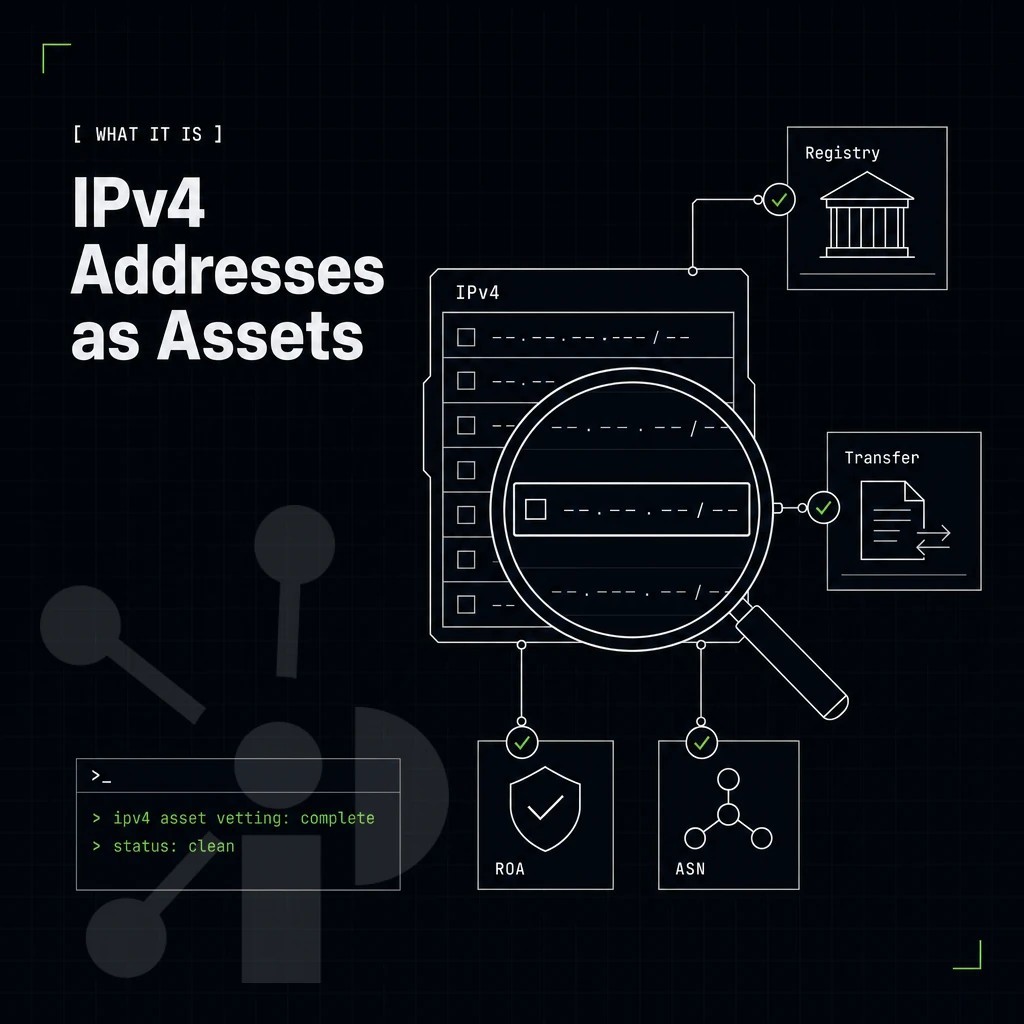
A company’s IPv4 blocks are reported as intangibles on the balance sheet at the acquisition price (or the fair market value as determined most recently). Closed broker transactions are the only information available regarding prices for intangible properties such as servers, and thus accurate IP valuation for financial reporting requires a good understanding of recent comparable transactions. Some organizations may also apply the cost method when recording these intangible assets, carrying them at historical acquisition price less any impairment.
What drives IP value in asset valuation
Several factors go into determining the value of an IP block: size, RIR region, reputation history, and transfer eligibility.
Leases, licensing deals, and the cost method of ownership
While IP assets held by licensees are to be valued differently than owned space, licensed space appears on the books differently than owned blocks of IP held by a company. Owned blocks that qualify for transfer of these to third parties have significant liquidity premium because they can be sold in an established market. Companies often treat these intellectual property assets as strategic holdings that can be monetized when market conditions favor sellers.
Getting an accurate intellectual property valuation for intangible assets
When purchasing IP addresses, engage a broker who can provide recent closed transaction data for all RIR regions. For buying and selling IP addresses, Tixx by Prefixx verifies ownership, transfer eligibility, IP address blacklists, and IP address routing for any block of IP addresses before they are sold. The way an appraiser arrived at his/her baseline for IPv4 address appraisal needs to be understood in order to understand which of the three methods for IP space valuation were used.
Key factors that determine the value of your IP assets
The value of IP address space is influenced by many factors. If you are looking to sell, lease or purchase an IP address block it is important to have an accurate IP valuation. Below are the key factors that influence the price of IP address space in the secondary market. Understanding these variables is essential when determining whether a proposed transaction reflects fair market conditions.
Block size and RIR region for attracting partners
Aggregations of larger CIDR sizes command a premium IP value over more fragmented IP address space, due to their space-efficient nature. A contiguous /20 is worth more per IP than four non-contiguous /22s. Organizations pursuing joint ventures often prefer such consolidated blocks because they simplify routing agreements and reduce administrative overhead when integrating network infrastructure.
Historically, assets held by ARIN have traded at a premium to similar assets held by RIPE NCC and APNIC assets in the first half of most years. This is due in part to high demand from North American companies and users. Regional pricing dynamics also reflect the composition of market participants, as enterprises and institutional investors alike concentrate their acquisition activity where regulatory frameworks are most familiar.
Intangible assets of reputation and routing hygiene
Blocks with clean Spamhaus ZEN and DNSBL records generally command higher value for the IP addresses in them on the open market than their soiled counterparts. An active listing can drastically decrease value or even kill a sale entirely. Routing hygiene compounds this in that RPKI-valid prefixes with consistent IRR route objects (inter-RPKi-route-objects) for example indicate that a block of IP is ready to announce and is operationally sound to do so with no need for remediation.
Transfer eligibility and legacy status by market method
Allocated space (with current RSA or LRSA) can be transferred without problems. Transfers must comply with regional registry policies that govern IP rights and ensure proper documentation of the allocation status.
Tixx, Prefixx’s pre-sale quality control process assesses all of these criteria for every block put up for sale through the market. As a result, Investors can be sure that their assets are being evaluated by the same standards that businesses use.
For lease-holders, these same dimensions are also input for the income approach, where the future cash flows generated by the assets are the relevant measure. This transparency in evaluation standards also serves the broader goal of attracting partners who require confidence in asset quality before committing to transactions.
Frequently asked questions about intellectual property
How is IP valuation of assets typically conducted?
A accurate appraisal requires a thorough understanding of four things: the RIR region the block is registered under, its size, its routing and reputation history, and current transfer market activity in that region. Because no official price index exists to establish IP value, brokers cross-reference recent comparable transactions to arrive at a realistic range. Tixx by Prefixx adds a structured layer to this by scoring every block's intellectual property assets on ownership clarity, blacklist status, routing hygiene, and transfer eligibility before any deal moves forward. Brokers rely on this comparative analysis to provide their clients with defensible valuations that reflect actual market conditions rather than theoretical pricing models.
Does valuing IP assets matter when IPv4 address blocks are bought and sold?
Yes. All five RIRs operate transfer policies that allow organizations to buy and sell IPv4 address space as intellectual property on the secondary market. ARIN, RIPE NCC, and APNIC run their own transfer frameworks; LACNIC transfers are facilitated through approved brokers. Prefixx handles the full process end to end, from sourcing and intellectual property valuation through Tixx quality control, escrow-secured settlement, and RIR transfer paperwork, with zero fees charged to the buyer.
What factors most influence IP address valuation?
Reputation history matters too in any IP valuation, because a block carrying blacklist entries or abuse complaints requires remediation work that buyers price in. Access to reputation data enables prospective purchasers to make informed decisions about whether remediation costs justify the asking price.
What history can IP assets like an IP address actually reveal about past usage?
BGP route history tools reveal how long a prefix has been announced in a well established market of ASNs, and whether it has ever been hijacked or left unrouted for extended periods. A clean routing record can strengthen the terms of a licensing agreement by demonstrating stable operational history.
Does block size affect IP assets valuation?
This method relies on the fact that smaller blocks, particularly /24s, are the most liquid unit in the market and often trade at a premium per address because they are the minimum routable size and suit a wider range of buyers. The premium reflects not only scarcity and routing utility but also the reduced complexity and lower transaction costs, including legal fees, associated with transferring smaller allocations.
When trying to put a valuation on IPv4 addresses, which are finite and transferable intangible assets that carry weight on the balance sheet, you have to pick a method to price them: cost, market, or income.
Most people are going to use the cash flow valuation and market worth the IP address block based on how much money it is going to make. Additionally, Then use market information to arrive at a number that corresponds with what other people are paying for IP address space in ARIN, RIPE NCC, and APNIC markets today.
A clean Spamhaus record and valid RPKI with consistent validity commands a premium to an identical block of IP addresses with a poor abuse history. Thus, quality control prior to the valuation process and sale of interest can be as valuable as the price the number was sold for.
If you are preparing to buy, sell, or lease IPv4 space and need a current market assessment, Prefixx runs Tixx quality checks on every block and can give you a clear picture of what your address space is worth today.
Contact us to discuss your IPv4 needs today
No hidden fees, free consult. A broker replies within one business day.