
By Savvas Bout, Founder of Prefixx. Last updated 23 September 2026.
Your unused IPv4 blocks in your ARIN, RIPE NCC or APNIC account are either making money for you or costing you money. Selling your IPv4s against choosing to lease IPv4 addresses will require an answer to a simple question: Do you need cash quickly or do you wish to earn recurring cash without selling the underlying asset?
Understanding your organization's liquidity requirements and long-term infrastructure plans will help you make the right decision between these two approaches. The decision ultimately reflects whether you view your address space as a liquid asset to be converted immediately or as an investment that generates passive income over time.
A number of these factors are often completely left out by guides writing on this topic, including the transfer time, RIR holding-period restrictions. The ‘reputation’ of the particular IP address block in question, and where the block will end up in the buyer’s routing table. Each transfer scenario represents a unique instance where these variables combine differently depending on the specific address range and parties involved.
There, Risks occur, how escrow and quality control affect things and where a network team’s needs lead them to select a particular option over another. Proper capacity planning and resource utilization become critical when aligning IP inventory with actual traffic demands and growth projections.
How to sell or lease IP addresses and what it means for usage
There are two ways to make money from IPv4 address space: selling IP addresses on a permanent basis or renting them out to others on a temporary basis. Each of these models has its own financial and legal structure, and these setups or IPs of organization determine the subsequent steps that can be taken. For community perspectives, see I own 4 blocks of /22 - Shall I lease or sell them better.
Selling IPs: permanent ownership transfer priced per IP
A sale of IP addresses transfers the addresses to a new RIR record of the buyer. The seller receives a fixed amount of money and is released from all obligations connected with the IP addresses. The buyer is then responsible for the routing, the reputation of the IP addresses and their subsequent sale. This transfer process differs fundamentally from a marketplace model where multiple buyers and sellers interact directly without brokered intermediation.
Typical sellers include any company across asia pacific that has downsized, gone through a merger, or moved to cloud computing and no longer needs the space. Organizations in this position often evaluate leasing IPv4 addresses as an alternative that preserves future flexibility while generating immediate revenue from idle resources.
Leasing IPs: keeping ownership, earning recurring revenue
Lease agreements allow the registered holder to retain title. Leased IP addresses remain listed on the lessor’s RIR record for the duration of the lease. Lessee gains IP address for a fixed time period at a set price, while lessor gains income without losing the asset. This arrangement works well for organizations with short term capacity needs or those testing new infrastructure before committing to ownership.
Many operators with uncertain long term plans prefer to lease their surplus IP rather than sell it on a permanent basis. IPv4 leasing preserves flexibility for organizations that may need to scale back up or pivot their infrastructure strategy in the future.
Block size and contact details for the entire process
Whether you want to sell IPs, lease IPs, or simply explore which path fits your situation, our consultants walk through the numbers with you. Reach us at Prefixx.net.
Pros and cons of selling vs leasing IPv4 addresses
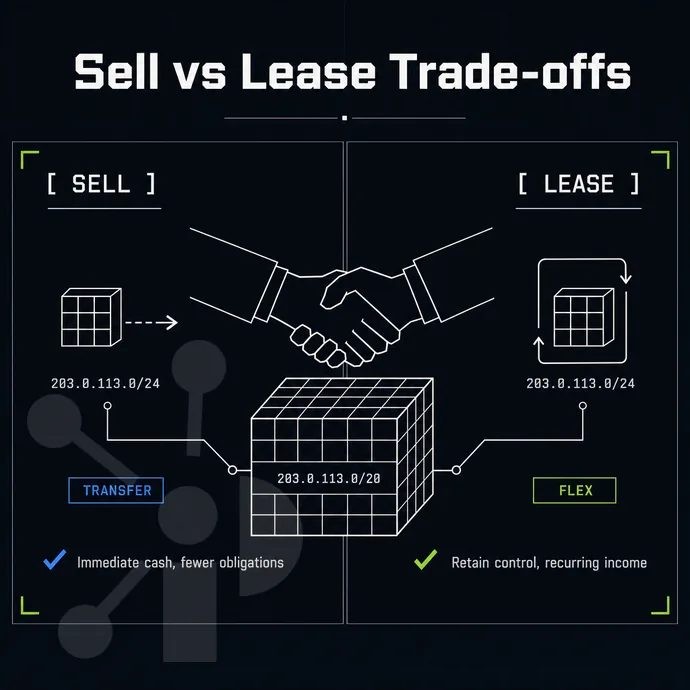
Deciding between a permanent sale and a lease IPv4 deal affects your cash flow, your obligations and your long-term options. The two types of deals are not alike and therefore one is not inherently better than the other. It ultimately depends on how much operational discomfort you are willing to accept versus whether you want to sell at today's price and move on or rent out and collect income for years to come.
Selling IPv4 addresses: how to calculate costs
- You receive immediate liquidity and are under no obligation to continue to manage the block(s) as they are now fully sold and you have no ongoing work to manage this completed sale.
- Loss of appreciating asset. Value of IPv4 addresses has continued to appreciate since the free pool of IP addresses was closed. Today’s price is locked in when a sale of IP addresses is transferred. There is no value left after that.
Note: Policy restrictions per RIR may impose a holding period before a transferred block can be resold.
Sell vs lease IPv4 addresses
- Lease IP addresses and earn recurring income while still owning the block and having it on your RIR account. You can still sell the block later.
- Ongoing obligations. You are responsible for lessee approval, tracking utilization, and monitoring reputation while a listing is leased. If an abuse complaint is received it will be addressed by you as the registered holder.
- Note that not all RIRs allow unrestricted leasing of IPv4 address space, so you should check the policies of your registry before leasing out IPv4 space to a third party.
When you decide to list your IPv4 address(es) through our company, we handle lessee vetting, white-glove reputation monitoring, and all the routing documentation for you. This approach ensures that lessees meet technical and financial criteria while protecting the interests of address holders throughout the arrangement with qualified customers.
When selling makes more sense than leasing
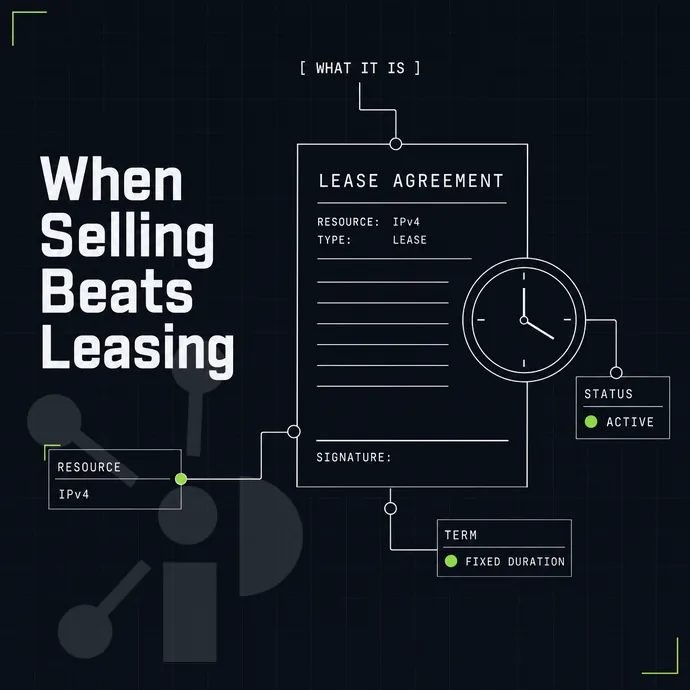
Much like leasing IPv4 addresses, the leasing of parking spaces is very suitable for holders who want to gain on-going income from a space that they themselves will also use from time to time. The analogy extends further when considering that both parking space owners and address holders can generate revenue while retaining the asset for their own occasional use, much like landlords do with tenants.
When selling more sense than leasing
Consider selling if any of these apply:
- Your organization is winding down and needs immediate capital.
- You hold a small IP block where lease returns are marginal.
- ,.
- Local RIR policies cause short term lock-up on transfers.
Factor in waiting periods and secure payment approvals
The time it takes for RIR transfer approval is not immediate. This waiting period can vary from registry to registry and from previous block history. Be sure to factor this into your planning and set a realistic sale date. Understanding the registry's procedural requirements and ensuring all documentation meets their standards helps avoid delays in compliance review.
What we do at Prefixx
Prefixx acts as the agent to sell your home from listing to close of sale. We thoroughly vet potential buyers and handle the escrow process as well as all paperwork required to transfer ownership of your home. Commission is only payable on a successful sale of your home at the right price, and therefore we only get paid if you get paid. Here is an overview of how we can assist in selling your home.
Why choose Prefixx to sell or lease your IPv4 addresses
Prefixx is a boutique IPv4 brokerage, not a self-serve marketplace. We broker the sale and lease of IPv4 addresses end to end, with a senior consultant on every deal. Each instance of a transaction is handled individually by a dedicated consultant who manages all technical and administrative steps.
- No buyer fees, seller-only commission. We charge 3 to 8% of the sale price, no win no fee. Sellers keep the rest.
- Tixx quality control. Every block is verified for ownership, blacklist status and routing hygiene before it reaches a buyer or lessee.
- Escrow-secured payment. Funds clear through escrow, so both sides transact with confidence.
- White-glove lease service. Geo-location correction, rDNS, history monitoring and abuse handling are included. Leased addresses come with a non-revocation guarantee and provisioning within 24 hours.
- Registered across all major registries. We are registered with ARIN, RIPE and APNIC, with LACNIC facilitated, covering North America, Europe, Asia-Pacific and Latin America.
Whether sell vs lease IPv4 is still an open question for your organization, our team can help you calculate costs, model recurring income and choose the right path. Visit Prefixx.net/sell-IPv4-addresses and leave your contact details for a personalized offer.
Frequently asked questions about secure payment
When does IPv4 lease monetization that covers europe break even versus a lump sum?
There is no single published price. Market value shifts by RIR region, block size, routing history, and IP standing. A /24 block of IPs under ARIN and an identically sized block under RIPE can trade at noticeably different rates in the same month. Tixx, Prefixx's pre-sale quality control process, scores every block's transfer readiness and routing hygiene, which directly affects what a buyer will pay. Contact Prefixx for a current market valuation on your specific block. Buyers and sellers work with brokers to determine fair pricing based on these variables and current demand conditions.
What is IPv4 leasing and how does it work?
When you lease IP addresses, you enter a contractual arrangement where the registered owner of an address block grants a third party the right to announce and use those addresses for a defined period. The owner retains full RIR registration and legal title throughout. The lessee gets routable, usable address space without going through a permanent transfer. Lease agreements typically cover routing documentation (LOA, RPKI ROA, IRR route objects), reverse DNS delegation, and non-revocation protections for the lessee.
What does IP monetization mean when you lease an IP address?
Leasing an IP address means paying a price for the right to use and announce that address space, not to own it. The lessee can route the block of IPs, assign them to infrastructure, and operate them as if they were their own, but the RIR registration stays with the original holder. This arrangement works well for organizations with short term needs who prefer not to commit capital to outright acquisition.
A well-structured lease includes an LOA so your upstream accepts the announcement, RPKI ROAs to validate your routing, and a non-revocation clause, all factors to calculate costs and risks before the block goes live mid-term. Prefixx includes all of that at one price as part of its white-glove lease service, with provisioning within 24 hours. Each lease arrangement should include a complete set of routing authorizations and documentation to ensure seamless operation throughout the term.
What is the break-even point between leasing and selling IPv4 addresses?
The break-even depends on current market sale prices versus the monthly lease rate your block can command, and how long you are willing to wait. If lease income over your expected holding period exceeds the net sale proceeds (sale price minus commission), leasing wins financially. Prefixx can model both scenarios against current market conditions for your specific block and region. Understanding the break even point helps you decide whether immediate liquidity or long-term income better serves your financial strategy.
Do I keep ownership of my addresses if I lease them?
Leasing transfers usage rights only, not registration. Your name remains on the RIR record for the entire lease term. No RIR transfer is filed, and no change-of-registration takes place. You can reclaim the block at the end of the lease term, renew the arrangement, or sell the addresses outright at any point after the lease expires. Organizations that lease IP addresses retain full control over the asset's future disposition while generating interim revenue.
Which RIR regions have the most demand for leased IPv4 addresses?
ARIN (North America) and the RIPE registry (Europe, Middle East, and Central Asia) consistently see the strongest lease demand, driven by large cloud, hosting, and enterprise markets with strict geolocation requirements. APNIC (Asia-Pacific) demand is growing, particularly for blocks that geo-locate cleanly to specific countries in the region. LACNIC and AFRINIC IPv4 leasing markets are smaller but active, especially for any company that needs regionally correct IP address history for local services. Block origin and clean routing history matter in every region.
What ongoing obligations come with leasing out IPv4 addresses?
As the registered owner of those IPs, you remain the RIR's point of contact, which means abuse complaints addressed to your block land with you first. You are also responsible for ensuring the lessee's use stays within RIR policy. Prefixx's white-glove lease service handles reputation monitoring across 12 DNSBLs, abuse complaint processing, geolocation correction, and reverse DNS management on your behalf, so the operational burden stays minimal. You keep ownership and Prefixx keeps the block clean.
There are two objectives here: use your idle IP to get capital now, or earn income over time while retaining ownership of the IP. Selling your excess IPs pays you a one-time payment, liquidates the asset, and eliminates all related obligations. Leasing retains all ownership of your space and produces current income, and can always be reclaimed by you should your needs change in the future.
Your choice depends on whether you prioritize immediate liquidity or prefer maintaining long-term control of the asset while generating steady revenue. Your choice depends on whether you prioritize immediate liquidity or prefer maintaining long-term control of the asset while generating steady revenue from your investment.
The size of the block you are trying to sell and the timing of the sale in the IP market can have a big impact on the level of interest from potential buyers.
While larger blocks listed for sale with ARIN or the European registry generate strong buyer interest, leasing IPv4 addresses can be a more practical path for owners of smaller prefixes that are challenging to sell quickly. A lease can provide a way to utilize the IP addresses to be sold while waiting for that “perfect” offer.
If you are weighing both options for a specific block, Prefixx can run the numbers with you. Contact the team at Prefixx.net to get a valuation and a no-obligation recommendation on whether to sell or lease.
Contact us to discuss your IPv4 needs today
No hidden fees, free consult. A broker replies within one business day.