
By Savvas Bout, Founder of Prefixx. Last updated 7 October 2026.
Buying a Class C IP address block has become difficult as the free pool has all but disappeared.
Additionally, An ill advised purchase can lead to purchases of IP addresses that are already blacklisted by major spam filters and CDNs. As a result, buying IP address on the secondary market is the norm, but it is a difficult process that can cost a lot of time and money and even negatively impact one’s reputation. Choosing the wrong vendor or skipping due diligence can compound these risks significantly.
Find out what a Class C block means in today's RIR world, what makes a clean block different from a liability, and whether leasing or buying address space suits your team.
Finally, learn the key variables that influence price for ARIN, RIPE NCC. Additionally, APNIC registered blocks include assignment details, allowing you to compare apples to apples and make the best purchase decision based on real market data as opposed to Blind Offers.
How to buy class c IP address block vs class b explained
The most searched term in the IPv4 market is “Class C” block. The term “Class C” block is often used and even understood differently by people reading old 1990s textbooks and modern agreements for assignment of IPv4 addresses. It is worth to get familiar with both terms before you buy Class C blocks online.
IP addresses and classful origins
In classful addressing, the entire IPv4 address space is organized into a few large blocks. For example, /24 addresses range from 192.0.0.0 to 223.255.255.255 with a default subnet mask of /24. There are 256 addresses in each Class-C block with 254 of them available to use as host addresses. The remaining two addresses are reserved for network identification and broadcast usage.
Class A addresses are used for very large allocations, while Class B networks have tens of thousands of possible addresses. class-c is the smallest of the standard address space blocks and was used to connect small organizations to the early Internet. For community perspectives, see IPv6 saved my ass yesterday, due to an IPv4 sale . Organizations requiring medium-sized allocations often find that a class b network provides the right balance between capacity and manageability for their infrastructure needs.
Why cidr replaced classful networking
In the early 1990s the IETF turned down classful addressing in favor of CIDR.
What buying class c networks means today
By 'CIDR /24 block' people actually mean a /24 prefix, 256 addresses in a single route object, like 203.0.113.0/24 which can be transferred by any RIR. Prefixx is a well-known brokering service for /24 network blocks and subnets which are traded on Tixx and other exchanges, with the blocks going through Tixx quality control before they reach a buyer.
Assuming the term /24 is well understood, it remains to explain why organizations are buying /24s in a fully allocated address space.
Why organizations still buy class c networks in 2025
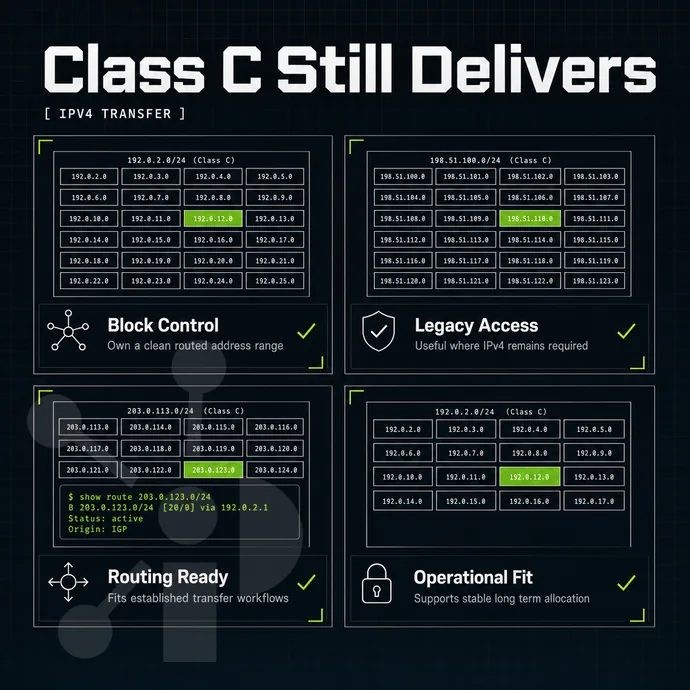
The five RIR free pools of IPv4 addresses ran out between 2011 and 2020, and since then all new IPv4 addresses are sold on the secondary transfer market.
Why a /24 subnet mask specifically
Anything smaller than a /24 may be filtered by ISPs.
Use cases that drive demand
Your hosting provider needs dedicated /24 subnet networks to ensure that each of your customers is isolated on his or her own IP address range.
Typically such space is acquired via the migration market and a /24 is the standard size transferred.
Where Prefixx fits your subnet mask workflow
We verify the availability of prefixxes in the range of /24 to /16 across all Regional Internet Registries (ARIN, RIPE NCC, APNIC and LACNIC). We check for the ownership and black lists as well as proper IP routing of all sourced prefixxes before we make them available for sale to potential buyers.
This post will outline the different block sizes and help clarify how IP address blocks are classified before approaching the market to purchase the required block.
How IPv4 address blocks are classified and sized
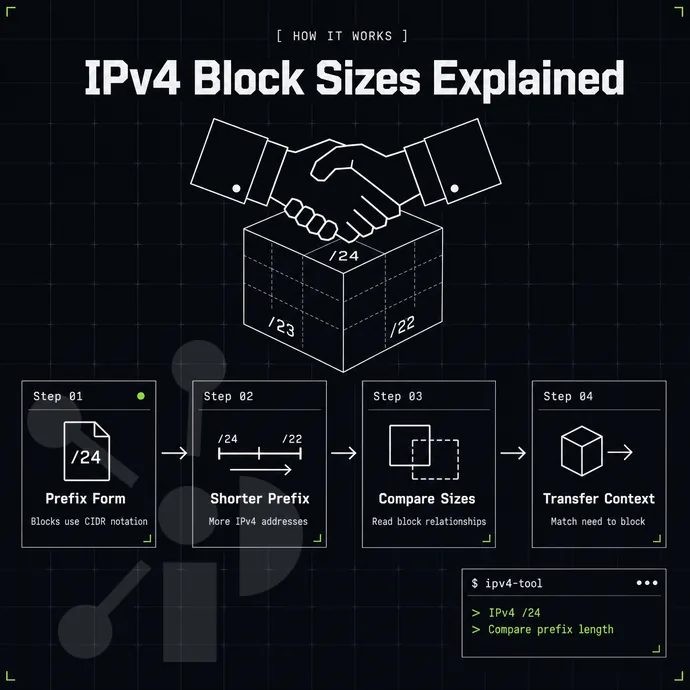
IPv4 blocks are sold in CIDR form as prefixes (e.g. /24) not in the old classful A/B/C form. By familiarizing yourself with the length of a prefix you can quickly determine if a given block of IP addresses is adequate for your purposes before talking to a market supplier. Organizations that historically operated a class b network may find themselves needing additional smaller prefixes to accommodate modern routing policies and geographic distribution requirements.
Reading the prefix table with subnet mask notation
- Start with a /24. A /24 contains 256 IP addresses with a subnet mask of 255.255.255.0. This is equivalent to one /24 network subnet block in the legacy IP address space and is the most liquid size in the secondary market.
- It doubles up in steps of halving the prefix number and doubling the number of addresses. So for example /23 equals 512 addresses, /22 equals 1,024 addresses, /21 equals 2,048 addresses. /20 equals 4,096 addresses, and so on up to /16 which equals 65,536 addresses or roughly a Class B sized network.
- Note the per-IP cost of larger blocks of address space, they have a higher total cost but lower per-IP price. Hence buying a /22 instead of four /24 subnets might even be cheaper per IP address.
Partial blocks vs the entire class b network
- Do you need the whole class or just a slice? Market for partial blocks for free. You don’t need a full /16 to get Class B-scale address space. A /20 or /21 is usually sufficient for enterprise use cases.
- Checking routing table acceptance. Announcements less than /24 in size are generally rejected by the global routing table. Therefore, by splitting up purchased subnets below /24 in size, their addresses will not be reachable from the public internet.
RIR policy and transfer eligibility
- Match the block size to the registry rules for minimum reallocation size and justification requirements. For example a single portability of a /20 to ARIN follows different approval steps than a /24 relocation.
- Before you place a bid, please make sure the IP block you are interested in is delegation-eligible. Tixx, our pre-sale quality check, verifies a number of things including the RIR to which the IP block is assigned. The IP block’s routing quality, and whether or not the IP block is on a blacklist.
Note: Subnet mask notation and CIDR notation describe the same boundary. A /24 and 255.255.255.0 are identical. Mixing them in documentation causes confusion during LOA and ROA preparation. Many network engineers working with cisco routers rely on consistent notation to avoid configuration errors during prefix delegation.
Once you have determined the required prefix size, the real cost of that block on the open market is what you need to know next. The final figure depends on registry region, prefix reputation, and whether routing hygiene has been verified.
What does a class c IP block cost on the secondary market
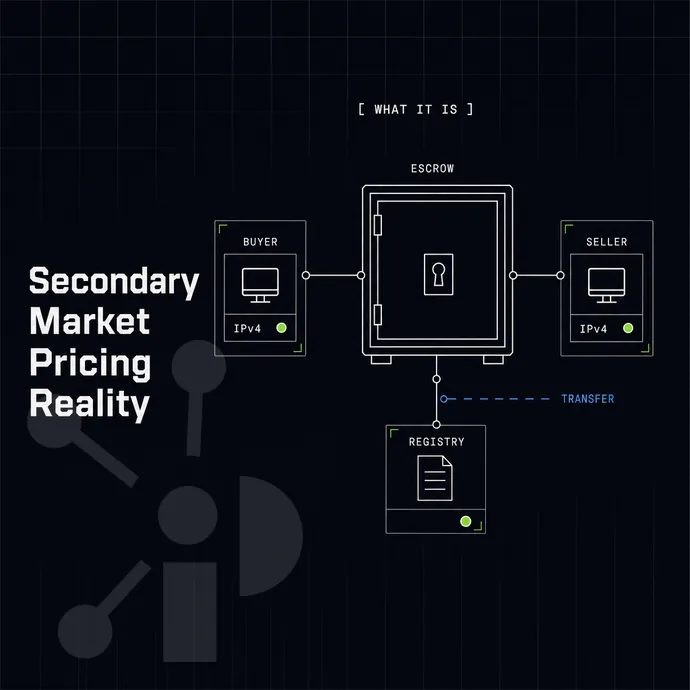
In the secondary market for IPv4 IP range, there is no fixed price list, so understanding what drives the price helps form a realistic budget before approaching a seller.
The price range buyers actually see
A classful /24 block typically trades in the $15-$20 per IP address range, totaling $3,840-$5,120 for the full block.
Key factors determining the final price
The RIR region is one of the strongest variables when it comes to pricing IP addresses. An ARIN block and a corresponding RIPE NCC block of identical size can trade at vastly different rates in the same month. For APNIC space, the premium is related to local need.
The cleanliness of a block (a prefix) has value. A prefix with clean subnets, a solid history on the blacklists, and good routing hygiene is more valuable to customers than a prefix with past abuse complaints or RPKI mismatches. Tixx by Prefixx checks the ownership, the blacklists and the routing hygiene of a block before a deal is closed.
Prefix size affects the per-IP price.
Leasing as a lower-commitment path
The outright purchase of IP is not the only method of acquiring a sufficient block of numbers to deliver fully routable IP connectivity. The leasing of a classful block of IP numbers allows organizations to obtain IP addresses without having to pay the acquisition cost of the numbers. Leasing arrangements typically offer flexibility in contract terms and allow organizations to scale their IP resources without committing to permanent ownership, though they do not provide the same long-term return on investment as outright ownership.
This method of acquiring IP addresses is particularly suitable for organizations that require large numbers of IP addresses quickly or wish to test a range of IP addresses before committing to their acquisition. Note that as with purchase, you never own the resource you have leased. A full comparison of buying and leasing IP is covered later in this article. The registry itself owns the resource in perpetuity, and both lessees and purchasers are merely authorized users under the registry's policies.
Even knowing the price does not give you the full picture. The other important part is knowing the steps the transaction needs to go through, including how the subnets are handled, in order for the block to move from the seller's RIR account to your RIR account.
The transfer process: from listing to RIR registration
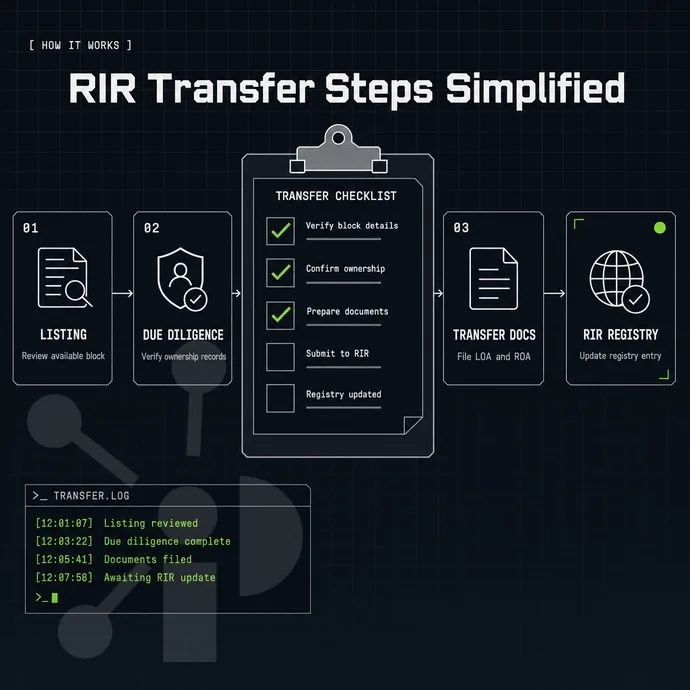
Purchasing a /24 IP block is more than negotiations over cost.
Due diligence, subnet mask checks, and escrow
Tixx, our pre-transition quality check, verifies ownership, handoff eligibility, blacklist status, and routing quality across subnets before handing resources over to customers. Neither party can then pay out the funds nor cancel the transaction while the other is still to fulfill its obligations.
RIR submission and re-registration
When funds are held in escrow, we can initiate the shifting to the relevant registry. Transfers of IP numbers held in ARIN or RIPE NCC namespaces typically take a few weeks to complete. Inter-RIR transfers add a layer of complexity and time. LACNIC facilitated transfers rather than us completing a registration.
After a search and review by the registry (check for correct eligibility etc.) the address range is re-registered under the account of the buyer. The user name on the RIR’s record of registered address spaces is changed to that of the buyer.
The IP address range is formally assigned to the new holder by the registry and the escrow account is released to the seller to withdraw the funds. The registry verifies that all documentation is in order and that the buyer is an eligible recipient subject to the applicable policies of that RIR.
Routing paperwork: LOA, ROA, and IRR
After registration of the block by our team, the LOA is forwarded to the upstream ISP of the buyer in order to announce the block via BGP. Subsequently, network engineers set up the RPKI ROA and IRR route objects to restrict origin ASN and align the announcement with common best practices within the community. The upstream provider will then assign the routing policy and propagate the announcement across its peering fabric.
The porting process assumes a clean block.
Buying vs leasing a class c block: which makes more sense
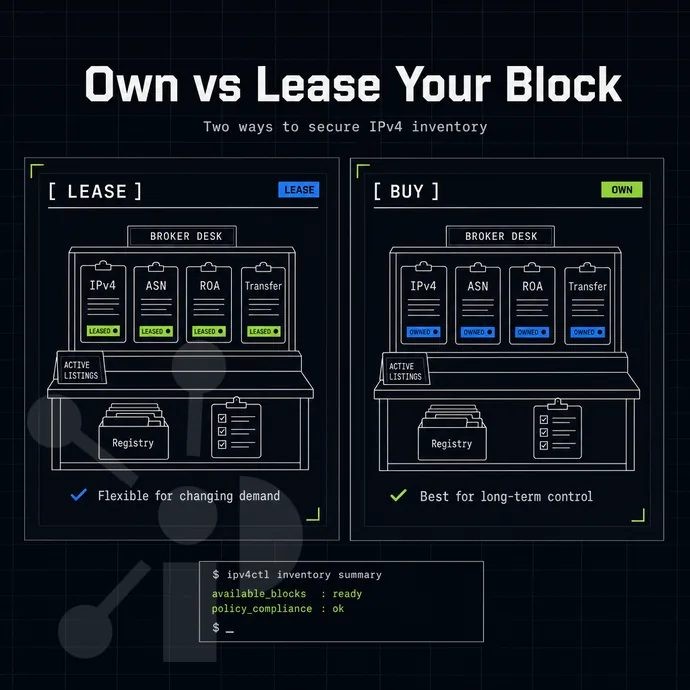
There are two ways to get your hands on a /24 subnet allocation phone number block: buy it outright or lease it. The two models have very different financial and functional implications, depending on a few key factors including your budget, the value you need from the numbers long-term, and how your company accounts for spending that has been allocated like this. Each model offers distinct benefits depending on whether you prioritize ownership, flexibility, or cash flow management.
Buying with subnet mask ownership and permanence
A purchase of IP addresses transfers full RIR registration to you and your company, listing the IP addresses as an asset on your balance sheet. You can sell the IP addresses in the future, and they will move with you to an upstream provider if necessary.
A purchase is ideal for a permanent hosting infrastructure, where the cost of the IP addresses will be amortized over several years. The ownership model provides long-term benefits that include full control over routing policies and the ability to maintain consistent IP reputation across infrastructure changes.
Note: Buying requires upfront capital and a full RIR forwarding, which adds weeks to the timeline. Budget for both the block cost and any transfer fees.
Leasing subnets for speed and flexibility
You can also get a routable IP block without RIR allocation. Operational spend rather than capital is better for tighter capex budgets or short-term connected projects like a campaign, a Cisco lab or a test environment. Whether leasing makes sense depends on your project timeline and whether you need permanent ownership or temporary connectivity.
This block will be undone at lease end.
Which path fits your situation
You want to hold a block for a very long time and have a tradable asset? You need a block for a short time or you want to keep your money? Prefixx takes care of both options from start to end and will assign you Tixx quality-controlled block and white-glove routing paperwork. The team will assign routing tables and registry documentation once your preferred model is confirmed.
The path to closing a deal is influenced more by the broker you select than most home buyers realize. The broker serves as your front line through negotiation, due diligence, and registry coordination.
Why choose Prefixx to buy your class c block
Every deal has a senior consultant attached, from sourcing the right address block through closing in escrow. When you buy a /24 range block through us, you get a vetted /24 of usable address segment, not a surprise.
- Zero buyer fees. Sellers pay a 3 to 8% commission. You pay nothing on top of the block price.
- Tixx quality control. Every block clears ownership checks, blacklist scans and routing hygiene review before it reaches a buyer.
- White-glove routing paperwork. Our team prepares the LOA, RPKI ROA and IRR route objects so your IP addresses route cleanly from day one.
- Registered across ARIN, RIPE NCC and APNIC. We handle the RIR disposition end to end, with LACNIC facilitated.
- BYOIP deployment support. Need to bring your block onto bare metal? We coordinate the full deployment with no per-IP surcharge.
We have brokered IP segment across all five RIR regions since 2018, backed by a team in the networking industry since 2007. To explore available /24 allocation networks or get a personalized offer, visit Prefixx.net/buy-IPv4-addresses and reach out to our team.
Frequently asked questions about subnets
Where can I find an example of brokers matching buyers with sellers of IP address blocks?
IPv4 blocks are bought on the secondary market through a registered IPv4 broker or directly between organizations via RIR-facilitated transfers. Brokers like Prefixx source and sell vetted blocks across ARIN, RIPE NCC, APNIC, and LACNIC, handle escrow, and manage all divestiture paperwork end to end.
Prefixx runs Tixx quality control on every block before it can assign a buyer, covering ownership, blacklist status, and routing hygiene.
What does a class b IPv4 block with its subnets typically cost?
There is no single published price for IPv4 network segment. The market rate varies by registry region, block size, reputation history, and current supply and requirement. A /24 under ARIN and an identically sized block under RIPE NCC can trade at noticeably different rates in the same month, and neither figure is connected to any official registry publication. Contact a broker for a current personalized offer based on the specific block and region you need.
Can you buy your own IP address?
Organizations can acquire IPv4 address region through an RIR-approved acquisition, after which those addresses are registered to them in the registry's WHOIS database. The minimum routable block is a /24 (256 addresses), and that is the practical floor for most purchases. Once the trading completes, you hold the resource and can announce it via BGP from your own ASN, at which point you can also deploy it through a BYOIP program on a cloud or bare-metal provider.
How much does it cost to buy a US IP address?
US addresses and subnets fall under ARIN, and ARIN-region blocks have historically traded at a premium compared to some other registries, reflecting strong North American end-user appetite. The exact per-address price shifts with market conditions and block size. Larger blocks tend to carry a lower per-address cost than smaller ones. For a current market rate on a specific ARIN block, request a personalized offer through a registered ARIN broker such as Prefixx.
What is the smallest block I can route via BGP?
A /24 (256 addresses) is the de facto minimum prefix length accepted by the global BGP routing table. Most transit providers and major networks filter any allocation longer than a /24, meaning a /25 or smaller will not propagate across the internet. This is a community norm enforced through prefix-length filtering, not a formal protocol rule. If you need fewer than 256 addresses, leasing a portion of a /24 is usually more practical than buying a block you cannot route independently.
How long does an IPv4 transfer take?
ARIN transfers typically complete in a few business days once all paperwork is submitted and approved. RIPE NCC transfers are often faster, sometimes completing within one to two business days. The time line for each registry depends on how quickly both parties submit their documentation and whether the registry flags any compliance questions during review.
Working with a broker that prepares the LOA, RPKI ROAs, and IRR route objects for your IP blocks and subnets on your behalf, as Prefixx does, reduces delays caused by missing or incorrect paperwork. Each registry maintains its own documentation requirements and approval time line, so having an experienced broker prepare materials in the correct format streamlines the entire process.
Purchasing a 256-IP subnet block is a serious matter. The secondary market for new IPv4 space is the only place to go, to buy new IP addresses. Prices for Class C blocks vary greatly based on the RIR region in which the block is registered as well as by reputation. The process of transferring a block of IP addresses from one person to another can also be very administrative in nature.
So you want to understand how to select a viable IP block and get the most out of your dollar? First, size your requirement against the number of hosts you REALLY need. Next, factor in the regional pricing between ARIN and RIPE NCC.
A clean /24 allocation with a good routing history and no blacklist hits is more valuable than a cheaper block that you will have to spend time to repair.
If you are ready to source a vetted /24, submit an inquiry at Prefixx.net.
Contact us to discuss your IPv4 needs today
No hidden fees, free consult. A broker replies within one business day.