
By Savvas Bout, Founder of Prefixx. Last updated 23 September 2026.
Today, all RIPE address space is sold on the secondary market. The RIPE NCC waiting list was closed years ago and the free RIPE address space pool has been depleted since 2019. Thus engineers and managers responsible for European, ME/AS and CA network infrastructure services have to look for address space on the secondary market and buy/lease it. Organizations ranging from hosting providers to ISPs must now navigate the secondary market to acquire the address space their infrastructure demands.
The RIPE NCC has its own rules, procedures and time frames for IP address space transfers between registries as well as for eligibility checks. Those rules differ significantly from the ones of ARIN and APNIC . For more context, see RIPE IP addresses : r/AskNetsec.
Misunderstanding those rules and services may prevent a transfer at the registry level or even result in purchased IP space being blacklisted or running into problems with routing policies. Organizations that fail to hear back from the registry within expected timeframes should verify that all documentation was submitted correctly and meets current policy requirements.
This guide goes through all the aspects of buying RIPE NCC address space. It describes how RIPE NCC address space is organized, how the price per IP address changes with the size of the IP address block you want to buy, the process of transferring IP addresses from seller to buyer that includes RIR approval. Additionally, The essential points to check for when buying a block of IP addresses. The guide aims to cover both technical and administrative considerations that arise during the acquisition process.
In addition to buying IP addresses, the guide also describes leasing them as an alternative to buying them outright. It also covers the necessary routing configurations (LOA, RPKI ROA, IRR) that networks require to put leased IP addresses into production. It starts with a basic description of what a RIPE IPv4 address is and who allocates it. Proper routing configuration is essential to ensure reliable connectivity and optimal performance once the addresses are deployed.
For a complete overview, explore our ripe ip guide.
What are ripe IP resources and how do they work?
The term “RIPE-allocated IP” refers to IP addresses (both IPv4 and IPv6) allocated by the RIPE NCC within the RIPE service region, which covers Europe, the Middle East and parts of Asia.
Ripe community vs. Ripe network coordination center
RIPE is the open community forum for the Internet. The RIPE NCC (Reseaux IP Europeens Network Coordination Centre) is a not-for-profit regional internet registry which allocates Internet number resources to its members.
What the ripe network coordination center manages
The RIPE NCC allocates IP addresses, AS numbers and other resources to Local Internet Registries (LIRs) and end users in 76 countries.
Why the distinction matters for internet resources
When you buy or lease a “RIPE block” (IP space registered under the RIPE NCC), the transfer is done under the RIPE NCC’s policies (not under those of ARIN or APNIC for example). Our team handles all the formalities for any transfer of a RIPE NCC space from end to end. Before you can start to think about these details though, you need to understand what RIPE NCC is and how it works.
Which countries fall inside the RIPE NCC service region?
RIPE NCC is the Regional Internet Registry for Europe, the Middle East and Central Asia. With 76 or more countries and their networks listed within this territory, understanding which RIR governs your address space is critical for any transfer, lease or IP routing decision in your environment. The registry's role extends to maintaining accurate records for all networks operating within its jurisdiction, ensuring proper coordination of Internet number resources across the entire service area.
The global RIR system for technical coordination
There are different registries in the world that assign IP addresses, register AS Numbers and define the policies of a certain zone. A table below gives you an overview of all IP address registries.
| RIR | Service region |
|---|---|
| RIPE NCC | Europe, Middle East, Central Asia |
| ARIN | North America |
| APNIC | Asia Pacific region |
| LACNIC | Latin America |
| AFRINIC | Africa |
Why region matters for services
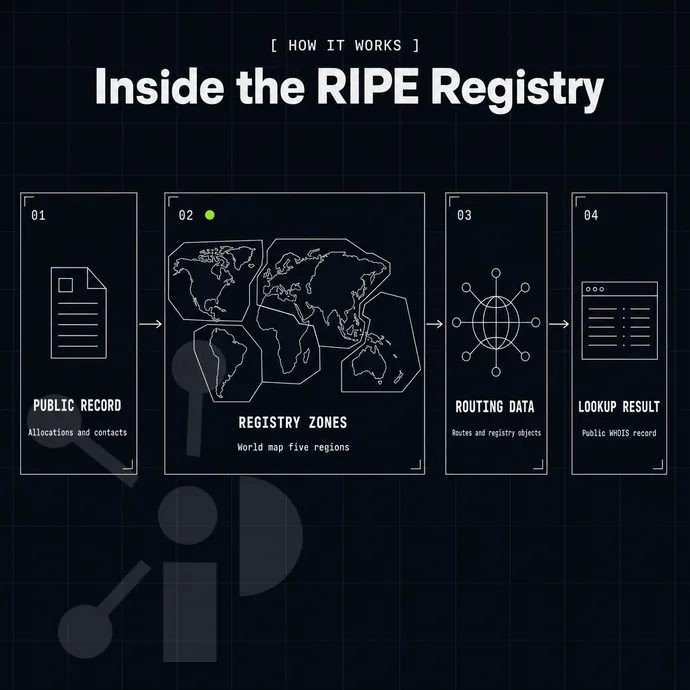
Remember that each of the RIRs has its own policy forum and transfer rules. A block registered under the RIPE NCC is governed by the RIPE policies, not those of ARIN. After you verified that the block is registered under the RIPE NCC, you need to get familiar with the RIPE database.
How the RIPE database works
The RIPE Database is the public database holding IP address allocations, routing information, and contact information for entities operating in the RIPE NCC service area, covering Europe, the Middle East, and parts of Asia.
RIPE network coordination center database objects
We model every RIPE database record as a typed object: inetnum objects describe address space holdings of contacts (ranging from individual users to large corporations), route objects associate IRR records with origin ASNs, forming the IRR data used for routing policy validation. This structured object model enables readers to query and interpret the database programmatically for due diligence and routing policy analysis.
Query methods for internet resources
network engineers can query the database three ways: the web interface at apps.db.ripe.net, the RESTful API for programmatic lookups, and the classic command-line WHOIS tool.
Submitting and maintaining records services
Objects for LIRs and PI holders are submitted or updated through the RIPE NCC portal. Should the IRR information for internet number resources become stale during routing operation, route filtering will fail to serve its purpose downstream and the information will not have reached its destination.

The database record of a network’s route objects is the first to change when a block of IP addresses is transferred from one holder to another. Operators who neglect to update these records may find that downstream providers skip their announcements entirely during prefix validation.
What happens when a ripe IP block changes hands?
The unallocated IPv4 address pool managed by the RIPE NCC has been depleted since 2019/2020. Currently, in the RIPE coverage area environment, the only way to get IPv4 addresses is on the secondary market for transferred IPv4 addresses, where current address holders offer them for sale or for leasing to other users. Some holders list their available address space through online marketplaces or broker platforms, while others prefer direct negotiation without public ads.
How the transfer process works
The transfer is registered with RIPE NCC by submitting a transfer request. After verification by the administrators the holder of the IP address space is updated in the RIPE Database. Administrators typically notify the parties by email once the verification is complete and the database update has been processed in their inbox.
In addition to transferring IP address space to another LIR within the RIPE registry service area, IP address space can also be transferred to registries of other Regional Internet Registries ( inter-RIR transfer ) to serve networks within the service geographic zone of ARIN or APNIC.
Why pricing varies by region
The size of a block in question, as well as the world of the registry it resides in, can greatly impact price. A /24 registered under the RIPE registry can have a vastly different value than the same /24 registered under ARIN in the same month for example. There is no official price list.
Where Prefixx fits
We broker vetted number resources across all RIR networks, handle the transfer paperwork end to end, and run Tixx quality checks on every block before it reaches a buyer. If you are ready to move forward, here is how Prefixx supports the full process. Our brokers carry out comprehensive due diligence to ensure each transaction meets registry requirements and routing standards.
Buying or transferring ripe IP space: how Prefixx can help
The available pool of RIPE's regional registry's IP addresses has been exhausted. So IP addresses in the RIPE geographic territory have to be purchased or leased on the secondary market. Prefixx sources IP address blocks, checks them on Tixx for quality and handles the complete transfer to the European IP registry including LOA, RPKI ROA and IRR route objects.
- Zero buyer fees, seller-only commission model.
- Tixx checks for ownership, blacklists, routing hygiene before a block is sent to you.
- Inter-RIR transfer support for ARIN, RIPE Network Coordination Centre and APNIC customers.
- White-glove handling of all your routing paperwork, we take care of submitting it for you.
Reach out to our consultants or explore transfer options to get a personalized quote.
Frequently asked questions
How do telecom orgs assign ripe atlas IPs, and is there a forum open for discussing this?
A European IP address is an IPv4 or IPv6 address allocated or assigned under the authority of the NCC, the regional internet registry for Europe, the Middle East and Central Asia. Organizations in that geographic territory receive their address space directly from RIPE's coordination centre or through a Local Internet Registry (LIR) that holds a the RIR membership. Because the European region's RIR's unreserved IPv4 pool emptied in 2019, new IPv4 addresses in this operational zone are only available through the secondary transfer market.
What does ripe stand for?
RIPE stands for Réseaux IP Européens, which is French for "European IP Networks." The name reflects the organization's origins as a collaborative community for European infrastructure operators in the early 1990s. Today the RIPE community is global in participation, even though its registry mandate covers a defined geographic administrative zone.
What does RIPE NCC stand for?
RIPE's address authority stands for Réseaux IP Européens Network Coordination Centre. The "NCC" portion distinguishes the formal registry organization from the broader RIPE community, which is an open discussion platform of connectivity providers and internet service providers. the RIPE authority is the legal entity responsible for allocating IP address space, maintaining the RIPE Database, and coordinating global network infrastructure across its service network zone. The organization maintains its headquarters in Amsterdam, serving as the administrative center for registry operations across the service zone.
What is the RIPE organization and its RIPE database?
RIPE (Réseaux IP Européens) is an open, collaborative community of network service providers, web service providers, and other public network stakeholders that shapes policy and best practices for IP network infrastructure in EMEA, Western Asia, and Central Asia. The community convenes regularly through working groups and public events to discuss technical coordination and policy development.
It is not a membership organization itself; that role belongs to RIPE's governing body, which serves as its operational and administrative arm. the IP registry is one of the five Regional Internet Registries (RIRs) worldwide, alongside ARIN, APNIC, LACNIC, and AFRINIC, each responsible for managing IP address allocation in its own geographic scope. These five RIRs receive their initial address allocations from IANA, which coordinates the global pool of IP addresses at the highest level.
RIPE's administrative body is the regional internet registry for Europe, the Middle East and Central Asia. All blocks of IP addresses in these regions are registered in the RIPE database.
Ownership records for all these blocks of IP addresses record to whom, from individual operators to large telecommunication organisations, the addresses belong, what the routing policy is, and who is allowed to transfer them. Updating a block of IP addresses in the database for these regions constitutes a transfer of those address services from one holder to another.
For example, to acquire more space, to sell a legacy allocation, or to troubleshoot routing or reputation problems with a particular prefix during your network's implementation.
If you are looking to buy, sell, or lease a RIPE address block, Prefixx handles the full process: Tixx quality control before any block reaches you, escrow-secured settlement, and white-glove routing paperwork including LOA, RPKI ROA, and IRR updates. Get in touch with the Prefixx team to discuss your requirements.
Contact us to discuss your IPv4 needs today
No hidden fees, free consult. A broker replies within one business day.