
By Savvas Bout, Founder of Prefixx. Last updated 8 October 2026.
When announcing a new IPv4 block, the geolocation IP data and location services tied to that address space will likely follow your business around the globe.
They may still reflect the country and city of the previous IP address holder.
In this article we’re going to look at how IP geolocation data is built from several data sources: RIR registration data, BGP routing tables, active probing of IP addresses and operator-submitted data such as is accepted via the RFC 8805 geofeed. While these four sources form the foundation of most geolocation systems, other methods such as latency measurements and traceroute analysis can supplement the core data.
We’ll explore how each IP geolocation provider weighs up these different data sources to form a location for a given IP address /24, and how differences in weighting up these sources can result in two databases storing differing location information for the same IP address block.
Potentially thousands of miles apart. We’ll also explore why IP geolocation information can ‘drift’ after an IP address block has been transferred or leased, and how you can go about updating the relevant IP geolocation databases with accurate location information for your new block of IP addresses before they go live.
How does geolocation IP work: the core mechanism
IP geolocation maps IP addresses to geographic locations. This is done by combining information from RIR registration databases, IP address space routing tables and commercial geolocation databases. The result is always an estimate and never a precise GPS coordinate. The estimate typically resolves to a city or region rather than geographical coordinates.
How caribbean internet address registry data determines IP geolocation
As every data packet contains an IP address of the sender, the server uses geolocation technology to look up this IP address in databases maintained by companies like MaxMind, IP2Location, DB-IP and ipinfo.io. These databases are built from RIR WHOIS data, BGP announcements and active probing on the Internet. These providers aggregate signals from multiple sources to ensure that websites, content delivery networks, and search engines can reliably map an IP address to its physical location.
Note that a lookup returns an approximate location such as a city and not a precise one. The location of an address can change, get proxied or even routed through a VPN so the location accuracy degrades in these cases. Websites and streaming platforms rely on these location estimates to determine whether visitors can access content based on regional licensing restrictions.
What IP geolocation data actually contains
The location of the visitor, at several levels of detail:
- Country: highest accuracy, usually above 95%.
- City: lower accuracy, varies by region and ISP.
- Postal code: least reliable, often omitted.
Why IP address blocks have limits on location data
One /24 supports thousands of end users via a single exit node.
Updates to the database provider’s records occur on different schedules and are typically not immediate.
User's IP address geolocation: where the data actually comes from
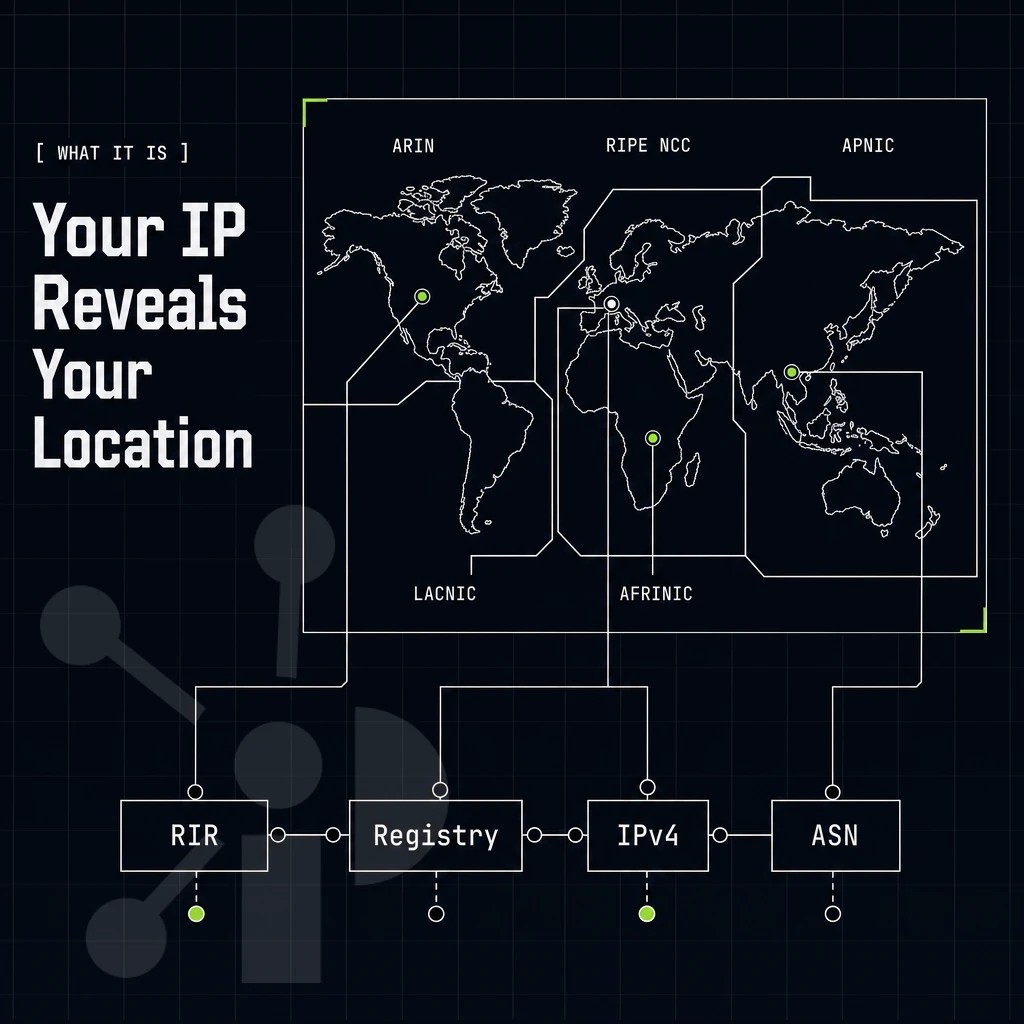
The accuracy of any data source that performs a geolocation lookup for an IP address and returns a location for that IP address.
The allocation hierarchy for internet service providers
The Internet Assigned Numbers Authority (IANA) is at the top of the hierarchy and allocates big blocks of IP addresses to the five Regional Internet Registries (RIRs). These regional registries then delegate smaller blocks to local Internet registries and ISPs, with address space typically assigned based on demonstrated need and geographic service areas.
The ARIN registry serves North America, the RIPE Network Coordination Centre serves Europe and the Middle East, APNIC serves Asia-Pacific, the CARIBNET registry serves the Caribbean and Latin America, and AFRINIC, the African Network Information Centre, serves Africa, each managing both static and dynamic IPs within their respective regions, though none can pinpoint an exact street address from an IP alone.
Each of these registries keeps track of which organization is assigned which blocks of IP addresses in the corresponding WHOIS database. These registries operate within frameworks established by their respective regions, though the allocation process itself does not account for local laws governing data residency or content restrictions.
What feeds the databases with geographical location data
To this basic registration information, geolocation services layer four levels of information on top: BGP tables show which device connected to which network is announcing prefixes from where in the world. User submitted data about wi fi access points, collected through opt-in APIs in browsers and apps, adds a street-level layer of information on top of the simple registration information provided by WHOIS.
Probing the network and measuring round-trip time to locations all over the globe allows geolocation services to approximate a physical location on the planet. BGP announcements from autonomous systems provide crucial routing intelligence that helps geolocation providers understand which networks control which address blocks.
How accurate is IP geolocation technology?
However, city-level geolocation accuracy varies greatly by region, and typically scores around 50-80%. Providers often struggle to maintain reliable city level precision because IP blocks frequently serve users across multiple municipalities within a metro area.
IP address space beingCarrier NATted (CGNAT); the user connecting to a destination via a VPN or proxy. The single most important thing to maintain geolocation accuracy is to keep the registration records up to date after an IP address has been transferred. Accurate geolocation also helps security teams identify anomalous login patterns that may indicate compromised credentials or data breaches.
New block holders get immediate daily RFC 8805 geofeed published by Prefixx and consumed by MaxMind, IP2Location, DB-IP, and ipinfo.io, with geolocation correction to improve IP geolocation accuracy as part of the white-glove service.
Primary methods used in IP based geolocation
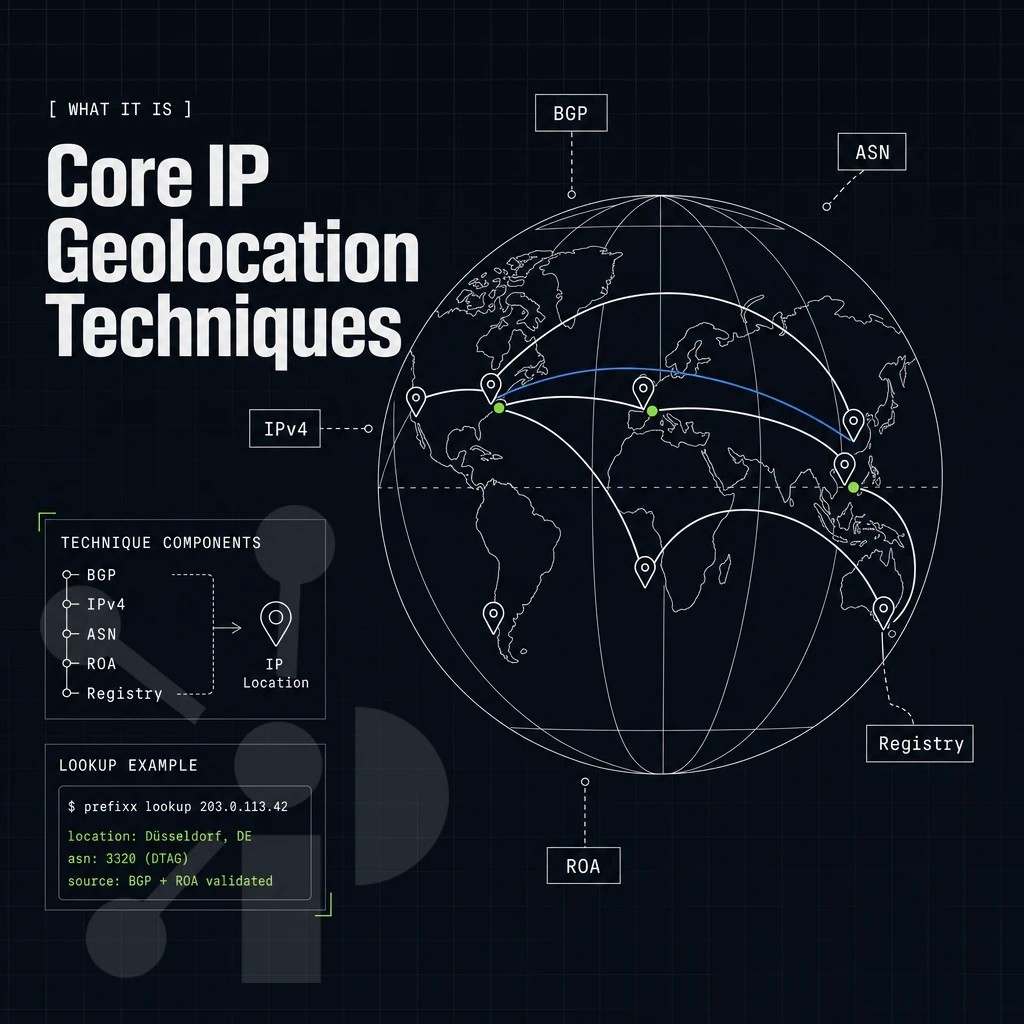
IP geolocation takes the internet protocol address of a website visitor and maps it to the physical location of that person or organization.
What does an IP address geolocation do?
IP geolocation data refers to the translation of a raw IP address to location data (country, region, city, postal code etc. and sometimes even latitude and longitude). The resulting location data is then used by services and applications for traffic routing, license compliance, content personalization and fraud detection. The quality of IP geolocation data differs strongly from method to method.
IP geolocation services: database and BGP lookup
- Geolocation databases lookup. A server receiving data packets of a visitor extracts the source IP from these packets. It then queries a geolocation database, which returns the mapped location of this IP based on registration data, BGP prefix-to-ASN mappings and historic routing information. This is the fastest way to determine a location and does not require any permission from the client.
- BGP prefix mapping. Each IP block is announced by an ASN. Mapping that ASN to a known network operator narrows the location to a city or region. Note: shared or proxied addresses reduce accuracy here.
Location services and device signals
- Network latency triangulation: send probes from multiple known points on the network and measure round-trip time to where the test device is. Intersect the results to find the location. Validates DB results.
- Wi-Fi access points. Your mobile device can tell your provider the identifiers of nearby Wi-Fi access points. The provider then looks up these identifiers in a database of mapped access points to get a more precise location than what can be obtained via IP alone.
- The use of GPS and cellular networks on mobile devices to supply precise location information to Web services when permission has been granted by the user. Device-based geolocation as opposed to IP-based geolocation and requires a browser prompt to enable Web services to access it.
IP geolocation data and device-based methods solve different problems. IP-lookup is everywhere, immediately available and does not require any user consent. Most companies use a combination of IP based geolocation and device-based methods where available, relying on IP-lookup to detect proxy servers or as a fallback when GPS and/or Wi-Fi data is not available. As more services and interactions move online, the combination of these geolocation methods becomes essential for maintaining security and user experience in the digital world.
The methods used for geographic mapping have their sweet spots and limitations which can vary a great deal at different levels of geographic granularity. The effectiveness of IP based geolocation depends heavily on whether the method chosen aligns with the geographic scope and precision required by the application.
How accurate is IP geolocation at country, region and city level
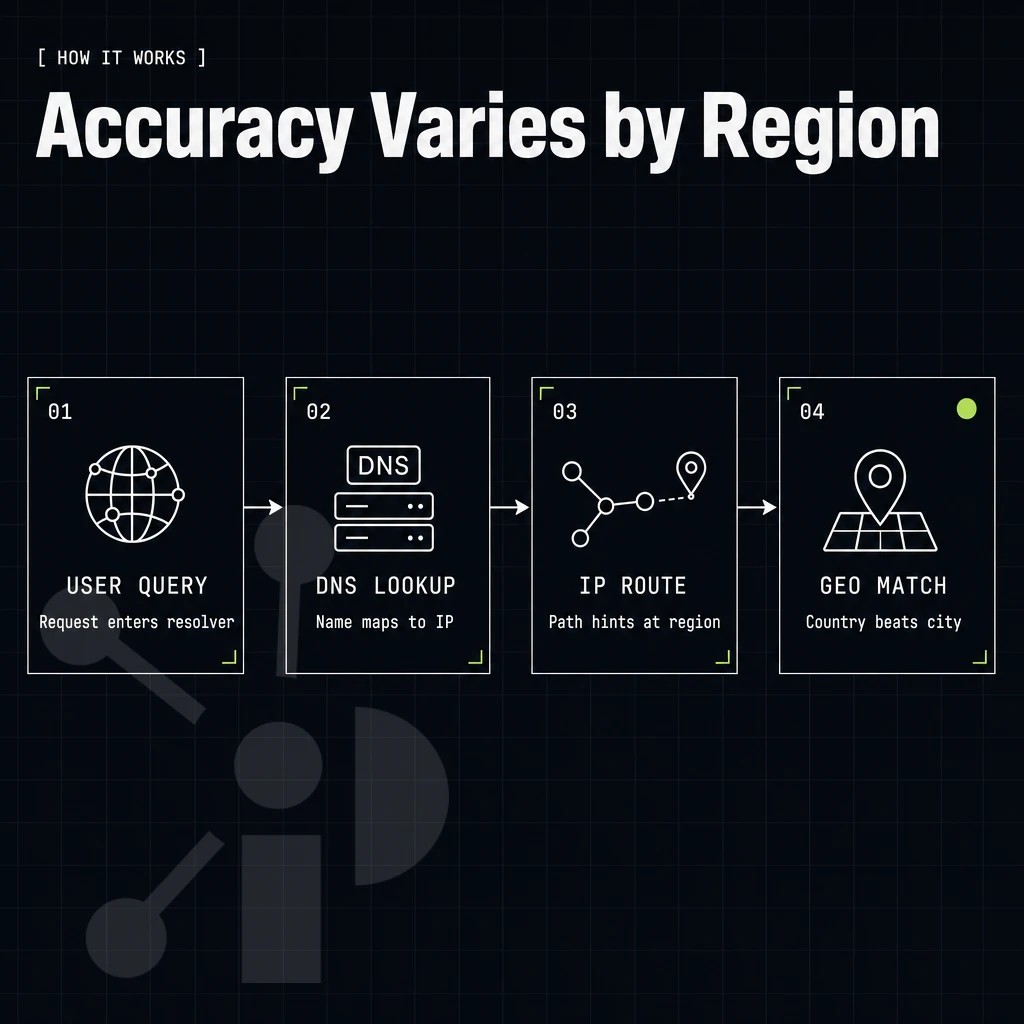
Accuracy of IP geolocation information does not scale uniformly with levels of detail. At deeper levels of information, many IP addresses will not have accurate geographical location data, and several characteristics of IP addresses and their associated networks can explain why not.
Accuracy by tier for dynamic IPs
Identification at the country level is generally the most reliable. By cross-referencing Regional Internet Registry allocation information with BGP routing tables and WHOIS databases, providers can accurately identify country level information most of the time. Region and state level information can be moderate in accuracy and depend on the level of granularity that providers have registered their IP address space at. City and street level information is generally not accurate enough using IP information to identify exact street addresses.
Does geolocation give the user's location exactly?
IP geolocation only provides an approximate location and NOT a specific physical address. The technology can typically identify country and city but cannot resolve an exact location such as a street address or building.
Why mobile devices and VPN users skew results
Also, virtual private networks tunnel IP traffic through a remote exit server, and thus the visible IP appears to be coming from the server's location rather than the user's location. A user accessing a streaming service through such a tunnel will appear to originate from the exit server's jurisdiction rather than their true physical location.
The fact that mobile phone users have dynamic IP addresses on their phones that change based on the cell tower they are currently using further compounds the problem. Cellular carriers assign addresses from large pools shared across regions, making precise geolocation of mobile devices particularly challenging for database providers.
We provide a daily geofeed according to RFC 8805 at Prefixx.net/geofeed.csv, which is then processed by MaxMind, IP2Location, DB-IP and ipinfo.io to keep the geolocation data up-to-date for all managed blocks.
In the following section we will see which applications these are.
Why geolocation lags after an IP block transfer or BYOIP deployment
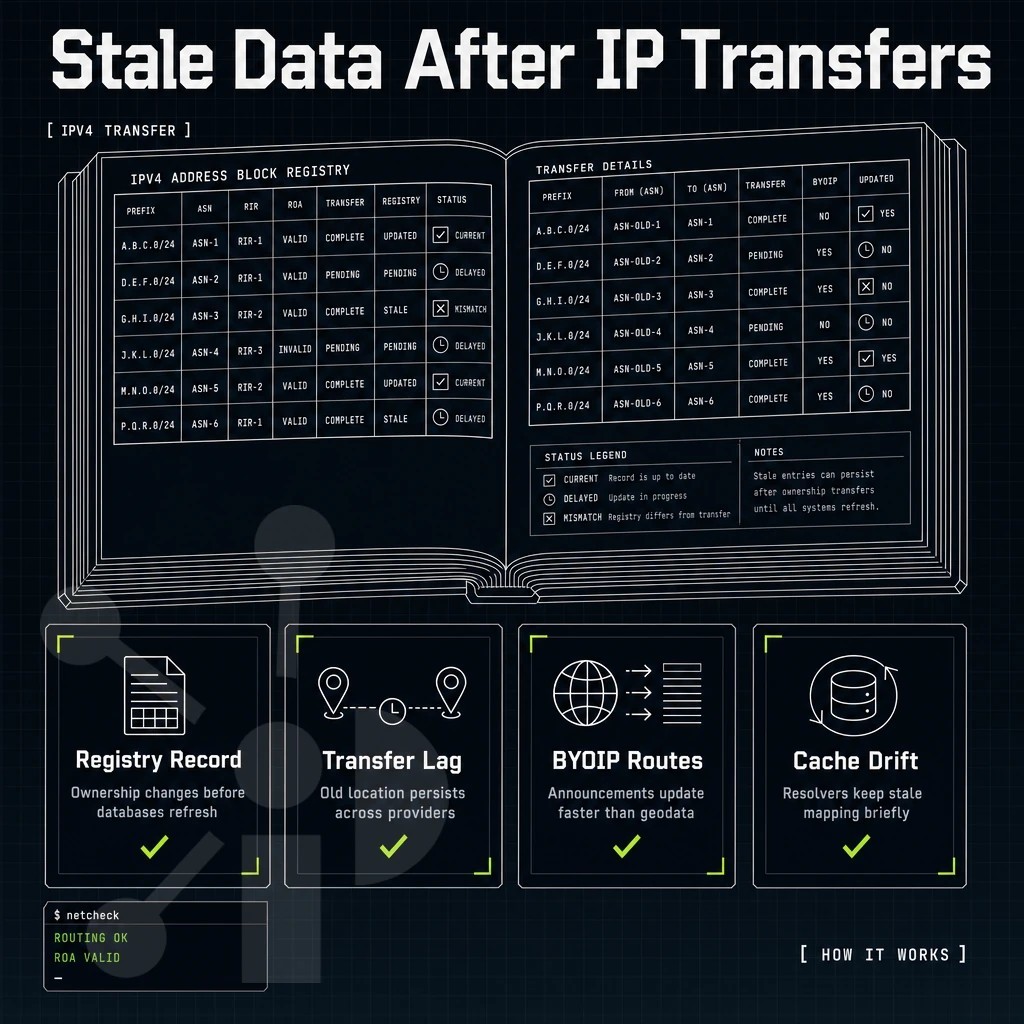
When an IP block changes hands on the secondary market, or gets announced via BYOIP, geolocation databases do not update instantly. The RIR registration details change, but providers pull from WHOIS databases on their own refresh cycles, sometimes weeks behind. That lag breaks geo-targeted content, online gambling compliance checks, and any service that depends on accurate IP geolocation data.
How rfc 8805 geofeeds close the gap
RFC 8805 enables a network operator to publish a geofeed file directly consumed by the providers.
It is then used by MaxMind, IP2Location, DB-IP and ipinfo.io.
Can VPN or proxy servers fool IP geolocation?
A VPN connects to the online world via a different computer network. This network changes your visible IP address to that of the VPN provider’s exit node. Geolocation databases then find the location of this exit node. This masking of true location can affect services that rely on geographic data for content delivery or targeted advertising.
Most mobile apps and online services these days not only check a user’s IP address but cross reference this with many other online data points. Thus, a VPN alone is not enough to hide a user online. What they need to worry about is mass, unauthorized tracking of their online activities via these secondary signals and not their IP address in isolation. These secondary signals can include browser fingerprints, device identifiers, and behavioral patterns that collectively reveal more about online users than IP addresses alone.
What this means for network infrastructure owners
You acquire a block of IP addresses, but fail to publish geofeed for those addresses. As a result, all databases that integrate with Prefixx will consider your IP address data to be stale until the next time that database is crawled by Prefixx. (As a white-glove service, geolocation correction is included in the services provided to customers leasing IP address space, as described below). The steps to do this for yourself are below.
How to correct a wrong IP geolocation: practical steps
Incorrect IP geolocation causes problems with digital services, i.e. video streaming services that are geographically blocked as well as city specific online advertising. This affects both individual users and organizations located in regions where the IP block's recorded location does not match its actual deployment.
Preparation for comparing internet service providers
- Check your RIR WHOIS record for your registered address to ensure it is correct for the block’s actual deployment location. Incorrect WHOIS data will have the potential to cause incorrect location signals to be generated in all subsequent databases.
- Please check your IRR route objects as BGP-derived geolocation is using the metadata from the route objects. Inconsistent IRR entries cause databases to go in the wrong geographical direction.
How do I fix an incorrect IP address geolocation for my address block?
- Publish an RFC 8805 geofeed file. A geofeed is a machine-readable source of truth for providers. Prefixx publishes and regenerates its geofeed on a daily basis at 06:00 UTC. The geofeed is then consumed by MaxMind, IP2Location, DB-IP and ipinfo.io.
- For each major provider listed above, there are directly accessable portals to submit correction requests for data inaccuracies. Each must be manually updated, as there is no way for the data to automatically be synced with submitted corrections.
Note: Skipping the geofeed and relying only on correction forms leaves the visitor's location data vulnerable to reverting on the next database rebuild. A geofeed is the durable fix. GPS coordinates in the file pin the block precisely. The GPS coordinates allow geolocation providers to map your block to a specific location rather than defaulting to a regional or country-level approximation.
Verification and ongoing fraud detection monitoring
- Wait for refresh cycles. Database updates for providers happen on their own schedules. Check all 4 providers again after 2-4 weeks.
When leasing a block of IP addresses, it is worth checking with your lessor if geolocation correction to reflect the true location is something that they handle as part of the onboarding process.
For Prefixx customers who have leased internet numbers like IP addresses and use our white-glove service, IP address geolocation correction within their respective service regions is done as standard, as is reverse DNS and reputation monitoring. This is especially important after a data breach as the historical ‘reputation’ of a block of IP addresses can have been affected.
IP geolocation information is generally compiled by matching an IP address to a physical location on a number of different levels, including RIR registration information. BGP routing tables, active probing of dynamic IPs and other IP addresses, and user submitted corrections to databases maintained by companies such as MaxMind and IP2Location that provide geolocation information. Country-level accuracy is generally good, but city-level accuracy is not and thus is frequently misused as if it were accurate.
The underlying data (in these databases) of how address space is registered and announced has greater impact on accurate location services than any of the databases above. A address block with clean routing tables, correct reverse DNS for announced address space, and up-to-date geofeed data will generally be accurate regardless of the geolocation database queried by downstream applications.
If your IPv4 block is resolving to the wrong country or city, the fix usually starts at the registration layer. Prefixx handles geolocation correction, RFC 8805 geofeed publishing, and rDNS management as part of its white-glove service on every lease.
Contact us to discuss your IPv4 needs today
No hidden fees, free consult. A broker replies within one business day.