
By Savvas Bout, Founder of Prefixx. Last updated 9 October 2026.
When considering an investment in IPv4 addresses, the common starting point is that the pool of available unallocated IPv4 addresses has long since been given out “for free”. Even seemingly “clean” IPv4 address space can have a “ reputation problem ” that is of greater value to fix than the actual IPv4 addresses themselves.
Factors that influence the price paid for IPv4 addresses include current market sentiment and thus can vary significantly over a short period of time. Understanding these market dynamics helps buyers evaluate the risks inherent in acquiring address space that may carry hidden liabilities or uncertain valuation trajectories.
Whether you are buying a /24 for a new BGP design, building out a portfolio of leased IPv4 addresses to reduce your initial outlay of capital, or trying to work out whether purchasing IPv4 addresses with your available capital is more advantageous than leasing in the current market, the variables to consider have increased in complexity over the last five years. Each approach represents a different risk profile and capital commitment, and understanding the trade-offs is essential before investing in any IPv4 strategy.
Get familiar with the real factors that determine the value of IPv4 addresses: RIR region, address block size, IPv4 routing, IP holder’s reputation, and IPv4 transfer terms and conditions. We will also outline the differences between buying and renting IP addresses . Each of these factors reflects how the addresses will perform once deployed in your network infrastructure.
In addition, we will discuss the roles of escrow accounts and quality assurance checks in both cases when dealing with IPv4 address blocks, and provide you with a simple formula to calculate whether the addresses you are offered for sale are being sold for the right price or not. Understanding the pricing dynamics of IPv4 blocks requires evaluating both the technical attributes of the addresses and the current market conditions that affect their valuation.
What is an IPv4 address investment and why it matters
An IPv4 investment consists of IPv4 addresses that have been acquired by purchase or leased for operational or financial purposes. There are roughly 4.3 billion allocated addresses on the Internet today, so all IPv4 address space is considered to be fully utilized and hence to function as finite, transferable assets on the open market.
Why IPv4 address blocks are scarce
By 2011 all of the regional Internet registries had exhausted their free pool of IPv4 addresses. There are currently no new IPv4 addresses being allocated. IPv4 addresses are now traded on the secondary market between current holders. Organizations seeking IPv4 resources must now acquire them from companies that hold existing allocations and are willing to sell.
IPv4 address blocks as transferable assets
IP assets can be bought, sold or leased under the terms and conditions of the relevant RIR transfer policies. That the IP assets have utility and are scarce makes them a suitable balance-sheet asset. Organizations acquiring these assets must ensure they can be properly announced and routed across the global network infrastructure.
What an IPv4 address investment looks like in practice
We typically assist a network operator looking for a /22 under ARIN to add more customers to their network. They buy IP address blocks through a broker they trust. The broker facilitates an escrow-secured transfer and announces the newly acquired IP addresses within days. The broker also verifies that the seller holds proper documentation and that the buyer has the necessary account credentials to access the RIR portal for the transfer.
We assist with transactions for IP address blocks across all five RIRs. Why this scarcity has and continues to command such high market value for so long is something that we will explore in this paper. Organizations considering investing in IPv4 must understand that scarcity alone does not guarantee returns without proper due diligence on block quality and transfer mechanics.
The case for investing in IPv4 address space
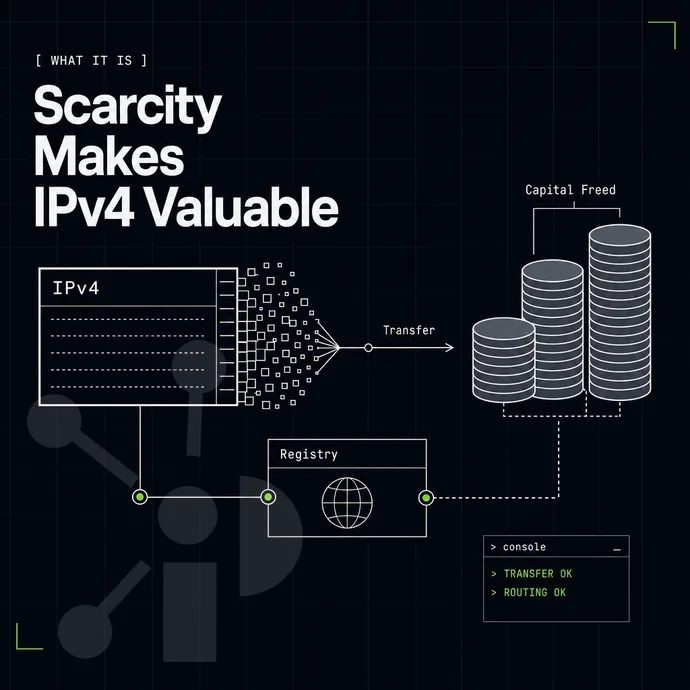
The IPv4 address space has become a tradable asset. The five RIRs have exhaustened their free address pools between 2011 and 2020. As a consequence the secondary market is the last pool of free addresses. The structural scarcity of IPv4 addresses is the driving force behind everything that follows. Organizations holding IPv4 assets now treat them as strategic resources that companies can acquire to support network expansion or monetize through sale.
Limited supply, growing demand
With roughly 4.3 billion assigned out of 4.3 billion possible IP addresses, the number of available IPv4 addresses is already fully allocated. Because of the growing demand by ISPs, hosting providers, enterprises and mobile carriers, on the Internet, the demand for IPv4 is increasing. Because there are so many Internet users, on the Internet, IPv4 remains the most important routing currency.
Why IPv6 does not remove the case for an IPv4 address
The rate of adoption of IPv6 is uneven. Many IPv6 enabled sites are still deployed with dual stacks to ensure continued operation with IPv4 address until a more credible near-term migration timeline emerges. So treating IPv4 as a depreciating asset is likely to find that the operators deployment assets have a significantly longer deployment runway than they anticipated. Organizations must evaluate whether their existing infrastructure can support dual-stack configurations before committing to long-term address strategies.
Is an IPv4 investment worth it for your business?
Operational forums are lately treating IPv4 blocks as a fairly recession-proof finite asset.
When buying IPv4 addresses, Prefixx can acquire the blocks for you, Tixx will verify the quality of each, and all full transfer paperwork (acquiring and transferring) will be handled by us for ARIN, RIPE NCC and APNIC blocks. Current market price for new acquisitions is your first ask here. Our team provides ongoing support throughout the acquisition process to ensure compliance with registry policies and smooth completion of the transfer.
More and more Datacenter and Cloud Providers support BYOIP for customers who need more space in their facilities. Owning your IP space turns a recurring expense into a fixed asset on your balance-sheet with a floor in terms of supply. The question on value for such an asset on the IPv4 transfer market however is complex and depends on several factors that influence the pricing.
Organizations evaluating whether to purchase or lease must weigh the upfront capital requirement against the long-term cost predictability that ownership provides. Many companies find that owning IP space also simplifies internal accounting and removes the ongoing administrative overhead of managing recurring lease agreements.
How IPv4 address block pricing works in the secondary market
The address resale market trades at market rate, determined by supply and demand in the market, with no official rate sheet published by any registry. Transactions typically occur through negotiated agreements where sellers list their blocks and buyers submit offers, with the space ultimately going to the highest bidder.
What drives the number
- Smaller blocks such as /24s command a higher per-IP price than larger blocks of IP. This is because there is a higher cost to provide routing for smaller blocks of IP and /24s are generally the smallest block size that most networks will route.
- The same-sized block of ARIN space as that RIPE NCC space can trade at very different prices in the same month in the RIR region. That price differential is a function of regional demand for IP addresses. Historically, space in the ARIN region has commanded a premium due to high demand from North American-based operators.
- Routing hygiene matters. Blocks with clean history and valid RPKI ROAs get more bids. A block with problems will get a lower price or no bids at all.
Reading market trends
- Scarcity signals. The value of Amazon’s IPv4 stockpile has been estimated to be around $1 billion. This number reflects the high market value of large blocks of IP address space, and the years that Amazon spent amassing this cache before the free pools of IPv4 addresses finally ran out.
- Price volatility. Prices move with macroeconomic, IPv6 adoption, and surprise demand spikes from cloud providers and ISPs. Each quarter is unpredictable and different from the last.
Before you transact
- Run a reputation and routing scan on any block before agreeing to terms. This is something we automatically do for you with Tixx by Prefixx on every block you put into the system.
- Verify the RIR for this move and confirm transfer eligibility. Cross-registry moves are time-consuming and add extra paperwork.
Note: Never assume a quoted price reflects current conditions. The secondary market moves fast, and a figure from last quarter may no longer apply. Once you have a realistic sense of what a block costs, the next decision is whether to buy it outright or lease it.
Buy, lease or hold: choosing the right IPv4 address strategy
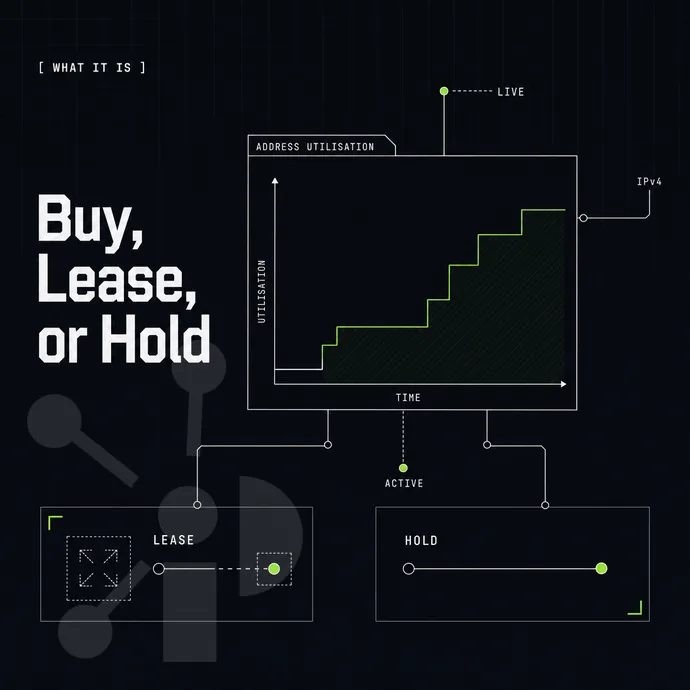
When it comes to making an investment in IPv4 addresses, companies generally consider two main options: buying them outright or leasing them. Getting this wrong costs more than the actual IP addresses. Organizations evaluating buying IPv4 addresses must weigh the strategic value of ownership against the operational flexibility that leasing provides in their specific deployment context.
Buy IP addresses: long term ownership, value, and transfer processes
Purchasing a block of IP addresses enables you to hold that transferable IP address space against your RIR account. The value of holding that long-term space against your RIR account, compounds as the free-pool space dwindles and secondary-market demand for such space continues to rise. The decision to purchase rather than lease reflects a strategic view that ownership provides both operational control and a hedge against future price volatility.
The primary trade-off against that increased value is the initial outlay of capital and the space of time it takes to go through the transfer process. This can vary greatly between registries and, for many businesses considering long-term ownership of fourth version internet protocol address space, can take weeks to transfer within the ARIN or APNIC spaces (where there are currently waitlists for legacy space allocations).
The transfer process itself can be time consuming, particularly when registry approval queues are long or when legacy space documentation must be assembled and verified.
Compliant transactions require clean title (i.e. verified ownership, no encumbrances, etc.), as well as a block that passes routing hygiene checks. Ensuring RIR compliance means adhering to the specific transfer policies and documentation requirements that each registry enforces for legitimate ownership changes.
Lease IP addresses: cash flow flexibility and routing readiness
The shift on the WISP and ISP forums is that when a /22 costs this much in capital, leasing it converts that capital cost into a very reasonable monthly cost. And you get immediate routing readiness, LOA, RPKI ROA, and IRR objects all provisioned for your IPv4 address through the American registry, along with a non-revocation guarantee for the BGP announcement you make. Leasing also provides immediate access to routing infrastructure without the upfront capital burden of ownership.
Provisioning time goal is 24 hours.
Leasing IP addresses through Prefixx is very straightforward. First, you simply submit an inquiry regarding the addresses you need. Prefixx then returns a personalized offer, valid for 72 hours, once terms and conditions have been outlined, and you can proceed to provisioning upon approval.
Holding blocks as assets
Some organizations purchase space in anticipation of future needs, treating IPv4 addresses as assets on their balance sheets. Some organizations and investors view these addresses as appreciating assets due to ongoing scarcity and sustained demand across global networks. Organizations and companies alike must evaluate whether their network growth projections justify the capital allocation required for outright purchase versus the operational flexibility of leasing arrangements.
While buying up large IP blocks when prices are climbing may make sense in the short term, holding idle IP resources can have negative consequences (including potential to cause reputation problems) and many RIRs have policies which require demonstration of current and/or future use of allocated space, even if not yet assigned from the acquiring organization.
For community perspectives, see I am planning to make a small investment into IPv4 ... . Some investors view IPv4 blocks as speculative holdings, though this approach carries the same reputation and policy compliance risks that apply to any organization acquiring address space without immediate deployment plans.
This ensures that any held blocks are kept clean and transfer-ready whether you eventually decide to deploy them, sell them on or opt for something else. Whatever approach you opt for, the following risks need to be taken into account and they apply to all three scenarios. Proper maintenance also preserves the technical integrity of your address space so it remains routable and usable across the global network.
IPv4 address risks every investor should understand
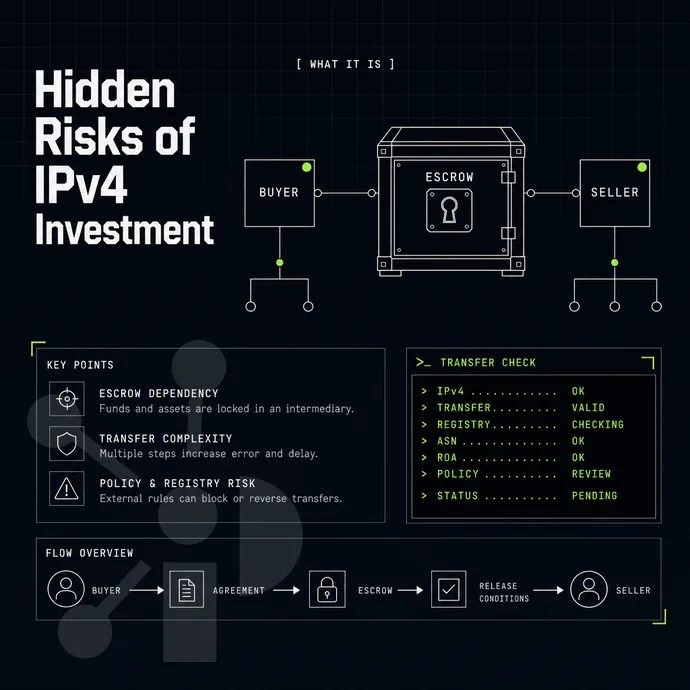
Far too many companies purchase blocks of IP addresses without a complete audit of what they actually bought and subsequently can’t afford the ensuing problems once the transfer has taken place. Understanding the full scope of potential risks before finalizing a purchase can prevent costly remediation efforts and operational disruptions down the line.
Reputation and routing readiness
A block with bad past reputation can arrive with a poor reputation history, carrying blacklist entries, abuse reports or with spam-flagged IP prefixes. Additionally, routing readiness issues will prevent smooth propagation of the block even after the RIR transfer has completed. These issues are caused by missing RPKI ROA s, IRR route objects or LOA documentation.
Our pre-sale quality control process, Tixx, checks for ownership, blacklists, routing issues and RIR issues on all blocks we sell. Although we cannot guarantee delisting of a problematic block, we will not list problem blocks in the first place. Our team provides ongoing support to ensure any issues identified during the audit are resolved before the block is made available for purchase.
Documentation requirements and transfer coordination
Paperwork chains differ from RIR to RIR, so when internet numbers are moving between registries (e.g. a block of numbers is moving from the ARIN region to the RIPE NCC region). The most common cause of delays in number transfer processes is errors in the transfer coordination process, such as missing or incorrect documentation that can hold up a transfer for weeks. Companies operating across multiple registry jurisdictions must therefore maintain separate compliance workflows tailored to each authority's specific procedural expectations.
Geolocation lag and market conditions
There is typically a lag of several days for geolocation databases to reflect a property’s new owner after a domain transfer has closed. This can impact online advertising targeting, fraud detection scoring and Content Delivery Network routing. We provide RFC 8805 formatted geofeed updates as a better alternative for rapid correction of misgeolocated domains, and work with major geolocation service providers, no waiting list for updates, which also perform reputation checks, to ensure prompt corrections that protect the long term value of your address space.
Market-wide factors can cause available supply to concentrate or dissipate, rendering long-term ownership of a block of less value if that block cannot be cleanly routed. The only reliable hedge for long-term value when buying IPv4 addresses is proper vetting of a potential purchase beforehand, and finding the right broker to assist with that vetting is critical to ultimate success.
Treating IPv4 acquisition as a strategic asset allocation rather than a purely operational expense can help organizations better evaluate the trade-offs between purchasing and leasing when investing in address space.
Why work with Prefixx for your IPv4 address investment
Prefixx is a boutique IPv4 brokerage established in 2018 and registered with ARIN, RIPE NCC and APNIC (LACNIC facilitated). We are a brokerage that specializes in buying, selling and leasing IPv4 address space. We charge zero fees to our buyers and our commission is a seller-only fee of 3% to 8% or no win no fee. All transactions are escrow-secured and all blocks of IP addresses are verified by Tixx quality control prior to being offered to buyers.
- We guarantee clean blocks. For every IPv4 address block Tixx checks for ownership, blacklists and routing hygiene before transfer.
- We handle white-glove routing paperwork for our customers. This involves setting up LOA, RPKI ROA and IRR route objects for customers’ IP space on all 5 regional Internet registries.
- We handle end-to-end Inter-RIR transfers. We coordinate the transfer of IP addresses for transfers between organizations expanding into any region (e.g. ARIN, RIPE NCC, APNIC, LACNIC).
- BYOIP deployment support. We support BYOIP on our bare metal servers (no additional charge per IP) as well as our cloud BYOIP programs on AWS, GCP, Azure and Cloudflare.
- A Senior Consultant is assigned to every transaction. There is no self-serve IP marketplace here, no automated queue system. Your IPv4 portfolio is managed by a real consultant from sourcing to settlement.
For current market pricing on IPv4 address blocks, visit our IPv4 pricing page or contact our team for a personalized quote.
Frequently asked questions
What are current market prices data centers pay when buying IPv4 addresses?
There is no single published price for IPv4 address space. Prices are set by the market and vary by block size, RIR region, routing history, and reputation. Brokers typically provide pricing guidance based on recent comparable transactions within the same registry and block size category.
Are IPv4 addresses a good long-term investment for data centers?
The structural case is straightforward: supply is fixed at roughly 4.3 billion addresses, every one is spoken for, and the free pools at all five RIRs emptied between 2011 and 2020. Demand from cloud providers, mobile carriers, and enterprises has not softened. Blocks that are clean, routable, and held in a well-documented RIR account have historically retained and grown in value. Organizations investing in IPv4 must evaluate whether they intend to deploy the addresses operationally or hold them as appreciating assets on their balance sheet.
Is an IPv4 address ever going away?
IPv6 adoption has grown steadily, but the global internet still routes enormous volumes of traffic over IPv4, and most commercial infrastructure depends on it. Scarcity is the defining feature of the market, and that scarcity is structural, not temporary. Organizations evaluating their network infrastructure strategy find that investing in IPv4 remains a practical necessity given the continued reliance on this protocol across enterprise and service provider environments.
Can I buy my own public IP address?
Yes, but the minimum tradeable unit is a /24 (256 addresses) under most RIR transfer policies. Individual IP addresses are not sold separately on the IP address trading market. To hold address space in your own name, you need an active RIR account or LIR membership, and the transfer must be approved by the relevant registry. Prefixx handles the RIR paperwork, escrow, and routing setup end to end for buyers acquiring blocks across ARIN, RIPE NCC, APNIC, and LACNIC.
Buying vs leasing an IPv4 address: what is the difference?
Buying transfers full ownership of the block to you via an RIR-recorded transaction. Leasing gives you the right to announce and use the addresses for the lease term, without an ownership transfer. Leasing is faster to provision and carries a lower upfront cost, while buying builds a balance-sheet asset. Both models provide legitimate routing and announcement rights, ensuring that operators have the access they need to deploy services immediately.
How do I sell IPv4 addresses I already own?
Start by confirming your RIR registration is current and the block is transfer-eligible. From there, a broker like Prefixx lists the block, vets buyers, and closes the deal through escrow.
The IPv4 address space is a finite, tradeable commodity with real demand behind it. The last of the free pools have long since been exhausted and new network operators join the aftermarket to purchase the blocks of IP addresses they require. The basic structural scarcity of IPv4 addresses makes for a solid investment proposition.
However, The lack of transparency in pricing, the risk to one’s reputation and the large differential between a ‘clean’ and ‘tainted’ IP address block all present significant challenges to would-be investors. Buying IP addresses to hold as long-term equity, leasing them to release capital for immediate use or holding them and actively managing their ‘hygiene’ all are valid strategies.
Getting those details right is where most investors lose value. A vetted set of IP blocks sourced through escrow, with Tixx quality control confirming ownership, routing hygiene and blacklist status before settlement, is a fundamentally different asset from one acquired without due diligence. If you are ready to buy, sell or lease IPv4 address space, reach out to Prefixx to get a personalized offer.
Contact us to discuss your IPv4 needs today
No hidden fees, free consult. A broker replies within one business day.