
By Savvas Bout, Founder of Prefixx. Last updated 23 October 2026.
Waiting for addresses on the ARIN IPv4 waiting list is not something you want to do if you are planning to set up the necessary infrastructure in a few weeks. Even if you apply today for IP addresses, the resources you are waiting for may never actually materialize. ARIN uses a free pool of IP addresses.
This space is drawn from previously allocated addresses that the American Registry either reclaims or has returned to it by the holder of the allocation or assignment.
This article explains how the ARIN IPv4 waiting list works, how long the wait is, what block sizes are available, and why most organizations end up on the secondary transfer market instead.
This article contrasts the waiting list with buying or leasing addresses on the open market, outlining the pros and cons of each to help you find the best acquisition strategy for your timeline and budget.
For a complete overview, explore our arin ipv4 waitlist guide.
What is the ARIN IPv4 waiting list in the first quarter?
The five RIRs exhausted their free pools of IPv4 addresses between 2011 and 2020.
What is the ARIN IPv4 waiting list and who can apply?
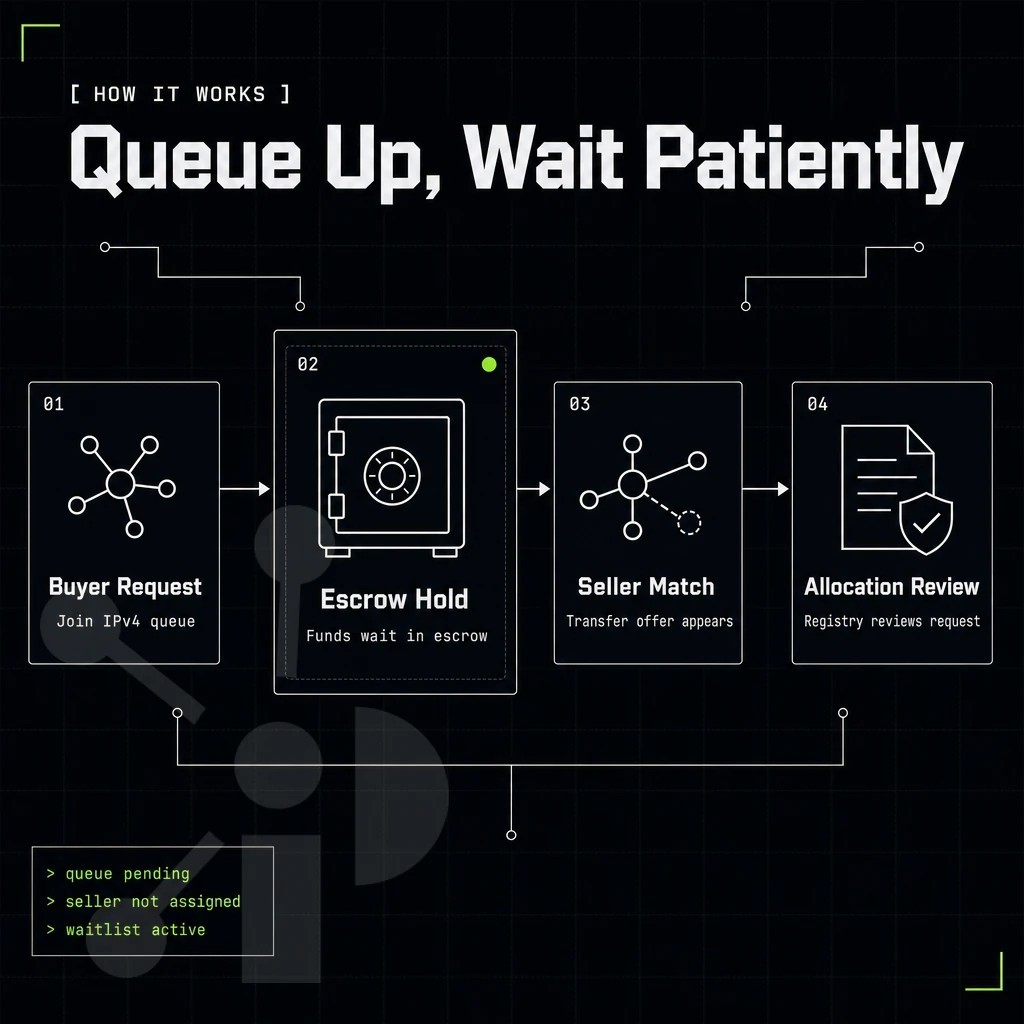
For any organization that qualifies and makes a request for space, they will be placed on the waiting list. Each request is reviewed for need justification. When any recovered or returned IPv4 address space becomes available, ARIN works down the list of waiting applications and notifies each applicant by email.
The organization is on the list and the space is waiting for them, not reserved for them. Organizations that fail to respond within the specified timeframe or demonstrate non payment of applicable fees may forfeit their position and the addresses will be offered to the next applicant in queue.
The financial services team handles billing for offered blocks. The helpdesk, as well as external consultants, are available to assist if anything blocks you from creating a compliant request. Timely responses to billing inquiries help ensure that requests proceed smoothly and that non payment issues do not delay the review process.
What is the difference between an ARIN waitlist request and a secondary market purchase?
Waiting lists for IPv4 addresses are being offered at registry prices, sometimes even with a delay of more than a year. On the secondary market, you can get a block of addresses within weeks, including full transfer paperwork. Organizations seeking predictable timelines often find the secondary market better suited to their operational needs during periods of network expansion or infrastructure transition.
- Waiting list: lower cost, unpredictable timeline, limited to smaller block sizes as ARIN recovers space.
- Secondary market: faster, broader size selection, addresses vetted before transfer.
We trade used IPv4 address space on the secondary market across all RIRs (ARIN, RIPE NCC, APNIC, LACNIC and AFRINIC). All internet numbers and blocks are delivered fully ready for routing (LOA, RPKI ROA, IRR objects etc) and ready to go as of day 1. Working with a broker of strong reputation ensures that all documentation is handled correctly and that blocks are clean and unencumbered.
How the ARIN IPv4 waiting list process works
The ARIN waiting list for free pool numbers is a last resort, not a reliable source.
Following requirements for waiting list eligibility
To add your organization to this list, the organization must hold a current Registration Services Agreement (RSA or LRSA) with ARIN.
Waiting list process and queue mechanics
After determining eligibility, an organization with a need for new space will submit a new request via ARIN Online.
Requests are automatically removed if payment is not received within the specified time frame. Organizations that no longer meet the stated criteria at the time of Fulfillment are automatically removed from consideration. They will need to re-qualify and submit another request for consideration. Organizations must also be prepared to accept the offered block within the notification window or risk removal from the queue.
How many IPv4 addresses are left in the ARIN free pool?
ARIN used up the general free pool of IP addresses in 2015. The occasional /24 of returned or re-assigned IP addresses trickles back in. Historically, wait times for such allocation have ranged from 12 to 20 months or so. No guarantees of any sort of timely allocation. Some applicants have experienced even longer delays when the size of their request exceeds the blocks that happen to become available during their window.
The conveyance Market or “allocation market” for short is how most organizations acquire additional IP address space. Better known as IP space, in the faster and more cost effective alternative to waiting for a new Pool of IP Addresses to be assigned.
At Prefixx we help source the right size vetted blocks of space in ARIN, RIPE NCC and APNIC regions, complete with all necessary Escrow and reallocation paperwork, and perform Tixx quality checking on every block of space we sell to ensure that every buyer of IP space gets the best possible IP space for their use case. Our team provides exclusive access to pre-vetted inventory and dedicated support throughout the acquisition process.
How ARIN distributes IPv4 addresses from the waiting list
In the distribution of unallocated IPv4 address space by ARIN, each block of space distributed comes from returned allocations, from resources which have been revoked, and from legacy addresses that have been recovered. This process can help to set a proper basis of expectation in seeking to join a waitlist for such space.
How ARIN builds the waiting list pool
- Space that was returned and/or revoked for an organization’s space (i.e. addresses that were returned by an organization and/or had been revoked by an organization) are added to the available pool of space by ARIN. Legacy resources that were recovered are also added to the pool in the same way.
- Excluded from special use space recovery. Not every recovered IP address will qualify. Special use space (i.e. IANA reserved ranges) is excluded from eligibility for distribution in a recovered block.
- We publish information on eligible blocks for waitlist fulfillment. ARIN maintains a public page where we list all the address blocks that we clear for waitlist fulfillment. It is suggested that blocklist operators use this information to take stale entries off their lists.
Address block matching and waiting list distribution cadence
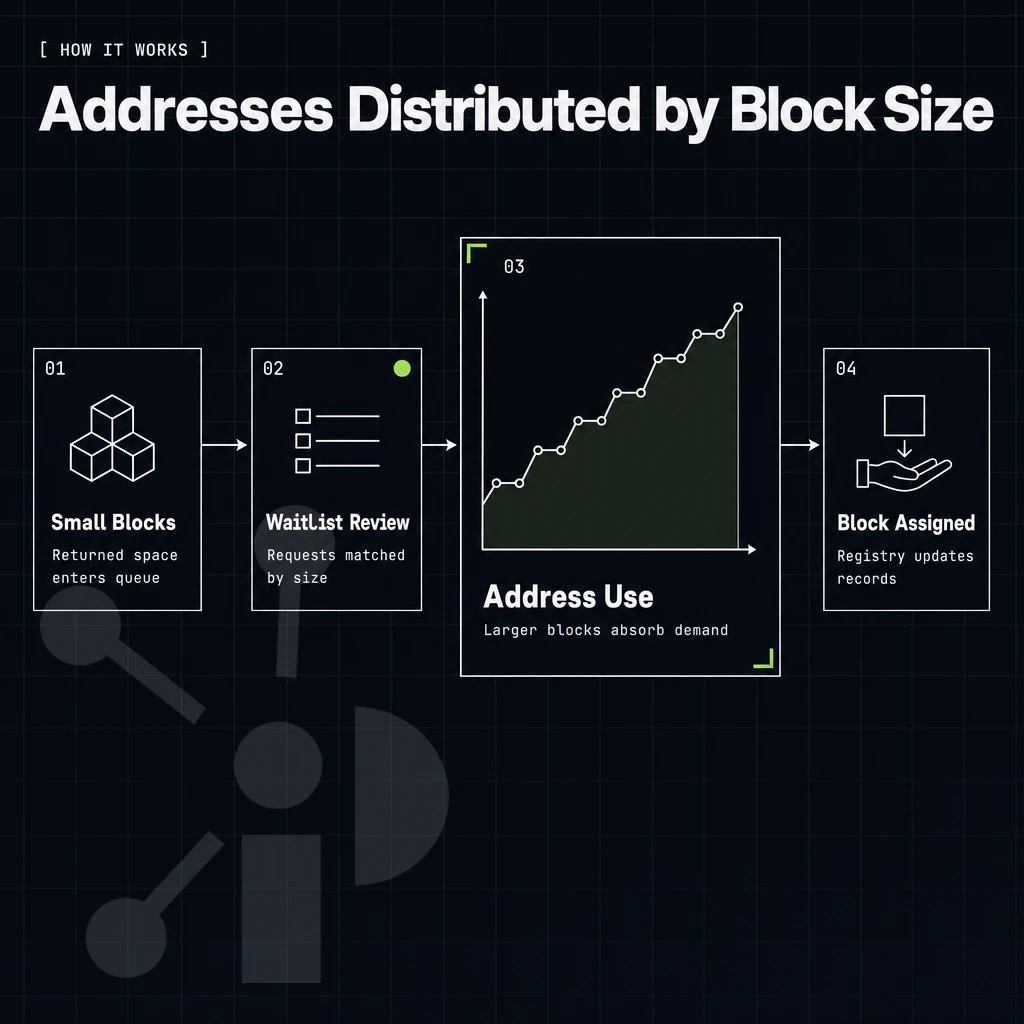
- Requests for addresses are processed in a first-come-first-served fashion by size. ARIN goes through the pool of address blocks and the waitlist of total requests for addresses, and matches each address block in the pool with the closest available match for a request for addresses. Because of the nature of the available space (i.e., fewer large address blocks are returned), larger requests for addresses will typically take longer to process than smaller requests.
- ARIN distributes cleared IPv4 address blocks on a quarterly basis. Distribution announcements are made and the community is notified. The cleared-blocks page is also updated as needed. The first announcement of the year usually sets the ‘bar’ for the rest of the year.
- Update address block to trigger transaction paperwork once a match is confirmed. The formal assignment will then be initiated by ARIN and recipient will set up routing (or have broker do this for them).
How long does it take to receive IPv4 addresses from the ARIN waitlist?
Note that there is no set time frame for receiving IP block from ARIN. Additionally, Wait time will depend on amount of address pool recaptured by ARIN on a quarterly basis, as well as whether requested IP pool size matches available address range. Organizations should understand that recapture rates can vary significantly from one first quarter to the next, making planning difficult.
In the mean time, smaller size of IP range requested will allow request to go through faster. If you need to stick to a timeline, it’s probably best to acquire address block through a broker (buying/leasing) rather than waiting for ARIN to process requests for IP address block in recaptured address inventory. The following section details actual wait times. Brokers can typically close transactions in a matter of weeks, giving you certainty over your infrastructure rollout schedule.
Why the ARIN IPv4 waitlist is not a reliable path for most organizations
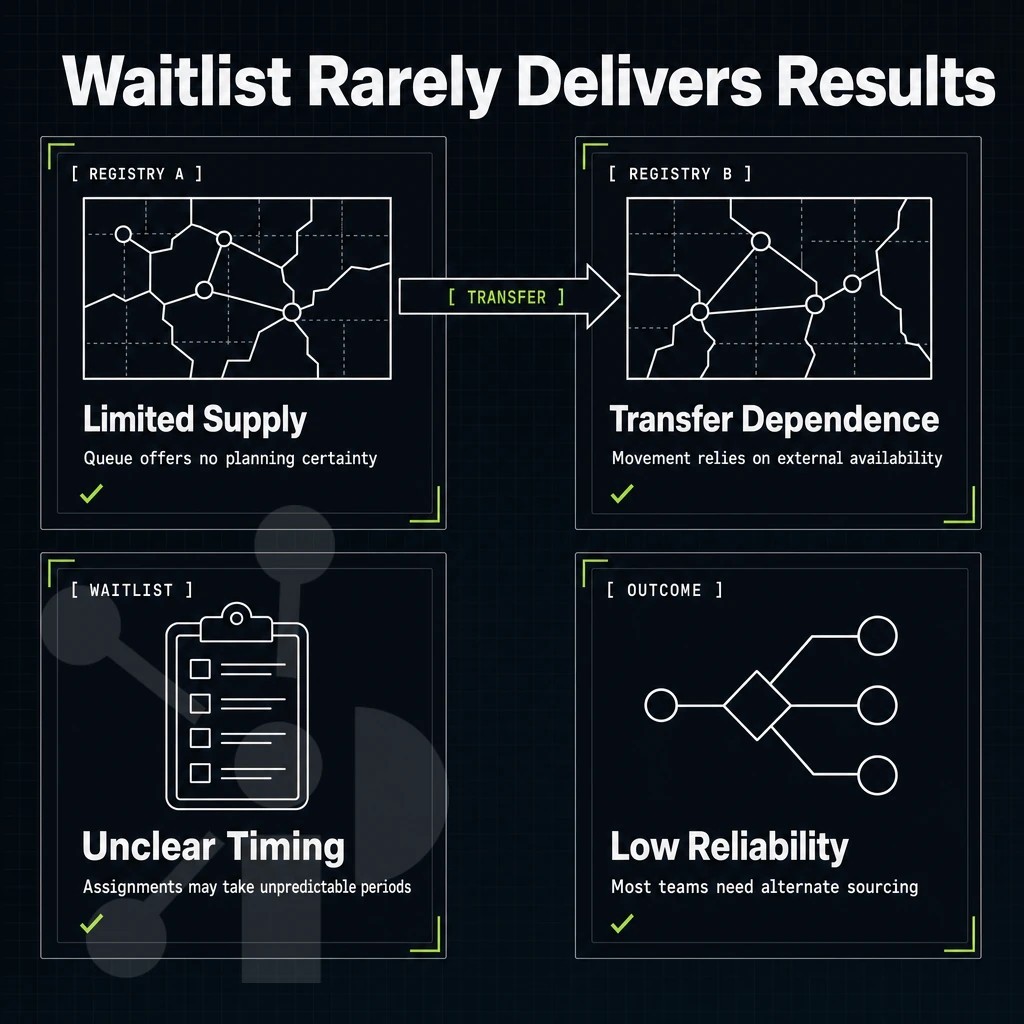
The waitlist at ARIN is a last-resort to assign IP addresses, and not a planning tool. As such, the waitlist creates a host of uncertainties for any organization with a near-term IP request or need: e.g. when will IP stock be assigned, how much address reserve will be assigned, and will an organization remain eligible for IP reserve assignment at all. Organizations relying on the waiting list face unpredictable timelines that can derail deployment schedules and force last-minute architectural compromises.
Unpredictable waiting list timelines and no size guarantee
ARIN's financial services team publicly stated several years ago, following requirements discussed at NANOG 88 in Seattle, that wait times would be in the order of years, not months. These timelines were reiterated at the spring policy meeting in June, underscoring the registry's position on realistic expectations.
The waitlist is not a reserved address capacity for a particular block size. Instead, on the particular date that IP capacity becomes available, ARIN attempts to award IPv4 addresses of the size(s) requested by the waitlist members, and the size(s) awarded can be less than requested by a growing ISP or enterprise that is in the process of planning and building out a network and cannot plan around this uncertainty.
The available capacity represents an aggregate of reclaimed blocks that may not align with the contiguous ranges applicants need for their routing architecture.
Waiting list eligibility requirements and removal risk
Therefore, an organization’s changing needs, a weakening justification for an award, and a failure to respond within a given time frame can all result in an award being removed from consideration entirely. ARIN will notify applicants when blocks become available, but organizations must respond promptly or risk losing their place in the queue.
- Needs justification must remain current and documentable.
- A single missed message from ARIN can trigger removal.
- Block size awarded may not match operational requirements.
How to resolve an IPv4 address shortage without a waiting list
In the ARIN registry region, every one of the address blocks within the quota is held by some entity or person. Each registered entity may hold one or more blocks, which together form their aggregate holdings within the registry.
We work with a large network of brokers that have vetted all blocks available across all RIR regions. These have been put through escrow-secured settlements and Tixx quality control before they are made available for purchase by Prefixx clients. Our team of experts handles every step of the process, from finding the right address block, to taking care of the necessary paperwork to route it to where it is needed. Here is an example of how we do things in practice.
How Prefixx helps organizations move beyond the waiting list
Prefixx is a boutique IPv4 brokerage, based in Miami and founded in 2018. We facilitate the buying, selling and leasing of IPv4 addresses in all five RIR regions. Thus, Prefixx clients are no longer required to wait in the American Registry for Internet Numbers's queue in order to obtain the required IPv4 address bank in a timely manner.
- Zero buyer fees. The services fees are only charged to sellers to ensure your entire acquisition budget is spent on purchasing addresses as opposed to being spent on services fees.
- Tixx quality control. Each block of IP bank is verified for ownership, blacklist status, routing health and RIR validation before being assigned to a customer.
- We take care of the white-glove paperwork. We create the LOA, the RPKI ROA and the IRR route objects for you.
- Leasing available. If a full purchase isn’t quite what you’re looking for, leasing addresses your needs immediately and includes a non-revocation guarantee.
- Prefixx is a registered broker with the American Registry for Internet Numbers's system, RIPE NCC and APNIC. We also facilitate transfers of LACNIC address reservoir.
For details on available blocks or assistance finding the right resource assignment, visit Prefixx.net or submit a ticket to speak with a consultant.
While the regional internet registry IPv4 address waitlist does exist as a request queue, it is not a useful tool for planning. Wait time is essentially unpredictable, allocations are typically small, and there’s no real guarantee that you’ll ever receive a block of IP addresses. Thus, for real deployment dates, the secondary migration market for addresses in the ARIN region is essentially the only useful way to acquire an IP address reservoir.
The portability market is on your schedule, not the American Registry for Internet Numbers's system's waitlist program’s. The size of the blocks to reassignment is variable: a /24 up to a /16. There are RIRs for every continent and a well-defined process for delegation of each of these blocks, with assistance creating a schedule that is somewhat predictable.
The real variable is to find on the brokerage market a block of an appropriate size for your use case that has been adequately vetted for trade at a fair price, is not blacklisted, and has been subject to a good quarter or more of clean routing history.
That is exactly where Prefixx fits. Every block goes through Tixx quality control before it reaches a buyer on the waiting list, transactions are escrow-secured, and the team handles RIR deal paperwork end to end. Browse available blocks or get a personalized offer at Prefixx.net.
Contact us to discuss your IPv4 needs today
No hidden fees, free consult. A broker replies within one business day.