
By Savvas Bout, Founder of Prefixx. Last updated 11 November 2026.
Buying a block of IPv4 addresses means inheriting all of the prior holder's good and bad decisions.
Gaps in a chain can result in the buyer purchasing blacklisted space, 'disputed' resources reflecting the us government's view on restricted assets, or even ones that fail to move through the registry due to some prior transfer not having been correctly recorded. In some jurisdictions, disputes over ownership may escalate to require judicial recognition of the rightful holder before the registry will process the transfer.
Verifying a complete chain of title for a IP address before you hand over any cash is the core of this article. We also go into the history of title for a block of IP addresses in relation to lease agreements.
The validity of your RPKI signatures and the process of an inter-RIR transfer of titles for a block of IP addresses.
What is IPv4 chain of title for IP addresses
The IPv4 chain of title refers to a documented history of a block of IP addresses that traces back to the RIR assignment of the block. Additionally, Then lists all of the subsequent holders of the block to the present holder. Without the chain of title for a particular block of assigned IP addresses, a potential buyer, lessee or registry would have no way of verifying the current holder's right to use and sell the IP addresses.
IP address ownership and property rights
Property is transferred via deeds and hence tracked via a history of deeds for real estate. The same approach is used to track ownership of IPv4 address space i.e.
Each change in the end-owner of a block of IP addresses is recorded at the relevant RIR, and this intangible data forms a complete and verifiable history of all past owners of any particular block of IP addresses. A complete and verifiable record of all past owners constitutes a concise history that buyers rely on to assess the legitimacy of the transfer.
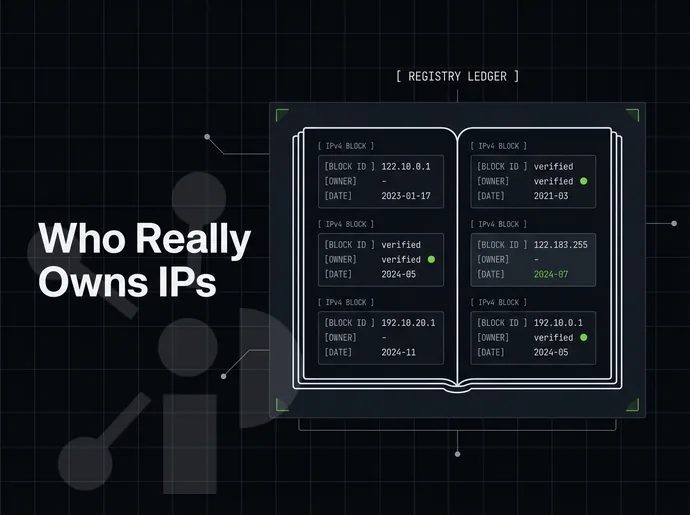
The IP addresses in the address block custody documentation record
This documentation comprises the relevant RIR records, inter-regional transfer documentation and Letters of Authority (LOAs) for each segment of the chain.
Determining ownership across regional internet registries
Property rights to a block of IP addresses are usually RIR specific and thus affect transfer eligibility, whether a range of addresses is considered a legacy address and RPKI signing rights. There is a big difference between the way property rights to IP addresses are recorded by ARIN under its RSA and by RIPE NCC under its contractual model. These structural differences potentially affect how disputes are resolved and which remedies are available when ownership questions arise.
Our consultants will verify the full chain of ownership for you before any deal is done. We then also need to verify how that chain of ownership is recorded by each of the registries involved.
How to verify and prove ownership before a transfer
Verifying the ownership of a vehicle before transfer involves a substantial amount of research to verify the original allocation and all subsequent owners.
Check the registry records first
This query involves looking up the block of IP numbers in question at the relevant RIR (e.g. ARIN for space allocated in the US). The lookup will confirm whether the allocated space matches the seller's claimed holdings and whether any encumbrances exist.
For ARIN-space held by others, verify that the holder has a signed RSA (or LRSA) online at the ARIN website. Buyers can confirm the presence and status of that agreement by reviewing the organization's record through their ARIN online account.
Cross-check routing and reputation
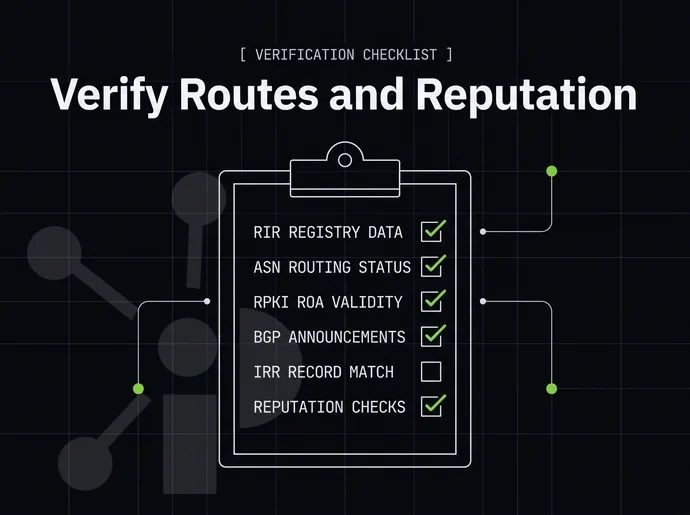
The difference between what the registry says and how traffic actually flows on the Internet appears to be substantial. In the meantime, verify DNSBL blacklists for major systems and verify general routing health for a given IP and corresponding domain name. Both IP addresses and domain names carry historical reputations that get locked into a block. Just as domain names can be flagged for spam or phishing, IP blocks inherit reputation signals that affect deliverability and trust scores across the internet.
How tixx handles this for you
Internet number disputes frequently revolve around governance of IP address RIR records as authoritative data.
Common chain-of-title problems and how they are resolved
Most IPv4 deals fail due to chain-of-title defects. A complete and accurate history of all transfers of all prior owners is needed to confirm ownership. Yet, most legacy IP addresses lack complete and accurate documentation of all prior owners and their transfers of same. The four problems below cover the majority of cases we see.
The four most common defects
| Problem | Root cause | Resolution path |
|---|---|---|
| No RSA or LRSA on file | Block pre-dates modern RIR policy | Sign a Legacy Resource Agreement; ARIN processes these in weeks, not months |
| Informal transfer never recorded | Handshake deal, no RIR paperwork filed | File corrective transfer paperwork with supporting evidence; timeline varies by RIR |
| M&A without registry update | Legal entity changed; WHOIS still shows predecessor | Submit merger documentation to the RIR; straightforward if corporate records are intact |
| Policy violation flag | Abuse, hijacking history, or utilization breach | Engage the RIR directly; some flags lift on remediation, others require arbitration |
When IP addresses resolution is contested
Many problems with domain name registration can be solved within the RIRs current processes. However, issues with disputed ownership are outside the normal ability of domain name registries to resolve. When a complex legal issue arises over who holds the rights to a block, the registries typically require the parties to resolve the matter through external legal channels before any transfer can proceed.
Due diligence recommendation for IP addresses
DUE DILIGENCE, flag changes to registration history. The Tixx by Prefixx system checks for status of ownership, transfer ability and IP routing and sniffing of blocks before they are sold on to buyers. The platform automates the process of determining ownership by cross-referencing registry records with historical WHOIS data and flagging any inconsistencies that require manual review.
Frequently asked questions about IP addresses
How does property law shape stakeholder views on IP address rights in non-legacy chain of title?
A chain of title is the documented sequence of assignments and transfers that connects a block of IPv4 addresses from its original RIR allocation to its current holder. Each documented assignment in that sequence represents a formal change in the registry's record of which entity holds the assigned names and numbers.
A clean, unbroken chain is what gives a buyer confidence that the seller has the legal standing to transfer the block. That legal standing rests on the documented IP address property rights that flow from the original allocation through every recorded holder.
Under property law, how do I find who owns an IPv4 address block?
Start with the WHOIS database of the responsible RIR, from a free market view, these are private corporations like ARIN for North American space, RIPE NCC for European and Middle Eastern space, APNIC for Asia-Pacific, and so on. The american registry maintains its own distinct policy framework and transfer procedures that differ from those of other regional registries.
For a deeper check, cross-reference the IRR route objects and RPKI ROA data to confirm that the announced origin ASN matches the registered holder. This cross-referencing step ensures that the routing configuration for the IP addresses aligns with the registry data and has not been hijacked or misconfigured.
What happens if there is a gap in the chain of title?
A gap means there is at least one transfer or reassignment of own property rights that was never recorded with the RIR, leaving the registry's records inconsistent with the actual history of the block. When exclusive property rights are not properly documented at each step, the registry cannot confirm the current holder's authority to transfer.
Buyers who close a deal without resolving a gap risk receiving a block they cannot formally transfer into their own name.
Are IPv4 addresses considered property under property law?
RIR policy documents describe IPv4 addresses as number resources subject to registry policies, not as property in the traditional legal sense. Courts in several jurisdictions have nonetheless treated address blocks as assets with economic value, particularly in bankruptcy and fraud cases, but no single global legal framework, not even guidance from any overseeing internet corporation, definitively settles the question of determining ownership. This apparent tension between registry policy and judicial treatment creates uncertainty that buyers must navigate when evaluating the enforceability of their rights.
What matters practically, and what will shape future developments in this space, is that those who evaluate potential solutions understand the RIR recognizes the registered holder as the party with transfer rights, and that any sale or lease agreement reflects the policy constraints of the relevant registry.
A qualified broker structures transactions to satisfy both the registry's requirements and the contractual needs of the parties. The broker must also ensure that the agreement accounts for any contractual limitations imposed by the registry on the use or subsequent transfer of the block.
What is the difference between a legacy and a non-legacy IPv4 block for transfer purposes?
Legacy blocks were allocated before the RIR system was fully established, often directly by IANA or early network bodies, and determining ownership is complicated by the fact that many holders never signed a formal Registration Services Agreement with a registry. Non-legacy blocks were allocated under current RIR policy and come with a signed RSA that binds the holder to the registry's transfer rules. The distinction matters because legacy internet numbers often lack the formal contractual trail that modern allocations carry by default.
Legacy holders can transfer their space, but much like navigating the us court system, they typically need to sign an LRSA or RSA with the relevant RIR before the transfer can proceed, which adds a step to the process. The requirements and documentation steps differ depending on whether the legacy block falls under the ARIN region or another registry's jurisdiction.
How does tixx by Prefixx verify chain of title before a sale?
Tixx is Prefixx's pre-sale quality control process, applied to every block before it reaches a buyer. It checks RIR WHOIS records to confirm the seller is the registered holder, reviews transfer eligibility under the applicable registry's policy much like how the us court system verifies standing before proceeding, and flags any discrepancies between the WHOIS record, IRR route objects, and RPKI ROA data. The system validates that basic information such as the registered holder name and allocation date align across all registry sources before clearing the block for sale.
The process also covers blacklist status and routing hygiene, producing a health report and a transfer readiness score.
What documents prove IP address ownership for an inter-rir transfer?
The exact set varies by registry pair, but the core documents are the same across most inter-RIR transfers: proof of organizational identity for both the source and recipient organizations, a signed transfer agreement between the parties, and confirmation from the source RIR that the block is eligible for transfer and that the seller is the registered holder in good standing with all property rights bound to that entity on record. The identity verification requirements apply equally whether the parties are individuals or large companies.
For legacy space, a signed LRSA or RSA with the source RIR is typically required before the transfer can be initiated.
A clean chain of title is not a mere formality. When determining ownership, if RIR records do not match sellers' documentation of past ownership, a transfer can get stuck, a block can be untransferable or a buyer may even assume hidden liabilities.
Because the secondary market for IPv4 addresses has no central clearinghouse, the owners’ documentation, the transfer eligibility and the proper routing of the IP addresses must be checked by the two parties involved in a transfer.
Two simple rules to always follow regardless of the registry in question and the deal size: Verify before you sign by checking the WHOIS. Tracing allocation history for any IP addresses in question and verifying for any encumbrances or open abuse cases.
If you are buying, selling, or leasing a block and want every ownership and quality check handled before the transaction closes, Prefixx runs Tixx quality control on every block and manages the full transfer paperwork end to end. Reach out to start a conversation.
Contact us to discuss your IPv4 needs today
No hidden fees, free consult. A broker replies within one business day.