
By Savvas Bout, Founder of Prefixx. Last updated 23 October 2026.
Even before the very first IP address can be transferred, whether in the RIPE region or elsewhere, it has to pass one single gate that most buyers and sellers are not even aware of: IP transfer qualification.
Sometimes it takes several weeks and even months of paperwork going back and forth through the registry before the deal is finally resolved. Delays often stem from incomplete documentation or misalignment between what organizations submit and what the registry requires for compliance.
The eligibility criteria to transfer IPv4 address space in the five regions are different and keep changing. Moreover, transfers between two registries of different regions require the two RIRs to approve the transfer. Organizations planning transfers should review current policies at both the source and destination registries to understand which requirements apply to their specific transaction.
This article explains what the five RIRs check for in IPv4 address space that their customers want to transfer from one customer to another. It explains where the biggest problems occur across RIR regions and how to check whether a specific block of IPv4 addresses is transferable and what needs to happen by when.
What RIR transfer policies eligibility means
The address block transferability status of an organization and the internet number resources it holds is defined by a set of conditions that must be met by the organization before a transfer of a block of number resources can be approved by a regional internet registry. Compliance with these conditions ensures that organizations maintain good standing with their respective registry throughout the transfer process.
These conditions, which also apply to inter RIR transfers, are used as a filter to check if the organization is the rightful owner of the number resources, if it complies with the relevant policies and if it maintains its number resources in proper routing condition. Compliance with RIR policies is verified at multiple stages throughout the transfer approval workflow.
Why eligibility rules exist
All five RIRs used to have “free pools” of IP addresses, but those ran out between 2011 and 2020. Thus, every block of IP addresses that is traded on the secondary market represents real, monetized resources. The registries enforce the RIRs’ policies in order to prevent IP address fraud, to maintain good routing practices, and to ensure that only a legitimate holder of an IP address block can transfer it.
Each of the five Regional Internet Registries develops its own requirements for number resource allocations via a community-based policy development process. As a result, while a block may require the same amount of number space as another block, transfer policies mean that approval may require different information or even different approval from ARIN, RIPE NCC, APNIC, LACNIC or AFRINIC. These requirements can shift over time as the community adopts policy changes that refine eligibility criteria or documentation standards.
Intra RIR transfers of internet number resources
Intra-RIR IP address space movements are between entities within a single service region of a RIR. For example, an ARIN to ARIN transfer or a RIPE to RIPE transfer. Both organizations must have current agreements with the RIR where the space is held and the space must be transfer eligible under the current registration. The same principles apply whether the transaction occurs in the ARIN region or any other single-registry service area.
Inter RIR transfers explained
Inter-RIR transfers are done between regions. Thus, a block of IP addresses allocated by ARIN can be transferred to the RIPE NCC region. Resources need to be requested according to the policy of the destination registry. In addition, a bilateral transfer agreement between the two registries needs to exist.
Not all registry pairs support inter-RIR transfers. Each registry enforces its own eligibility rules when resources move into or out of its service area, so a transfer originating in the ARIN region must satisfy both the source and destination policies.
The Prefixx team of brokers operate within the confines of ARIN, RIPE NCC and APNIC markets, and can facilitate LACNIC transactions. We ensure that both the buyer and seller are eligible to complete a transfer before filing the request. Prefixx works with organizations of all sizes to navigate the technical and administrative requirements that each registry imposes.
ARIN, RIPE, and other RIRs and their service regions
The five RIRs set their own transfer policy through independent policy formation processes, with different eligibility criteria governing transfer activity in each of the regions where they serve. All five RIRs support the transfer of IPv4 addresses and AS Numbers (including legacy ones). Coordination between registries becomes essential when transfers span multiple service regions, as each RIR must verify that the policies of other RIRs have been satisfied before approving the cross-registry movement.
Registry coverage and policy snapshot
| Registry | Service region | Needs justification required? | Legacy resources supported? |
|---|---|---|---|
| ARIN | North America | Yes, for receiving org | Yes, under RSA or LRSA |
| RIPE NCC | Europe, Middle East, Central Asia | No | Yes |
| APNIC | Asia-Pacific | Yes, for receiving org | Yes |
| LACNIC | Latin America | Yes | Facilitated |
| AFRINIC | Africa | Yes | Yes |
Does RIPE NCC require a needs justification for the receiving organization?
No. The RIPE NCC service region is the only one where the receiving organization faces no needs justification requirement. As a result of this, any RIPE NCC member in good standing can receive a transfer of IP numbers without them having to provide and justify needs for their use.
The RIPE NCC service region is a very attractive option for would-be buyers of IP numbers who cannot meet any such 24-months utilization requirement imposed by other registries. Unlike RIPE, registries such as ARIN and APNIC maintain strict utilization thresholds that applicants must satisfy before approval.
How IPv4 addresses move across a regional internet registry boundary
The transfer process first needs confirmation of eligibility by the source registry and acceptance of the block by the destination registry according to the respective policies. When an inter RIR transfer is initiated, the source registry validates the transferor's eligibility while the destination registry independently assesses whether the receiving party meets its own acceptance criteria.
Transfers to RIPE NCC from ARIN for example are very common and smoothly operated. As soon as more than two RIRs are involved, Internet governance rules state that no single entity is in charge to enforce a certain timeline. The procedural complexity of inter RIR transfers increases when routing coordination or policy interpretation differs between the source and destination registries.
Prefixx is an approved ARIN, RIPE NCC, APNIC and LACNIC broker. We deal with all the paperwork required to complete an inter-RIR transfer and can prevent transfers from being rejected. In this section we set out the key conditions that must be met by both parties to complete a same-registry transfer.
Core eligibility requirements for intra-rir transfers
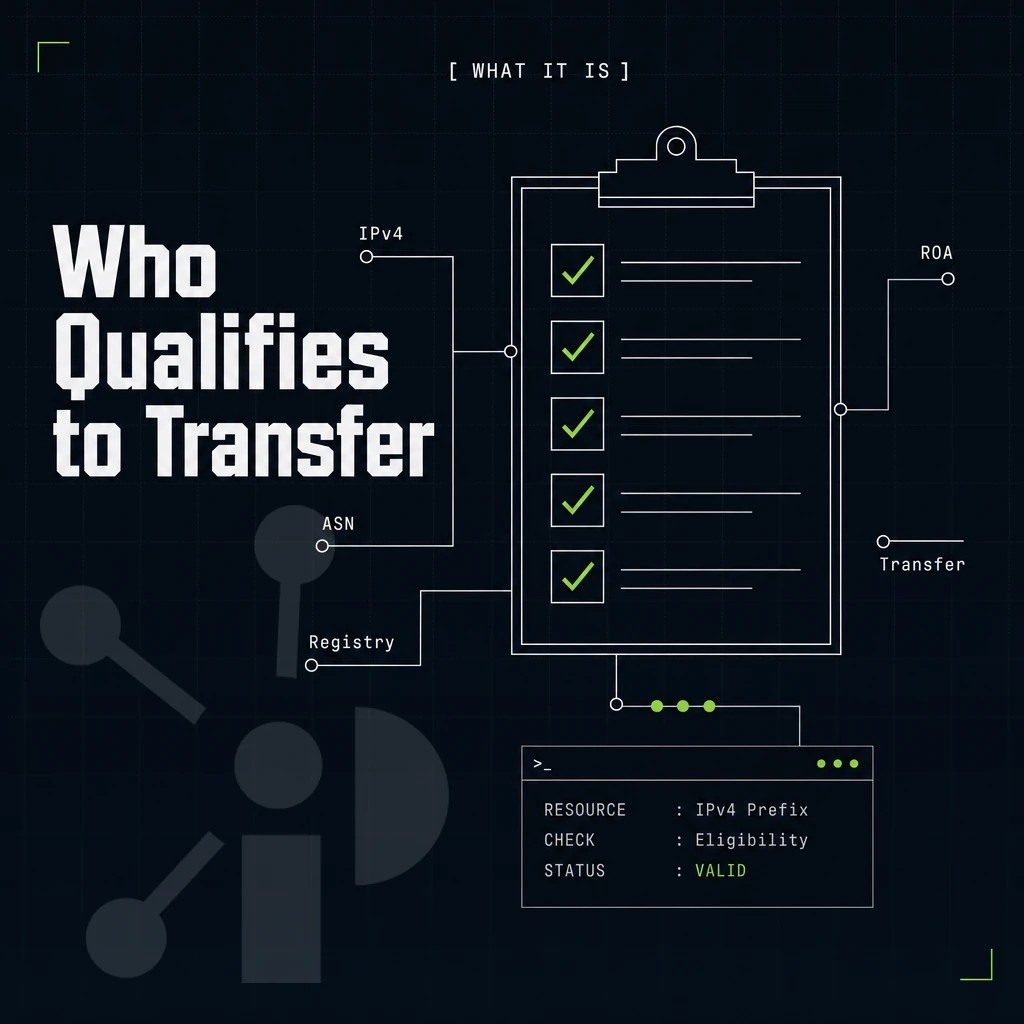
Intra-RIR transfers are transfers of address space between two parties within the same registry service region. Conditions for such transfers between resource holders vary across RIR service regions, and it's best to confirm the eligibility criteria before you start drawing up the necessary documents, as it can save weeks of back-and-forth. Each registry publishes its own set of RIR policies that govern these intra-regional transactions, and staying current with those rules is essential for smooth execution.
Preparation flat fees
Confirm both parties hold a valid organization identifier with the relevant registry. The transferring party must also have annual registration renewal fees paid and no outstanding compliance issues. A lapsed account blocks the transfer at the first review step. The organization identifier must be registered to a legal entity or natural person with verified contact details on file.
ARIN requires the recipient to submit a demonstrated need justification. RIPE NCC does not impose a needs-based requirement on the recipient, but each RIR requires both parties to be current members or sponsored by a sponsoring LIR. The recipient's ability to demonstrate operational need is tied to the size of the allocation being requested.
Documentation
Prepare an asset purchase agreement or equivalent contractual evidence. This proves the commercial basis of the transfer. Where the registry asks for it, attach a technical capability statement showing the recipient can operationally use the space.
Avoid submitting sensitive information beyond the required scope. Detailed information about internal network topology, for example, is rarely needed and can slow review if it raises questions. Registries focus on verifying routing capability and organizational legitimacy rather than requiring detailed network architecture diagrams.
Note: Submitting incomplete documentation is the most common cause of transfer delays. Confirm the exact checklist with the registry before filing.
Which RIR pairs currently support inter RIR transfers
ARIN, RIPE NCC, and APNIC support inter-RIR transfers between each of these RIRs on a bilateral basis. LACNIC inter-RIR transfers are normally negotiated on a case by case basis. AFRINIC does not currently participate in inter-RIR transfers.
Note that the needs based policies for inter-RIR transfers and for intra-RIR transfers are generally different, so what applies to a transfer within an RIR does not necessarily apply to a transfer between RIRs. Organizations planning cross-registry transactions should verify bilateral support arrangements with other RIRs before committing to a deal structure.
Submission via ARIN online
For an ARIN IP address transfer, both the transferor and recipient use ARIN Online, the online member database for the ARIN registry. The Org ID of the recipient must be active and the needs justification uploaded before a transfer ticket can be opened. Prefixx prepares the entire set of files required for a transfer and submits the files on your behalf, including the LOA, RPKI ROA and IRR route objects across the relevant RIR regions.
We cover off where these extra requirements apply and what they mean in practice in the next section.
Inter-rir transfer eligibility: where the rules get stricter
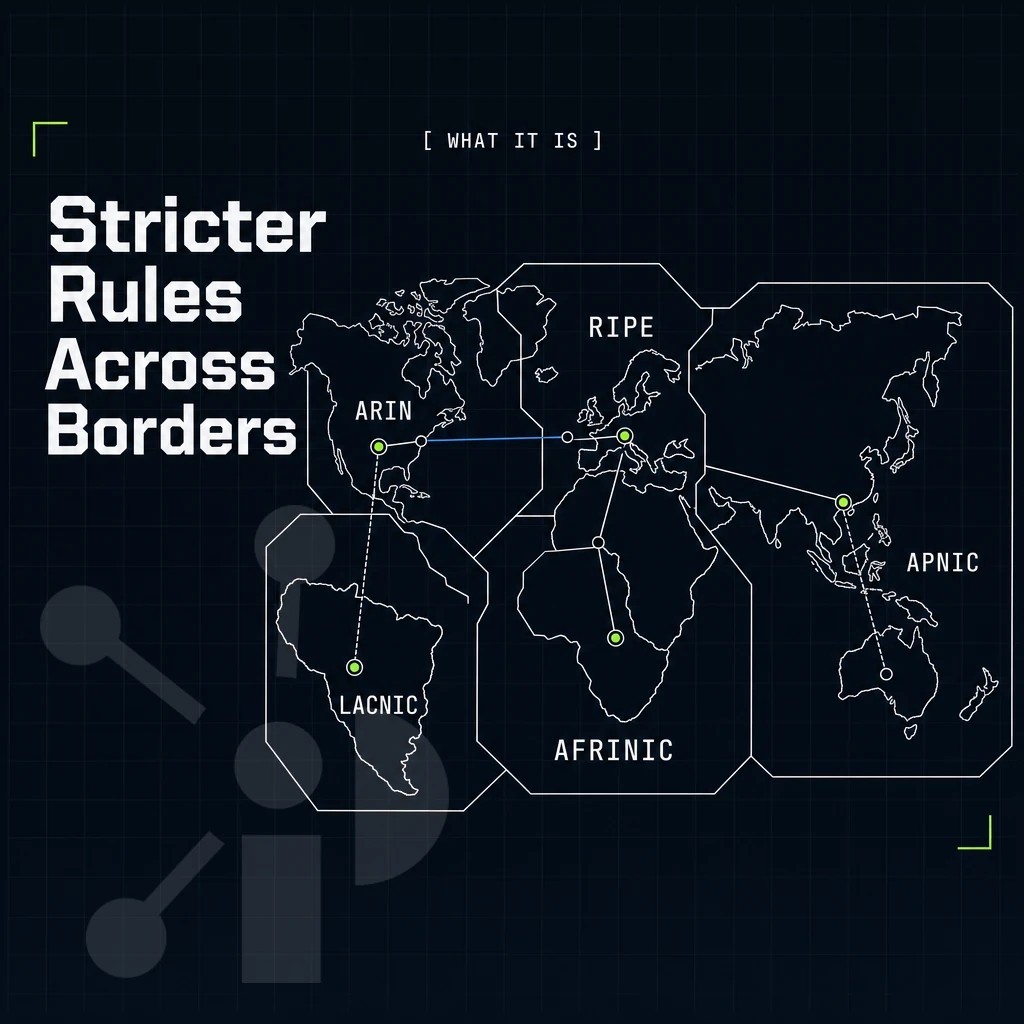
Inter-RIR transfers between two independent registries are typically more complex to complete than a simple transfer between domains hosted on the same registry. This is due in part to the need for both sides to have suitable, reciprocal transfer policies in place prior to submission of a transfer request. Coordination with other RIRs becomes necessary when the source and destination registries maintain different documentation standards or approval timelines.
Which inter-rir corridors are open
There are established corridors of inter-RIR transfers such as ARIN-RIPE NCC, ARIN-APNIC, and RIPE NCC-APNIC. These RIRs have reciprocal agreements that are based on similar eligibility criteria and thus make inter-RIR transfers feasible. LACNIC has some constraints on inter-RIR transfers that are not fully open, whereas AFRINIC’s inter-RIR transfer policy is very limited and on a case by case basis. The complexity of these cross-regional transactions depends significantly on the specific RIRs involved and their respective policy frameworks.
Not all RIR pairs have reached an agreement to allow IP address transfers, for example, the RIPE NCC service region has no cross-transfer agreement with every other RIR, meaning parties who request resources through cross-regional trades remain out of reach to both buyers and sellers alike. Organizations planning transfers involving the ARIN region should verify bilateral agreements early in their planning process to ensure the intended transaction corridor is supported.
How receiving rir's policies govern eligibility
Even when an organization has met all the requirements of the sending registry, including its fee structure, the recipient organization must still fulfill the eligibility requirements of the registry where it seeks registration, making it important not to waste scarce resources by overlooking those criteria. The receiving registry evaluates whether the transferred resources will be properly maintained and routed according to its own operational standards.
Before approving a resource transfer, the RIR where the organization is going to get registered checks if the organization has a justified need for the IP addresses, if it is a member or if it has a contractual relationship with the RIR. Additionally, the RIR also checks if the allocated block size is in line with the RIR's allocation policies. The registry verifies that the requested block does not exceed what the organization can justify under current allocation policy thresholds.
Some receiving registries may also require a signed RSA or LRSA before they add resources to their database.
Legacy status and documentation requirements
The legacy status of a block can impact eligibility at the various registries. At the RIPE NCC, there are various contractual checks that must be met before a block can be transferred. It’s best to verify the legacy status of a block as early as possible to avoid late stage rejection of a transfer.
Policies for legacy resources at RIRs can differ greatly between registries. It’s best to check with both registries before submitting any documentation regarding a block of legacy numbers.
What documentation is required to transfer IP addresses?
The core set of requirements to transfer an IP address block vary from corridor to corridor. Typically, the organization seeking a transfer of a block of IP addresses must provide proof of organizational identity of themselves. They must execute a signed contract with the receiving registry for the block of IP addresses in question. For needs-based registries, a justification of need will also be required. Registries verify that organizations meet these baseline criteria through documentation review and database cross-checks before approving any resource movement.
Note that RPKI ROA updates, IRR route object changes across RIR regions, and a Letter of Authorization are requirements that are handled after a transfer has been approved. However, it is wise to have these ready before you begin the approval process.
As part of our normal process of completing a deal for IPv4 addresses on behalf of our clients, Prefixx will prepare the LOA, RPKI ROAs, and IRR objects necessary for the transaction.
ARIN eligibility rules in detail
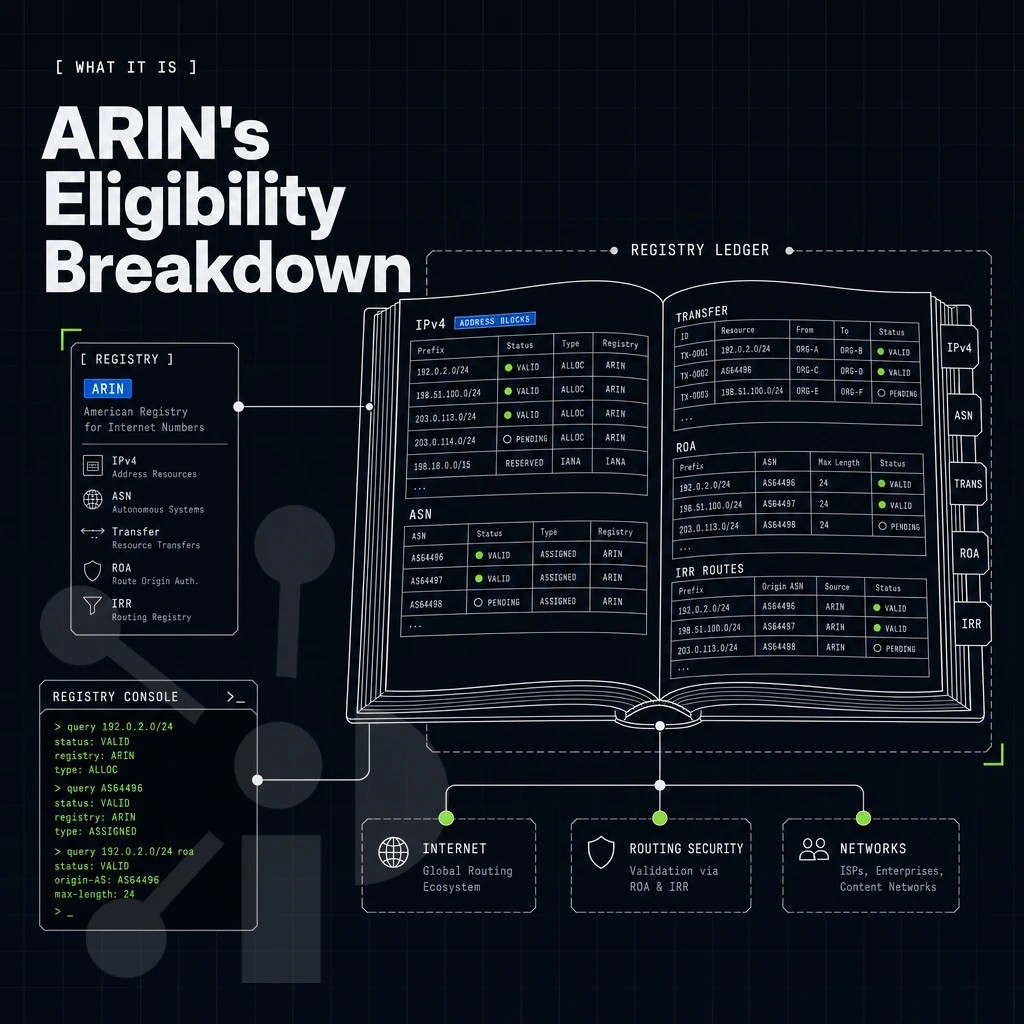
ARIN's transfer rules are among the most documented in the RIR world. Getting this right before you start filling out the online form can save weeks of time. The relevant parts of the policy are 8.3, for (specified) transfers within ARIN, and 8.4, for (specified) transfers to and from outside ARIN.
Core eligibility requirements
The seller and buyer must both have active ARIN online accounts with valid Org IDs. The party transferring the block must be the registered resource holder for that block of IP addresses (no outstanding fees, no liens, no policy violations, etc.).
ARIN applies needs-based allocation policies to recipient organizations. Organizations requesting space must provide sufficient documentation to demonstrate that said space will be brought online within a 24-month time frame. For example, a /22 allocation would require about 1,000 active host(s) in use within that time frame. The documentation requirements ensure that organizations can demonstrate legitimate operational plans for the address space they acquire.
Documentation ARIN typically requires
- Network justification detailing current utilization and projected growth.
- An asset purchase agreement confirming the commercial transaction.
- Documents that verify your organization (e.g. articles of incorporation, government-issued ID for a sole proprietor).
- A completed resource transfer request submitted through the ARIN Online system.
ARIN charges per transfer request (in addition to any normal brokerage commission) for such services and our office will complete all document packages and submit on your behalf.
Can legacy IPv4 internet number resources be transferred between registries?
Legacy resources held by legacy resource holders (at time prior to RIR system implementation) can be transferred from one RIR to another under ARIN 8.4. Our consultants can facilitate the RSA conversion as part of the transfer deal.
RIPE NCC eligibility criteria is different from the above two. Understanding how RIR policies differ across registries helps organizations plan their transfer strategy more effectively.
RIPE NCC service region eligibility rules in detail
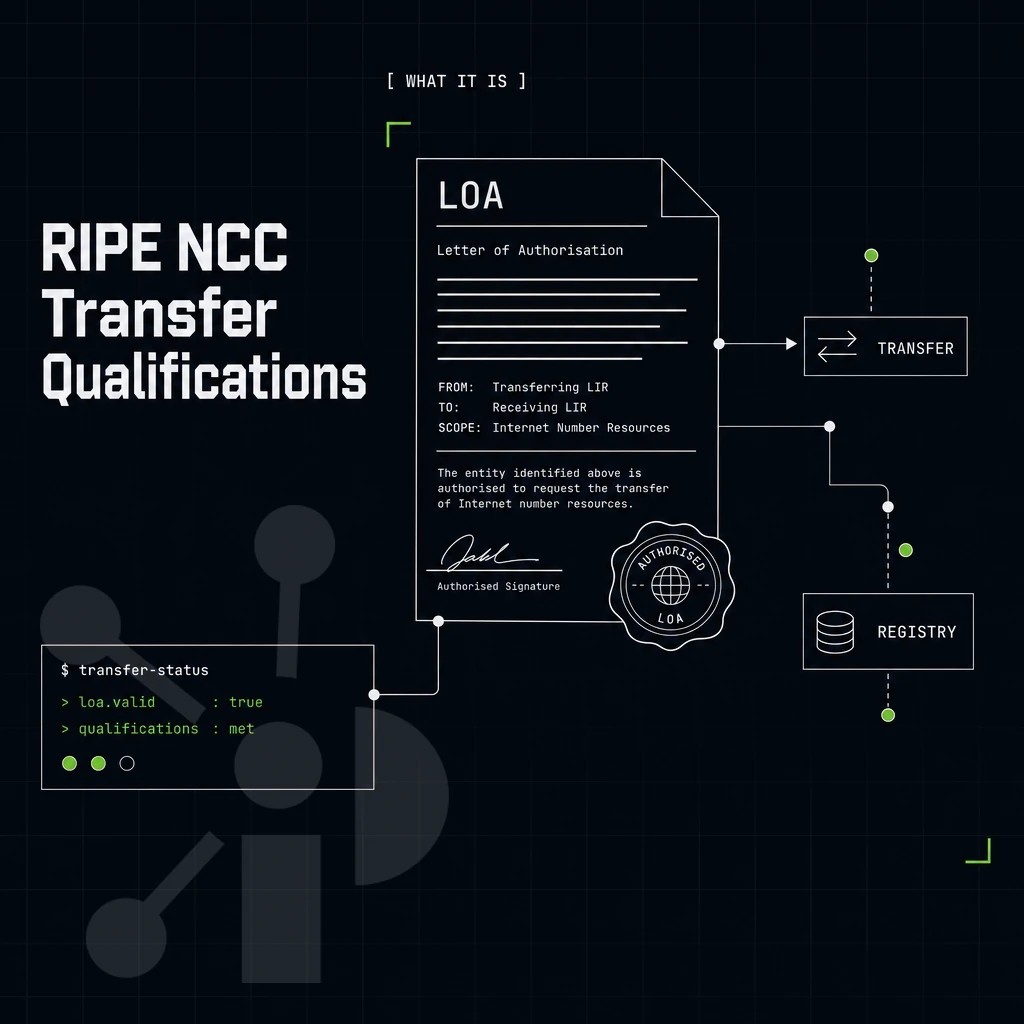
The eligibility for transfer of a RIPE NCC hold to another party is easier than many networks assume. There is no requirement for the receiving party for any needs-based justification, all that matters is that the party is a current member. It The relevant information in the database for that party is up to date, and that the current fees for that party are up to date.
Membership and sponsorship requirements
The buyer and seller in both cases are RIPE NCC members and hold an active LIR account. Both organizations must maintain their membership status throughout the entire transfer process to ensure the transaction can be completed.
The block has to be registered in the RIPE database with current and correct contact information. The RIPE database verifies the ownership of a block before a transfer request can be processed. Additionally, annual fees have to be paid current, otherwise the account will be blocked and no processing can be done.
How RIPE NCC service region pricing compares to ARIN
Whereas RIPE does not require any verification or justification from the buyer for transferred resources, under ARIN policy the receiving party must provide a needs justification that is demonstrated to be sufficient to support the transfer.
The secondary market rates for the RIPE region deviate from those of ARIN for comparable block sizes. The rates depend on the service region as well as the block’s reputation and routing history. Neither registry publishes official market rates for IP numbers. You have to ask for current prices.
What happens to LOA, ROA and IRR records after a block is transferred?
ROAs published by previous resource holders of an AS number for a block of IP addresses become invalid when that block is transferred to a new holder operating under a different AS number. That new holder must then publish his or her own RPKI ROAs for that block of IP addresses under his or her own resource certificate.
Moreover, in intra RIR transfers, IRR route objects that reference the old origin ASN of a holder of a block of IP addresses must be deleted by that holder and replaced by corresponding objects for the new holder of that same block of IP addresses. Otherwise that holder’s block of IP addresses will appear to be published inconsistently by that holder to peers.
LOA’s are deal-specific and do not carry over from one deal to the next.
Note that APNIC, LACNIC, and AFRINIC each have their own requirements on top of those of ARIN and RIPE NCC. These requirements should be understood prior to negotiating a deal that involves their regions.
APNIC, LACNIC and AFRINIC eligibility considerations
Note that the transfer policies of APNIC, LACNIC and AFRINIC differ significantly from those of ARIN and RIPE NCC and thus should be verified with the respective RIRs before submitting a request for transfer. As with other aspects of RIR policy, these policies go through the community process of the respective RIR and thus change on the respective timeline of that RIR.
Understanding eligibility across different RIRs
APNIC will complete a needs-based assessment of the receiving organization prior to approving a transfer. Transfer destination must be a member or sponsored by a member of APNIC. APNIC also supports Inter-RIR transfers with ARIN and the RIPE NCC, making it one of the more easily accessible of the other RIRs for performing inter-RIR IP number transfers.
The process for inter-RIR IP number transfers is treated as facilitated by LACNIC rather than fully reciprocal. To receive IP numbers, the organization must be a LACNIC member and meet the related requirements and justification. In these cases, the transfer process is coordinated by both involved RIRs, which generally takes longer than a transfer between registries of the same RIR.
The inter-RIR transfer policy for AFRINIC is limited. There are some Internet number resource transfers that are not currently supported into or out of the AFRINIC region. You should check the latest published policy on this web site before trying to make any deals that involve other regions.
Why would a transfer request be rejected by a registry?
These rejections have predictable causes, such as failed needs test, missing documentation, or a block with open issues. We have even seen other organizations have their transfers rejected because the resource was not in good standing with the registry that issued the resource.
Policy mismatches across RIR regions are another cause. A transfer structure that satisfies ARIN may not satisfy APNIC's needs-based rules. Note: never assume approval in one region implies approval in another.
Transfer policies to review before submitting a transfer request
- Check if the organization is a member or sponsored. APNIC and LACNIC require this step before proceeding with the request.
- Justify your needs in this document, needs-based registries are not obligated to fulfill needs lacking objective utilization information.
- Check the block status. Tixx by Prefixx checks for ownership, transfer eligibility, blacklists and routing health before any trade is processed.
- Early contact with both registries. Contact with LACNIC in particular in order to warn both parties of the change and avoid any delays in the process.
- Check if the RIR’s policies haven’t changed in the community process and that what is true today isn’t true anymore as of last year.
Despite preparation, transfer requests can fail. This section describes the most common reasons for a transfer request to be rejected and how you can prevent these problems.
Common reasons a transfer request is rejected
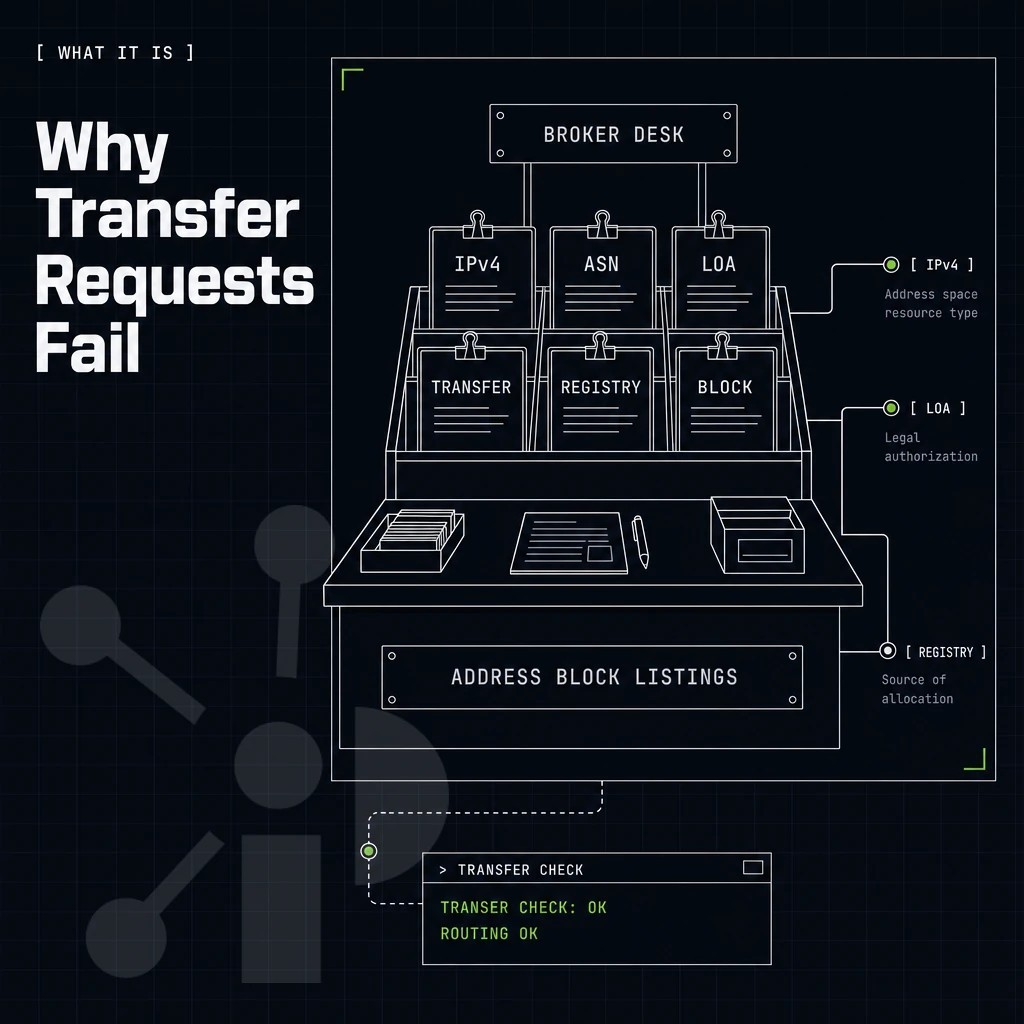
Most resource holders underestimate how frequently transfer requests fail.
Administrative and organizational failures
Money outstanding and a lapsed annual registration for a renewal will stop any transfer out of a registry until the debt is paid. An org ID on the recipient’s side that is inactive or unverified will have the same effect. Also the intended recipient must have active membership at the RIPE NCC or be sponsored by an LIR.
Lack of documentation for asset purchase agreements are another common trigger point.
Needs-based policy failures
This means that for any IP address transfer, the party requesting the transfer must provide sufficient justification for the size of the allocation being requested. Justification that only describes current usage (and no 24-month forecast) will typically be denied.
While templates have in the past been approved for use in justifying IP address transfers, including inter RIR transfers, over time the policies and evidence considered sufficient have evolved, meaning that a template approved two years ago will very likely not be approved today.
Note that ARIN restricts IP number transfers to organizations (i.e. not to individual people acting in that capacity).
Due diligence: routing and dispute holds
Registries mark IP address ranges under dispute or administrative lock.
Tixx by Prefixx performs pre-transfer quality control on your behalf. It confirms the current ownership of the IP addresses you are purchasing, your status with your local RIR, whether you are blacklisted and other basic routing health issues.
Issues like these would get your block rejected mid-transfer if you didn’t know about them beforehand. After confirming your eligibility to purchase the IP addresses and checking the required documentation, the actual transfer is initiated through your ARIN online account and then follows a fixed process.
Transfer policies and the process step by step
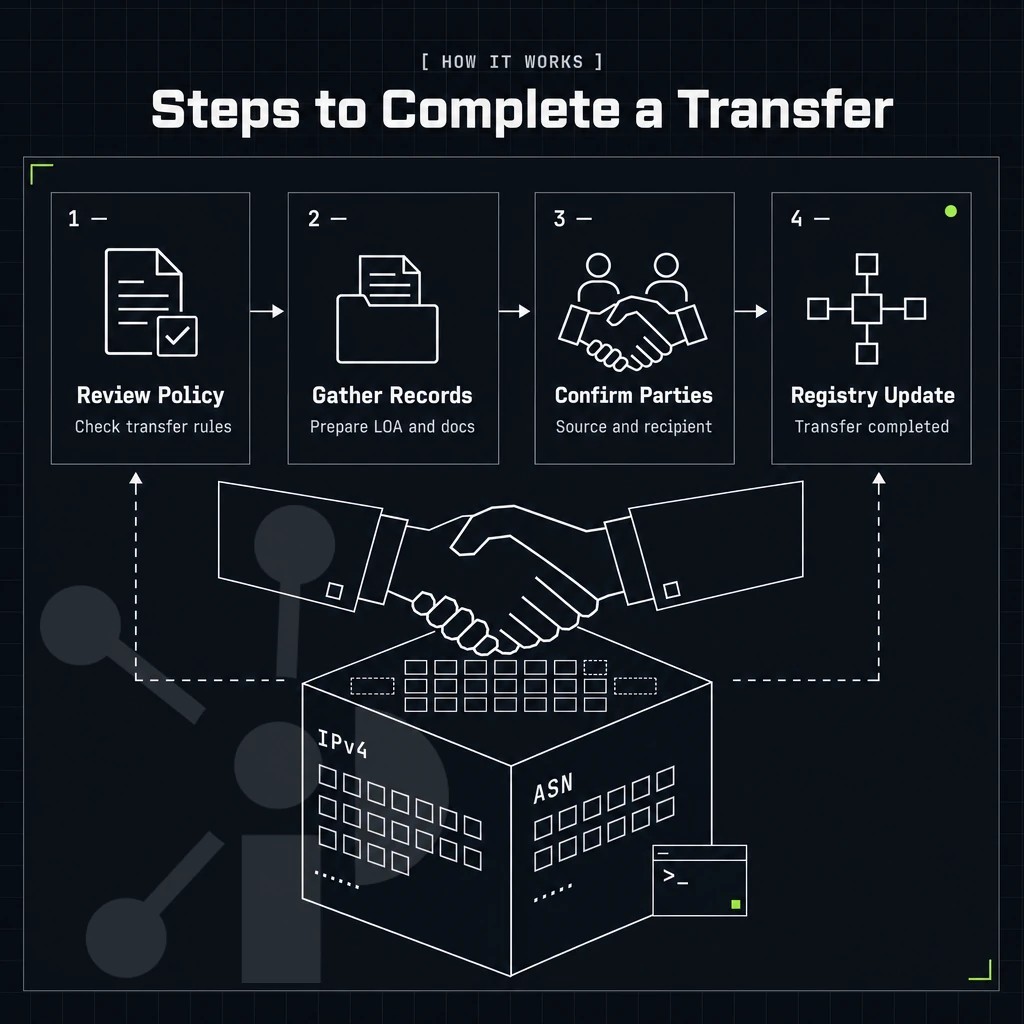
The transfer of any Internet number resource follows a basic sequence of actions that is the same for all registries. This sequence must be adhered to in order to avoid delays, rejected actions, and unnecessary effort spent by organizations in inter RIR coordination efforts.
Eligibility and documentation first
It is necessary to verify both sender’s and receiver’s registry’s transfer procedures before any submissions are made. Resources must be held by the seller in good standing. The buyer must have a valid org ID and account active with the receiving RIR.
Asset transfers typically require a copy of the Asset Purchase Agreement and proof of organizational identity. Registry fees vary by registry and by block size. Ensure all required documentation is in place prior to opening the portal.
Submitting and confirming the request
The transfer of IP addresses is initiated through a transfer request on the portal for the respective IP address registry, such as ARIN Online, the RIPE NCC portal or the APNIC portal. Both parties confirm the transfer request. After verifying the eligibility of the requesting party and reviewing required documentation, the IP addresses are updated in the registry’s database.
An inter-RIR transfer typically means both registries are processing the move. For example, a RIPE-to-ARIN transfer would require parallel approvals from two different registry teams.
Routing records after registration
Routable blocks are not created by Registration alone. After the RIR database has been updated to reflect the new Resource Holder, the corresponding LOA, RPKI ROA and IRR route objects also need to be updated. Our team is creating all necessary documents for inter RIR transfers and setting up the corresponding entries in the networks so that the new ownership becomes effective from the very first day.
Upstreams and filtering systems will very quickly spot a gap for any of these documents not being present after a transfer has completed.
How Prefixx handles RIR transfer eligibility for clients
Prefixx is a registered broker with ARIN, RIPE NCC and APNIC, with LACNIC transfers facilitated. We manage the full eligibility and documentation process on behalf of both buyers and sellers, so neither party has to navigate inter-RIR transfer policy alone.
- Tixx quality control on every block. We verify ownership, transfer eligibility, blacklists and routing quality prior to deal closure. Health report and transfer readiness score provided to buyer.
- We prepare all the necessary white-glove documentation (LOA, RPKI ROA, IRR route objects etc) so you don’t have to run round all the different RIRs.
- End-to-end inter-RIR transfers. We handle transfer requests across ARIN, RIPE NCC, APNIC and LACNIC, including cross-registry moves between RIR service regions.
- Escrow-secured transactions are enforced throughout the trading process. Funds and resources are only moved if both parties to the transaction are satisfied.
- RIPE LIR sponsorship available. Sponsoring of a PI or ASN holder without their own LIR is possible with us in order to remain in the good books of the RIPE NCC.
- No buyer fees, Sellers pay commission 3-8%, No Win No Fee, Buyers pay nothing.
Our senior consultants can explain the eligibility criteria for allocation of IPv4 addresses in different RIR regions and the associated documentation required.
Key points on RIR transfer eligibility
Eligibility for RIR transfer varies significantly from one registry to another and even between different types of transfers. Typically intra-RIR transfers (i.e. transfers that stay within a single registry’s service region) are facilitated on an easier basis than inter-RIR transfers (i.e. those that cross RIR service region boundaries) which are subject to the rules of the receiving RIR as well as those of the transferring party’s registry.
ARIN and APNIC require needs-based justification for the transfer of Internet number resources. In contrast, RIPE NCC does not require such justification. For any transfer, both the source and destination organizations must have a valid Organization Identifier (e.g. a company name), no outstanding fees, and provide documentation with respect to an transfer agreement among other things.
Note that mere transfer of Internet number resources does not affect routing in the Internet. After update of registration data in the RIPE database or in ARIN Online account resources are transferred to new holder. He must then update LOA, RPKI ROA and IRR route objects for the transferred resources. Otherwise they will not be seen or will be considered as invalid on the Internet.
RIR portability eligibility is not defined by a single rulebook and can vary from Registry to Registry including required documentation, timeframes and justified need. Inter-RIR transfers also typically require the existence of specific bilateral agreements between the Registries involved that can prohibit a transfer in certain circumstances. Getting the initial paperwork correct prior to approaching a counterpart to agree a transfer can save weeks.
The two critical factors that determine whether or not a transfer will clear are (1) the organizational standing of the parties with their respective RIR or other regional internet registry and (2) the quality of the address block in question. A block with bad routing hygiene, disputed ownership, or recent transfer lock(s) will fail eligibility checks regardless of fee models or how motivated the buyer and seller are to make the transfer happen.
If you are preparing to buy, sell, or move address space across registries, Prefixx runs Tixx quality control on every block and handles the full transfer paperwork across ARIN, RIPE NCC, and APNIC. Start with an eligibility review at Prefixx.net.
Contact us to discuss your IPv4 needs today
No hidden fees, free consult. A broker replies within one business day.