
By Savvas Bout, Founder of Prefixx. Last updated 23 September 2026.
Every APNIC-allocated IPv4 /8 block ever assigned by IANA to the Asia-Pacific region has a unique history to it. The way the Internet’s address space was allocated and assigned before the free pool of addresses ran out is still very relevant today to the networking community in the region. People searching for a clean, large.
Additionally, Routable IPv4 block are interested to know the original IANA allocation history of the assigned APNIC block in order to find out whether a particular address range is legacy. Assigned directly by APNIC or has changed hands via. secondary market transfers in the past.
The history of an IPv4 address block even influences the type of transfer that can be done today, how long the process will take, and which global policy rules apply. Transfer applicants typically need to provide historical allocation records and supporting documents to verify the provenance of the address block.
In this guide, we map out the /8 blocks allocated by APNIC and distinguish IANA-reserved ranges from APNIC-managed IP address space. For each block, we explain the RIPE NCC status of the ranges and what it means for you when acquiring an IP address.
We outline how the size of the block, the history of registration, and the RIR’s standing affect your routing stability and ability to transfer IP addresses. Finally, we explain the role of a broker in acquiring a specific prefix of IP addresses for use in the Asia-Pacific region.
As well as for bringing your own IP addresses to cloud platforms and deploying your own IP routing. Brokers also assist with the technical development required to integrate acquired prefixes into existing network architectures and routing configurations.
What IANA /8 address blocks are and why they matter
A /8 block contains 16,777,216 IP addresses. This is the reason IANA allocates IP address space to regional bodies and not to end users. In order to understand how APNIC received its IP address space, one needs to understand how IP address space is allocated in the hierarchical structure of IP address space allocation. IANA serves as the central authority coordinating these allocations under policies developed through ICANN's multi-stakeholder processes.
What is IANA and what role does it play in IPv4 address allocation?
The Internet Assigned Numbers Authority (IANA) is at the top of the IPv4 address space hierarchy. It coordinates the total global pool of IPv4 address space, distributing /8s to the five RIRs. It does not assign IP addresses to individual networks or companies. Through this coordinated approach, IANA ensures that address space is distributed equitably across regions serving the entire connected world.
Each RIR then delegates portions of its allocated IP address space to the internet number resources managed by national internet registries, Internet Service Providers (ISPs) and enterprises within their respective regions. The way the global internet numbering system is managed, structured and audited is kept consistent at the top of the root of the system. This hierarchical model ensures that allocated address space remains traceable from the RIR level down through each subsequent delegation to end users.
How the /8 block size shapes IPv4 address space
A /8 is the first octet of an IPv4 address space. Historically, IANA allocated large /8 blocks to the regional registries. For example, APNIC initially received a number of /8 blocks including 111.0.0.0/8 and 112.0.0.0/8 as Asia’s address space demand increased in the 2000s. This allocation model serves as a clear example of how IANA distributed address space to meet regional demand during the era of abundant IPv4 availability.
When IANA used up its last free block of address space in 2011, there was no more unused address space at the top level of the Internet. All currently allocated address space was allocated in earlier IANA allocations.
Why future use matters for buyers and sellers
Knowing the registry lineage of a block of IP addresses enables us to know transfer restrictions, pricing and even routing reputation. A block of IP addresses allocated under APNIC is transfer subject to the rules of APNIC for transfers, regardless how many previous owners there have been. We can thereby trace back the original IANA allocation to determine how the IANA space was distributed amongst the five regional registries.
How the internet assigned numbers authority distributed /8 blocks to RIRs
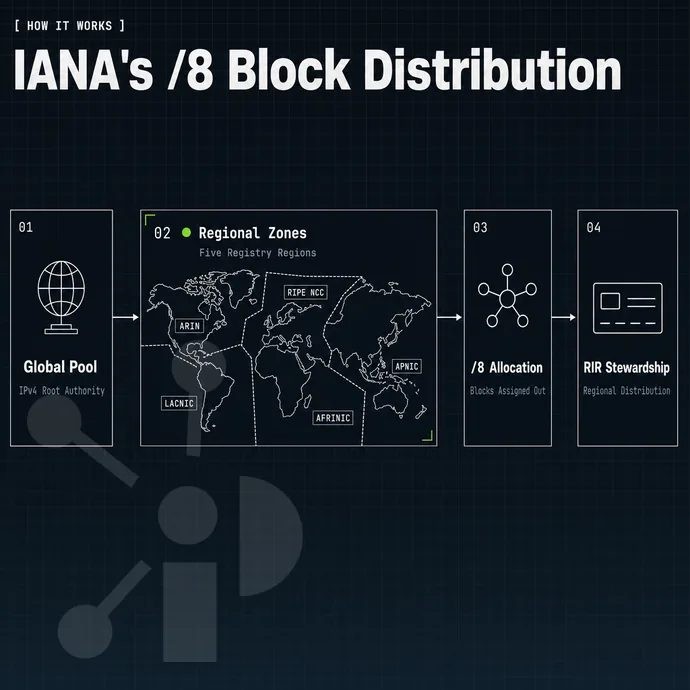
Historically, IANA has managed to serve as the root authority for IPv4 addresses. Under the overall umbrella of global policies established by ICANN, IANA allocated the IPv4 address space in /8 blocks, holding approximately 16.7M addresses per /8, to the 5 Regional Internet Registries. The RIRs then in turn allocated IP address space to their respective member networks. This hierarchical structure of address allocation reflects the broader governance framework that coordinates Internet number resource distribution worldwide.
How the RIPE NCC demand-driven model worked
Regional Internet Registries (RIRs) used to request IANA for additional /8s as their local needs increased. IANA reviewed such requests against published criteria and, where appropriate, allocated /8s from the central pool of reserved IP addresses. This process funded the growth of the Internet for many years. The allocation framework supported the development of regional Internet infrastructure as demand expanded across different geographic areas.
The five RIRs, their regions, and the global pool
| RIR | Region | Final /8 status |
|---|---|---|
| ARIN | North America | Received one of the last five /8s in February 2011 |
| RIPE NCC | Europe, Middle East, Central Asia | Received one of the last five /8s in February 2011 |
| APNIC | Asia-Pacific | Received one of the last five /8s in February 2011 |
| LACNIC | Latin America | Received one of the last five /8s in February 2011 |
| AFRINIC | Africa | Received one of the last five /8s in February 2011 |
How many /8 blocks did APNIC receive from IANA?
APNIC was allocated the largest amount of historical information on record, with over 40 /8 blocks allocated throughout the distribution period. In February 2011, the final five /8 blocks were allocated by IANA to each of the RIRS simultaneously bringing the global free pool to a close for good. The distribution of these final blocks occurred in early April, marking a pivotal transition in how organizations would obtain address space going forward.
This event is the key date for anyone looking to buy more IPv4 addresses in the future. As all new IPv4 address space is released on the secondary transfer market, Prefixx provides a service to source the best blocks of vetted IPv4 addresses in all five RIR regions. Organizations seeking to expand their address holdings can leverage broker expertise to identify available resources that meet their technical and geographic requirements.
Prefixx completes all of the paperwork involved with the transfer of IPv4 address space and the blocks of IP addresses are also tested on the Tixx test server before they are sold on to buyers. The following sections describe how the /8 ranges of IPv4 address space were distributed by APNIC. The transfer process follows established procedures to ensure compliance with regional policies and registry requirements.
Apnic's specific /8 allocations IANA distributed
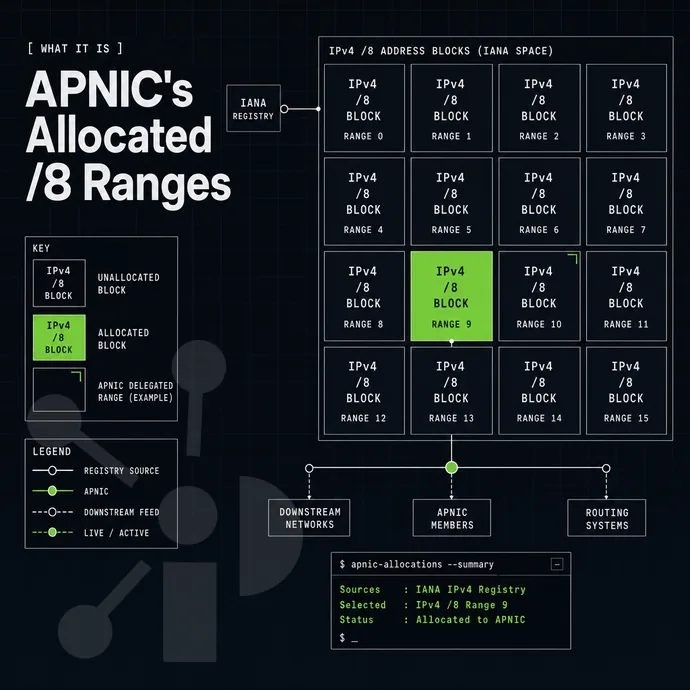
The space was originally distributed by IANA in large /8 blocks to the5 regional registries over several decades. A great deal of the Asia Pacific space is held by APNIC in the region’s routing tables.
Therefore it’s extremely important for companies to check out the ranges of IP addresses that have been allocated by each of the regional registries before buying or renting out any IP addresses. Understanding which address blocks fall under APNIC's jurisdiction helps organizations verify routing legitimacy and assess transfer eligibility for their planned acquisitions.
APNIC allocated IPv4 /8 blocks: IANA delegation history
The following IP address ranges were formally delegated to APNIC for assignment within the Asia-Pacific region. These APNIC allocated IPv4 8 blocks IANA ranges are: 1.0.0.0/8, 14.0.0.0/8, 27.0.0.0/8, 36.0.0.0/8, 39.0.0.0/8, 42.0.0.0/8, 43.0.0.0/8, 49.0.0.0/8, 58.0.0.0/8, 61.0.0.0/8, 101.0.0.0/8, 103.0.0.0/8, 106.0.0.0/8, 110.0.0.0/8, 126.0.0.0/8. Several of these ranges were IANA-reserved before being delegated to APNIC. Each range was formally designated through IANA's allocation process to serve the growing connectivity needs of the Asia-Pacific region.
In addition, APNIC was allocated the 43.0.0.0/8 block from the IANA recovered pool. These recovered-pool blocks are transferred and subject to same rules and policies as the originally allocated space of that size and scope. ICANN oversees the coordination of these recovered-pool allocations through its role in managing the global domain name system and unique identifier assignments.
Note: Not every address within these ranges is freely transferable. Some sub-blocks carry historical assignment records or legacy status that affects transfer eligibility. Always run a Tixx check before proceeding.What is apnic's final /8 global policy?
When APNIC’s free pool dropped to a single /8 block of address space, the community adopted prop-088, which reserves 103.0.0.0/8 as the final /8 block of APNIC address space. Members that meet the criteria of this policy are able to receive a single /22 block of space from this reserved pool. Regardless of the size of the organization or the amount of address space that the organization already holds. Organizations that satisfy the policy requirements are considered eligible to request this allocation.
- Verify applicant meets Membership criteria and has not previously been allocated a final /8 block of IP space.
- The resource request is submitted through the APNIC Online portal. The request is verified against the rules in prop-088 for APNIC’s eligibility criteria.
- Allocate single /22 from 103.0.0.0/8. No further space will be allocated from this pool to the single entity allocated here.
By slowly depleting the address space, and keeping small players in the region connected, the APNIC reserved address space of 103.0.0.0/8 is tightly controlled and rarely transfers on the secondary market. Note though that not all reserved address space is treated this way, there is a separate class of reserved address space that is prohibited from transfer via IETF standards, not APNIC policy. Organizations that receive allocations from this pool must demonstrate they will operate networks serving end users in the Asia-Pacific region.
IANA special purpose address blocks and reserved registry
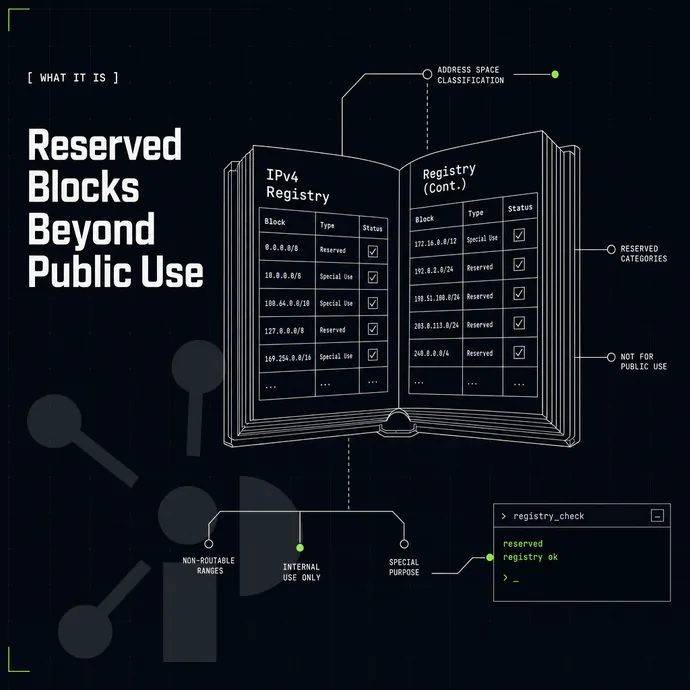
Many /8 blocks were not allocated by the RIRs to registries or users. Instead, IANA held them out of the regular IPv4 space, allocating them according to a set of rules specified in a number of IETF RFCs. These /8s have never been on the transfer market and are not part of any registry’s allocation space. The specific allocation rules and restrictions for these blocks are detailed in the relevant IETF standards documents.
What are the reserved IP address prefixes in the IANA address space?
These special addresses are defined in the special purpose address registry maintained by IANA. The table below shows some of the most important of these address assignments managed by registries. The registry distinguishes between special-purpose assignments and standard allocations to ensure proper routing treatment across networks.
| Block | Purpose | Defining RFC |
|---|---|---|
| 0.0.0.0/8 | Self identification (this network) | RFC 1122 |
| 10.0.0.0/8 | Private use | RFC 1918 |
| 127.0.0.0/8 | Loopback | RFC 1122 |
| 172.16.0.0/12 | Private (enterprise NAT) | RFC 1918 |
| 192.168.0.0/16 | Private (home/SMB NAT) | RFC 1918 |
| 224.0.0.0/4 | Multicast | RFC 5771 |
| 240.0.0.0/4 | Reserved for future use | RFC 1112 |
| 255.255.255.255/32 | Limited broadcast destination address | RFC 919 |
Why these ranges never reach the transfer market
These are not expired / recovered allocations. They are defined in IETF standards and cannot be transferred / sold / leased. No RIR can allocate these. These blocks remain permanently reserved for special protocol functions and no registry may operate them as general-use address space.
Two large address blocks at the top of the address space are 224.0.0.0/4 and 240.0.0.0/4. Together they use up 1/8th of the entire IPv4 address space. The future use of 240.0.0.0/4 has not been fulfilled in practical terms for decades.
Regional internet registries and their operational impact on available supply
These reserved ranges are excluded from the counts of usable IPv4 addresses by analysts. Thus the real pool of usable addresses is reduced even further by the range of all addresses actually for sale on the secondary market, outside of these ranges of reserved addresses.
The constrained supply of IP addresses and the free pool hitting the floor of APNIC are issues that cannot be understood in separate terms. Organizations seeking to expand their networks must carefully evaluate available resources on the transfer market to meet their addressing needs.
Apnic's final /8 policy and what happens after exhaustion
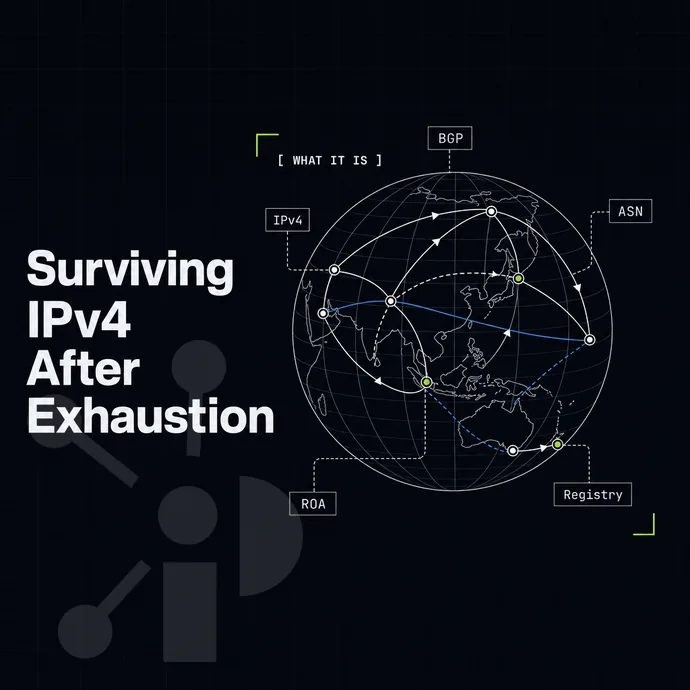
The regional internet community in the Asia-Pacific region adopted to the APNIC free pool shrinking down to a single /8 block. The new distribution model for IPv4 addresses has had a permanent impact on the way addresses are flowing in the region and it has greatly changed the world of IPv4 supply. Today most IPv4 address acquisitions and assignments take place on the secondary market. The implementation of this new distribution model required significant policy adjustments across the region's network operators and service providers.
How prop-088 changed address blocks distribution
The proposal, prop-088, stated that once APNIC had only one /8 left for distribution, each APNIC member, new or existing. Would receive a /22 of 1024 IP addresses regardless of their prior use of IP addresses or current needs. This policy was implemented to ensure equitable distribution of the remaining address space among all members.
Addresses that are subsequently recovered by APNIC whether voluntarily returned, recovered due to policy violations or allocated from the IANA recovered pool. Will be allocated from the final /8 pool of address space currently available under current APNIC policy. Previously, APNIC recovered space was allocated in somewhat larger blocks of address space under previous versions of the APNIC Address Policy.
A key point agreed during community discussion of the proposal process was that no organization gets a second bite of the free-pool. Once an organization has been allocated one of these large blocks like a /22, they are ineligible for further allocations from the free-pool. The community-driven proposal mechanism ensures that allocation policies reflect the operational needs of network operators across the region.
What happened when IANA ran out of /8 blocks to distribute?
In February 2011, IANA assigned the last five /8 IP address space blocks to the five RIRs. After that date, there was no more global IP address space assigned, and RIRs could only distribute the IP address space they already had managed, plus any additional IP address space that later was assigned to them by IANA. By April 2011, the regional registries began implementing their own exhaustion policies to manage the remaining address space they had received.
APNIC depleted its general pool in April 2011. Since then, the secondary transfer market has become the primary means for organizations requiring more than a /22.
Address blocks and the fragmented routing swamp
With smaller allocations, there are more IP addresses and prefixes in the global routing table. More and more /24 announcements arrive with addresses that were part of a /22 allocation in the past. And most of these announcements come from organizations that where allocated a /22 in the first place but where split up in even smaller subnets.
This is called the address swamp: more routes, using up more space in smaller blocks, more table overhead. This fragmentation places additional strain on global routing infrastructure as routers must process and store an ever-growing number of more-specific prefixes.
- The routing tables now include more specific prefixes than ever before.
- Smaller shares trade at a premium on the transfer market.
- Transferred IP addresses carry full ownership, whereas a /22 from the free pool does not.
For Prefixx we have thoroughly checked all APNIC addresses across spaces of all sizes. We deal with all the paperwork needed for a transfer and set up RPKI ROA s and IRR-objects for you. This full support for the proposal will be explained in more detail in the following section.
Why Prefixx for APNIC region transfers and IPv4 transactions
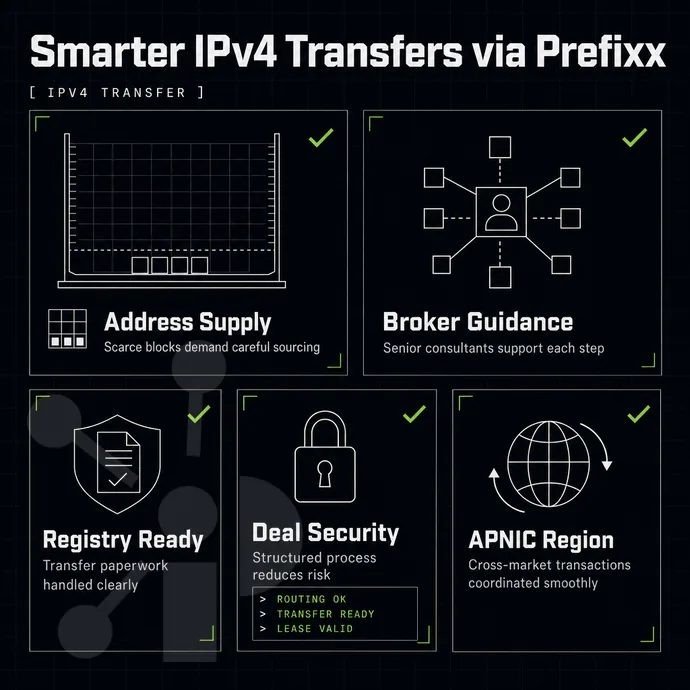
Prefixx is a registered broker with ARIN, RIPE NCC, and APNIC. Our senior consultants specialize in helping clients buy and sell IPv4 address space in all five regional Internet registries (RIRs). This includes inter-RIR trades of APNIC allocated IPv4 address space, that will be moved between regions as part of the transaction. All transaction assignments across registries are human-in-the-loop from sourcing to close of deal.
- Zero buyer fees. Seller(s) pay a 3% to 8% commission on their sale. The buyer of IPv4 space pays nothing as all listings are 100% vetted.
- We at Tixx do a quality check on every block of IP addresses before we allow them to be sold to customers. This includes verification of the owner, blacklist check, routing check and check of the RIR where the IP addresses are registered.
- Escrow-secured transactions. All funds and IP addresses are transferred at the same time to ensure both parties are protected.
- We can prepare the LOA, RPKI ROA, and IRR route objects for you as part of our white-glove routing service.
- Inter-RIR transfer support. We facilitate the transfer of IP address space between customers in different RIRs (ARIN, RIPE NCC, APNIC, LACNIC).
If your organization is acquiring or divesting IPv4 address space in the APNIC region or across registries, explore our transfer services or contact our team to discuss your requirements.
Note that every /8 APNIC received from IANA has been fully allocated. The free pool of IPv4 addresses has been closed and the final /8 policy only allows new entrants to IANA IPv4 addresses to receive a single /22 block of IPv4 addresses. After that, all additional IPv4 space in the Asia-Pacific region must be obtained through the secondary transfer market.
Knowing which /8 blocks APNIC allocated is important. This is because the RIR of origin of a /8 block of addresses affects current policy issues such as transfer eligibility. IP address holder’s IP address space’s IP routing reputation and required paperwork to transfer IP address space between registries.
If you need to acquire APNIC-region addresses, or if you hold legacy space and want to understand your transfer options, Prefixx handles the full process: Tixx quality checks on every block, escrow-secured settlement, and white-glove preparation of your LOA, RPKI ROA, and IRR route objects. Start an inquiry at Prefixx.net and reach a consensus on your personalized proposal within 72 hours.
Contact us to discuss your IPv4 needs today
No hidden fees, free consult. A broker replies within one business day.