
By Savvas Bout, Founder of Prefixx. Last updated 23 October 2026.
Every address block on the IPv4 exchange has an owner, a price history and a reputation score. This makes it very difficult for network engineers and infrastructure leads to operate in the IPv4 marketplace. The information that is available (i.e. registry transfer records) is opaque. Network engineers must therefore rely on incomplete data when making purchasing decisions.
The price of an IPv4 address block can vary greatly depending on the RIR region, the network size of the block, and where it is located. Furthermore, a block that looks very good on paper can in reality connect with a lot of blacklist baggage. Buyers who understand these variables can better evaluate whether a given block represents a sound investment opportunity. Scarcity continues to shape pricing dynamics as global demand for address space remains strong across all registry regions.
Deals go wrong when there is a gap between what buyers need to know about a secondary trading world transaction and what the secondary exchange makes visible. This article describes the secondary address exchange for IPv4 , outlines the reasons for differences in price per IPv4 address for ARIN, RIPE NCC and APNIC regions, discusses factors to consider when purchasing a block of IPv4 before committing to a transfer.
Understanding how registry policies change over time helps purchasers anticipate which blocks will remain compliant with evolving technical requirements. Registry policies themselves evolve in response to technical developments and community needs, requiring purchasers to stay informed about policy changes that may affect block usability.
Additionally, Compares buying versus leasing a block of IPv4 addresses. The article concludes with descriptions of quality control and how escrow, alongside transparent pricing, account for what is meant by a well-run transaction. The choice between purchase and lease depends on whether the acquiring party requires permanent ownership or temporary access to address space.
What the IPv4 addresses market is and why it exists
All existing IPv4 addresses have been assigned. Today’s secondary market for IPv4 addresses is fueled by all the allocated address space that the registries are out of. To get new address space, one must enter the transfer IPv4 exchange.
What does IPv4 addresses stand for?
IPv4 (Internet Protocol version 4) is used for identification of devices connected to networks by means of 32-bit IP addresses. The 32 bits of IP addresses can serve a maximum of 4.3 billion IPv4 addresses. Although this seemed like an awfully large number in 1981, when IPv4 addresses were first distributed, it has now run out! For more context, see IPv4 address exhaustion.
How regional internet registries exhausted the free pools
Between 2011 and 2020, IANA distributed the entire IPv4 address space to the five regional internet registries (RIRs), which then exhausted their free pools one by one.
How to buy IP addresses in large blocks
When organizations need to buy IP addresses, they must purchase them from existing holders on the secondary transfer exchange. This process involves a number of steps including ownership verification, pricing and RIR transfer filings, and routing configuration. Organizations looking to expand their network infrastructure rely on this secondary transfer process to acquire the address space they need.
We can handle all of this for you, and have done so for many organizations. In order to advise on the cost of IP address space and explain the large variations in price between regions and for different block sizes, we first need to understand that space in detail. Understanding the technical and administrative details of each block ensures accurate pricing and smooth transfer execution.
What drives IPv4 addresses pricing today
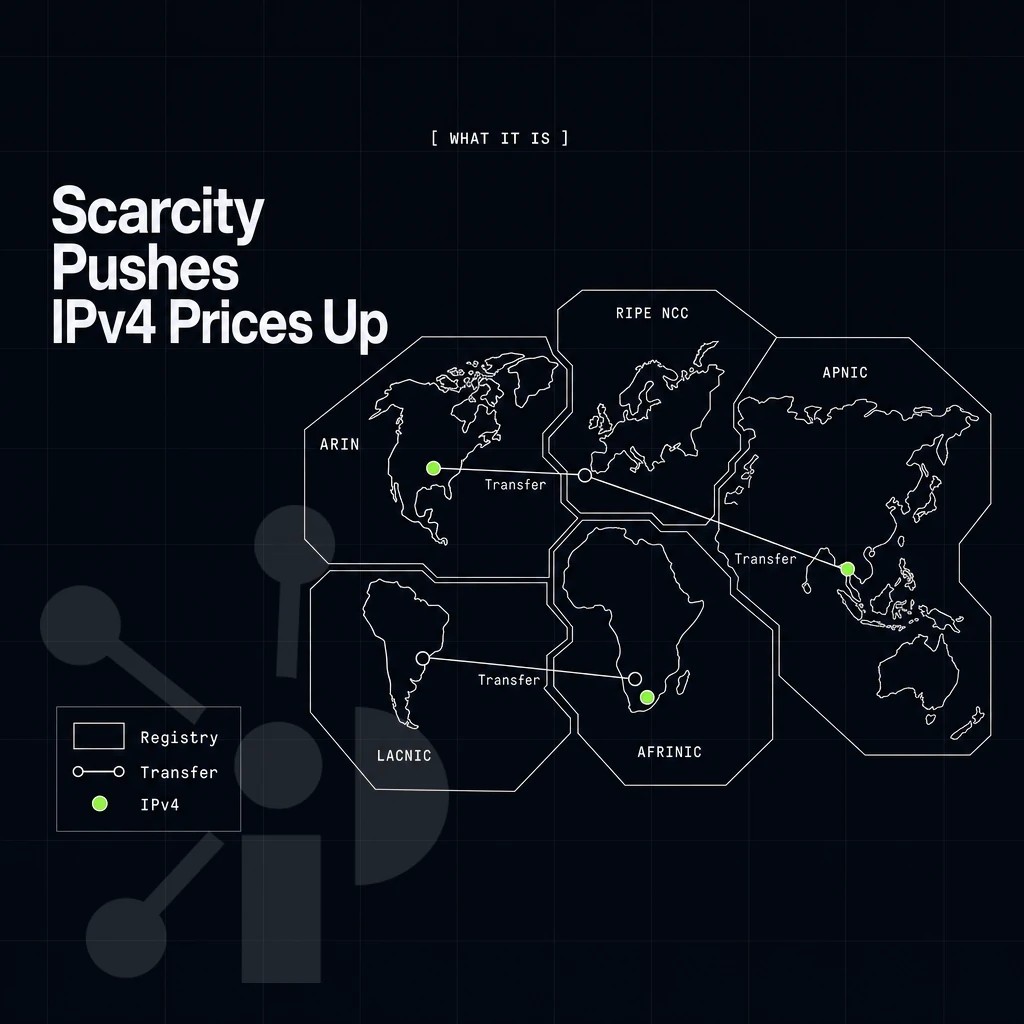
Pricing IPv4 addresses on the resale platform has no official index. All supply of IPv4 addresses has been allocated out by the registries. The price that organizations pay for IPv4 addresses to resell on the transfer platform today can vary based on a number of variables, which in turn can compound on each other. In order to try to avoid paying too much for an IPv4 property, and to avoid purchasing it too early, one needs to try to understand these industry variables.
Organizations that have decided to acquire addresses must weigh these variables carefully to determine the right timing and approach for their specific requirements. Pricing reflects the scarcity of available address space and the varying levels of demand across different network sizes and geographic regions. As demand patterns and registry policies continue to evolve, pricing mechanisms adapt to reflect changing market conditions and availability constraints.
Core pricing variables that make calculations time consuming
- Region: Prices for registered blocks of IP addresses can vary depending on the Region where they are registered (ARIN, RIPE NCC, APNIC) and even trade at different rates within the same month. There is no official rate for any of these Regions. Price is determined by where buyers need their IP addresses to be routed, not where the registry is located.
- Block size. Because smaller prefixes carry a higher per-address premium, a /24 for example will typically cost more per IP than a /20 in the same region.
- Reputation and routing hygiene. A clean block of IP addresses with no history of being on a blacklist and valid RPKI validation commands a stronger price than a block with abuse history or a hijack record.
- The main factor to consider when transferring a block of IP addresses is transfer eligibility. The constraints of RIR policy, legacy resource status and current RSA standing all determine whether a block can be transferred and how quickly this can happen. Restricted eligibility for otherwise suitable space prevents it from being assigned.
Timing and opacity in strong relationships
- brokerage marketplace cycles influence price, since Technology spending in general is shifting. Companies are buying up infrastructure in anticipation of the next growth phase, thus driving up prices on said infrastructure. Meanwhile, distressed sellers are driving down the prices of their underperforming assets.
- Structural opacity. Since there is no public price feed for the transfer address brokerage, the prices are negotiated on the basis of comparable recent transactions. This was a design choice for the transfer IP brokerage, not a gap to fill.
Note: Skipping a reputation check before agreeing a price is the most common mistake. A block that looks correctly sized and regionally right can still carry hidden blacklist entries that require remediation time and cost after transfer.
Those risks connect directly to how every well-run transaction should be structured, from pricing to final terms, which is what the next section covers. Discovering reputation issues late in the process can force renegotiation or even cause the deal to collapse, so early verification helps both parties adjust expectations and avoid last-minute surprises that change the transaction's economics.
Buying, selling and leasing: how transactions work
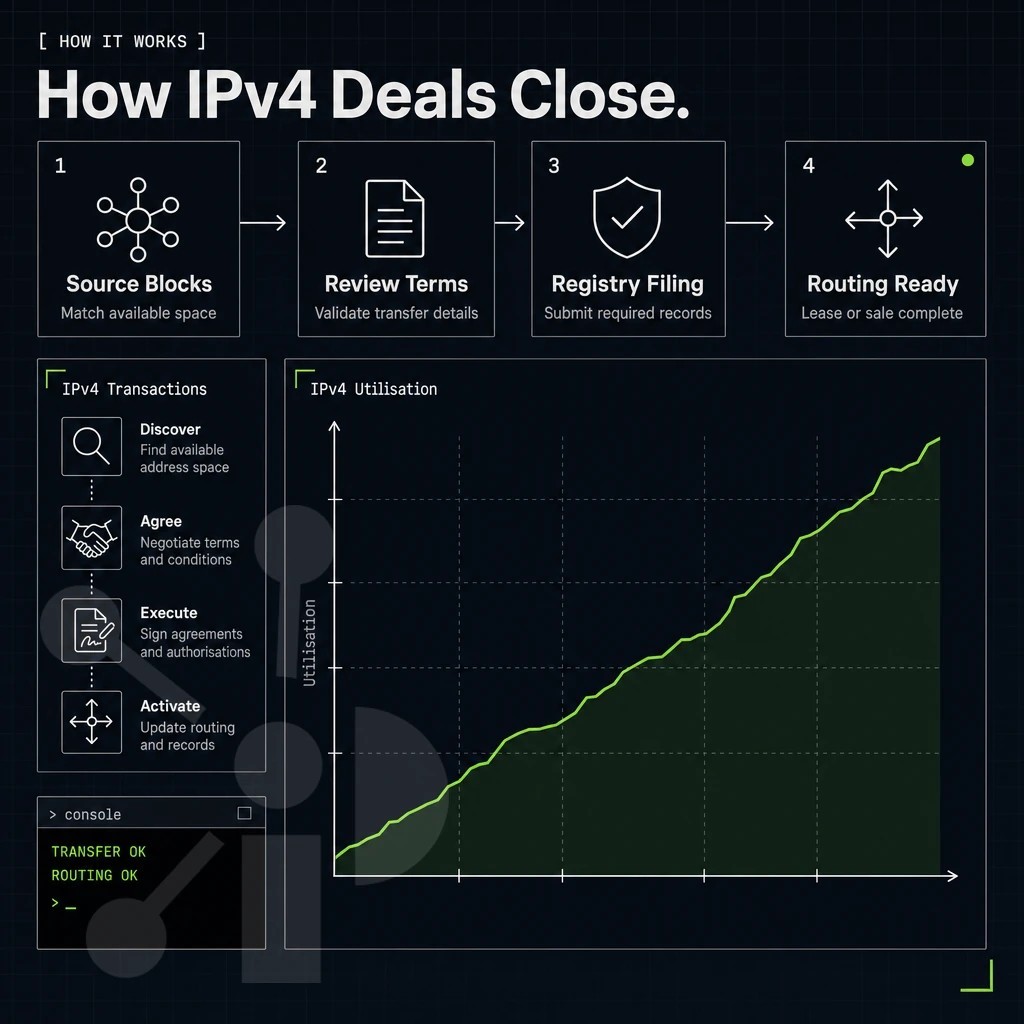
The trading ecosystem for IPv4 addresses is primarily conducted by means of three transactions. Each of these is established by law and outlines the rules placed upon each party throughout the span of a purchase or sale agreement. The trading ecosystem operates within a framework that governs how parties engage across different jurisdictions and registry policies around the world.
How many IPv4 addresses are left in small blocks
There are 4.3 billion IPv4 addresses and all of them are assigned. The five RIRs have long since exhausted their free pools of IPv4 addresses. Today, all available IPv4 address blocks are offered for sale on the secondary transfer address ecosystem.
Thus, significant due diligence on the part of the buyer is required to verify the seller's ownership of the IP addresses as well as proper routing. Buyers must verify that the addresses they acquire are genuine resources held under the seller's registry account and free of encumbrances.
Buying and leasing: what changes hands
Buying transfers ownership of the transfer permanently. Once the transaction is complete (approval by the RIR, update of the registry), businesses that receive the addresses bear sole responsibility for the receiving network. Leasing on the other hand grants only temporary use rights. Once a lease is established, the lessee can connect to the network using an LOA, RPKI ROA, as well as an IRR route object. For companies, the non-revocation guarantee and the necessary provisioning to connect your service are both assured within 24 hours.
Routing large blocks through the transfer process
We do deals at Prefixx by starting with an inquiry and then offering a personalized deal for 72 hours that is valid for the specific block size and RIR region(s) needed. There is no public marketplace with listed prices for deals at Prefixx. Each inquiry receives a response within one business day, and most deals close within a month once both parties agree to terms.
Tixx quality control is performed on every block before it is distributed to companies' RIRs. A block is moved through escrow before any sale is deemed complete. In preparation for sale, businesses acting on behalf of clients verify the seller's documentation and submit all relevant paperwork for the sale and the subsequent preparation of routing documents. This verification process protects businesses from acquiring blocks with undisclosed routing problems or incomplete ownership documentation.
Commission is paid by the seller for the sale of his IP in the range of 3% to 8% of the sale value. Buyers of IP are not charged any commission or other fees for the purchase of IP that they require. This commission structure reflects the competitive nature of the brokerage model, where intermediaries work to match qualified buyers with sellers who meet registry eligibility requirements.
Prefixx is a registered broker with ARIN, RIPE NCC and APNIC. LACNIC transfers can also be facilitated. Each deal is managed from start to finish for all services needed, for example sourcing and routing.
Another level of complexity is added to certain transactions in the world of property transfers by moving a block of interests not only between parties but also between registries. Cross-registry moves require careful coordination to ensure uninterrupted routing and access throughout the transition period.
Inter-rir transfers and cross-registry complexity
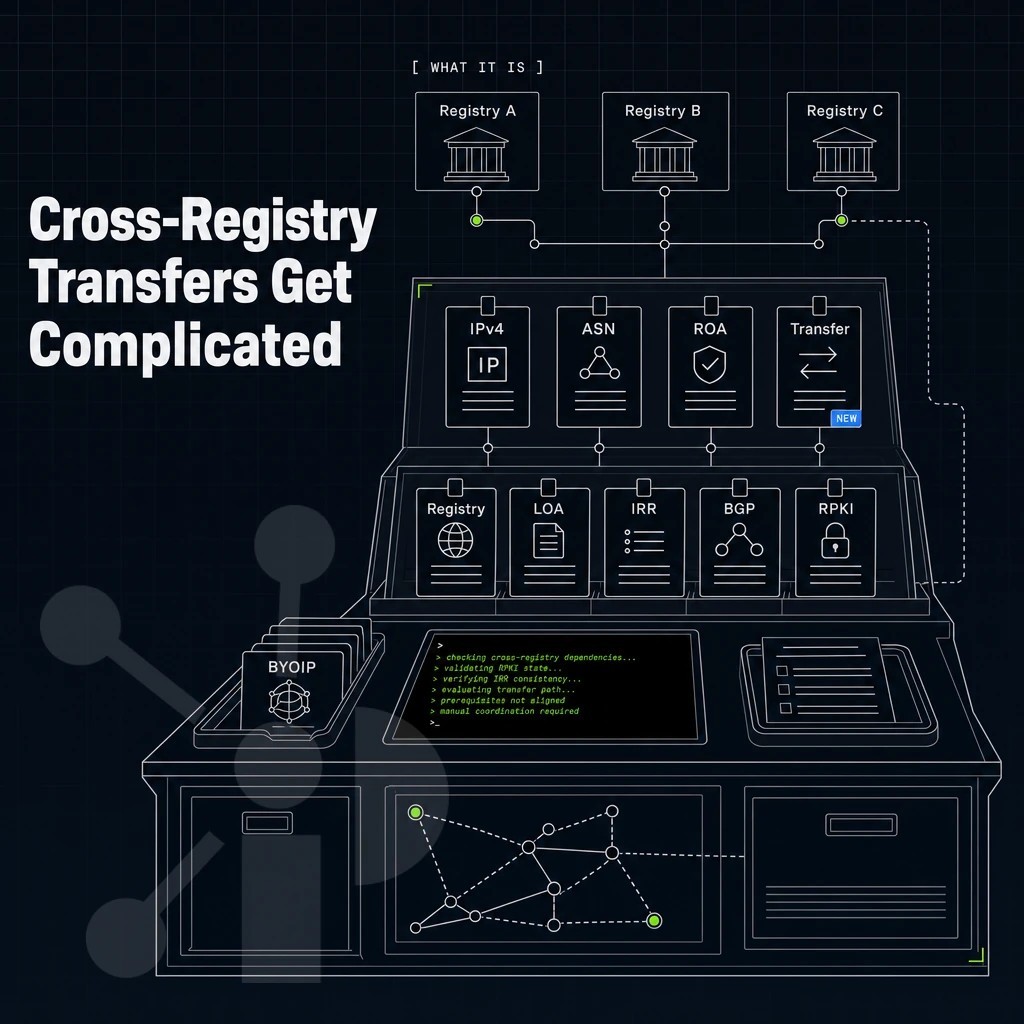
Inter-RIR transfers are used to move IPv4 address space between RIRs (e.g. ARIN to RIPE NCC). These are typically used by clients in companies with a shifting footprint, or geolocation specific requirements, and those who have been restricted by the policies of their current RIR.
Why organizations move small blocks across registries
A company expanding into Europe might want to allocate space under RIPE NCC to get correct geolocation and to do clean routing in that part of the world. Other reasons to move assets include policy reasons: ARIN, RIPE NCC and APNIC each have their own holding and usage policy.
Transferring large blocks and what to expect
All three ARIN, RIPE NCC and APNIC support cross-registry transfers, LACNIC is facilitated rather than natively supported. Navigating these cross-registry processes effectively depends on strong relationships with registry staff who understand the technical and policy nuances of each jurisdiction.
After the transfer, update the IRR records and RPKI ROA s for the transferred resources in the new registry. Otherwise, routing for the affected networks will break.
Where Prefixx fits in on the internet
Our consultants manage all the paperwork required for transfer of IP address space, and can handle signing of a lease whilst the transfer is completing. We also manage inter-RIR transfers between all supported registries around the world, handling pricing and completing all necessary routing documents on behalf of our customers. Our consultants work closely with clients to ensure every step of the transfer process is transparent and aligned with their technical requirements.
Why choose Prefixx for IPv4 market transactions
Prefixx is a boutique IPv4 brokerage with resources registered across ARIN, RIPE NCC and APNIC. We broker the buying, selling and leasing of IPv4 addresses across all block sizes, with senior consultants managing every deal from first inquiry through completed transfer.
- Zero buyer fees. Sellers pay a 3-8% commission only on a successful transfer. Buyers spend nothing.
- Tixx quality control. Every block is checked for clean ownership, blacklist status and routing hygiene before it reaches a buyer.
- Escrow-secured transfers. Funds and addresses move through escrow, so both buyers and sellers transact with confidence.
- White-glove routing paperwork. Our team prepares the LOA, RPKI ROA and IRR route objects included with every lease.
- BYOIP deployment support. We handle BYOIP onto Netrouting bare metal with no per-IP surcharge.
If you are ready to buy IP addresses, sell a block or explore lease options, browse the Prefixx marketplace or contact our team for a personalized quote.
The IPv4 IP ecosystem is permanent infrastructure, not a temporary patch. Every free pool is exhausted, secondary transfers are the only supply, and pricing moves with block size, RIR region, and reputation history. Those three variables alone can shift what buyers remit or sellers receive by a meaningful margin, which is why entering the transfer ecosystem without current data is a real financial risk.
An ARIN block and a RIPE NCC block of identical size follow different transfer rules, timelines, and eligibility requirements.
If you are planning to buy, sell, or lease internet address space, Prefixx handles the sourcing, Tixx quality control, escrow, and all routing paperwork across ARIN, RIPE NCC, APNIC, and LACNIC. Contact the team at Prefixx.net to get a current resale ecosystem view and a personalized offer.
Contact us to discuss your IPv4 needs today
No hidden fees, free consult. A broker replies within one business day.