
By Savvas Bout, Founder of Prefixx. Last updated 25 August 2026.
How many IP addresses are in a /24 that you have allocated to a block of address space? That number will tell you if a single /24 subnet mask covering two address blocks is sufficient for your deployment or any other device on your network, and how much the transfer or lease of addresses will cost you.
A /24 is often the smallest unit of IP space a carrier will route across their network without filtering. As a result, it is the standard unit of IP block in the secondary market and the base unit against which longer prefixes are priced and measured. For more context, see Subnet.
This post describes the exact address count derived from the host portion of each prefix, subnet math for various prefix lengths, and how this affects routing policy and RIR eligibility.
If you're buying or leasing a 24 subnet as an internet service provider, the numbers here will shape your cost model, your routing, and your operations. Start with the address count, then work through cidr notation, reserved addresses, common block sizes, subnetting, and deployment.
How many IP addresses in a /24 subnet mask?
A /24 subnet contains a total of 256 IP addresses. Of these 256 addresses, 254 can be used for devices on the network. The 2 addresses that are left are reserved. The first address of the subnet is used as the network address. The last address of the subnet is used as the broadcast address for the network.
The first IP in the range serves as the network identifier and cannot be allocated to any host or device. Understanding how many IP addresses in a 24 helps network administrators plan capacity and determine whether a single prefix will meet their deployment needs. The last IP in the usable range, typically ending in .254, represents the highest address available for host assignment before reaching the broadcast address.
The subnet mask and host portion explained
A /24 uses the subnet mask 255.255.255.0. There are 24 bits for the network portion. 8 bits are left for the hosts. When all the bits in the host portion are set to 1, you have the broadcast address; when they're all 0, you have the network address. Those eight bits in the host portion allow for 256 possible combinations, ranging from 00000000 to 11111111 in binary representation.
The host section provides the flexibility to uniquely identify each device within the subnet, making the /24 prefix ideal for small to medium deployments. Understanding how many bits are allocated to the network versus the host portion is fundamental to calculating usable addresses and planning subnet capacity.
Setting up a network and the respective network settings can be done very fast. For example the block 192.168.1.0/24 contains the IP addresses from 192.168.1.0 until 192.168.1.255. Therefore the IP addresses 192.168.1.1 to 192.168.1.254 are available for assignment. To apply these settings in most router configuration interfaces, simply type the desired IP address into the appropriate field and press enter to confirm the assignment.
Why two addresses are always reserved
For every IPv4 subnet, there is one address lost at the start of the range and one at the end. The network ID identifies the subnet in question and the subnet’s broadcast ID is used to send packets to all ID’s on a given subnet simultaneously. Neither can be assigned to host ID’s. Routers use the network id to make forwarding decisions and determine which subnet a packet belongs to before delivering it to the appropriate destination.
What this means for broadcast address space planning
The /24 is the smallest block of IP addresses typically routed on the public internet, making it ideal for a small to medium sized network.
There are two special IP addresses that are always off-limits, explained in more detail below.
Common subnet sizes: how many ips does each block hold?
A block of IPv4 addresses is defined by a prefix length that determines how many IP addresses the block contains. Below is a table outlining the most common subnet sizes used in network design.
Cidr notation and the math behind it
A prefix length of /N means the remaining 32-N bits are host bits, and each additional bit doubles the address count.
How many ips each prefix actually delivers
| Prefix | Subnet mask (decimal notation) | Total IPs | Usable IPs |
|---|---|---|---|
| /16 | 255.255.0.0 | 65,536 | 65,534 |
| /20 | 255.255.240.0 | 4,096 | 4,094 |
| /22 | 255.255.252.0 | 1,024 | 1,022 |
| /23 | 255.255.254.0 | 512 | 510 |
| /24 | 255.255.255.0 | 256 | 254 |
| /25 | 255.255.255.128 | 128 | 126 |
| /26 | 255.255.255.192 | 64 | 62 |
| /27 | 255.255.255.224 | 32 | 30 |
| /28 | 255.255.255.240 | 16 | 14 |
| /29 | 255.255.255.248 | 8 | 6 |
| /30 | 255.255.255.252 | 4 | 2 |
The /24 subnet mask and the class c legacy
This creates a 24 subnet identical to the old Class C boundary.
Note that the 24 subnet is the standard tradeable unit in the RIR transfer market .
How to split a /24 subnet mask into smaller blocks
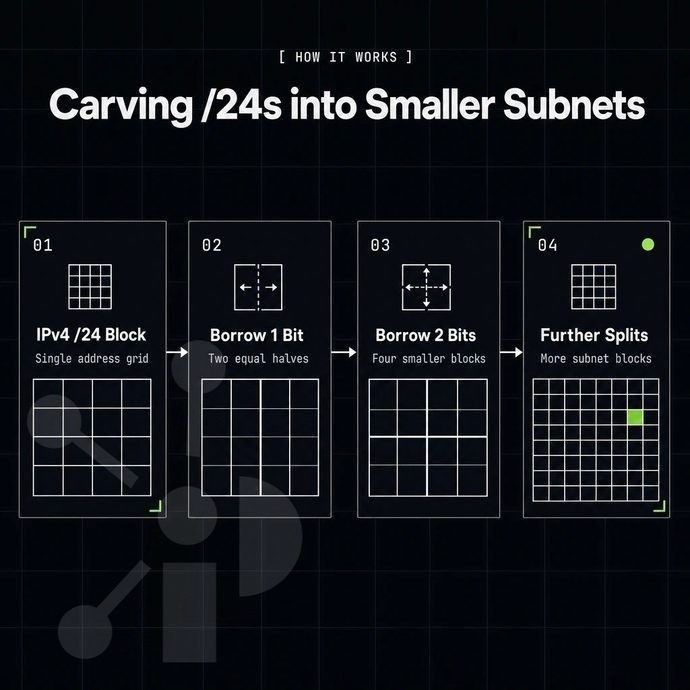
In most network segmentation scenarios, a /24 gets split into smaller blocks. Each bit moved from the host part to the subnet part doubles the number of subnets while halving the number of network devices a single subnet can accommodate. For more context, see Subnet.
Network address octet roles for network administrators
In a /24 the third octet will identify the network. The fourth octet (the last octet) will identify the host, containing values between 0 and 255 and allowing for 256 addresses per subnet. The first three octets remain constant across all addresses in the subnet, defining the network portion.
Common split sizes: final thoughts
Borrowing one bit yields 2 /25 subnets with 126 hosts each for network devices, borrowing two bits yields 4 /26 subnets with 62 hosts each, and borrowing three bits yields 8 /27 subnets with 30 hosts each. This pattern continues down to a /30 for a point-to-point network connection. Understanding common subnet sizes like /25, /26, and /27 helps network administrators choose the right prefix length for their specific deployment requirements.
- /25: two subnets, 126 hosts each.
- /26: four subnets, 62 hosts each.
- /27: eight subnets, 30 hosts each.
Practical use cases
Splitting a /24 improves security between local area networks by separating departments, VLANs, and DMZ zones. A router bridges segments by assigning two IP addresses, so a compromised device in one subnet can't reach another without traffic inspection.
Practical examples: the /24 subnet mask in real networks
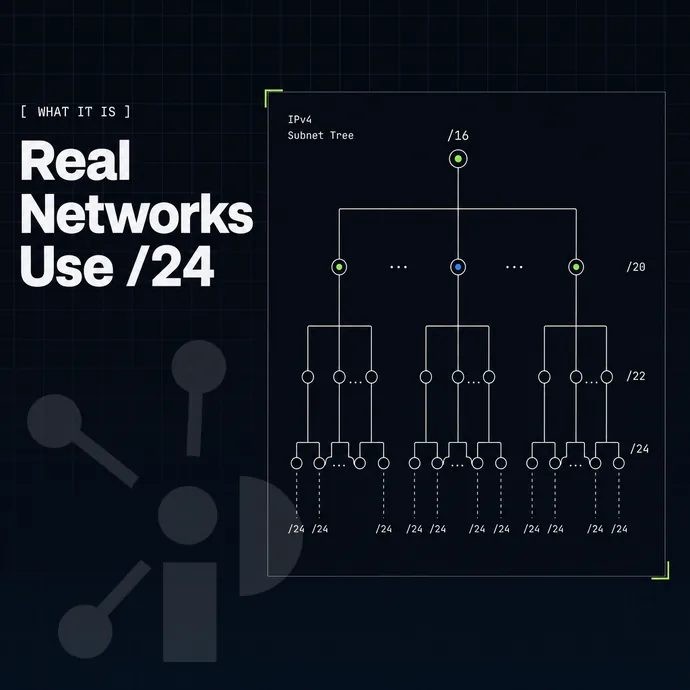
We take a closer look at a /24 network in practice for 3 scenarios that are typical for deployments. Before diving into these practical examples, it's worth sharing some final thoughts on how prefix length directly shapes network design decisions and operational complexity.
Network and broadcast addresses in the classic 192.168.1.0/24
The network interface of a home router is.1, the network address is.0 and the broadcast address is.255. The remaining 254 IP addresses (from.2 to.254) are assigned by the router via DHCP to any connected devices on the LAN. Each device connected to the router receives a unique IP from this pool, ensuring no conflicts occur during communication.
In a busy household with many devices, smart TVs and even a number of sensors (IoT) there are normally not enough IP addresses to assign to all devices.
Enterprise: splitting a /24 across departments
One /24 can be carved up into four /26s, so Finance, Engineering, HR, and Guest Wi-Fi can all be in their own subnets with 62 useable IP addresses each. Other devices on other subnets have to route through the firewall, but don’t use up any extra IP addresses.
ISP routing and classless inter domain routing: the /24 floor
A /24 is typically the smallest block of IP addresses that a transit provider will announce in the global routing table. Announcing smaller blocks of IP addresses on the public internet can result in those IP addresses being filtered and dropped by upstream peers.
Buying or leasing a /24 block through Prefixx gives the customer a fully routable block of IP addresses, complete with a clean network ID, vetted by Tixx. Additionally, regardless of network size, have been provided with a LOA, RPKI ROA, and IRR objects by Prefixx before the customer begins to send packets from their network.
| Context | Typical range used | Key constraint |
|---|---|---|
| Home / small office | .1 to.50 (typical) | Private space only; not routable publicly |
| Enterprise subnetting | Four /26s from one /24 | Segmentation and firewall policy |
| Public routing | All 256 addresses announced | /24 is the global minimum prefix |
Frequently asked questions
After reserving two addresses, how many usable ips remain in a /24 cidr subnet?
A /24 contains 256 IP addresses. The prefix length 24 means 24 bits are fixed for the network, leaving 8 bits for host addressing. Two to the power of 8 equals 256, so every /24 network block, without exception, holds exactly 256 addresses.
How many usable IP addresses are in a /24?
The first address is the network address and the last is the broadcast address. Both are reserved by the protocol and cannot be assigned to a device, leaving 254 addresses for actual use.
Is /24 the same as a subnet mask of 255.255.255.0?
A network engineer knows that the mask 255.255.255.0 written in binary is 24 consecutive ones followed by 8 zeros, which is exactly what /24 expresses in CIDR notation. You will see both forms in router configs and RIR documentation across any network, and they always mean 256 addresses.
How many host addresses are in a /25?
A /25 contains 128 IP addresses, 126 of which are usable. Splitting a /24 at the /25 boundary gives you two equal blocks: one where the first IP covers the lower half of the range and one covering the upper half.
How do you split a /24 subnet mask?
You subnet a network by extending the prefix length by one or more bits. The process is called subnetting, and it continues down to a /32, which is a single host address.
How many host addresses are in a /29?
A /29 contains 8 IP addresses, of which 6 are usable. The network and broadcast addresses consume one each, as they do in every subnet. A /29 is a common allocation for small point-to-point links or server clusters that need only a handful of usable IPs.
What is the smallest subnet that can be routed on the public internet?
A /24 is the de facto minimum routable prefix on the public internet network. Most transit providers and internet exchanges filter announcements longer than /24, meaning a /25 or smaller will typically be dropped by upstream routers and never reach the global routing table. This is why the /24 is the standard unit of trade in the IPv4 address market: it is the smallest block that reliably propagates across all major networks.
A /24 subnet contains 256 IP addresses. Of these 2 are reserved for the network and for broadcast, so there are 254 IP addresses for hosts. This host count applies to a /24 rather than larger subnets, whether you are configuring a physical office LAN or a BGP-announced block for a cloud-based workload.
By using CIDR notation for assigning IP addresses, you can fix the block size exactly. For example, a /25 will give you half as much space as you would get with a /23 (which would give you double the space of the original block).
This math must be correct before you acquire and start to use an IP range (e.g., buy it, lease it) to enhance security and efficiency, or you will end up having to re-size it later.
If you are sourcing a /24 or larger block for production use, Prefixx vets every block through Tixx quality control before it reaches you, covering ownership, blacklist status and routing hygiene. Browse available blocks at Prefixx.net or contact the team for a personalized offer.
Contact us to discuss your IPv4 needs today
No hidden fees, free consult. A broker replies within one business day.