
By Savvas Bout, Founder of Prefixx. Last updated 25 August 2026.
When a network engineer needs an additional block of IPv4 addresses, the typical path for acquiring them is through secondary markets, which lack public price feeds and centralized registries for available space. Transfer times vary by RIR. IP brokers fill this void.
For clients who have brokers with direct registry relationships, the opacity is removed and the broker can source vetted blocks for their clients, negotiate on their behalf, handle escrow. Brokers also help clients connect their newly acquired address space to existing network infrastructure by coordinating with upstream providers and ensuring proper routing announcements are in place.
Additionally, Manage transfer of ownership of the block, i.e. paperwork that stumps first-time buyers. Whether a broker's expertise can facilitate a smooth acquisition of a block of IPv4 address space or lead to a months-long exercise in frustration depends on a few things. Is the broker registered with ARIN, RIPE NCC, and APNIC?
Does the broker have a process for quality control before handing off a block of IPv4 address space to a client? Buyers should know what timeline is expected for their specific registry region, since approval windows can range from days to several weeks. The approval process itself can be complex, involving multiple verification steps and coordination between the buyer, seller, and registry officials.
The above guide explains what an IP broker can do for you, how the brokerage model is set up for the five RIR regions. What you have to pay attention to when going through a broker’s process of work. Additionally, Last but not least. leasing compared to buying IPs outright. If you are among the clients looking at options for buying/selling IPs, this above information will enable you to better ask questions to set yourself up for the best deal possible.
What is an IP broker and how do they handle IP resources?
An IP broker is an intermediary that brings together buyers and sellers of IPv4 address space, such as complete blocks. The broker calculates a proper value for the address space, handles negotiations, the RIR transfer paperwork and the escrow for the parties involved.
Why the role exists for regulatory compliance
By 2011, the five Regional Internet Registries (RIRs) had used up their free pools of IP addresses. Today, all IP address sales take place on the secondary market for IP. As a result, brokers for IP have sprouted up to serve the secondary market, which has no central exchange, no listed prices, and strict legal requirements for transfers of IP addresses.
What a broker actually does
A broker can source blocks, verify ownership, and negotiate a price before submitting a transfer request to the relevant RIR, acting as a single point of contact for buyers and sellers.
IP assets quality control
When buying IP addresses, it is very important to check if a block of IP addresses has been blacklisted in the past. Is being routed properly and if the RIR (Regional Internet Registry) that owns the block of IP addresses is reputable. Tixx runs these checks for all the blocks of IP addresses that Prefixx brokers, and supplies buyers with a full health report before any commitments are made.
Thorough pre-acquisition checks help buyers identify potential routing issues or reputation problems that could disrupt operations after the block changes hands. Prefixx offers tailored solutions that combine automated reputation scanning with manual registry verification to ensure every block meets operational standards before closing. Buyers should verify that the block can connect cleanly to their existing network infrastructure and that upstream providers will accept announcements for the address range without additional filtering or delay.
You will have no idea how they complete a deal day to day.
How IP brokerage services work from inquiry to transfer
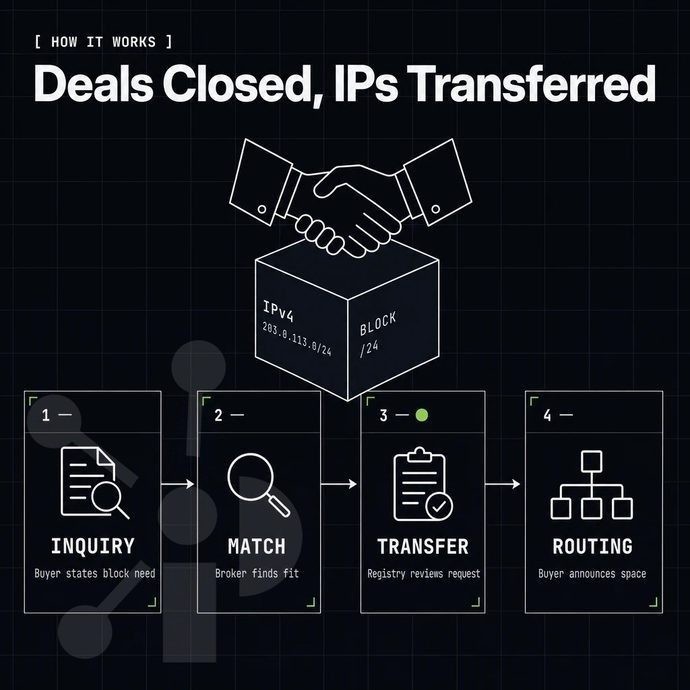
All IP brokerage transactions are executed following a fixed sequence of steps. Hereby, all parties can speed up the process of buying and/or selling IP addresses and at the same time avoid costly mistakes. All professional brokers are registered with ARIN, RIPE NCC or APNIC, the main IP address registries. Additionally, Therefore execute the transaction in accordance with the required terms and conditions as set by the IP address registries.
IP brokerage services and brokerage fee: the core stages
First a broker does a needs assessment (e.g. number of IP addresses, RIR region, intended use of IP addresses). He then either tries to find space for you or posts space for sale that others have offered. Drawing on strong relationships with RIR contacts, he will handle price negotiations and set up escrow to hold your payment until a transfer submission is successfully processed.
Experienced brokers will also advise on compliance requirements specific to each registry region to prevent delays or rejections during the approval process. Brokers also assist with technical questions about routing announcements and registry-specific forms that first-time buyers often find confusing.
Quality checks and documentation handled efficiently
It is at Due Diligence where real expertise is brought to bear. The Broker verifies 100% clean ownership, checks the block against various reputation lists, and confirms all network routing is 100% clean. In heritage cases of spam, transferring such a holding can result in instant transfer holds. All submissions need to be accompanied by correct documentation, i.e.
Brokers who prioritize confidentiality also ensure that sensitive transaction details and client information remain protected throughout the entire due diligence process. Reputable brokers implement multi-layer verification protocols to secure each transaction against fraud and ensure that ownership records match registry data before funds are released from escrow.
Post-transfer support
After the transfer is approved by RIR, the new holder of the IP address space needs RPKI ROAs, IRR route objects and geolocation corrections. Thus, the block will be allocated and brought into service by your network, without any hiccups. Brokers with technical depth can also coordinate with your hosting provider to ensure BGP announcements align with the newly transferred prefix.
Experienced brokers often provide post-approval consulting to help clients implement these technical solutions correctly and avoid common misconfigurations. These configurations enable your infrastructure to connect seamlessly with upstream providers and peer networks once the block is active.
This all applies regardless of whether you need to facilitate a full purchase, sell off unused space, or lease it for a set amount of time. Each transaction type has its own mechanics, and businesses that develop strong relationships with experienced brokers can better manage costs and time frames for completing the transaction.
Many growing companies find that working with a broker reduces the administrative burden and accelerates their ability to scale infrastructure on predictable timelines. Organizations exploring a temporary lease arrangement should confirm with their broker whether the registry permits such agreements and what contractual protections apply during the term.
What IPv4 brokers actually do: buying, selling and leasing IPv4 addresses
There are three different types of transactions that an IPv4 broker can handle. Each of these can serve a different purpose for a business. Selecting the correct transaction will have an impact on the cost, time frame, and policies relating to the rights and assets that are allocated to the transaction.
Buying and selling IPv4 addresses
- Outright Purchase, The buyer(s) will own the block(s) in question outright. The strategy makes sense for a buyer that needs the corresponding addresses for the long term. The strategy is for buying domains. We can source the best and approved inventory for you. We also manage the RIR transfer process for you, and help you with buying the domains through an escrow.
- An outright sale. Brokers list unused space on their books to attract suitable buyers. The broker does the valuation, checks out potential buyers and completes the necessary paperwork and documentation for the sale. Companies are able to recoup their investment without having to deal with the transaction.
Leasing IPv4 addresses
- Temporary access. Leasing IPv4 addresses for project use is offered as a rental on a non transferable basis. Such a rental would be used for short term projects, and for the times of year of increased server capacity, and for testing and development of applications and servers. The lessee will assign all of the IP addresses of the leased number range on a non-revocation basis while they are in use. Additionally, Then return the number range to the lessor when no longer required.
Supporting services with IPv4 addresses
- Routing paperwork. Better brokers will also help you to create necessary LOA, RPKI ROA and IRR route objects to announce big block of IP addresses. Some of them can even help you to deploy BYOIP on cloud or on bare metal servers.
- Inter-RIR moves. When a block needs to be transferred between different registry regions, brokers will coordinate the transfer with both registries for you.
Note: Always contact the broker before assuming a block is transfer-eligible. Legacy resources and certain AFRINIC holdings carry restrictions that affect timing.
Now that you know which transaction type applies and how IPv4 brokers handle it efficiently, you can start to understand what you will be charged and what drives your costs up or down.
Deep understanding of IPv4 addresses: pricing and valuation
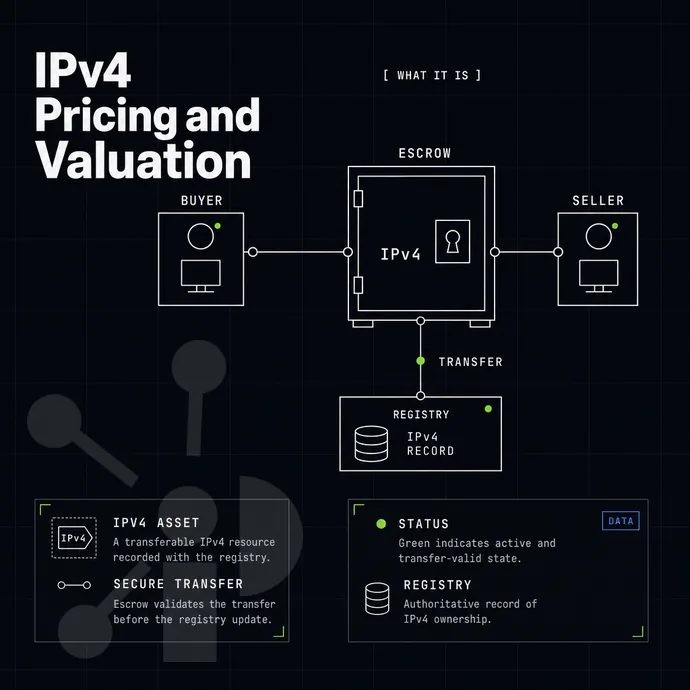
There is no set price for IPv4 addresses.
Deep understanding of what moves the price
The first variable to consider is block size.
ARIN and RIPE NCC blocks can sell at very different rates within the same month, driven by regional demand from businesses and specific policies.
A block of IPv4 addresses with a bad reputation, for example one listed on a major blacklist, can be rejected by mail servers and security appliances long after it changes hands. That is why every block is checked before it reaches a buyer.
Why market conditions evolve continuously
Supply is fixed. The five RIR free pools were exhausted between 2011 and 2020, and thus all IPv4 addresses are now traded on the secondary market. Given the high demand from cloud building, carrier-grade NAT avoidance and BYOIP services, the supply is under constant pressure. Market developments are taking place on a quarterly basis, thus there is no public price list. Each offer is negotiated on a case-by-case basis.
IPv4 addresses: brokerage fees and hidden costs
There are no fees of any kind for the buyers. Small amounts of assets are charged at the higher end of the range of fees for sellers.
There are no brokerage fees for the buyers and there are no hidden fees and charges in the fine print of the contract terms and conditions.
In order for a transfer to complete, it needs to comply with the rules of the relevant registry. Many deals fall at this hurdle, but with proper guidance they should not. Each registry will review the justification documents and either approve or reject the request, so both buyer and seller must accept the specific requirements before proceeding. Navigating these registry-specific requirements can become complex when multiple jurisdictions or legacy resource categories are involved in a single transaction.
Why choose Prefixx for IP broker services
Prefixx is a boutique IPv4 broker founded in 2018 and registered with ARIN, RIPE NCC and APNIC (LACNIC facilitated). Our team has roots in the networking industry since 2007, and we handle the entire process for buyers and sellers of IPv4 addresses, from sourcing through handover documentation.
- Zero buyer fees. A seller-only 3-8% commission on a no-win-no-fee basis keeps transactions straightforward and fair.
- Tixx quality control. Every IPv4 address block is checked for ownership, blacklists and routing hygiene before it reaches a buyer.
- Escrow-secured deals. All parties involved are protected through escrow from day one.
- White-glove leasing. Leasing IPv4 includes geo-location correction, rDNS, reputation monitoring and a non-revocation guarantee, provisioned within 24 hours.
- BYOIP and inter-RIR transfers. We prepare LOA, RPKI ROA and IRR documentation and support transfers across all five RIR regions.
If you are interested in buying, selling or leasing IPv4 addresses, contact our team to discuss your requirements. Organizations exploring a short-term lease arrangement can benefit from flexible contract terms that align with project timelines or seasonal demand spikes.
Frequently asked questions
Which IPv4 brokers have managed address block trades for over a decade?
An IPv4 block broker is a specialist intermediary that facilitates the buying, selling, and leasing of IPv4 address blocks on the secondary market. Because the five regional internet registries exhausted their free pools between 2011 and 2020, the only way to acquire address space today is through that secondary market. A broker like Prefixx handles these transactions end to end: vetting the block's ownership and routing hygiene, managing escrow, preparing the RIR transition paperwork, and delivering clean, routable space to the buyer. Organizations that need address space can obtain it exclusively through these secondary-market channels, since free allocations are no longer available from any registry. Prefixx offers tailored solutions for enterprises requiring immediate address space, ensuring compliance with registry requirements while minimizing acquisition delays. Once the block is delivered, the buyer can connect it to their network infrastructure and begin announcing routes through their upstream providers or peering arrangements. As IPv4 scarcity intensifies around the world, demand for secondary-market blocks continues to grow across all registry regions.
What do IPv4 brokers typically charge when you buy an IP address?
There is no single published price for IPv4 addresses. Market rates shift based on block size, the registry region (ARIN, RIPE NCC, APNIC, and others with strong relationships can trade at noticeably different rates in the same month), and the reputation history of the specific block. Buyers operating across multiple continents often discover that pricing dynamics differ significantly by region, reflecting local demand patterns and the availability of address space in each part of the world.
Prices have risen steadily since the free pools emptied, and the only way to sell or acquire addresses at an accurate figure is to request a personalized offer from a broker. Prefixx charges zero buyer-side fees, so the price you see is the market price for the block itself.
How can you make money with IPv4 addresses through IPv4 brokers?
Companies that consolidated infrastructure, completed mergers, or migrated to cloud often have legacy blocks sitting idle. Leasing is a second option: you retain ownership while a broker places the space with tenants and handles all routing administration in exchange for a brokerage fee. Prefixx's seller-only commission runs from 3% to 8% of the sale price, with no fee charged unless the deal closes. A typical lease arrangement spans twelve to thirty-six months, giving organizations predictable revenue from underutilized address space without permanently relinquishing registry control.
Can an IP address be sold?
All five regional internet registries support transfers of IPv4 address blocks, including legacy resources. A intermediary manages those transactions end to end for businesses: Prefixx runs every block through Tixx quality control before listing, confirming ownership, RIR standing, blacklist status, and routing hygiene so the reassignment proceeds without delays. Organizations around the world rely on these registry frameworks to maintain accurate records of address ownership and enable legitimate commerce in scarce IPv4 resources.
Buying vs leasing IPv4 addresses through IPv4 brokers
Buying transfers full ownership of the address block to you through an RIR-recorded transaction. You control the space permanently and can sell it again later. Leasing gives you the right to secure and use the address assets for the duration of the agreement, without an ownership relocation.
Leasing suits organizations that need space quickly or want to avoid the upfront cost of a purchase. Prefixx leases give businesses access to a non-revocation guarantee, RPKI, LOA, reverse DNS, and white-glove routing support, with provisioning within 24 hours.
The market for the portability of IPv4 addresses is technical, opaque and can have serious consequences. Transfers can be delayed, put on hold, or even blocked, with serious consequences for the network infrastructure and reputation of the previous owner of the routable address addresses. A registered facilitator can handle the most frequent problems for your transactions: valuation, escrow, RIR documents and quality control before you can start using the newly acquired public address addresses.
What separates a good reseller from the best? For starters, the proper registration of transfers with all relevant registries (ARIN, RIPE NCC. APNIC) to ensure that each porting transactions are properly filed and the receiving organization's WHOIS information is updated to reflect accurately the newly assigned block. Second, a dealer conducts appropriate due diligence on the specific block prior to movement (e.g. blacklists, routing health, etc. as well as a historical review of the block’s prior ownership).
If you are ready to buy, sell, or lease IPv4 space, Prefixx handles every step from initial valuation through to routing paperwork and post-shifting reputation monitoring. Submit an inquiry to get a personalized offer within 72 hours.
Contact us to discuss your IPv4 needs today
No hidden fees, free consult. A broker replies within one business day.