
By Savvas Bout, Founder of Prefixx. Last updated 27 August 2026.
The African region is managed by AFRINIC (Regional Internet Registry), which oversees address space allocation across 54 countries. This matters for any network engineer or IP manager working with African operators or looking to manage infrastructure in the region.
An understanding of how AFRINIC manages the transfer, lease and allocation of IP addresses is not optional background information.
AFRINIC operates under its own policy framework, transfer rules, and membership requirements, often quite different from what ARIN or RIPE NCC requires. This article explains AFRINIC address space in detail, including how network operators handle transfers and inter-RIR moves under current policy.
We explain what due diligence for an African-region block of IP addresses entails and where you can expect routing hygiene and reputation checks in the acquisition process. We start with explaining what AFRINIC is and what it actually does.
AFRINIC as the internet registry for africa
AFRINIC ( African Network Information Centre ) is the Regional Internet Registry for Africa and the Indian Ocean region.
African network information centre: core mandate
AFRINIC, the Internet Registry for Africa, distributes IP address space and AS Numbers to operators, ISPs and enterprises in Africa.
The NIST Cybersecurity Resource Center (CSRC) Glossary contains an entry for AFRINIC, stating that AFRINIC is “the Regional Internet Registry for Africa” which manages and allocates Internet numbers under a community-driven policy. This definition formally recognizes AFRINIC as one of the five RIRs around the world.
What AFRINIC does for africa and the indian ocean region
AFRINIC’s work with regard to allocation of IP addresses to countries and organizations across Africa. In order to develop local routing expertise for operators of networks, in addition to other activities, is overseen by the CEO and staff of AFRINIC. Additionally, An elected Board of Directors drawn from across the African community. The Board of Directors is selected through AFRINIC elections, which allow members to choose representatives who will guide policy development and organizational strategy.
Why RIR structure matters for internet number resources transfers
Blocks registered under AFRINIC, the african network information centre, are individually transferable, and any transfer involving more than one registry is handled by the Prefixx team. We examine the historical, registry-specific internet governance factors behind AFRINIC's policies and explain why each one looks the way it does, reflecting a broader commitment to strengthen internet self governance and keep African stakeholders in control of resource allocation decisions.
A brief history: how AFRINIC was founded
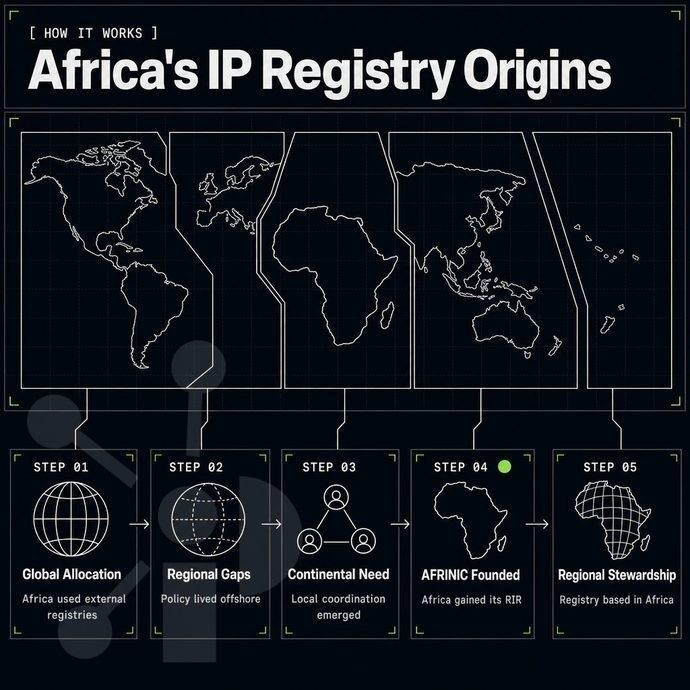
The Internet in Africa had to rely on regional bodies outside of the continent before AFRINIC was established. Users from African countries had to rely on other registries for allocation of IP address space. These users had no regional body to represent their interests in decisions regarding the African Internet and its infrastructure. Establishing AFRINIC was a push from within the continent.
The african internet community's case for a regional internet registry
From Northern Africa to the southernmost tip of the continent, the African internet community agreed that Africa needed its own registry to manage IP addresses, routing information, and secure internet infrastructure.
IP address space and the path to self-governance
The address space for Africa was assigned out to AFRINIC (5th RIR) in 2005.
Internet society, internet number resources policy, and lasting impact
Internet governance for Africa changed fundamentally when AFRINIC took over allocations for the continent. As a neutral not-for-profit internet registry for Africa accountable to its African membership, AFRINIC embodies internet self governance in practice: regional communities making their own policy while the Number Resource Organization ensures global consistency. This model has enabled initiatives like Smart Africa, which relies on locally managed internet infrastructure to support digital transformation across member states.
Knowing the history of IP number allocation and management for organizations today acquiring or transferring IP number space in AFRINIC region is important.
Where AFRINIC fits in managing internet number resources
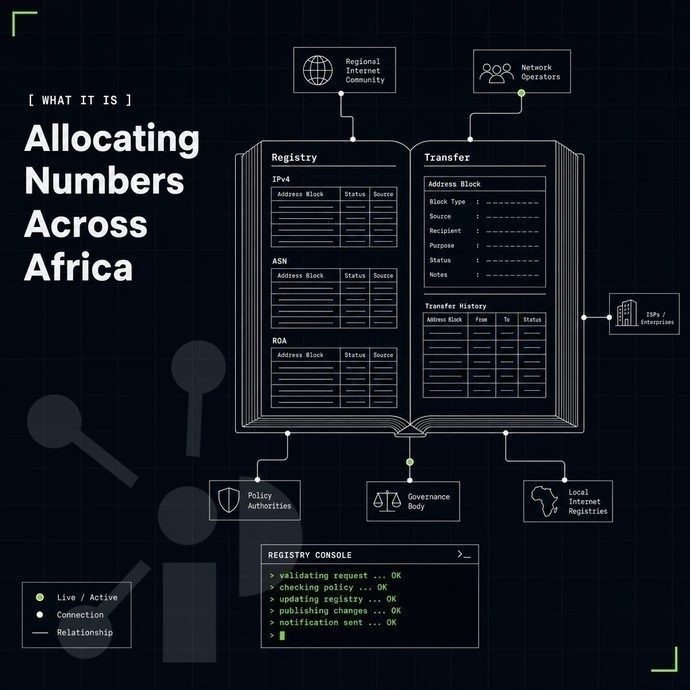
Five Regional Internet Registries (RIRs) manage the world’s IP address space and Autonomous System Numbers (ASNs). RIRs serve regions of the world and supply operators in those regions with any resources they need. Each RIR has its own policies and maintains a registry of IP addresses and AS numbers for its region. Understanding how each RIR manages its allocated IP address space is essential for organizations planning cross-border network deployments or multi-regional infrastructure.
Each autonomous system receives a unique ASN from its regional registry, enabling border gateway protocol routing and ensuring that traffic can be properly directed across interconnected networks worldwide. Organizations planning multi-regional peering arrangements must coordinate autonomous system numbers across different RIR jurisdictions to ensure consistent routing policies and avoid conflicts in global BGP tables.
The RIR for Africa, AFRINIC, is served by five RIRs around the world, and this page describes where each of them is located in relation to the transfer or leasing of African address space .
The five-rir structure and its coordinating bodies
The Internet Assigned Numbers Authority (IANA) distributes large address blocks to the five registries, including IPv4 space and autonomous system numbers essential for routing traffic between independent networks across the global internet.
Proposals for rules that support internet technology usage go through public comment periods, and comments from operators and other stakeholders are taken into account before a decision is made. Each proposal is carefully considered by the community to ensure it aligns with regional needs and technical requirements before implementation. Policy revisions are then refined based on feedback received, ensuring that final rules reflect the practical concerns of network operators across the region.
Once an updated draft incorporates community feedback, it moves to the final review stage where technical accuracy and policy consistency are verified. This transparent approach to policy development exemplifies internet self governance, where decisions emerge from consensus rather than top-down mandates. This transparent approach to policy development exemplifies how regional registries strengthen internet self governance, where decisions emerge from consensus rather than top-down mandates.
Where each RIR operates including the indian ocean
| RIR | Region | Coverage notes |
|---|---|---|
| ARIN | North America | USA, Canada, many Caribbean territories |
| RIPE NCC | Europe, Middle East, Central Asia | Largest member count; spans 75 countries and sub regions |
| APNIC | Asia-Pacific | Covers economies from Japan to Australia |
| LACNIC | Latin America and Caribbean | Youngest of the five registries at founding |
| AFRINIC | Africa and Indian Ocean | Headquartered in Mauritius; last RIR established |
Afrinic's place in the transfer market
AFRINIC started operations in 2005. The free pool of AFRINIC was used up later than the ones for North America and Europe. Thus, the pricing and transfer of African address space is affected compared to the same space held by other RIRs.
AFRINIC held IP address blocks are transferred by Prefixx. Organizations interested in acquiring AFRINIC-held blocks can schedule a first consultation with Prefixx to review eligibility requirements and transfer timelines specific to the African region.
AFRINIC governance: how this regional internet registry is run
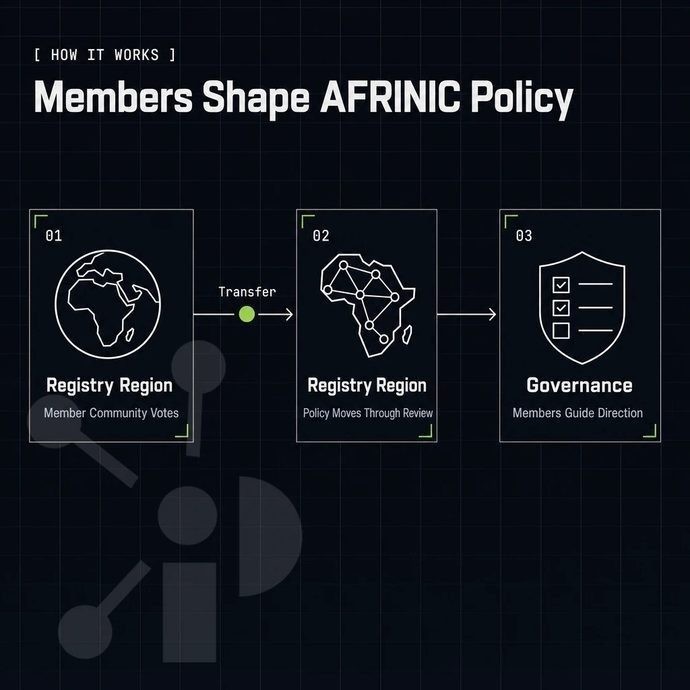
AFRINIC is a member-driven organization. The community and users of number resources, issued by AFRINIC, are responsible for the governance and direction of the organization. This includes the election of the Board of Directors and the chief executive officer, as well as the development of policies and guidelines that determine how address space is allocated and managed across Africa by african governments and other stakeholders.
Member-driven policy development processes strengthen internet self governance by ensuring that allocation rules reflect the operational realities and infrastructure priorities of the African continent.
Membership and voting rights at a regional internet registry
African Member Organizations recognized by the AFRINIC board are assigned and/or hold Resource allocations/assignments in the AFRINIC registry. As AFRINIC members, they have voting rights. The elections for filling Board seats on the governing body of AFRINIC are held among the AFRINIC members, where each seat has a fixed term. Contested elections are decided by the entire AFRINIC membership rather than by an appointed election committee.
The Board of AFRINIC oversees fiduciary responsibilities and sets a strategic direction for the Registry within the constraints of its Constitution and the mandates of the African internet community. The Board of Directors comprises individuals who represent the interests of the African Internet Community at large. This includes, but is not limited to, all Network Operators, Internet Service Providers, Governments and relevant Civil Society Organisations across the continent.
Policy development and public meetings driven by cloud innovation
Policy making at AFRINIC is not a top down process. All Public Policy Meetings are open to any stakeholder, with proposals taken through transparent community discussion on mailing lists and formal consensus calls before the new Board can ratify them.
Regional internet registry governance review of internet numbers
AFRINIC is currently undergoing significant changes to the organization's constitution to strengthen internet self governance as part of an on-going review of the bylaws. A bylaws review committee was established to develop an amended constitution for AFRINIC and the first round of consultation with the community has been completed.
Understand the governance around acquiring and transferring address space. We track all the latest developments in AFRINIC policy and internet governance, so our clients always have the most up-to-date information, rather than being forced to rely on last year's guidelines. In the wake of full IPv4 exhaustion, every operator managing autonomous system numbers in the region will need to find a way to source new address space.
IPv4 exhaustion and what it means for the AFRINIC region
By 2020 all five RIRs had depleted their supply of free IPv4 addresses, with AFRINIC finally exhausting supply of free direct addresses in 2020. Thus all internet number resources for African networks and Internet Service Providers (ISPs) are now acquired by means of address transfers or leases.
Understanding internet number resources exhaustion landscape
- Free pools of IPv4 addresses no longer exist. AFRINIC has exhausted its supply of free IPv4 addresses and therefore does not distribute new IPv4 addresses from a free pool. Instead, addresses for new Internet operators are sourced from the secondary market for distribution on a professional and efficient basis.
- Support at AFRINIC: The AFRINIC organization continues to support the transfer of IPv4 address space, as well as AS numbers, including legacy numbers. The new, updated AFRINIC transfer policy (draft) has started to influence the community’s procedures and processes to make and complete transfers. Note that a needs-assessment by AFRINIC is required for all transfers.
Acquiring address space today
- Buying vs Leasing: Both options are available to acquire Internet Number Resources. Buying assets grants full ownership, and corresponding voting rights within AFRINIC policies. Leasing of assets instead enables quick acquisition of required Internet Number Resources, at fixed costs and without need to initiate transfer process.
- Work with a registered broker. A broker registered with AFRINIC helps distribute blocks of vetted IP addresses in the most efficient way. We handle the paperwork, the escrow, and the routing setup for you end to end.
The details of the inter-RIR IP address transfer to AFRINIC of interest to buyers and sellers is outlined in the next section.
Inter-rir transfers involving AFRINIC: what buyers and sellers need to know
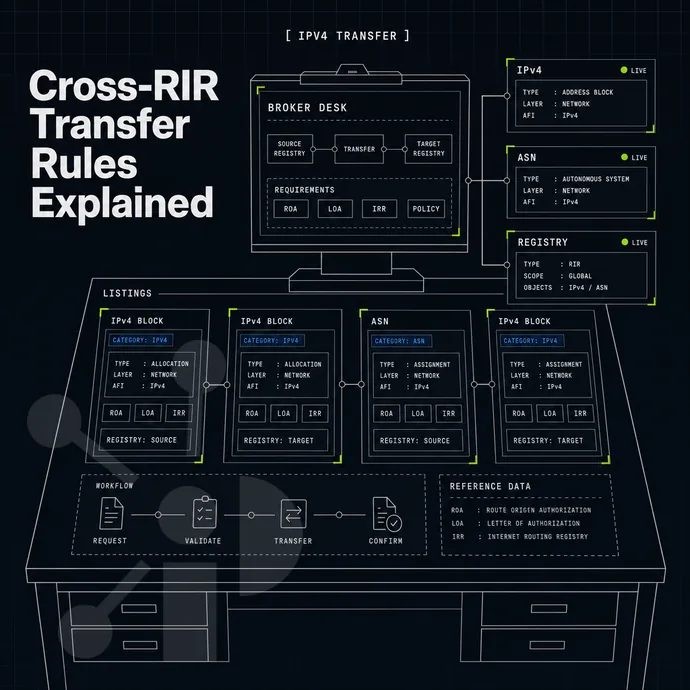
As Africa's Regional Internet Registry (RIR), AFRINIC is responsible for the allocation and management of Internet number resources for the continent. Address space originally issued within the african network information centre region can be transferred intra-continentally, and sellers may also list blocks allocated by other RIRs worldwide for transfer to buyers here. This is not like a standard internet number resources transfer from ARIN to RIPE NCC, so we outline the critical distinctions below for buyers' and sellers' protection.
Policy eligibility and transfer agreements
AFRINIC’s transfer policy has been developed through public policy meetings. Not all possibilities are agreed upon in the Indian Ocean region or elsewhere, so internet users and operators should confirm transfer eligibility beforehand rather than spending effort on the details.
Buyers will need to establish a legitimate need for the addresses in question.
Documentation: LOA, RPKI ROA, and IRR
For inter-RIR transfers that involve resources managed by AFRINIC, a Letter of Authorization, up-to-date RPKI ROA, and IRR route objects for the new Responsible Party are required. These must be consistent from the start in order to maintain routing hygiene worldwide. Such inconsistencies can lead to reachability problems that are difficult to fix and may take weeks to resolve.
Note that the timelines for transfers facilitated by AFRINIC may be longer than equivalent transfers between ARIN and RIPE NCC.
How Prefixx facilitates these transfers
Prefixx is a registered broker for ARIN, RIPE NCC and APNIC. We can do transfers for LACNIC and AFRINIC addresses.
As well as updates to the autonomous system routing for a customer in the indian ocean region, are prepared and processed end to end by the Tixx quality control team. The team checks every block of IP addresses that are being offered for sale for ownership, for any entries in blacklists.
For a full breakdown of transfer mechanics across all registries, see our IPv4 transfers pillar page. Reach out to discuss your specific development timeline and block requirements.
Frequently asked questions about internet number resources
How does AFRINIC handle internet number resources within internet governance frameworks?
AFRINIC is the Regional Internet Registry responsible for allocating and managing IPv4, IPv6, and ASN resources across the African continent. It maintains the regional routing registry, enforces resource policy, and coordinates with the other four RIRs on the global governance of internet number resources. Organizations in Africa apply to AFRINIC for address space and must meet its policies to receive or transfer resources.
Where is the african network information centre headquartered?
AFRINIC is headquartered in Ebene, Mauritius. Mauritius was chosen for its stable regulatory environment and central position relative to the African continent.
Which five rirs include the african network information centre?
The five RIR organizations are ARIN (North America), RIPE NCC (Europe, Middle East, and the Central Asian region), APNIC (Asia-Pacific), LACNIC (Latin America), and AFRINIC (Africa). Each registry manages IP address allocation and policy for its own region. Together they coordinate global Internet number resource governance under the oversight of IANA.
Is AFRINIC short for african network information centre?
AFRINIC stands for African Network Information Centre. The name follows the same naming convention used by the other RIRs, such as APNIC (Asia-Pacific Network Information Centre) and RIPE NCC (Réseaux IP Européens Network Coordination Centre). It became an independent RIR in 2005.
When did AFRINIC run out of IPv4 addresses?
AFRINIC was the last of the five RIRs to exhaust its free IPv4 pool, reaching that point in 2020. Organizations in the AFRINIC region that need additional IPv4 addresses must now acquire them through transfers or leases.
How does AFRINIC governance work?
AFRINIC is a member-based organization governed by a Board of Directors elected by its membership. Policy governing internet number resource management is developed through an open, bottom-up process: any stakeholder can propose a policy change, which is then debated in public mailing lists and at the biannual AFRINIC conference before the board ratifies it.
Can I transfer IPv4 addresses into or out of the AFRINIC region?
Intra-AFRINIC transfers (within the region) are supported under AFRINIC policy. Cross-registry transfers between AFRINIC and other RIRs such as ARIN, RIPE NCC, or APNIC are more restricted and depend on the policies of both registries involved. Prefixx handles inter-RIR transfers across ARIN, RIPE NCC, and APNIC, and facilitates transfers involving the African Network Information Centre, so if you are exploring options for moving address space into or out of Africa, speaking with a specialist is the right first step.
AFRINIC is the Regional Internet Registry for Africa and the Indian Ocean. AFRINIC allocates and manages IPv4 and IPv6 address space as well as routing registry data to support the growth of internet infrastructure in 56 economies. The framework for the allocation of address space and the transfer of address space registered under AFRINIC is similar to that of other RIRs (ARIN. RIPE NCC, APNIC, LACNIC) and thus subject to similar transfer eligibility criteria and requirements for. routing hygiene.
If you are looking to buy, sell or lease IPv4 addresses across any RIR region, including AFRINIC, Prefixx handles the full process: Tixx quality checks, escrow-secured settlement.
Contact us to discuss your IPv4 needs today
No hidden fees, free consult. A broker replies within one business day.