
While all marketplaces where you lease IPv4 addresses promise clean and routable IP blocks, the gap between promise and reality can cause a lot of pain and can take weeks to fix. When you need IP space for a new data center, to bridge a time-lag for an RIR transfer, or to expand a CDN edge node, the marketplace matters a lot.
Leasing platforms for IP address blocks can vary greatly. Some simple platforms just sell you a block of IP addresses and then you are on your own. Others, like Prefixx, sell you a block of IP addresses but also set up RPKI ROA for you, create IRR route objects, complete LOA paperwork, geolocate your space for better routing.
Additionally, Monitor the health of your IP address’ reputation. When you need to go online quickly, such huge differences can be critical. Platforms that handle routing, reputation monitoring, and registry coordination allow teams to scale their infrastructure without hiring specialized networking staff.
In this guide we will differentiate IPv4 leasing marketplace s from listing boards for commodities, highlight key points to verify before signing a lease agreement and, most importantly, reveal the details that most people miss until it is too late. We will start with the basics.
What is an IPv4 leasing marketplace and how does it work
An IPv4 leasing platform is a medium (be it a platform or a brokerage service) where companies with large IPv4 blocks can list that space for rental to companies who need IP space for routing purposes but do not wish to buy large blocks of IPv4 address space on a permanent basis. These platforms connect lessors who control unused address space with buyers seeking temporary allocation without the capital outlay of acquisition.
The lessor retains ownership of the space and the lessee is granted LoA (Letter of Authorization) and RPKI ROA for the block to advertise. Organizations that lease IPv4 space through this arrangement avoid the capital outlay of a full transfer while maintaining operational control for their routing needs.
What is IPv4 leasing?
Leasing IPv4 addresses means you pay for the rights to use these for a fixed period of time. We agree a lease term for the number of IP addresses you require, the originating Autonomous System Number (ASN) and any special requests, for example reverse DNS and geolocation. Importantly, you never actually own the IPv4 addresses you lease. Lease agreements can be structured with flexible terms to accommodate varying project timelines and budget constraints.
Leasing is generally the right solution for companies which require addresses fast, do not wish to enter into long-term commitments or are testing out a new network segment before they can be purchased outright. Leasing provides the flexibility to expand your address allocation incrementally as your routing requirements grow without committing capital to a full purchase.
IPv4 leasing vs inter-rir transfer what is the difference
A transfer of IP addresses between registrants at a Regional Internet Registry (RIR) is permanent, whereas a lease is not. The original registrant of record at the RIR is always the original holder of the IP address space. The lessee gains only routing authorization to use the space, never gains registry title to the space.
This distinction is critical for all things compliance and audit, as well as future resale of leased space. The lessee gains only routing authorization to use the space, never gains registry title to the space or any ownership rights that would permit independent access to registry modification functions.
Is IPv4 leasing the cheapest way to get address space?
Self-serve marketplaces typically automate the delivery of Letters of Authorization (LOAs) and post listed prices for blocks of IPv4 addresses. These platforms display real-time availability so buyers can immediately see which address blocks are ready for transfer without waiting for manual broker responses.
In a brokered model, all inquiries regarding available blocks of IP addresses are processed via a single platform (Prefixx.com) and, once a block is determined to be suitable for a client, our brokering consultants run Tixx.com checks to verify the quality of the block prior to leasing of relevant IPv4 address space to the client to mitigate any potential reputation risk. Our brokering consultants provide guidance and assistance throughout the verification and leasing process to ensure each client receives a suitable block.
While understanding the mechanics of a car lease is important, the more important decision involves comparing pricing across your network of dealerships and determining whether you should lease a car as opposed to purchasing it with cash. Similarly, when evaluating IP address blocks, organizations must weigh the flexibility of leasing against the long-term commitment that outright purchases require.
The cheapest way to lease IPv4 addresses is not always the lowest headline rate
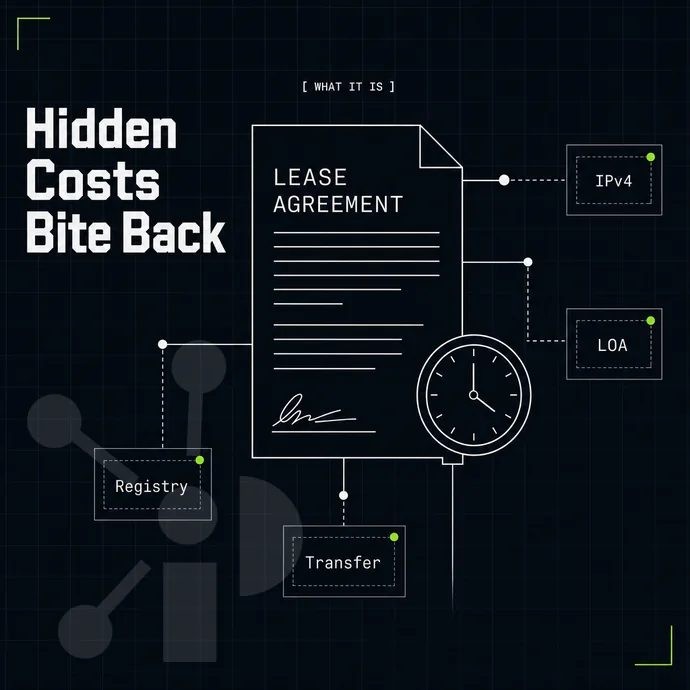
The advertised price per IP in the headline is just one line item in the total cost to own an IP. There are many hidden charges, the cost of remediation due to past reputation, and contract terms that look cheap on the surface but are very expensive by month three. When buying or leasing IP resources, understanding the full financial picture requires looking beyond the advertised rate to all ancillary fees.
What drives a cost effective total price
- The block size and RIR region are key factors to consider when purchasing larger subnets to carry at lower per-IP rates. The optimal subnet size will depend on your specific routing policies. Note that ARIN and RIPE NCC block prices can trade at very different rates for leases of the same month-sized term, and must be compared like-for-like by region and prefix length.
- Lease clean status. Does the provider perform reputation checks and compliance screening prior to provisioning a new block? Are additional charges applied to run these reports or to clean a ‘dirty’ block later? Are all regulatory compliance vetting activities included in the provisioning charge or are these extra and charged as a separate activity?
- LOA and ROA preparation. Some marketplaces even promote instant LOA generation for their clients. While automated LOA workflows are often set up within minutes, however, the burden of correct implementation still rests with the user. At Prefixx the LOA, the corresponding RPKI ROA as well as the IRR route objects are prepared manually and sent off correctly.
- rDNS delegation. This is often unlisted, verify it is covered in the Terms & Conditions before signing.
Contract terms, transparent pricing, and automated provisioning
Pricing models are opaque when the costs are buried in multi-page schedules. A company that has Transparent Pricing will list out all of the components and all of the setup charges and all of the routing paperwork charges and all of the charges for all of the reputation tooling that they use. This clarity ensures that organizations understand exactly what they are buying before committing to a transfer or lease agreement.
So the pricing you receive will be quoted for the exact block and shipping to the exact region that you require, and all of the other requirements that you have. Providers offering this level of detail often provide direct assistance in interpreting the quote and adjusting specifications to meet your technical requirements.
Note: A low headline rate tied to a long lock-in period can cost more than a slightly higher rate on a flexible term. Always calculate total cost over your expected lease duration, not just month one. The same principle applies when comparing leasing against outright acquisition, since the total expense of buying includes transfer fees and ongoing maintenance that must be weighed against cumulative lease payments.
How much does it cost to buy or lease IP addresses?
The purchase price for a given block size can vary greatly by RIR region and recent transfer history as well as current market demand. Thus, there is no fixed list price for a given IP address space, e.g. ARIN and RIPE NCC space of the same size can trade at vastly different prices within the same month.
Organizations evaluating outright purchases rather than leasing should factor in these same regional pricing dynamics when budgeting for permanent IPv4 acquisition. When evaluating whether leasing or buying makes sense for your organization, these regional pricing dynamics apply equally to both acquisition models.
As a broker, Prefixx charges no buyer fees, with pricing for sellers set at a commission of 3-8% (depending on size of block) paid to Prefixx, with larger blocks trading at the lower end of this range. Contact us for a current market offer on a specific prefix you need.
Even when we understand what costs we're paying for, we need a way to compare the pricing of different providers against each other. Transparent pricing structures allow network operators to evaluate the true monthly expense of each provider's offering without hidden variables.
What to look for in an IP leasing marketplace: key evaluation criteria
No two IP address leasing marketplaces offer the same degree of protection. A single weak point in any of these can cause serious problems for your network, including being unable to route traffic once a lease ends or renews, and potentially causing damage to your reputation. Addressing these concerns requires careful evaluation of a provider's operational track record and the robustness of their technical infrastructure.
Block size, RIR coverage, and automated provisioning
A credible marketplace holds all of the IP resources in all of the registries, ie ARIN for North America, RIPE NCC for Europe and the Middle East, APNIC for Asia-Pacific. If there are gaps in a provider's coverage of registries when you lease IPv4 addresses, you will end up sourcing from multiple vendors, which leads to extra administrative work, risk, and inconsistent policy enforcement. Real-time visibility into inventory availability across all registries ensures you can secure the blocks you need without delays or fragmented sourcing.
Check what range of subnet sizes are available. A large enterprise will require a /22 or larger, whereas a small operator may only require a /24. Don’t be forced into over-provisioning or dropping the lot because the marketplace only stocks one size.
Lease clean terms, guarantees, and compliance screening
The flexible pricing and terms of month to month contracts versus multi-year contracts are best suited to specific cash flow models and market conditions. More important is the non-revocation guarantee (the provider guaranteeing the block will not be pulled from the contract mid-lease term). Businesses that anticipate rapid growth should prioritize contracts that allow them to scale their address allocations without renegotiating terms or incurring penalties for expanding their footprint.
Screening compliance prior to provisioning a new network block of IP addresses is non-negotiable and should include a check against current ownership, pricing, eligibility for transfer, and a dozen or so DNSBLs. Screening the address history for prior bad actors can also prevent 'inherited' blacklistings from adversely affecting mail or network traffic flows on the newly provisioned range. Addressing common questions about block eligibility and historical usage upfront helps lessees understand what screening entails before provisioning begins.
Routing documentation and rdns delegation
We require the signed LOA, the signed RPKI ROA and the signed IRR route objects to be delivered to you prior to the announcement of your block of IP addresses by your provider. These are not additional services. Providers offering technical assistance ensure that clients understand how to configure and maintain these authentication records throughout the lease term.
The ability to manage the rdns for your mail and abuse servers is just as important as managing the IP itself. Providers should grant you direct access to reverse DNS configuration tools so you maintain full control over your infrastructure.
Prefixx provides this and more, including monitoring of your IP against 12 DNSBLs as part of the white-glove service provided to clients with a lease on their IP assets. Treated as a managed resource as opposed to a simple handoff of static IP addresses. This managed approach to IPv4 leasing ensures that technical and administrative burdens remain with the platform rather than the client.
How much does it cost to get a dedicated IP?
The price for a Dedicated IP(s) can vary greatly by registry, block size and term of lease. As there is no set published rate for Dedicated IPs, pricing fluctuates depending on supply and demand across the network of respective regions of the world for the various registries and the supplier. Availability of specific block sizes in a given registry region can shift rapidly as demand patterns change, making real-time inventory visibility essential for procurement planning.
By having one platform deal with everything end to end (sourcing addresses through to paperwork for each route and ongoing monitoring of the reputation of each address), you can reduce your operational overhead and ensure that your policies are always being adhered to across your entire network. This consolidated approach is particularly valuable when working with multiple upstream providers or ISPs, as it ensures consistent routing policy and documentation across all peering relationships.
With our evaluation criteria, including pricing, in place, we can look at the two dominant market models and see how they really compare. Real-time inventory availability and transparent lease terms separate platforms that serve buyers efficiently from those that rely on opaque broker negotiations.
Common use cases: which businesses lease IPv4 address space
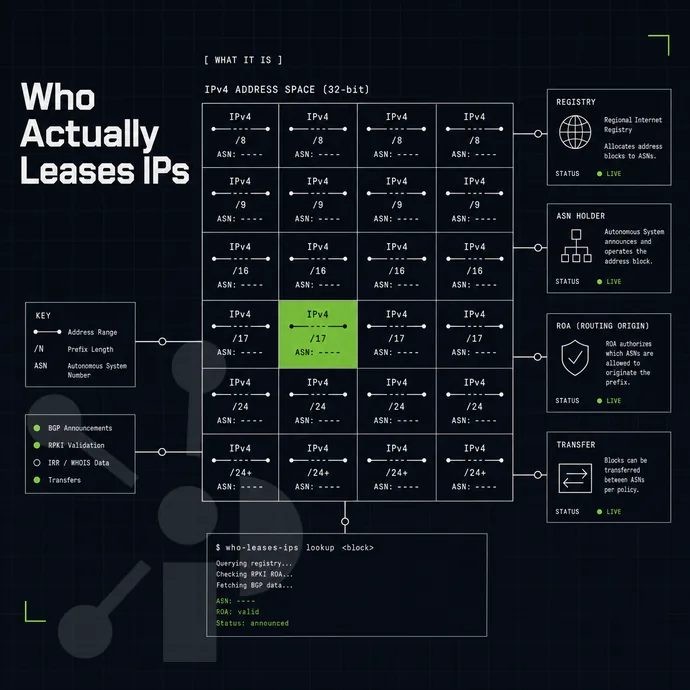
Companies leasing IPv4 address space have different requirements. The optimal lease structure for them depends on parameters such as the size of the block they are looking for, the RIR they are dealing with, and their respective use cases. The following profiles reflect the most common customer groups in the current market. Organizations that lease IPv4 addresses must evaluate whether their operational model aligns better with self-serve automation or brokered consultation before committing to a provider.
ISPs, data centers, and hosting providers
When an ISP is expanding their routing tables they generally need large blocks of IPv4 block ( /20 and larger) that are announced from within a specific RIR. A hosting provider on the other hand typically starts with a /22 or /23 block of space and then grows as required.
Both types of organizations focus heavily on maintaining a good IP address reputation and ensuring that their RPKI is accurate from the very start. Both buyers and lessees prioritize clean reputation history when selecting address blocks to ensure immediate usability for their networks.
Enterprises and cloud operators needing IP space
Enterprises in transition need to fill small blocks of address space for a shorter period of time. Cloud providers running BYOIP for their customers on AWS, GCP, Azure, OCI or Cloudflare require minimum prefix lengths for assignment on these platforms of /24 and larger.
Email delivery teams and ad-tech platforms lease out clean IPv4 space to help protect sender score. A single blacklisted / denied internet protocol address range can immediately collapse deliverability. The reputation history of the IPv4 block range can be just as important as the prefix length. Buyers in these sectors prioritize clean address space because their business models depend on maintaining trust with end users and avoiding blocklists.
Are there hidden fees when leasing IPv4 addresses?
Look for “no hidden fees” language in reputable leases, and beware of set-up charges, overage charges by address block, and LOA/RPKI paperwork that some providers charge for as extras. All of the white-glove service (LOA, RPKI ROAs, IRR route objects, reputation monitoring, etc.) is included in Prefixx lease pricing, with no hidden extras. agreement expires with no obligation to transfer and no penalty for exit. Providers offering white-glove service typically include dedicated assistance throughout the lease lifecycle to ensure smooth configuration and routing.
Leasing can be a great option for organizations in difficult to serve regions where purchasing would be cost-prohibitive. It converts a large capital expenditure to a fixed monthly cost and allows for full use of all routing rights for the lease term. Organizations can evaluate whether leasing aligns with their budget by reviewing the pricing structure against their projected usage and growth timeline.
If those use cases match your situation, here is what working with Prefixx specifically looks like. Prefixx supports deployments that need to scale from a handful of addresses to enterprise-grade allocations across multiple regions.
Why choose Prefixx for IPv4 leasing
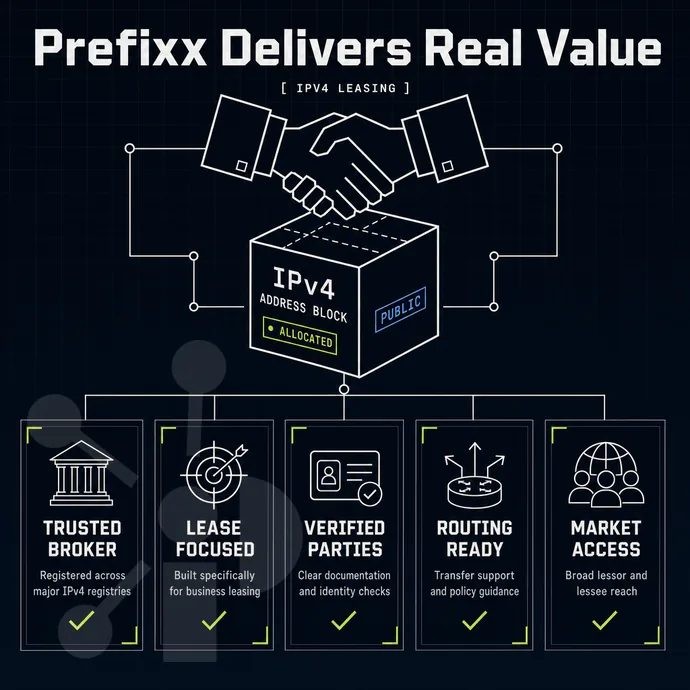
Prefixx is a registered IPv4 broker with ARIN, RIPE NCC and APNIC (LACNIC facilitated), built specifically around IPv4 leasing for businesses that need clean, routable IPv4 allocation without long-term commitments or hidden fees. Every block goes through Tixx quality control before it reaches a lessee: ownership verification, blacklist scanning, routing hygiene checks and RIR standing review. You get transparent, vetted network address resources from day one.
- White-glove included on every lease. Our team prepares the LOA, RPKI ROA and IRR route objects, handles rDNS delegation, corrects geolocation and monitors reputation across 12 DNSBLs. Clients do not chase paperwork.
- Non-revocation guarantee and provisioning within 24 hours. Your lease IPv4 addresses stay routable for the full lease term. No surprise additional fees, no mid-contract pull-back.
- Zero buyer fees. Pricing is inquiry-based with a personalized offer valid for 72 hours. Cost-effective and transparent, with no per-IPv4 address surcharges on BYOIP deployment onto Netrouting bare metal.
- Portal tooling included. BGP monitoring, reputation checks across 12 DNSBLs, geolocation tools and the ability to manage rDNS records, all in one platform.
- Flexible block sizes across every RIR region. Whether you need smaller blocks or large blocks, we source and vet IPv4 addresses to match your intended use and scale.
Ready to lease IPv4 addresses or compare options? Reach out to our consultants for a no-obligation quote tailored to your network and block size requirements.
Headline rates mean little if the block arrives blacklisted, mis-geolocated, or without proper routing paperwork. The real cost of a lease includes the time your team spends fixing problems the provider should have caught before provisioning.
Brokered marketplaces consistently outperform self-serve platforms on the factors that matter most to operations teams looking to lease IPv4 addresses: pre-vetted blocks, guaranteed non-revocation, long term commitments on white-glove handling of LOA, RPKI ROAs, and IRR objects. That difference compounds when you need an inter-RIR transfer or BYOIP deployment on bare metal.
If you are ready to lease address block allocation addresses from a vetted block with full routing support included, explore Prefixx's IPv4 lease options or contact the team directly for a personalized offer on the block size and RIR region you need.
Contact us to discuss your IPv4 needs today
No hidden fees, free consult. A broker replies within one business day.