
By Savvas Bout, Founder of Prefixx. Last updated 12 October 2026.
acquiring IPv4 blocks for leasing is a highly deliberate form of capital spending to build out a network. A buyer of IPv4 purchases a block of IP space and earns lease payments against the full cost of said space, with all the associated assets remaining on the buyer's balance sheet.
The key to making such math work is buying very clean, transferable IP space at the right price and putting it into service as soon as possible. Buyers must evaluate whether the upfront acquisition cost aligns with projected lease income over the intended holding period.
Every step of this process has real risk however. In IPv4 address leasing, space with prior blacklist activity will receive lower lease rates than clean space, for example.
Also time spent in routing and related paperwork around a decision to lease IPv4 addresses can delay the date at which first cash is received, and a failed RIR transfer leaves one with an asset that one cannot announce. Clean space also simplifies incident response when abuse complaints arise, since lessors face fewer pre-existing reputation issues to untangle.
This article is a comprehensive guide to acquiring domain names and leasing them out for their intended use. It outlines the key criteria for buying IPs in blocks of domain names, along with the quality control checks that Tixx-style companies perform before any commitment is made. The manner in which escrow-secured transfers protect the capital of would-be buyers. These quality control procedures ensure that buyers maintain full ownership and control over the assets they acquire.
Additionally, The white-glove routing support that is provided using LOA, RPKI ROA and IRR. It also goes into detail regarding the lease structure itself including non-revocation guarantees and the provision of services and the reputation monitoring to ensure that leased domains are generating income and not listed on a blocklist of offending sites. The white-glove support extends to coordinating migration logistics when lessees need to transition address space between autonomous systems or hosting environments.
What buying IPv4 addresses to lease out actually means
Investor-operators buy IPv4 addresses in secondary transfer markets and lease out the block of purchased IP addresses to users who need IP addresses for routing purposes but do not wish to purchase IP addresses for long periods of time.
Why the model exists to address supply challenges
All of the regional internet registries used up their free pool of IP addresses between 2011 and 2020.
What owning an IP space block really means
The buyer becomes the holder of record at the RIR (i.e., they hold the address block on the RIR’s records). Tenants or users of the holder of record receive a Letter of Authorization (LOA) from the holder of record to announce the IP addresses from their own AS Number (ASN). The owner of the address block (the holder of record) remains the owner throughout. For community perspectives, see Opinions on leasing out unused IPv4 blocks : r/networking.
Routing support and the operator's role
Acquired IP space needs to be turned into a leasable asset. This means that RPKI ROAs, IRR route objects as well as LOAs related to IPv4 address leasing for each tenant have to be prepared and signed. We do this paperwork for our customers. We make sure that every lease is route-ready from the beginning. Proper documentation reduces the administrative cost of onboarding each new tenant and minimizes the risk of routing disputes.
Choosing the right prefix size before you buy
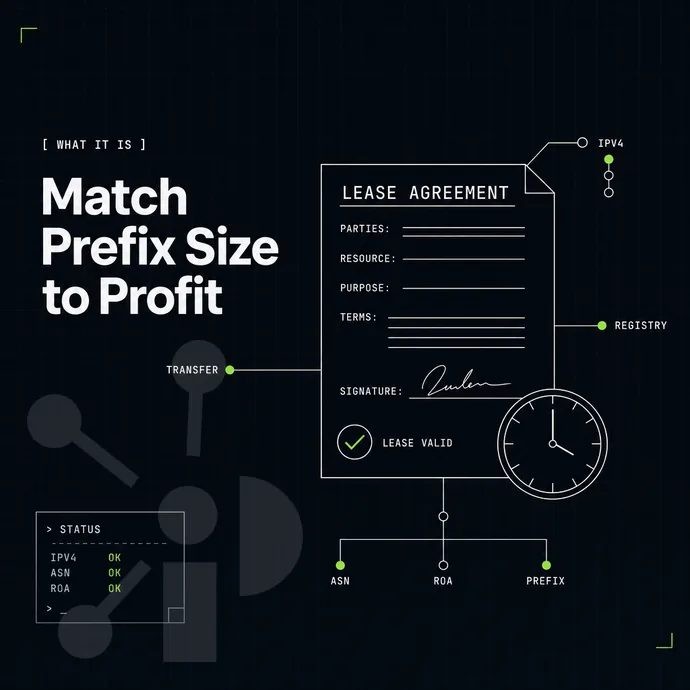
The Prefix size will influence how much capital is locked in IP purchase, the number of Tenants that can be served and how quickly a block of IP will fill up. The address count in your chosen prefix directly determines both your upfront investment and the granularity with which you can allocate space to individual tenants.
Match block size to your business needs
- Start with a /24. The /24 is the minimum routable unit on the public internet and holds 256 IP addresses. For many organizations, the /24 is the most liquid size of IP space (i.e. easiest to buy, easiest to sublease, most universally accepted by upstream providers).
- Consider a /23 or /22 block size for growth. Doubling or quadrupling the amount of addresses will reduce the cost per address. However, this block size has narrower tenant requirements (less contiguous space needed by lessees) than larger block sizes.
- Allocate a /20 or larger block for wholesale / multi-tenant models. You can then go and subnet that /20 up into /24’s that you can lease to individual tenants. That helps to spread the risk to the tenants.
Factor in lease term structure for long term commitment needs
- Match the block size with your commitment period. A /24 is suitable for short term or trial lease periods. larger allocation sizes are suitable for longer lease terms where you can lock in returns and minimize re-leasing activity.
- Understand PTR delegation for /24 slices you rent out. Each slice will need reverse-DNS authority delegation. Plan for the administrative load for a large block of /24s split into many slices.
Understand regional internet registry pricing before buying IPs
- Look up the RIR for that block. RIRs for ARIN and RIPE NCC lists for same size prefixes trade at vastly different rates. There is no published rate by either registry for such, so prices vary by region, by the history of the specific block in question, and by time.
- Get a Tixx report before you sign up (e.g. for new or unknown blocks). Prefixx runs all blocks through Tixx quality check for ownership, routing quality and blacklisting. A clean report then also protects your lease revenue right from the start.
Note: Buying a /22 to lease as four /24s looks efficient on paper, but fill rate matters. An unfilled /24 sitting idle still cost you acquisition capital. Once you have sized the block correctly, the next question is whether buying outright makes more sense than leasing for your specific situation. Aligning block size with your actual tenant pipeline ensures that capital deployed matches business needs rather than theoretical capacity.
Why choose Prefixx when buying IPv4 to lease out
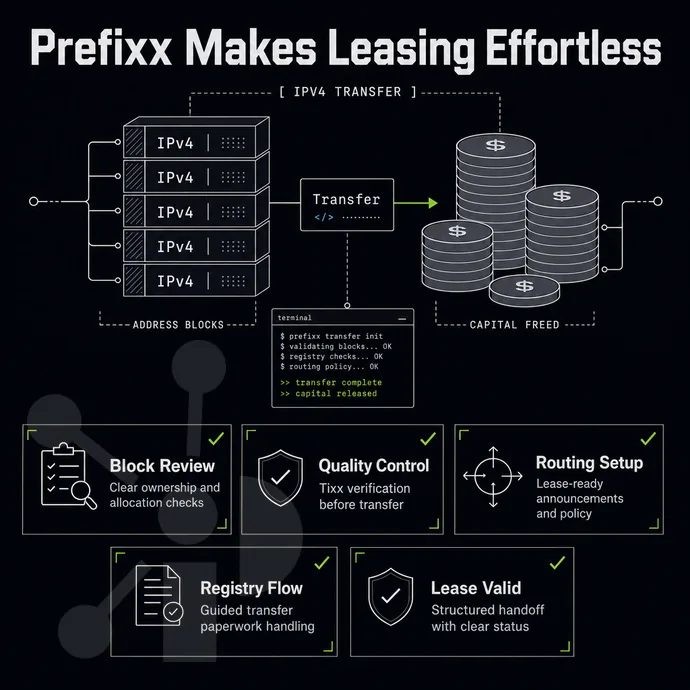
We broker the entire process of buying IPv4 addresses to lease out, from block review and Tixx quality control through to routing setup and ongoing abuse response. Every IP block we source is checked for past abuse, blacklist status, routing hygiene, and RIR standing before it reaches you. Before committing capital, buyers should assess each block's transfer eligibility and confirm that the seller holds clear registration rights at the relevant RIR.
- Zero buyer fees. Our seller-only commission structure means your capital goes toward acquiring IPv4 addresses, not paying brokerage costs.
- Tixx QC on every block. Ownership, origin ASN, RPKI validity, and abuse contacts are verified before transfer.
- White-glove routing assistance. Our team prepares the LOA, RPKI ROA, and IRR route objects so your leased addresses announce cleanly from day one.
- Non-revocation lease guarantee. Downstream tenants get stable, leased addresses with 24-hour provisioning and a clear escalation path for incident response.
- Registered with ARIN, RIPE NCC, and APNIC. We handle inter-RIR transfers and applicable policies across all five RIR regions, with LACNIC facilitated.
If you are assessing prefix size, lease term, or long-term control of your IPv4 leasing business, our consultants can help you plan. Visit Prefixx.net/buy-IPv4-addresses or contact sales to discuss your requirements. Structuring your portfolio around stable tenants and predictable cash flow requires a long term commitment to operational excellence and market positioning.
Frequently asked questions about IPv4 leasing
How to use address leasing with route authorization for a specific business count?
Start by acquiring a block through a registered IPv4 broker . The broker handles RIR transfer paperwork, escrow settlement, and Tixx-style quality checks so you and your hosting provider receive clean, routable network space with no hidden blacklist baggage. Proper documentation of ownership and transfer history is verified during this process to ensure the space is free of encumbrances.
Once the block is registered to you at the relevant RIR, you hold the ownership rights and can structure lease agreements with tenants. Prefixx manages the full acquisition process, from sourcing vetted blocks across ARIN, RIPE NCC , APNIC, and LACNIC through to completed transfer, so you can move straight to building a lease portfolio. This ownership structure provides long term control over the asset, allowing you to manage tenant relationships and lease terms according to your own strategic timeline.
What prefix size should I acquire for IPv4 address leasing?
A /24 is the minimum routable unit accepted by most transit providers and, absent prior abuse, the smallest block that makes practical sense for leasing. If you plan to serve multiple tenants simultaneously, a /22 or /21 network gives you enough room to carve out /24 or /23 allocations per tenant without exhausting the pool. Tenants running short term projects often prefer /24 allocations because they can be deployed quickly without committing to a larger footprint.
Larger blocks also tend to carry a lower per-address cost, which improves your margin when handling IPv4 address leasing of individual /24s. Keep in mind that every sub-allocation you hand to a tenant still needs its own LOA, RPKI ROA, and IRR route object, so factor that operational overhead into your sizing decision. Operators who manage multiple tenant assignments will benefit from automation tools that streamline LOA generation and route object updates across their portfolio.
Is it legal to lease IPv4 addresses you own?
Yes. All five RIRs permit the registered holder of an IP range, regardless of address count, to authorize third-party use through a lease or service agreement. The key requirement in any address leasing arrangement is that the registered holder remains the party of record at the RIR and retains responsibility for the network space under the relevant RIR's policies. The registered holder's ongoing responsibility ensures that IP address leasing arrangements remain compliant with RIR transfer policies and usage guidelines.
Leasing IPv4 addresses is not a transfer of registration, so the block stays in your name while your tenant announces it under their ASN or yours. Structuring the agreement correctly, with a non-revocation clause, clear routing authorization, and defined abuse-handling responsibilities, protects both parties. Clear abuse response protocols should be documented in the lease agreement to define how complaints are escalated and resolved between lessor and tenant.
How can I lease an IPv4 subnet to a tenant?
Issue your tenant a Letter of Authorization that names the specific prefix addresses, their ASN, and the permitted announcement scope. Alongside the LOA for the lease IPv4 addresses, create an RPKI ROA authorizing their ASN to originate the prefix, and register a corresponding IRR route object so upstream providers accept the announcement. The tenant's network team will use these credentials when announcing ASN routes to their upstream transit providers.
Set a defined lease term, document abuse-handling responsibilities in the agreement, and confirm reverse DNS delegation if the tenant needs PTR records. Prefixx handles all of this routing paperwork as part of its white-glove service, so lessors working through Prefixx do not need to manage ROA creation or IRR updates manually. Registry contact details must remain current throughout the lease period to ensure proper WHOIS updates and maintain the transferability of the asset.
What routing paperwork does a lessor need to provide to tenants?
Three documents are required for a tenant to announce leased space cleanly. Each document proves that the tenant has authorization to use the IP address range and helps upstream providers validate the announcement.
Third, an IRR route object in a recognized database such as RIPE, RADB, or ARIN's IRR, matching the origin ASN and prefix.
Buying IPv4 space to lease out is a great way to make yield on your investment, but you need to start with a clean block of IP addresses. Inherited IP addresses’ bad rep. will reduce the amount of lease revenue you can earn quickly. As no one will want to pay a premium for a IP address that is immediately added to Spamhaus’ ZEN list of known bad guys.
The size of your block of IP addresses. The RIR in which the addresses are located and how clean your routing tables are will determine what you can sell your IP addresses for in the short term and how fast you can sell all of them.
There’s another big variable that most buyers fail to accurately estimate, the operational overhead involved in managing LOAs, RPKI ROAs, IRR objects, abuse reports, and geolocation corrections. If the buyer includes the cost of these items in the upfront deal, they can create a highly profitable lease portfolio. Otherwise, they’ll be stuck managing a support burden.
If you're sourcing blocks to lease, Prefixx handles acquisition, Tixx quality control, and the full routing paperwork stack. Start with a block inquiry at Prefixx.net and get a vetted shortlist matched to your target lease market.
Contact us to discuss your IPv4 needs today
No hidden fees, free consult. A broker replies within one business day.