
By Savvas Bout, Founder of Prefixx. Last updated 9 October 2026.
One of the quickest ways to lose stock that you have budgeted for is to fail the eligibility checks for an IPv4 buyer. The eligibility checks for a transferee at the major registries (ARIN, RIPE NCC, APNIC , LACNIC) can take weeks to verify and generally require positive verification of criteria listed in documentation. Organizations must demonstrate they have the technical infrastructure and operational capital to justify receiving address space under current registry policies.
The purpose of these checks is to manage IP address space as a resource as opposed to a commodity that can be transferred by anyone at will. Organizations evaluating acquisition must weigh the operational costs of compliance against the strategic value of the resource. This resource-oriented approach means that companies must present clear operational justification rather than simply demonstrating financial capacity to acquire the addresses.
Whether you are buying space outright or renting a batch of IP addresses with full routing support, this guide details exactly what you can expect the domain registries and their brokers will check for in terms of eligibility, what will bar you from registering, and what steps your organization can take to verify that everything will be okay before making an offer. The guide provides comprehensive details on the verification process to help organizations prepare their applications correctly.
And how quality control services such as Tixx by Prefixx can fit in. We begin with a simple overview of what the applicant organization’s checks actually entail. Understanding these requirements helps any business evaluate whether their operational needs align with the eligibility criteria enforced by regional registries.
What IPv4 buyer eligibility checks actually cover
Two lines of due diligence must be satisfied for a buyer for IPv4 space: the registry doing due diligence on the buyer organization. Additionally, The buyer doing careful due diligence on the block of numbers being offered for sale. Each registry maintains its own procedures for verifying that the buyer organization has a legitimate operational need and can properly manage the resources being transferred to its account.
Registry records eligibility and organization standing
The RIRs verify that the receiving organization is a current member and satisfies the relevant resource policies. The receiving organization must have a current record which indicates no outstanding fees, no sanctions and a rational for the requested size of allocation. For more context, see IPv4 Address secondhand market : r/networking.
Block size checks: what the buyer must verify
The buyer of an IP block needs to assess the IP resources he buys. This includes a trace of the transfer via RDAP to check if the transfer was done properly, a check of the routing history for cases of hijacking or dormant IP addresses for a long time. Additionally, A check of the IP address’ reputation on the major DNSBLs. Understanding these factors helps buyers avoid unexpected costs from remediation or connectivity issues after acquisition.
IRR route objects provide a more complete view of the IRR data. Inconsistent or missing route objects indicate a block that will cause problems with BGP routing after peering. Routers at most networks rely on IRR data to build prefix filters, so blocks lacking proper route objects will be rejected by peering partners when companies attempt to announce them.
The six categories in brief including transfer fees
- Registry standing of the receiving organization.
- Justification requirements per RIR policy.
- Ownership verification via RDAP and WHOIS.
- Routing history and origin-ASN consistency.
- IP reputation across blacklist databases.
- IRR record accuracy.
The six Prefixx / Tixx checks are always run on each block before it is sold off to a customer as IP assets. The health report for each of the six categories checked against registry data always is perfect before any IP assets are transferred to a customer.
The six checks map to six different registry checks, with the individual registry check(s) required to register an IP address varying by geographical region. Buyers receive confirmation that all six checks have passed before any payment is processed for the transfer.
How each regional internet registry defines recipient eligibility
Each regional Internet registry has its own eligibility criteria for recipients.
Registry-by-registry transaction fees and requirements
| Registry | Membership | Justification required | Key condition |
|---|---|---|---|
| ARIN | Active account + signed RSA or LRSA | Yes, 24-month utilization plan | Must show existing space is utilized |
| RIPE NCC | LIR membership or sponsoring LIR | PI holders need a sponsor | Sponsor covers registry records and legal review |
| APNIC | Membership required | Demonstrated need | Smaller blocks follow the same framework |
| LACNIC | Membership required | Justification framework applies | Intended use must align with policy |
| AFRINIC | Membership required | Justification framework applies | Operates within its own registry region policy |
Additional fees and other factors that slow registry approval
The main reason for delays with assignments are incomplete justification documents. For an ARIN needs assessment, the review against the 24 month plan for current utilization is the most detailed review. The RIPE NCC can process an assignment request more quickly when a sponsoring LIR is in place. Approval from a registry is never automatic between RIRs.
How Prefixx helps reduce transfer costs
Tixx checks eligibility of ownership and/or transfer for any block before it is delivered to you. Issues with reputation systems are reported early. For very complex cross-registry scenarios, our senior consultants are happy to provide expert advice. Each client receives a detailed health report tied to their account showing the status of all six checks before any transfer proceeds.
While identifying the relevant registry is part of the preparations, verifying whether a block of land is free from any defects before signing contracts is also very important. Buyers should confirm that all parties authorized to sign transfer agreements have been properly identified and that no encumbrances exist on the resource.
Reading routing history and IRR records on any IP address
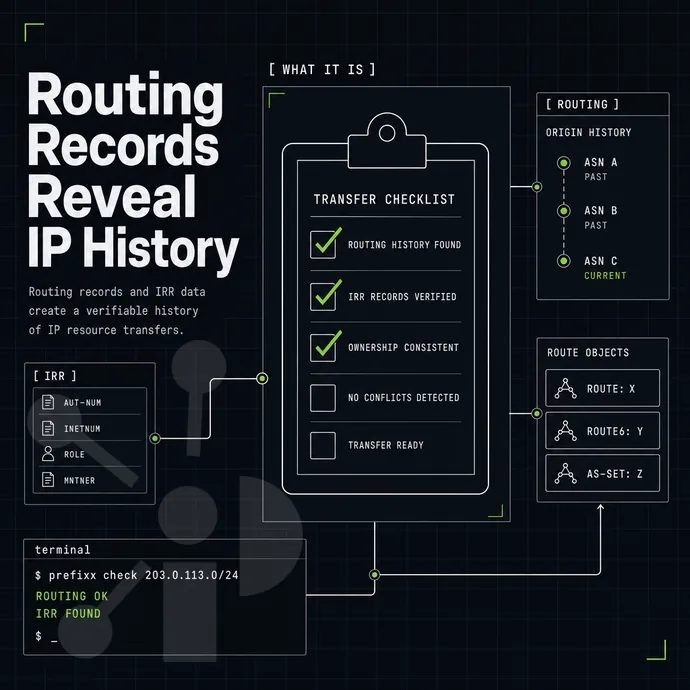
Together, the routing history and IRR records enable us to determine whether an IP address block has been properly managed by earlier operators, has always been properly announced, and has been handed over cleanly. Organizations considering buying IPv4 allocations should verify that both routing history and IRR records demonstrate consistent, legitimate use by previous holders.
IRR records and what stale data signals about RIR approval
These IRR records typically reside in databases such as RIPE DB, ARIN IRR, or RADB. A route object typically contains a prefix and the originating ASN that is authorized to announce that particular set of IP addresses. Many companies maintain their routing policies in these databases to ensure global reachability and proper announcement coordination.
When a previous operator of space that you now are announcing to relinquished their IP space, but never removed their route objects for that space, it could cause problems for downstream networks running with strict IRR filters, by refusing your announced space. Organizations buying IPv4 space should verify that all legacy route objects have been cleaned up before finalizing the acquisition to avoid these routing conflicts.
Similarly, missing records will cause many transit providers to simply drop the announcement. The resulting access problems are outside of your control and are caused by your missing announcements. Organizations buying IPv4 allocations must therefore verify that IRR entries are properly configured before attempting to announce the newly acquired prefixes.
Long term control as a routing health signal
History tools for BGP routes like RIPEstat or BGPView enable to ask for how long a certain IP address block has been announced by a single ASN. Regular announcements from one origin over years are a good indicator for stable and legitimate IP address stewards. This historical consistency matters because IPv4 addresses that demonstrate stable routing patterns are less likely to encounter filtering or reachability issues when transferred to new operators.
Gaps, changes of ASNs as well as announcements of IP addresses from a previous country’s registry space in the meantime indicate potential hijack events or IP addresses being resold in a short amount of time, which in turn need to be examined by the upstream network. Organizations buying IPv4 should verify the announcement history to ensure the space has not been involved in suspicious routing activity that could affect future peering relationships.
Short and fragmented announcement windows can be a bad sign. They can indicate that a block of addresses has changed hands frequently and been idle for long periods in between, which some Internet transit providers consider suspicious origin behavior. Providers may require additional verification or impose stricter terms of service before accepting payment for connectivity to such blocks.
RPKI ROA status as a separate verification layer
An RPKI ROA is used to cryptographically bind a single prefix to an authorized origin ASN and maximum length. A block with an invalid ROA (i.e. the origin ASN announced in BGP does not match the ROA) will be discarded by any router that implements Route Origin Validation for that prefix. Correcting an invalid ROA before completing the transfer ensures that the new holder can announce the prefix immediately upon payment and ownership transfer.
Resource status in the RPKI is verified to ensure no conflicting ROAs from previous holders of that resource are still published. Prefixx creates fresh LOA, ROA and IRR objects for every deal, reflecting a long term commitment to ensuring the block delivered has always been authorized in a clean and consistent manner across all layers. This commitment extends through the entire transaction lifecycle, from initial validation to final completion of the transfer process.
The routing hygiene of a block is how it behaved on the network. The reputation data of a sender includes his past behavior towards other people’s inboxes and infrastructure, which travels with the addresses of that sender. For community perspectives, see IPv4 Address secondhand market : r/networking.
IP reputation and abuse history: what to check and why it matters
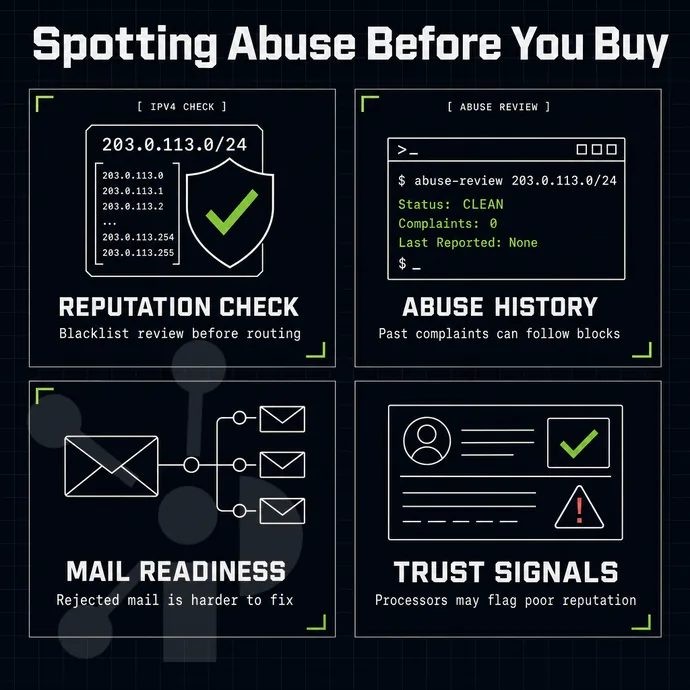
A blacklisted block can immediately cause you problems after you announce it. Email servers can start to reject your mail, payment processors start to flag your IP addresses for suspicious activity and your CDN starts to block requests. These reputation checks are not something you can ignore when you buy IP addresses.
IPv4 block IP reputation: check the whole address block
Instead of just sampling a few IP addresses from a /24 it's much more effective to check all of the IP addresses in the address block. Organizations buying IPv4 should verify reputation across the entire allocation to avoid inheriting addresses with existing blocklist entries.
Buy IP addresses with a clean address history
RIRs record surface abuse information in WHOIS remarks and in contact information for abuse reports. Blocks which have repeatedly been used for spam or DDoS attacks indicate previous misuse of the IP block. This information is subsequently transmitted to the new holder of the IP range. Acquiring organizations should verify these abuse records before finalizing any payment to ensure they understand the reputation challenges they may inherit.
What delisting means for an IP address org id
Removal from lists is possible but not guaranteed. The time and effort required for delisting can vary significantly depending on the severity of prior abuse and the responsiveness of list operators, which may affect operational costs.
Verifying ownership, checking the routing and the reputation of IP addresses manually requires a lot of time and also the right tools. Organizations that lack the technical resources or in-house expertise may find it more practical to allocate capital toward external verification services rather than building these capabilities internally.
Why choose Prefixx for IPv4 buyer eligibility and transfer support
Prefixx handles the full due diligence process so buyers receive only clean, transfer-ready IPv4 addresses. Every address block passes Tixx quality control: ownership, abuse history, routing hygiene, IRR records and RIR standing are all verified before a block reaches a buyer. Registry approval paperwork, including LOA, RPKI ROA and IRR route objects, is prepared by our team.
- Zero buyer fees on every purchase.
- Registered broker with ARIN, RIPE NCC and APNIC; LACNIC facilitated.
- Escrow-secured transactions protect both sides through the transfer process.
- Tixx checks confirm resource status, IP reputation and routing history on every IPv4 block.
- White-glove registry approval support across inter-RIR transfer paths.
Reach out to our consultants at Prefixx.net/buy-IPv4-addresses to discuss your requirements.
Frequently asked questions about your transfer path
How valuable is an IPv4 block along a transfer path for reputation checks?
IPv4 address pricing varies by RIR region, block size, and reputation history. A /24 under ARIN and an identically sized block under RIPE NCC can trade at noticeably different rates in the same month regardless of intended use, and neither number is published anywhere official. Prices have risen steadily since the regional registries exhausted their free pools between 2011 and 2020. Contact a broker for a current market quote on the specific block size and region you need.
How do I verify an IPv4 block has a clean transfer path history before buying?
A proper pre-sale check covers ownership verification in the RIR database, transfer eligibility, blacklist status across major DNSBLs, routing hygiene, and overall RIR standing. Prefixx runs every block through Tixx, its quality-control process, before any IP allocation reaches a buyer. The Tixx report includes a health score and a transfer-readiness rating. This process ensures that all technical and administrative requirements are satisfied before completion.
How many public IPv4 block allocations of addresses still remain available?
There are roughly 4.3 billion IPv4 addresses in total, and every one is spoken for. New address range can only be obtained through the secondary transfer market, meaning you buy or lease from an existing holder rather than from a registry. Organizations seeking IPv4 addresses must navigate a market where scarcity drives both pricing and the rigor of transfer procedures.
What justification do I need to pass ARIN buyer eligibility checks?
ARIN requires a demonstrated need for the IP subnet you are requesting. The application process begins when you submit a formal request outlining your technical justification and planned deployment timeline.
ARIN reviews whether the requested prefix size is proportionate to your documented need, so requesting a /16 when your plan supports a /20 will stall or block approval. Working with a registered ARIN broker helps you prepare the justification documentation in the format the registry expects. Organizations should ensure their technical justification aligns with the size they request to avoid delays in the approval process.
Buying IPv4 vs leasing IPv4 address blocks: key differences
Buying transfers full ownership of the block to you through the RIR, giving you permanent control and the ability to resell later. Leasing gives you routing rights for a defined term without an ownership transfer, which means lower upfront cost but no equity in the addresses. Organizations must evaluate which model aligns with their operational needs and whether their business requires the flexibility of ownership or the lower commitment of a lease arrangement.
Leases are faster to provision and suit short-term capacity needs or cloud BYOIP use cases. Buying makes more sense when you need long-term stability, want to avoid recurring lease fees, or plan to hold the block as an asset. Organizations should evaluate their operational timeline and growth projections to determine which approach aligns with their business model.
How long does the IPv4 transfer process take for registry approval?
Timelines differ by registry and transfer type. Intra-RIR transfers at ARIN and RIPE NCC typically complete in a matter of weeks once both parties submit a valid sale agreement and correct documentation, though complex cases or incomplete paperwork can extend that. Inter-RIR transfers, moving a block between registries, add coordination steps and generally take longer. Working with a registered broker who prepares the paperwork correctly the first time is the most reliable way to avoid delays.
What happens if the block I want to buy is on a dnsbl blacklist?
A blacklisted block can cause your outbound email to be rejected, your traffic to be filtered, and your reputation to suffer before you send a single packet. Some listings, such as those on Spamhaus ZEN or the CBL, can be delisted after the abuse source is removed and a signed agreement to maintain clean sending practices is in place, but timelines vary across large blocks of cases and no outcome is guaranteed. Delisting typically requires the new owner to sign an abuse policy acknowledgment and demonstrate that the source of prior violations has been remediated.
The safest approach is to reject any block with active blacklist entries before the deal closes. Prefixx scans every block across 12 DNSBLs as part of the Tixx quality-control process, so buyers see the full reputation picture before committing.
Check that buyer eligibility has not changed at the relevant RIR (it varies from RIR to RIR) as this is not a formality and can cause late transfers to fail. Verify ownership, check history of route. Additionally, run reputation checks for any reported abuse prior to signing off the block (it looks clean enough on paper but can contain blacklisted entries or have been hijacked in the past and transmitted to your network).
The practical lessons are: check these things out before you negotiate a price, not after. Check the IRR records for the block to see if they match the advertised origin.
If you want those checks handled for you, Prefixx runs Tixx quality control on every block before it reaches a buyer. Contact the team at Prefixx.net to review a specific block or start a sourcing conversation.
Contact us to discuss your IPv4 needs today
No hidden fees, free consult. A broker replies within one business day.