
By Savvas Bout, Founder of Prefixx. Last updated 23 October 2026.
Most buyers and sellers of IPv4 addresses have no idea that every single deal goes through a hidden compliance checkpoint. The KYC process for IPv4 transactions is not a piece of optional paperwork that the Regional Internet Registries can ignore. It is how they verify that valid IP addresses are being sold between recognized companies. Understanding the compliance checkpoint requires recognizing its history as a safeguard built into the registry system from the earliest days of commercial transfers.
Failure to comply with the KYC process for IPv4 address sales can result in transactions not proceeding, leased IP addresses not being able to be used. Alternatively, The worst case scenario of the buyer having a block of IP addresses with unclear ownership that can cause problems in every routing table that the IP addresses are sent to. Buyers may find themselves unable to route traffic or gain network access if their block is flagged due to incomplete verification.
Even within the same type of transfer (buy, lease, move space between RIRs), the requirements can vary by registry, block size. Each of the RIRs (ARIN, RIPE NCC, APNIC, LACNIC and AFRINIC) have their own criteria to determine eligibility for transfer, their own set of documentation requirements and their own timelines. The common elements are the verification of the participants involved in the transfer. A side-by-side comparison of these registry policies reveals significant differences in processing speed and documentation depth.
The verification of a clean chain of custody of the resources to be transferred and the verification of a legitimate need for the space by the recipient organization.
In this article we'll explore in more detail the verification process for IP addresses and the most common points of failure, as well as how using a broker can make your life easier and shift the burden of compliance to the broker. Thorough research into the historical allocation records helps confirm that no gaps or irregularities exist in the custody documentation.
What kyc for IPv4 addresses transactions actually means
KYC for IPv4 transactions is not just a simple checkbox, it is a multi-layered verification process for the buyer, the vendor and the registry involved in the exchange of IP addresses. Each layer has its own criteria to verify and missing one verification criteria halts the sale process.
What regional internet registries require for interested applicants
When transferring IP address space from one company to another, each of the Internet's five Regional Internet Registries (ARIN, RIPE NCC, APNIC, LACNIC, AFRINIC) requires organizational proof to approve the transfer.
In most cases, this consists of a copy of the articles of incorporation or similar organizational records, a letter describing the operational need for the additional IP address space, and a check with the relevant registry to connect and verify whether the receiving enterprise is a current, registrar-accredited customer of good standing. The registry may request a detailed breakdown of how the requested space will be allocated across different network functions or geographic locations.
ARIN also requires a signed RSA or LRSA prior to authorizing the movement of IP addresses into or out of the ARIN region.
Kyc inside the transfer process when you sell
Brokers and third-party holding providers conduct their own identity verification in parallel to yours.
- Government-issued ID for individual signatories.
- Corporate registration paperwork.
- Proof of authorization to act on behalf of the firm.
- Sanctions screening against OFAC and equivalent lists.
Our consultants at Prefixx coordinate all these checks with all the stakeholders involved simultaneously to avoid delays in a sequential process. This approach helps us connect all relevant registry contacts and compliance officers early in the process, ensuring alignment before formal submissions begin.
Why buyers need more addresses to justify the paperwork
The utilization justification for IPv4 addresses is scrutinized by the registries. As a result, A company that uses IPv4 addresses for a small internal network has the same document requirements as a company that buys a /16 of IPv4 addresses. Our team prepares the required justification narrative for the LOA and the routing information, so it is never submitted incomplete. The registry applies the same verification standard regardless of the price paid for the allocation.
Why registries and brokers require kyc before you buy or sell IP addresses
The high demand and real money involved in selling IPv4 address space makes it a target for scams, hijacking and fraudulent transfer. Businesses and RIRs require KYC in order to verify the owner of a block of IP addresses before that space can be transferred. Without KYC, disputes would abound and holders of IP address space in good standing would risk losing their allocated space.
Why registries require checks for interested applicants
Each of the RIRs (ARIN, RIPE NCC, APNIC, LACNIC and AFRINIC) has Transfer Policies that go beyond requiring a signature.
Where kyc applies to customers in a transaction
| Layer | Who checks | What they verify |
|---|---|---|
| Registry | ARIN, RIPE NCC, APNIC | Org eligibility, resource justification, transfer policy compliance |
| Escrow | Escrow provider | AML screening, identity documents, source of funds |
| Broker | Prefixx | Ownership chain, Tixx quality control, blacklist and routing hygiene |
Protecting buyers, sellers and their customers
AML for neutral holding account is an additional layer not provided by a simple Registry: verification of identity files, verification of source of capital, sanctions check etc. It protects both sides of the trade and keeps the cost of post-trade disputes low by flagging problems before the block is moved rather than afterwards. Early detection of compliance issues reduces the risks inherent in cross-border registry transfers and minimizes exposure for all participants.
When working with a registered broker such as Prefixx, KYC is implemented at all levels simultaneously. Tixx verify ownership and routing for all listed offers. Additionally, assets are held in secure holding service by the blockchain monies holding arrangement service until verified by the relevant registry, creating a clean and verifiable chain of title from the transferor’s agreement to settlement.
It’s all well and good knowing why each of these steps exist but it would be good to know which specific filings are required to satisfy each. Each registry publishes a specific set of required filings, and understanding which form to submit at each stage prevents delays in the approval workflow.
How the entire process of kyc and transfer works step by step
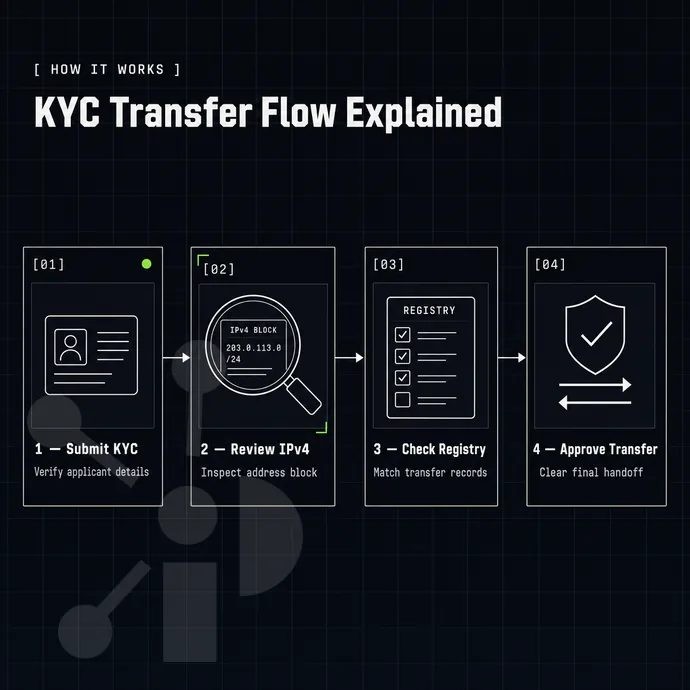
A KYC-gated transfer framework involves multiple actors and is checked against a fixed chain of checkpoints. If one of the checkpoints fails, the registry will reject the transfer request.
Identity and ownership verification service
To facilitate the agreement, the buyer and disposing party will provide the intermediary with government-issued ID and any entity documentation required by Prefixx.
In addition to the checks by the facilitator, the registry itself performs an eligibility check. The check for ARIN requires a needs-justification or RSA/LRSA standing. The check for RIPE NCC confirms whether the IP address/ASN is under a valid LIR or if it is sponsored by a sponsoring-LIR.
Agreement, funds, and internet registry submission
Following verification, both buyer and address holder sign the purchase agreement.
Registry application processing times vary widely, from a few days to several weeks.
Post-transfer routing paperwork costs
After the WHOIS has updated for the new registrant, Prefixx can then update the routing layer by creating the RPKI ROA and IRR route objects for the block to be announced and origin-validated. This step is included in the white-glove service for Prefixx leases.
Note: Your transfer is complete only when WHOIS, RPKI and IRR for the new holder have been updated. Prefixx can then verify that your routing chain is up-to-date before you begin to announce your new IPs.
The steps outlined above apply generally, but vary by the registry managing a particular range of IP blocks.
Registry-specific kyc rules across ARIN, RIPE NCC and APNIC for IP addresses
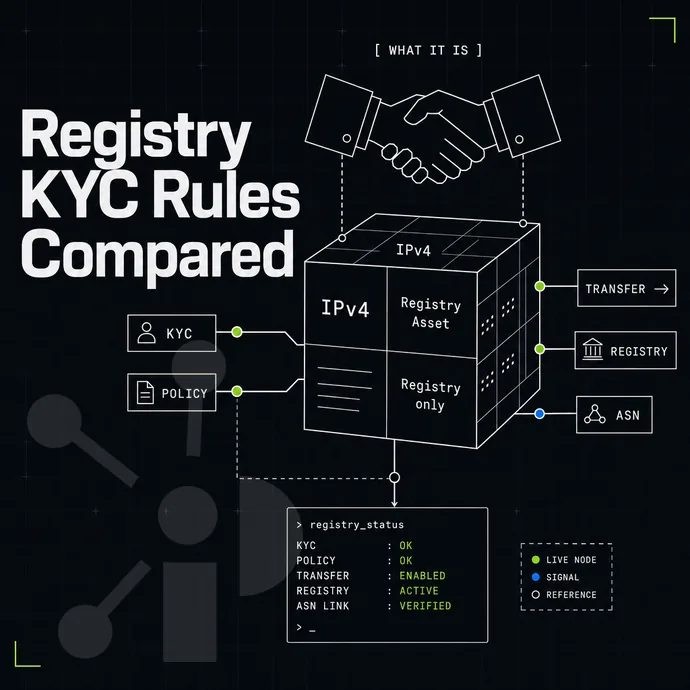
When transferring IPv4 addresses between organizations, each regional internet registry (RIR) applies different eligibility criteria.
ARIN: needs justification and pre-approval
When requesting a transfer of IP address space, the recipient must demonstrate genuine need.
Pre-approval for the ARIN assignment number is available and worth requesting early.
RIPE NCC: LIR membership or sponsoring-lir
The RIPE NCC has removed the need for justification for intra-RIR and inter-RIR transfers of /24 and larger blocks. We can offer RIPE LIR sponsorship to PI and ASN holders who do not have their own LIR, enabling them to obtain IP block without RIPE membership.
APNIC and LACNIC: membership and facilitated transfers
The APNIC model is mirrored for membership. As such, all transfers require each party to be an up to date APNIC member. The LACNIC model imposes stricter eligibility criteria than the other registries and we treat each proposed transfer requests on a case by case basis, as LACNIC facilitated transfers are not recorded in the same way as the other registries.
Outstanding registry fees for all 4 registries must be paid prior to transfer records being moved. Buyers must ensure they pay all outstanding fees before the registry will process the transfer request.
The rules for each registry can be complex.
How Prefixx handles kyc and due diligence across every deal
Prefixx is a registered reseller with ARIN, RIPE NCC and APNIC. We follow a fixed methodology for all deals, first checked by Tixx quality for correct ownership, no blacklists, correct routing.
- network addresses registered across different registries. We finalize transfers of IPv4 resources under the ARIN, RIPE NCC and APNIC registries, and assist with LACNIC transfers.
- Tixx pre-sale due diligence. We inspect every address subnet for RIR status, blacklists and routing health before we clear a purchase.
- We fulfill all the required paperwork. We prepare LOA, RPKI ROA and IRR route objects for you.
- No fees are charged to buyers. Sellers pay a commission of 3% to 8% and other related expenses.
- custodial holding-secured transactions. reserves are held in secure balance intermediary until all the migration steps have been completed thereby mitigating risk to both principals.
We provide a simple sequence to buy, sell or lease IPv4 addresses in verified ownership and clean IP allocation. Compare your options or get a quote from us today.
Frequently asked questions for businesses
What documents should I compare when reviewing IPv4 price and transfer requests as a buyer?
Most registries require proof of organizational identity, such as a certificate of incorporation or business registration, along with a signed conveyance agreement and evidence of a legitimate operational need for the IP range. ARIN additionally requires a signed 8.3 reassignment request and may ask for a network diagram or justification of utilization. Each party must sign the conveyance agreement to formally authorize the registry to update its records and complete the reallocation.
RIPE NCC requires the receiving operator to hold an active LIR membership or a sponsored resource holder agreement before the handover can proceed.
Does kyc apply to IPv4 lease transactions as well as purchases?
KYC applies to both, though the scope differs. A purchase triggers a formal registry reallocation, which carries the most rigorous identity and eligibility checks. A rental keeps the pool registered to the lessor, so registry-level KYC falls on the lessor rather than the lessee. That said, any reputable dealmaker will still verify the lessee's identity and intended use before issuing a Letter of Authorization, because the lessor's registry standing and reputation connect directly to how the space is used and any potential misuse reflects back on them. The same verification framework applies whether the underlying commercial arrangement is structured as an outright sale or as one of several acquisitions being consolidated under a single receiving entity.
How long does the kyc and registry approval process take?
liaison-side KYC, where identity and ownership instruments are reviewed, typically completes within a few business days when the counterparties submit execute documentation on the first attempt. Registry approval timelines vary: RIPE NCC transfers are generally the fastest, often completing within days of a clean submission, while ARIN reviews can run several weeks depending on queue depth and whether a needs-justification review is triggered.
Incomplete filings, missing signatures, or ownership disputes are the most common causes of delay. Each registry publishes a checklist that specifies which fields must appear on every submission form.
What happens if a seller cannot pass kyc or prove ownership of the address block?
The segment exchange cannot proceed to a registry portability without verified ownership, and a reputable third-party agent will halt the deal rather than submit a defective filing. Reputable facilitators maintain strict verification protocols to ensure that every filing submitted to the registry is complete and accurate before submission.
third-party settlement payment are not released until movement confirmation is received, so a buyer's capital is protected during any ownership dispute. Blocks that fail ownership verification should be treated as unsellable until the registry record is corrected.
Do kyc requirements differ between ARIN, RIPE NCC and APNIC transfers?
Yes, each registry has its own policy framework. ARIN operates under Section 8.3 of its Number Resource Policy, which requires the receiving provider to demonstrate a need for the space within 24 months, making needs justification a formal part of the routine. RIPE NCC does not apply a needs assessment for transfers between LIRs, but both individuals must be in good standing and the receiving network operator must have a valid RIPE NCC membership or sponsorship.
APNIC requires both organizations to be financial members and applies its own relocation policy under which the receiving registered entity must demonstrate eligibility. Inter-RIR transfers, such as moving a space from ARIN to RIPE NCC, layer both registries' requirements on top of each other and typically take longer to submit. The layered compliance framework makes inter-registry acquisitions more complex than domestic transfers within a single jurisdiction.
Can a broker handle kyc submissions to the registry on my behalf?
A intermediary can prepare, review and coordinate all transition paperwork, including the LOA, RPKI ROA and IRR route objects, and submit filings on your behalf where the registry permits authorized representative submissions. The registries ultimately require the resource holder or their designated contact to authenticate certain steps, so the facilitator acts as the expert guide rather than a fully independent proxy.
Clients can rely on Prefixx to handle this end to end: the specialists prepares every document, manages registry correspondence and flags any deficiencies before submission, so no one is navigating registry portals alone.
Why is escrow used alongside kyc in IPv4 transactions?
KYC establishes that the users are who they claim to be and that the transferring party has the right to assignment the group. protected holding account handles the financial risk that remains even after identity is confirmed: it ensures the buyer's remittance are committed but not released until the registry confirms the handoff, and it ensures the divestor does not lose control of the batch without receiving payment.
The two mechanisms address different failure modes and are both necessary. Without independent custodial service, a verified originating party could still disappear after receiving payment; without KYC, a fraudulent address owner could initiate a delegation of space they do not legitimately own. Prefixx uses neutral currency holder-secured settlement on every ownership change precisely because neither control alone is sufficient.
Yes, identity verification for IPv4 transfers is more than a formality. All registries want to protect the IPv4 address block and all brokers want to avoid that a deal falls over during the shifting operation. The required documentation for a porting of IPv4 addresses differs per RIR and even a missing article of incorporation or an unverified point of contact can cause considerable delays for weeks.
It pays to prepare prior to opening a deal. While entity artifacts, POCs and justification data can be thrown together overnight by a purchaser or subnet owner, such work translates into immediate time to close and savings from avoiding carrying costs. Registry-specific rules at ARIN, RIPE NCC and APNIC vary significantly and thus working with a registered IPv4 dealer is key.
Prefixx is registered with ARIN, RIPE NCC and APNIC, and handles the KYC coordination and routing paperwork on every deal. If you are buying, selling or leasing IPv4 space, contact the Prefixx team to get your documentation reviewed before the clock starts.
Contact us to discuss your IPv4 needs today
No hidden fees, free consult. A broker replies within one business day.